Quick Info
Curated Experiences
Villa Romana del Casale Guided Tour from Piazza Armerina
Piazza Armerina and Villa del Casale Day Trip from Catania
Central Sicily Grand Tour: Agrigento, Piazza Armerina and Enna
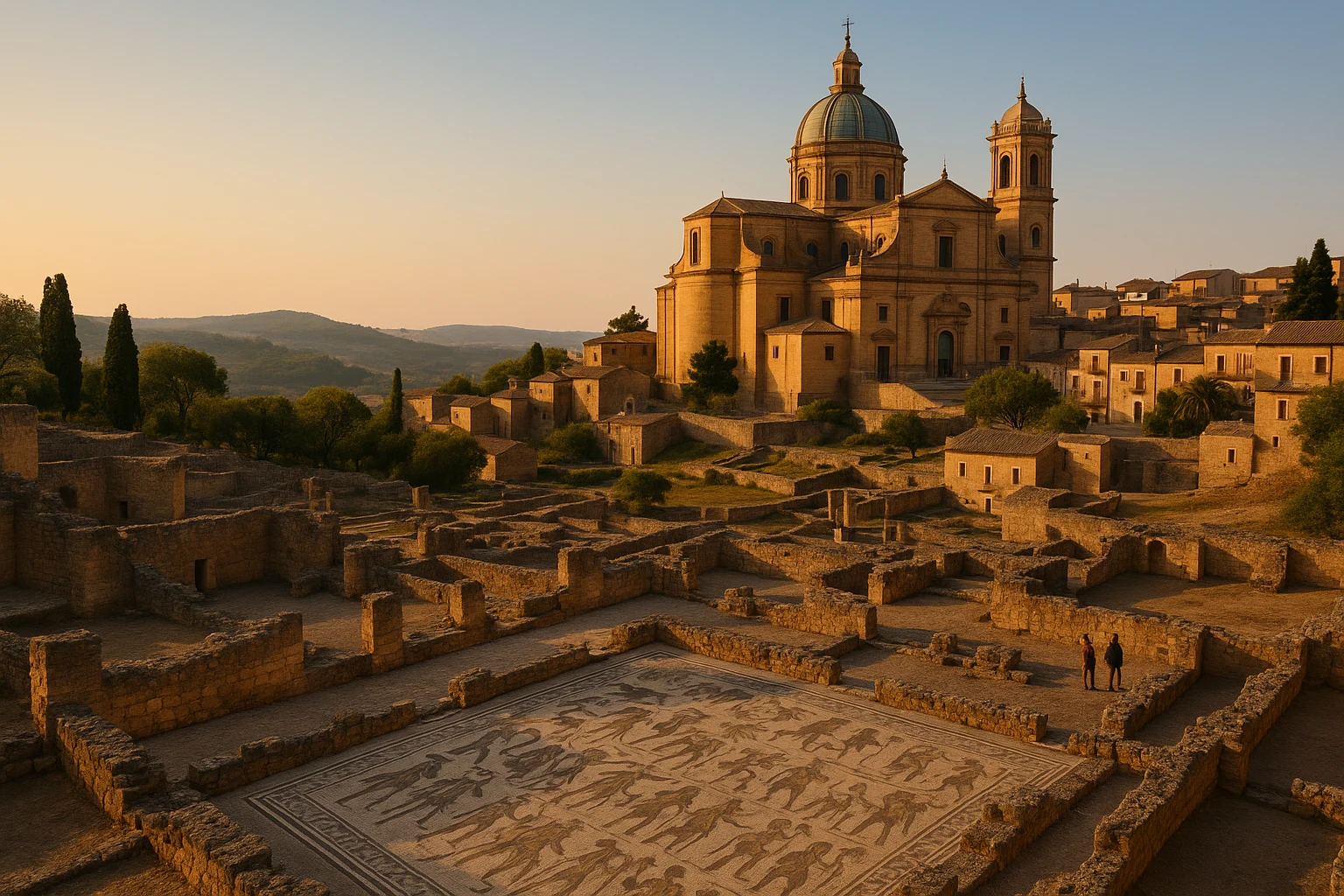
Tucked into the hills of central Sicily at nearly 700 meters above sea level, Piazza Armerina is a town that operates on two timescales simultaneously. In the medieval hilltop center, cream-colored Baroque palaces crowd narrow lanes that wind up toward a Norman cathedral whose blue-tiled dome has dominated the horizon since the 11th century. Five kilometers down the valley, sealed beneath a vast protective canopy, 3,500 square meters of Roman mosaic floors survive in extraordinary condition — hunting scenes, mythological tableaux, athletes, and the world’s most famous ancient depiction of women exercising in bikini-like garments, their forms preserved in stone tesserae with a clarity that centuries of buried soil somehow kept intact. Together, these two layers — the Norman town above and the Roman villa below — make Piazza Armerina one of central Sicily’s most rewarding stops, and the mosaic complex at Villa Romana del Casale one of the most important archaeological sites in the entire Mediterranean world.
What sets Piazza Armerina apart from Sicily’s more celebrated ancient destinations — Syracuse, Agrigento, Taormina — is its combination of scale and survival. The Roman villa’s mosaics cover a floor area larger than many modern museums, yet they belong to a single private residence built for a late-imperial aristocrat or governor of extraordinary wealth. The Norman town preserves a genuinely lived-in medieval character that mass tourism has not yet smoothed into uniformity. And the drive through central Sicily’s rolling interior landscape — grain fields, citrus groves, and the occasional collapsed masseria — adds a dimension of unhurried discovery that the island’s coastal circuit often lacks. Ancient Travels recommends Piazza Armerina as the anchor for a central Sicily day trip from Catania or as an overnight stay for travelers combining it with Agrigento and Enna. This guide covers the Villa’s mosaic highlights, the town’s Norman monuments, seasonal timing, transport options, and how to sequence a full day efficiently.
History: From Roman Villa to Norman Stronghold
Roman Foundation (3rd–4th century CE)
The story of Piazza Armerina’s greatest monument begins not with the town itself but with the Roman villa buried beneath it. Villa Romana del Casale was constructed over two phases in the late 3rd and early 4th centuries CE, most likely between 293 and 305 CE based on architectural evidence and stylistic comparisons of the mosaics with imperial court imagery. The identity of the owner has been debated for a century — candidates range from the co-emperor Maximian to wealthy Sicilian landowners — but there is no dispute about the villa’s scale: over 3,500 square meters of mosaic flooring arranged across 40 rooms, corridors, and colonnaded gardens represent an investment of time, skill, and money that only the highest stratum of Roman society could command. The mosaicists came from North Africa, their styles reflecting workshop traditions in Carthage and modern Tunisia, their tessera work combining portraiture, mythological allegory, and hunting narrative with a technical confidence that has never been surpassed in Roman floor decoration.
Arab and Early Medieval Period (9th–11th century CE)
The villa fell into disuse in the 5th century following the Vandal incursions into Sicily, and a landslide in the 12th century buried the site beneath meters of mud and rubble — the accident of geology that preserved the mosaics from centuries of human interference. Meanwhile, the hilltop site of Piazza Armerina was developing its own story. Arab geographers mention a settlement called Platia in the region during the 9th and 10th centuries, when Sicily formed part of the Emirate of Sicily and Arab agricultural techniques — irrigation, citrus cultivation, the diffusion of saffron and cotton — transformed the island’s economy and landscape. The Arab period left few visible monuments in Piazza Armerina itself, but its legacy survives in Sicilian dialect words, food traditions, and the landscape’s terraced fields.
Norman Conquest and Town Foundation (1061–12th century)
The Norman conquest of Sicily, launched in 1061 by Roger I de Hauteville, transformed Piazza Armerina from a modest hilltop settlement into a significant inland stronghold. The Normans displaced the existing population, resettled the town with Lombard colonists from northern Italy, and began the construction program that gave Piazza Armerina its distinctive character. The town’s layout — radiating lanes converging on the cathedral plateau — follows the Norman pattern of defensible hilltop urbanism imported from southern France and Calabria. Roger II subsequently granted the town royal privileges, establishing markets and guaranteeing its role as a regional administrative center. The Norman legacy is still visible in the cathedral’s foundation and in the Aragonese castle that dominates the northern promontory.
Aragonese and Baroque Expansion (13th–18th century)
Control of Piazza Armerina passed to the Kingdom of Aragon following the Sicilian Vespers uprising of 1282, and the town prospered during the 14th and 15th centuries as a market center for central Sicily’s grain and wool trade. The cathedral was expanded and embellished, the castle reinforced, and a succession of noble palaces constructed in the characteristic Sicilian Baroque style that blends Spanish influence with local limestone craftsmanship. The 17th and 18th centuries added the town’s most impressive secular architecture — the Palazzo Trigona, the Palazzo Gaetani, and the colonnaded facades of the Via Cavour — giving Piazza Armerina the Baroque character it retains today.
Modern Rediscovery
Systematic archaeological excavation of Villa Romana del Casale began under Italian archaeologist Paolo Orsi in the early 20th century, with significant campaigns continuing through the 1950s under Gino Vinicio Gentili. UNESCO inscribed the villa in 1997 as a World Heritage Site. The protective canopy structure visible today was installed in the 1990s and substantially upgraded in 2012–2015 to provide climate control and visitor walkways above the mosaic floors.
The Key Monuments: What to See at Piazza Armerina
Villa Romana del Casale: The Great Hunt Corridor
The villa’s most celebrated feature is the Great Hunt Corridor (Corridoio della Grande Caccia), a barrel-vaulted passageway approximately 60 meters long whose entire floor depicts a monumental hunting expedition spanning Africa and Asia. Elephant handlers, rhinoceroses, ostriches, tigers, and antelope fill a continuous mosaic narrative in which Roman huntsmen capture wild animals destined for the imperial arenas. The corridor’s central cartouche shows Africa and India personified as female figures, with the captured animals organized geographically around them. Every detail rewards close attention — the strain of ropes loading a caged tiger, the fearful expression of a handler gored by an escaped boar, the layered coastal scenery of the embarkation scene. This is not decoration; it is imperial propaganda rendered in stone. Allow at least 30 minutes here alone.
Villa Romana del Casale: The Bikini Mosaic Room
In a room identified as a gymnasium, the Bikini Mosaic depicts ten young women engaged in athletic activities — running, discus throwing, ball games, and an awards ceremony for the winner. They wear garments covering precisely the same areas as a modern two-piece swimsuit, making this the most reproduced ancient mosaic in Sicily and a perennial subject of scholarly debate. The mosaic’s freshness of color — ochre, terracotta, and white against a dark border — reflects the skill of the North African workshop that produced it. The figures are individualized, their expressions animated, their muscular forms rendered with confidence that belies the mosaic medium’s constraints. It remains one of the most humanly engaging images to survive from antiquity.
Villa Romana del Casale: The Triclinium and Mythological Rooms
The Triclinium (formal dining room) presents the labors of Hercules in a mythological cycle of extraordinary ambition — twelve canonical deeds arranged around a central gigantomachy panel showing the Olympians battling the Giants. Adjacent chambers carry Orpheus charming wild animals, scenes from the Odyssey, and a fragmentary erotic chamber. Taken together, the mythology rooms read as an intellectual autobiography of the owner: his claim to Herculean virtue, Orphic wisdom, and Homeric culture, expressed in the most expensive decorative medium available to the Roman world.
The Norman Cathedral of Piazza Armerina
The Cattedrale di Maria Santissima delle Vittorie crowns the town’s highest ridge and is visible from most of the surrounding valley. Its current form reflects building history beginning with a Norman foundation in 1096, substantially rebuilt in the 14th century, and crowned with a blue-majolica-tiled campanile added in 1658. The interior preserves a Byzantine-style icon of the Madonna del Vescovo, focus of the August Palio dei Normanni festival. The cathedral square offers a panoramic view over the lower town and the agricultural valley toward Enna — worth ascending to even if the Villa is your primary draw.
The Aragonese Castle and Town Center
The Castello Aragonese occupies the northern promontory of the hilltop and survives as a consolidated ruin — walls, towers, and the outline of the keep visible but not accessible for interior visits. Its strategic position commands views over all approach roads to the town. The historic center below the castle preserves a dense grid of Baroque palaces and churches navigable in a focused 45-minute walk: the Via Roma corridor links the main Piazza Garibaldi, the cathedral, and the castle promontory in a logical circuit. The compact scale of the town means that combining a villa morning with a town afternoon adds only 90 minutes of walking.
Getting There: Transportation and Access
Piazza Armerina sits in central Sicily’s interior, roughly equidistant from Catania and Palermo, and is reachable by bus or rental car; the Villa itself requires either a taxi from the town center or a seasonal minibus service.
From Catania
The most practical gateway is Catania, approximately 95 kilometers to the east.
- SAIS Autolinee bus: Departs from Via D’Amico near the central train station. Journey time approximately 1 hour 45 minutes; fares around €9–12 one way. Check timetables at saistrasporti.it as schedules change seasonally.
- Rental car: Approximately 1 hour 15 minutes via the A19 autostrada, exiting at Enna or Dittaino and following SS117bis south. Parking available at the Villa entrance.
- Private transfer: From Catania airport, €80–110 ($87–120 USD) one way; worth it for groups.
From Palermo
- SAIS Autolinee bus: Direct service from Palermo’s Piazza Giulio Cesare terminal, approximately 2 hours 30 minutes; fares around €12–15 one way.
- Rental car: Approximately 2 hours via the A19 autostrada east.
From the Town to the Villa
- Local minibus (summer only): Seasonal service between the town center and the Villa. Check with your accommodation for current times.
- Taxi: From Piazza Garibaldi approximately €8–12 ($9–13 USD) one way.
- Walking: 5 km; feasible in cool weather but not recommended in summer heat.
Admission and Hours
Entry to Villa Romana del Casale costs €10 per adult (approximately $11 USD), with reduced rates for EU citizens aged 18–25 (€5) and free entry for children under 18 and EU citizens over 65. The site is open daily from 9:00 AM to 7:00 PM in summer (April–October), closing at 5:00 PM in winter (November–March). Last entry is one hour before closing. Card and cash accepted. The Norman Cathedral in the town center is free to enter; a small donation is welcomed. Bring water — the Villa’s protective canopy traps heat in summer and fountain access is limited.
When to Visit: Seasonal Considerations
Spring (March–May)
Spring is the ideal season for Piazza Armerina. Temperatures range from 12–22°C (54–72°F), wildflowers cover the rolling hillsides of central Sicily, and the Villa receives far fewer visitors than in summer. Morning light through the canopy structures creates especially favorable conditions for photography. This is the recommended season for first-time visitors who want the full experience without heat or crowds.
Summer (June–August)
Summer brings temperatures up to 35°C (95°F) and significant visitor numbers, particularly in July and August when Italian domestic tourism peaks. Inside the Villa’s enclosed canopy areas, heat and humidity build by midday and can make extended visits uncomfortable. Arrive at opening time (9:00 AM) to complete the Villa before noon, then retreat to the cooler elevation of the hilltop town for lunch. August brings the lively Palio dei Normanni festival (13–14 August), a medieval pageant with jousting, processions, and costumed knights that animates the town center.
Autumn (September–October)
September and October rival spring as the best visiting months. Temperatures ease to 18–26°C (64–79°F), summer crowds thin considerably, and the harvest season adds local color to markets in the town. Early October evenings in the hilltop town — warm light, empty lanes, trattorias still serving al fresco — represent Piazza Armerina at its most quietly rewarding.
Winter (November–February)
Winter is quiet and cool, with temperatures ranging from 5–12°C (41–54°F) and occasional rain. The Villa reduces its hours and sees minimal visitors. The town’s Baroque churches and covered market make for a pleasant half-day even in poor weather, and accommodation prices drop significantly. Cold-weather visitors should bring layers and waterproof footwear.
Combining Piazza Armerina with Central Sicily
Piazza Armerina works best as the anchor of a central Sicily itinerary, paired with Enna to the north and Agrigento to the southwest.
The most rewarding sequence begins at Villa Romana del Casale by 9:00 AM, arriving with the first wave of visitors to claim the walkways above the Great Hunt Corridor before the midday heat builds. Allow 9:00 to 11:30 AM for the villa — the hunting corridor, the bikini mosaic chamber, and the triclinium mythology rooms are the essential circuit, with the peristyle garden and outer reception rooms for visitors with extra time. By noon, return to the town center and ascend to the cathedral square for the panoramic view. A 45-minute walking circuit through the hilltop streets takes in the Aragonese castle ruins, the Via Roma facades, and the Baroque palaces of the Via Cavour. Lunch at one of the trattorias on Piazza Garibaldi — arancini, pasta al ragù, and local Nero d’Avola wine are the standard offering at €12–18 per person — positions you for an afternoon departure by 2:00 PM.
From Piazza Armerina, Enna lies 30 kilometers north (40 minutes by car) and adds a dramatic cliff-top Norman castle and the Morgantina archaeological museum to the day. For a longer interior loop, combining Piazza Armerina with the Valley of the Temples at Agrigento (70 kilometers southwest, about one hour by car) creates a full day or two-day circuit. Travelers driving this route and overnighting in Agrigento can see the temples at sunset and sunrise — the most atmospheric conditions available at either site.
Why Piazza Armerina Matters
At Villa Romana del Casale, the 12th-century landslide that swallowed an aristocrat’s hunting lodge preserved 3,500 square meters of Roman mosaic that a thousand years of human habitation would certainly have destroyed. The accident of geology delivered the beauty intact. Standing on the walkways above the Great Hunt Corridor, you are looking at the personal taste and cultural aspirations of one enormously wealthy individual who commissioned North African craftsmen to proclaim, in stone, that he was a man of Herculean virtue, cosmopolitan learning, and inexhaustible resources. That message — extravagant, specific, entirely human — has crossed seventeen centuries without losing any of its force.
Combined with the Norman hilltop town that grew above and around this buried world, Piazza Armerina offers a conversation between civilizations — Roman, Arab, Norman, Aragonese — that is uniquely Sicilian in character and unhurried in pace. This is the island’s interior at its most layered and most rewarding.
Quick Facts
| Attribute | Details |
|---|---|
| Location | Piazza Armerina, Province of Enna, Sicily, Italy |
| UNESCO Status | Villa Romana del Casale — inscribed 1997 |
| Civilization | Roman–Norman–Aragonese |
| Historical Period | 3rd century CE–16th century CE |
| Established | c. 3rd century CE villa construction |
| Distance from Catania | ~95 km; 1 hr 15 min by car, 1 hr 45 min by bus |
| Distance from Palermo | ~170 km; ~2 hrs by car |
| Entry Fee (Villa) | €10 adults (~$11 USD); reduced rates available |
| Hours (Villa) | 9 AM–7 PM (Apr–Oct); 9 AM–5 PM (Nov–Mar) |
| Best Time to Visit | Spring (Apr–May) or Autumn (Sep–Oct) |
| Suggested Stay | Full day |
| Coordinates | 37.3833°N, 14.3667°E |
Explore More Sicily
- Villa Romana del Casale: The complete guide to the UNESCO mosaic villa — room-by-room highlights, timed entry strategy, and photography tips
- Valley of the Temples, Agrigento: Sicily’s greatest Greek sanctuary, 70 km southwest — pair with Piazza Armerina for a central Sicily circuit
- Syracuse Archaeological Park: The Greek theatre, Ear of Dionysius, and Roman amphitheatre on Sicily’s southeastern coast
- Taormina Ancient Theatre: Greco-Roman theatre with Etna views on Sicily’s northeast coast
Plan your complete Sicilian archaeological journey with our Sicily Ancient Sites Guide. Learn how to combine Sicily’s UNESCO sites in one itinerary with our Sicily Two-Week Itinerary Guide.
Frequently Asked Questions
How much time should I plan at Piazza Armerina?
Allow a full day: 2–3 hours at Villa Romana del Casale for the mosaics, then 1–2 hours exploring the Norman cathedral and historic hilltop town. Arriving by morning bus or rental car from Catania and returning in the early evening is the most practical approach.
What is the best time to visit Piazza Armerina?
April through June and September through October offer the most pleasant conditions — mild temperatures between 15–25°C (59–77°F) and fewer crowds than peak summer. Morning visits to the Villa are strongly recommended to avoid the heat that builds inside the protective canopy structures by midday.
How much does it cost to enter Villa Romana del Casale?
Entry to Villa Romana del Casale is €10 for adults (approximately $11 USD), with reduced rates for EU citizens aged 18–25 and free entry for children under 18. Italy's museum cards (Campania ArteCard, regional passes) do not cover this site, so plan to pay at the gate. Cash and card are accepted.
How do I get to Piazza Armerina from Catania?
SAIS Autolinee buses run from Catania's bus terminal (Via D'Amico) to Piazza Armerina in approximately 1 hour 45 minutes, with several departures daily (around €9–12 one-way). A rental car from Catania airport takes about 1 hour 15 minutes via the A19 autostrada and offers the most flexibility for reaching the Villa, which is 5 km outside town.
What will I see at Piazza Armerina beyond the mosaics?
Beyond Villa Romana del Casale, the town preserves a spectacular Norman baroque cathedral (Cattedrale di Maria SS. delle Vittorie) with a 16th-century campanile, the ruins of the Aragonese castle, and a compact medieval hilltop center of narrow lanes and Baroque palaces. The town hosts the lively Palio dei Normanni festival each August.
Is Piazza Armerina easy to reach without a car?
It is doable but requires planning. SAIS buses connect Catania and Palermo to Piazza Armerina, but frequency is limited (typically 3–5 departures per day). From the town center, local minibuses run to the Villa in summer; a taxi from the Piazza Armerina bus terminus to the Villa costs €8–12 ($9–13 USD). A rental car greatly simplifies the logistics.
Is Piazza Armerina safe for tourists?
Yes, Piazza Armerina is a welcoming, low-crime Sicilian hill town. Standard travel precautions apply: watch for pickpockets in crowded areas around the Villa entrance in peak season, and stay on marked paths within the archaeological site. The town center is compact and easily navigated on foot.
Nearby Ancient Sites
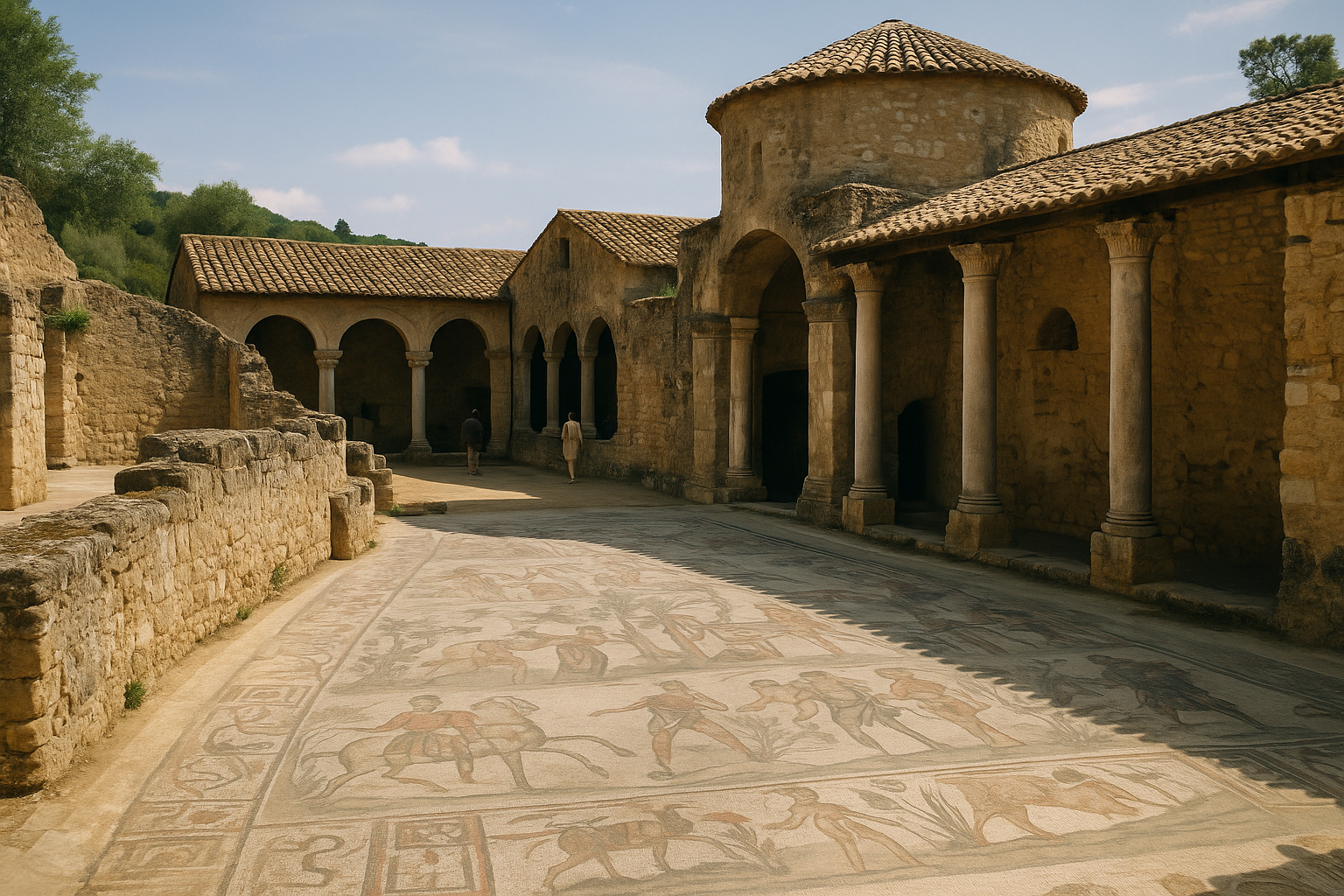
Villa Romana del Casale Guide 2026: Mosaics, Route Timing, and Sicily Planning
RomanPlan a smart visit to Villa Romana del Casale near Piazza Armerina, with mosaic highlights, timing s...
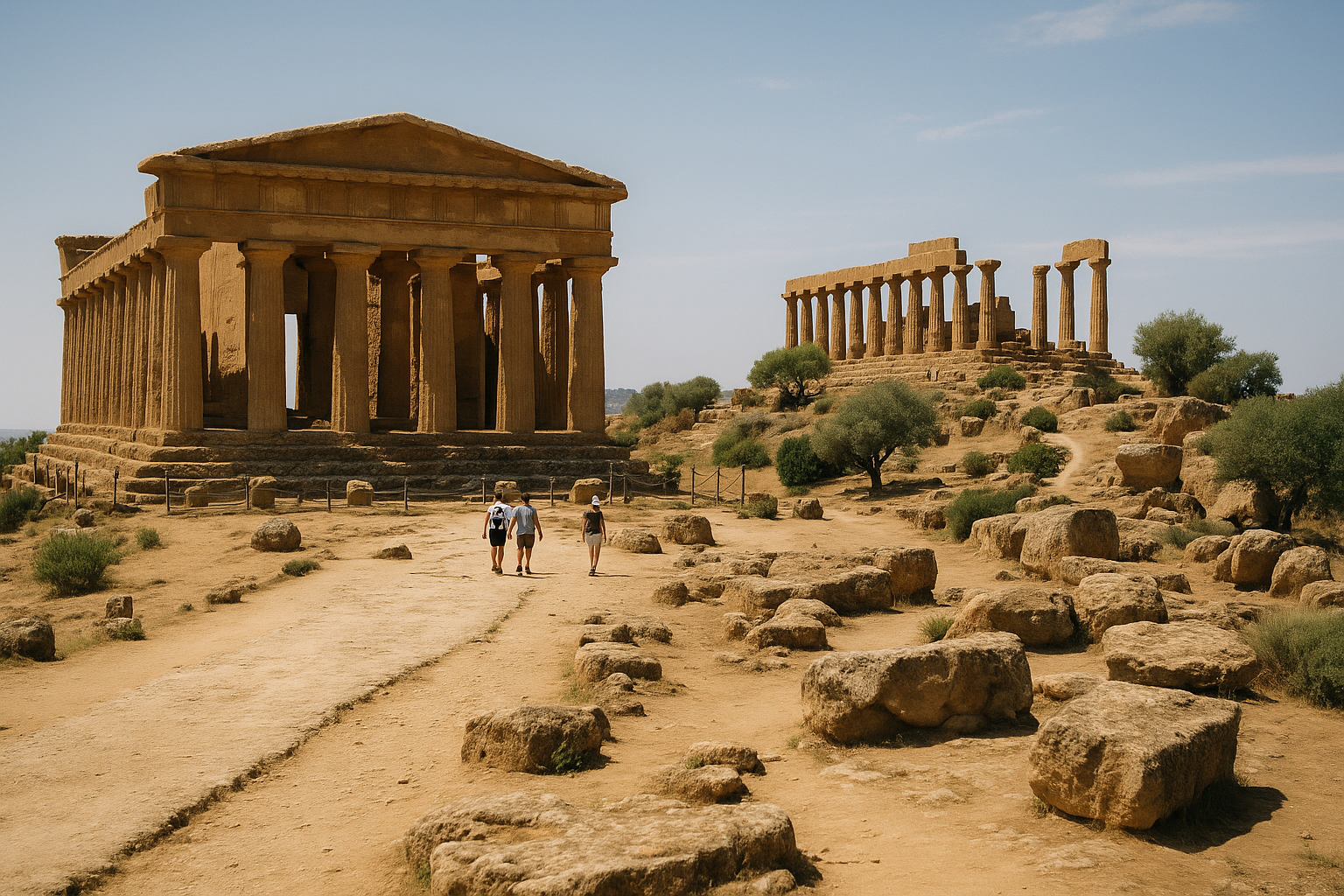
Valley of the Temples Agrigento Guide 2026: Concordia & Juno
Greek-Roman-NormanPlan your Agrigento Valley of the Temples visit with temple highlights, tickets, transport, and prac...
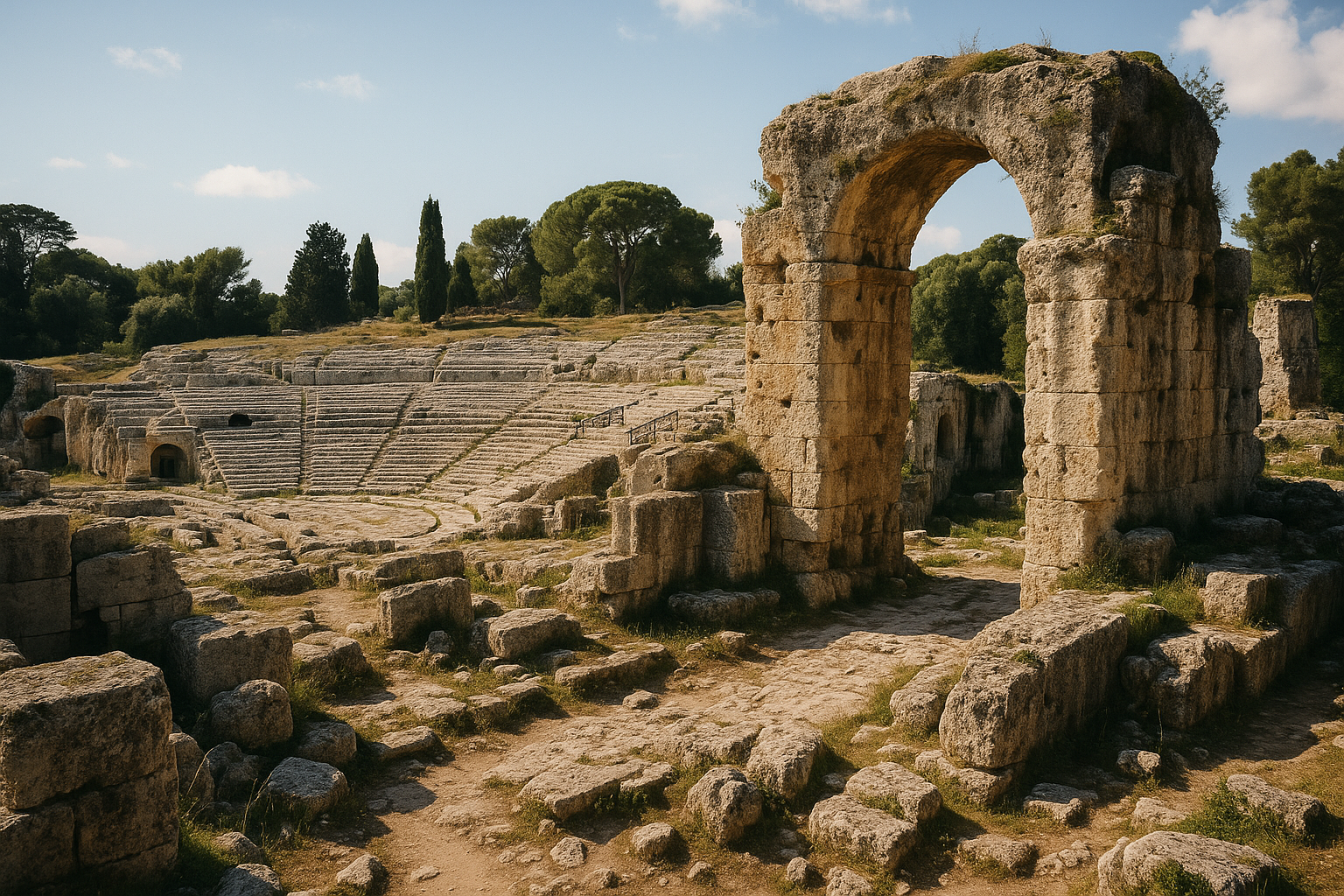
Syracuse Archaeological Park (Neapolis) Guide 2026
Greek-Roman-ByzantinePlan your visit to Syracuse Archaeological Park in Sicily with theatre highlights, Ear of Dionysius ...
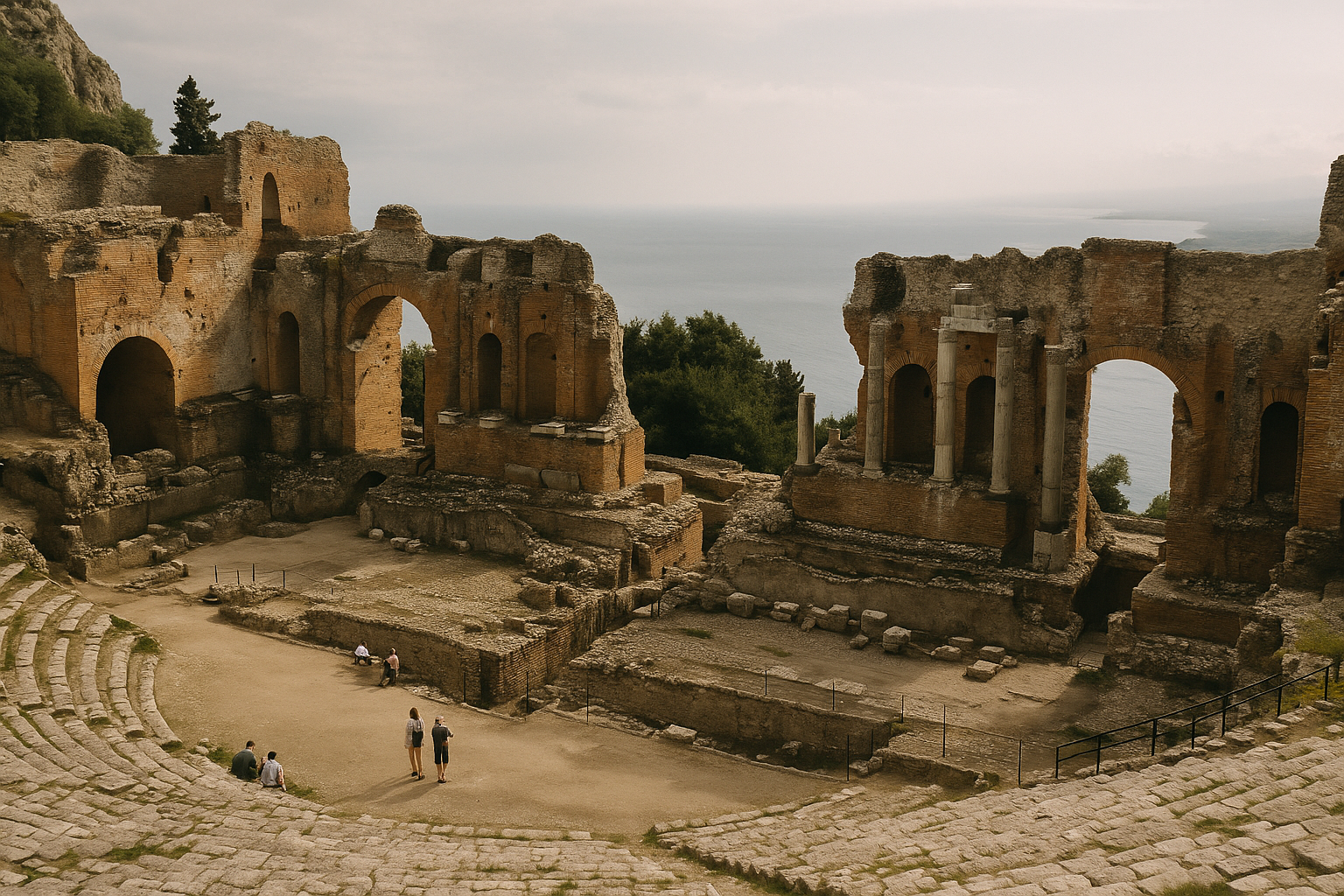
Taormina Ancient Theatre: Sicily’s Greek-Roman Stage Above the Sea
Greek / RomanPlan your visit to Taormina’s ancient theatre: history, views of Etna, tickets, logistics, and what ...