Quick Info
At a glance
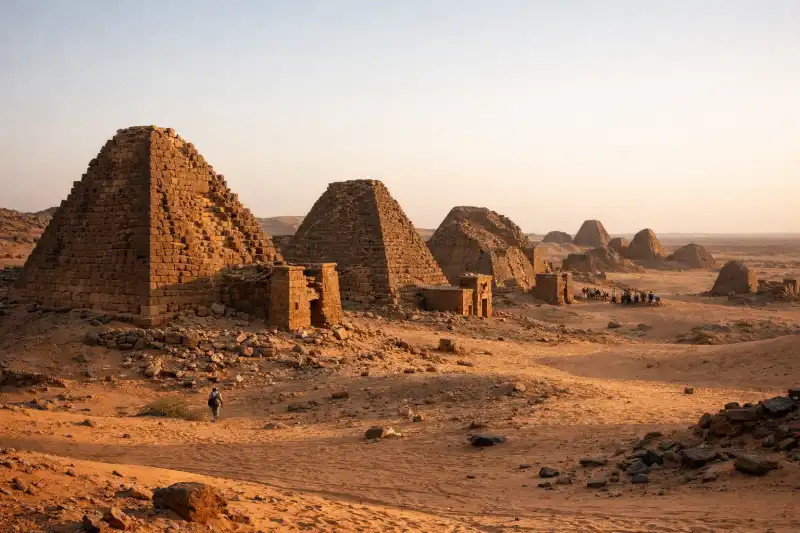
In the open desert of Sudan, the Pyramids of Meroe rise from the sand with a kind of stark elegance that feels both royal and remote. Unlike the broader, more familiar silhouettes of Egypt, these pyramids are smaller, steeper, and clustered in a landscape where the wind, light, and emptiness become part of the monument itself. The effect is unforgettable. One moment you are driving through a seemingly endless expanse of ochre and gold; the next, sharp stone forms appear along the horizon, revealing one of Africa’s most extraordinary ancient burial grounds.
Meroe was once one of the great centers of the Kingdom of Kush, the powerful civilization that flourished to the south of Egypt along the Nile. The pyramid fields here served as the resting place of kings, queens, and nobles, and together they form the most iconic remains of Kushite power. Today, visitors encounter not just a single monument but a vast necropolis spread across desert ridges east of the Nile. The site feels less like an isolated ruin and more like an ancient ceremonial landscape, shaped by royal ambition, religious belief, and centuries of desert silence. For travelers interested in ancient Africa beyond the usual routes, the Pyramids of Meroe offer something rare: grandeur without crowds, historical depth without heavy infrastructure, and a setting that still preserves a strong sense of discovery.
History
Early Kushite roots
The story of Meroe begins with the broader history of Kush, the Nubian kingdom that developed in what is now Sudan. Kush emerged as a major regional power in the first millennium BCE, drawing strength from its position along the Nile trade routes and from access to gold, ivory, livestock, and other valuable resources. Earlier Kushite rulers were centered farther north, especially at Napata, a city closely linked to the sacred mountain of Jebel Barkal. From there, Kushite kings exerted influence far beyond Nubia and even conquered Egypt, ruling as the pharaohs of the Twenty-Fifth Dynasty in the eighth and seventh centuries BCE.
This period of imperial expansion brought deep cultural exchange with Egypt. Kushite rulers adopted many Egyptian royal and religious traditions, including pyramid burials, temple architecture, and the worship of deities such as Amun. Yet Kush was never simply an imitation of Egypt. It maintained its own political identity, artistic style, and local traditions, blending imported ideas with indigenous forms in distinctive ways. That fusion would become especially clear at Meroe.
The rise of Meroe as a royal center
By roughly the third century BCE, royal burials increasingly shifted to Meroe, farther south and east in a region better placed for controlling trade and resources. The city of Meroe became one of the principal capitals of Kush and eventually the heart of the Meroitic kingdom. Located near the Nile but also connected to routes leading into central Africa and toward the Red Sea, it benefited from both agricultural support and long-distance commerce.
The pyramids built at Meroe during this period reflect a mature royal tradition. Rulers, queens, and members of the elite were interred beneath steep-sided pyramids set above underground burial chambers. Small offering chapels attached to the eastern face of many pyramids provided space for rituals and commemorative reliefs. These chapels often display a remarkable mixture of Egyptian-derived iconography and specifically Kushite motifs, including depictions of local regalia, distinctive clothing, and royal imagery that emphasizes the importance of queens as well as kings.
Meroe’s importance was not solely funerary. It was also an administrative, religious, and industrial center. Archaeological evidence points to iron production on a significant scale, leading some earlier scholars to call it the “Birmingham of Africa,” though that label can oversimplify its complexity. The city and its necropolis should instead be understood as parts of a sophisticated African kingdom with its own script, artistic conventions, and evolving political culture.
Queens, kings, and the Meroitic age
One of the most compelling aspects of Meroe is the visibility of royal women. The Kingdom of Kush is notable for the prominence of queens and queen mothers, some of whom wielded exceptional political authority. Classical writers referred to powerful Kushite ruling women as “Candace,” a title derived from the Meroitic kandake. Several of these royal women played major roles in governance, diplomacy, and military affairs.
The pyramid fields at Meroe preserve this dynastic world in stone. Separate cemetery groups contain the tombs of rulers and high-ranking elites, and many of the pyramids belonged to queens. Although smaller than the great Egyptian pyramids, they are architecturally striking because of their narrow bases and dramatic angles. They were never intended to replicate Giza; they belonged to a different kingdom, a different era, and a different visual language of power.
During the height of the Meroitic period, from roughly the third century BCE to the third century CE, Kush maintained contacts with Egypt under the Ptolemies and Romans, with sub-Saharan regions to the south, and with wider commercial networks reaching toward the Mediterranean and Indian Ocean worlds. This was a period of resilience and adaptation, during which Meroe stood as one of the most important political centers in northeastern Africa.
Decline, rediscovery, and preservation
By the fourth century CE, the kingdom centered at Meroe declined, probably due to a combination of shifting trade patterns, environmental pressures, internal change, and external military challenges. The city and its cemeteries were gradually abandoned, leaving the desert to preserve what remained. Centuries later, travelers and antiquarians reached the site, often with limited understanding of its history.
In the nineteenth century, some pyramids suffered severe damage at the hands of treasure hunters, most notoriously the Italian adventurer Giuseppe Ferlini, who blasted into several tombs in search of valuables. His actions destroyed portions of the monuments and permanently altered parts of the necropolis. Despite this loss, enough survives to convey the scale and beauty of the site.
Modern archaeology has transformed scholarly understanding of Meroe, highlighting its importance as a center of the Kingdom of Kush rather than a peripheral echo of Egypt. Today the pyramids form part of the UNESCO-listed Archaeological Sites of the Island of Meroe, recognized for their cultural significance and for the insight they offer into one of ancient Africa’s great civilizations.
Key Features
The most immediately striking feature of the Pyramids of Meroe is their form. These are not broad, monumental masses like the pyramids at Giza, but tall, narrow structures with steep sides that seem to spear upward from the desert. Many are partially ruined, their tops broken or their facing stones worn away, yet even in damaged condition they create a powerful architectural rhythm across the landscape. Seen together, they resemble a field of stone peaks arranged according to status, ritual, and dynastic memory.
The necropolis is typically divided into several cemetery groups, including the North Cemetery, South Cemetery, and West Cemetery. The North Cemetery contains many of the royal pyramids and is the area most visitors remember best. Here the monuments stand in dense clusters on sandy ground, some with their attached chapels still preserving carved reliefs. Walking among them gives a rare sense of physical intimacy with an ancient royal cemetery. The pyramids are close enough together to compare their proportions and details, yet the surrounding desert keeps the wider scene open and immense.
The attached chapels deserve special attention because they preserve much of the symbolic language of the site. On the eastern side of many pyramids, these small structures served as the visible focal point of funerary offerings. Relief carvings often show the deceased before deities, receiving blessings or participating in rituals connected to the afterlife. Although many scenes were inspired by Egyptian artistic models, the figures, crowns, ornaments, and compositions often reveal distinctly Kushite tastes. This is one of the site’s greatest rewards: the ability to see cultural exchange transformed into something local and original.
Another memorable feature is the setting itself. Meroe is not hidden inside a city or hemmed in by modern construction. It rises from the edge of the Nubian Desert, where dunes shift with the wind and the light changes dramatically over the course of the day. Early morning softens the stone into pale gold; at sunset, the pyramids can glow deep orange and red against the fading sky. Because of this, the landscape is inseparable from the archaeology. The site is not only a collection of tombs but also a carefully chosen setting where visibility, elevation, and desert isolation added meaning to royal burial.
Visitors should also notice the variety in preservation. Some pyramids remain relatively intact, while others survive only as truncated cores or scattered blocks. This unevenness is part of the story. It reflects ancient construction methods, natural erosion, and episodes of looting and destruction. Rather than diminishing the site, the range of conditions helps reveal its long history and the vulnerability of desert monuments once royal protection disappeared.
Beyond the pyramid fields themselves, the wider Meroe complex includes remains of the ancient city and related ceremonial structures, though these are often visited as separate stops. Taken together, they show that the pyramids were part of a much broader capital landscape. The cemetery was linked to urban life, state ideology, and regional power. The dead were buried not in isolation but near the political and spiritual heart of the kingdom.
Perhaps the most distinctive feature of Meroe, however, is its atmosphere. Many famous ancient sites are impressive because they are monumental; Meroe is impressive because it combines monumentality with solitude. Even when tourism is active, the experience is often quieter and more reflective than at better-known sites. There is space to stand back and take in the geometry of the pyramids against the horizon, or to walk close enough to study relief fragments and cut stone. That combination of scale and stillness gives Meroe a character unlike almost anywhere else in the ancient world.
Getting There
Most travelers reach the Pyramids of Meroe from Khartoum, Sudan’s capital. The site lies roughly 200 to 220 kilometers northeast of the city, and the journey by road usually takes around 3 to 4 hours depending on traffic, road conditions, and security arrangements. Private car hire is the most straightforward option. A full-day driver from Khartoum commonly costs in the range of $120 to $220 USD for the vehicle, though prices vary by season, fuel costs, and whether you include additional stops.
Shared transport can be cheaper but is less predictable for independent visitors. Minibuses or long-distance vehicles running toward Shendi or Atbara may cost the local equivalent of a few dollars to around $10 to $20 USD per person, but from there you may still need to arrange a taxi onward to the pyramid fields. That final segment can add another $15 to $40 USD depending on distance and negotiation. Because services are not geared primarily toward tourism, many visitors prefer a pre-arranged guide or driver.
Organized tours from Khartoum are often the easiest solution, especially if you want help with logistics, entry procedures, and timing for sunrise or sunset photography. Some itineraries combine Meroe with other Kushite sites such as Naqa and Musawwarat es-Sufra. Entrance fees can change, so it is wise to carry cash in local currency and some small bills.
Bring more water than you think you need, along with sun protection and a hat. Facilities at the site can be basic, and shade is limited. A four-wheel-drive vehicle is useful if your itinerary includes nearby desert camps, but it is not always necessary for the main road approach.
When to Visit
The best time to visit the Pyramids of Meroe is during the cooler months, generally from November through February. Daytime temperatures in this period are far more comfortable for walking among the monuments, and the softer winter light is excellent for photography. Early mornings can feel pleasantly cool, while afternoons are warm rather than punishing. For most travelers, this is the season that offers the most enjoyable balance between accessibility and comfort.
March and October can also be reasonable shoulder months, though temperatures begin to rise. If you travel during these periods, try to arrive at the site early in the morning or later in the afternoon to avoid the harshest midday heat. The desert setting offers almost no natural shade, and the reflective glare from sand and stone can make even moderate temperatures feel stronger.
From about April through September, conditions are typically much hotter. In peak summer, daytime heat can be intense enough to shorten your visit significantly, especially if you are sensitive to dry desert climates. Travel is still possible, but it requires careful planning, extra water, and realistic expectations about how much walking you can comfortably do. Photography can also be more challenging under the bright overhead sun.
Time of day matters almost as much as time of year. Sunrise and sunset are the most atmospheric moments at Meroe, when long shadows define the steep angles of the pyramids and the desert colors become richer. Many travelers consider sunset especially memorable, as the site shifts from bright gold to amber and then to muted violet tones. If your schedule allows, an overnight stay nearby lets you experience the pyramids in changing light and with fewer people around.
| Quick Facts | Details |
|---|---|
| Location | Near Meroe, River Nile State, Sudan |
| Civilization | Kingdom of Kush |
| Main period | c. 3rd century BCE to 4th century CE |
| Site type | Royal necropolis and pyramid cemetery |
| Famous for | Steep-sided Kushite pyramids in a desert setting |
| Nearest major city | Khartoum |
| Nearby town | Shendi |
| UNESCO status | Part of the Archaeological Sites of the Island of Meroe |
| Recommended visit length | Half day to full day |
| Best season | November to February |
A visit to the Pyramids of Meroe is ultimately about more than checking off another ancient site. It is an encounter with a royal landscape that broadens the map of the ancient world. Here, in the sands of Sudan, the story of pyramids belongs not only to Egypt but also to Kush, a powerful African kingdom with its own rulers, rituals, and artistic vision. The site invites visitors to slow down and look carefully: at the way each pyramid differs from the next, at the reliefs carved into chapel walls, at the desert that has both protected and threatened the monuments over centuries.
What makes Meroe memorable is the combination of beauty and perspective. The pyramids are visually striking on their own, but they also challenge familiar assumptions about where ancient monumental architecture flourished and who built it. For anyone interested in archaeology, ancient Africa, or places that still retain a sense of remoteness, Meroe rewards the journey. It stands as one of Sudan’s greatest treasures and one of the most compelling archaeological landscapes on the continent.
Guided tours: worth it?
A guide can be genuinely useful at Pyramids of Meroe, especially if you want help with transport, timing, tickets, or understanding a large site without losing half the day to logistics.
Best for
- First-time visitors who want context, not just photos
- Travelers who want transport, timing, or entry logistics handled
- Short visits where a planned route saves time
When to go self-guided
Go independently if you already have transport and tickets sorted, enjoy moving at your own pace, and are comfortable checking the latest official rules before you arrive.
What I’d avoid
Skip paid tours that bundle unrelated stops you do not actually want. The best option should either save meaningful planning time or add historical context you would miss on your own.
Sudan Meroe Pyramids Tours
Useful when: you want to compare guided formats before deciding
Khartoum to Meroe Day Trips
Useful when: transport or pickup logistics matter
Ancient Kush and Meroe Archaeology Tours
Useful when: you want to compare guided formats before deciding
Some tour links are affiliate links, which may earn Ancient Travel a small commission at no extra cost to you. I try to surface options that make practical sense for the site—not just anything bookable.
Frequently Asked Questions
Where are the Pyramids of Meroe located?
The Pyramids of Meroe are in northeastern Sudan, in River Nile State, near the Nile Valley and roughly 200 kilometers northeast of Khartoum.
Who built the Pyramids of Meroe?
They were built by the rulers and elites of the ancient Kingdom of Kush, especially during the period when Meroe served as a royal and political center.
How many pyramids are at Meroe?
The wider Meroe necropolis contains more than 200 pyramids and tomb structures, making it one of the largest concentrations of pyramids in the world.
Can you go inside the Pyramids of Meroe?
Most visitors explore the exterior of the pyramids and nearby chapels, as many burial chambers were damaged, looted, or are not generally open for routine tourist entry.
Is Meroe a day trip from Khartoum?
Yes, it can be visited as a long day trip from Khartoum, though many travelers prefer an overnight stay to enjoy sunrise or sunset in the desert.
What is the best time to visit the Pyramids of Meroe?
The cooler months from November to February are generally the best time to visit, with more comfortable daytime temperatures for walking around the site.
Nearby Ancient Sites
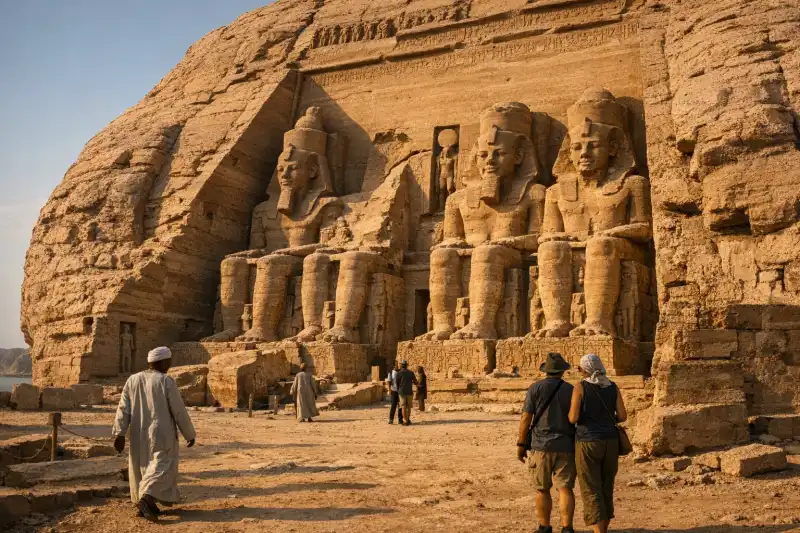
Abu Simbel
Ancient EgyptianDiscover Abu Simbel in Egypt, where colossal rock-cut temples of Ramses II rise above Lake Nasser ne...
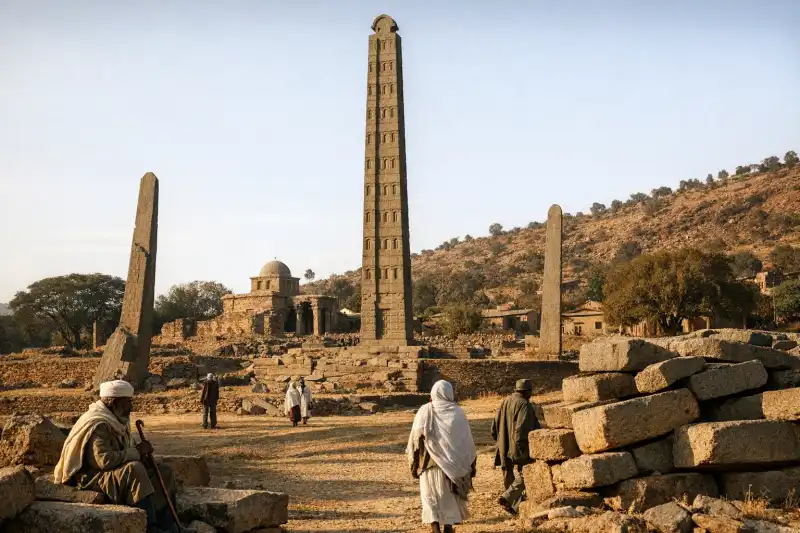
Aksum
Aksumite KingdomExplore Aksum, Ethiopia’s ancient royal city of towering stelae, early Christianity, and one of Afri...
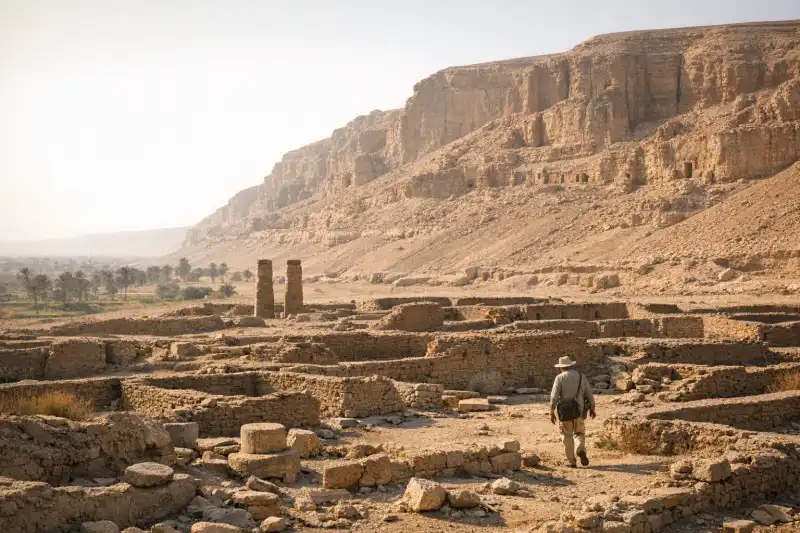
Amarna
Ancient EgyptianExplore Amarna in Egypt, Akhenaten’s short-lived royal capital, known for boundary stelae, desert to...