Quick Info
At a glance
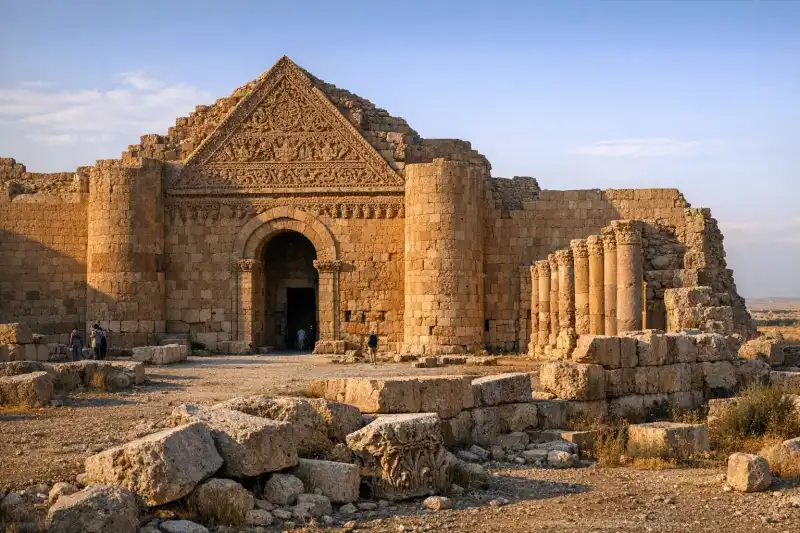
Qasr Al-Mshatta in Jordan rises from the dry plain south of Amman with the quiet authority of a monument that was never fully completed, yet still became one of the most celebrated masterpieces of early Islamic architecture. Near the modern highway and not far from Queen Alia International Airport, its weathered walls and broad enclosure can seem at first like a ruin of simple geometry in an open landscape. But as you move closer, the site begins to reveal something richer: an ambitious royal project from the Umayyad age, designed on a monumental scale and decorated with intricate stone carving of extraordinary refinement.
Unlike some ancient sites that overwhelm through height or survival, Qasr Al-Mshatta impresses through fragments, absence, and intention. The surviving remains hint at a palace complex that would have blended imperial ceremony, residential space, and perhaps agricultural or administrative functions within a fortified square plan. Most famous of all is its facade, whose carved ornament became so admired that a large section was transferred to Berlin in the nineteenth century, where it remains one of the landmarks of Islamic art collections. At the site itself in Jordan, visitors encounter both the power of what survives and the mystery of what was left unfinished. That combination makes Qasr Al-Mshatta one of the most rewarding places in Jordan for travelers interested in architecture, archaeology, and the formative centuries of Islamic rule.
History
The Umayyad vision
Qasr Al-Mshatta was built during the Umayyad period, most likely in the first half of the 8th century CE, when the Umayyad caliphs ruled a vast empire stretching from the Iberian Peninsula to Central Asia. This was an age of political ambition, artistic experimentation, and state building. In the lands of Bilad al-Sham, which included present-day Jordan, the Umayyads sponsored mosques, palaces, roads, agricultural works, and desert estates. Qasr Al-Mshatta belongs to the broader group often called the “desert castles” of Jordan and Syria, though that label can oversimplify the variety of their functions.
Most scholars connect Mshatta with the reign of the caliph al-Walid II, who ruled briefly from 743 to 744 CE. The palace appears to have been conceived as a prestigious rural residence or seasonal complex, one that projected dynastic legitimacy through scale and ornament. The design reflects both continuity and innovation: Roman and Byzantine building traditions remained influential in the region, while new Islamic court culture shaped how space, decoration, and authority were expressed. Qasr Al-Mshatta stands at that meeting point, preserving a rare architectural statement from the early Islamic world.
An unfinished palace
One of the most intriguing things about Qasr Al-Mshatta is that it appears never to have been completed. Archaeological evidence suggests that construction stopped abruptly, likely because of political upheaval. The death of al-Walid II and the instability that followed during the late Umayyad years may have interrupted the project. Not long afterward, the Abbasid Revolution of 750 CE overthrew the Umayyad dynasty in the eastern Islamic world, shifting political power away from Syria and Jordan toward Iraq.
That larger historical transition helps explain why Mshatta remained incomplete. A palace associated with a previous ruling house would have lost much of its immediate relevance once the dynasty collapsed. Some parts of the structure may have seen limited later use, but the grand original vision seems to have ended almost as suddenly as it began. This unfinished state is crucial to its importance today. At many sites, centuries of rebuilding can obscure the first design; at Qasr Al-Mshatta, by contrast, archaeologists can study a palace caught mid-creation, revealing construction methods, planning decisions, and decorative priorities.
Survival through change
Over the centuries, the palace entered the long afterlife common to many ruins in the Middle East. Stone was vulnerable to reuse, collapse, and natural weathering, and the site gradually became a broken shell of walls, foundations, and sculpted fragments. Yet enough remained to preserve the essence of the plan. Travelers, local communities, and later researchers recognized that this was no ordinary ruin. Its enclosure walls, corner towers, and especially the carved facade testified to a high-status building with unusual artistic ambition.
The site’s relative isolation helped preserve parts of it, though not untouched. Earthquakes, erosion, and human intervention all affected the palace. By the nineteenth century, Mshatta had become known to Western scholars and diplomats interested in the material culture of the early Islamic period. This attention would bring both conservation interest and one of the most controversial episodes in the monument’s history.
The facade and Berlin
In 1903, during the late Ottoman period, Sultan Abdul Hamid II presented a major section of the carved stone facade of Qasr Al-Mshatta to Kaiser Wilhelm II of Germany. The facade was transported to Berlin, where it became one of the treasures of what is now the Pergamon Museum. This transfer made Mshatta internationally famous, and generations of art historians have studied the carvings there as a key example of Umayyad ornament.
The facade itself is remarkable for its dense triangular panels filled with vine scrolls, rosettes, animals, and vegetal forms. It shows both the absorption of older Mediterranean artistic traditions and their transformation within an Islamic court context. Notably, the decorative scheme differs on either side of what is believed to have been the mosque area, with figural motifs absent near the sacred zone. That variation has often been cited in discussions of early Islamic attitudes toward representation.
While Berlin preserves the best-known portion, the removal of the facade also changed the experience of the site in Jordan. Visitors today encounter a monument that is historically inseparable from an absent masterpiece. Even so, Qasr Al-Mshatta remains deeply important in its original landscape, where its architecture can still be read as a whole.
Archaeology and modern significance
Modern archaeological work has clarified the palace’s layout and construction. Researchers have identified a large square enclosure with projecting towers, an entrance complex, a central courtyard, and a residential or ceremonial core organized around halls and rooms. The use of baked brick in vaulting and the combination of stone and brick construction provide valuable evidence for building techniques in Umayyad Jordan.
Today, Qasr Al-Mshatta is appreciated not only as an architectural ruin but as a document of transition: from late antique to Islamic forms, from inherited motifs to new courtly expression, and from dynastic ambition to unfinished abandonment. In Jordan’s rich archaeological landscape, where Nabataean, Roman, Byzantine, and Islamic sites all compete for attention, Mshatta offers a particularly important window onto the formative centuries of Islamic art and rulership.
Key Features
Qasr Al-Mshatta is best understood first through its overall plan. The palace was enclosed within a vast square perimeter, giving it the appearance of a fortified compound. This outer wall, punctuated by semicircular towers and anchored by corner bastions, creates an immediate impression of strength and order. Yet the fortress-like exterior should not mislead visitors into imagining a purely military function. Like several Umayyad palatial complexes, Mshatta combined defensive symbolism with elite residential and ceremonial uses. The walls marked control, prestige, and separation from the surrounding landscape as much as they promised protection.
The entrance front is the site’s most celebrated architectural feature. Even in its incomplete and partially diminished state, it conveys the lavish ambition of the original design. The famous facade once stretched across the outer wall in carved limestone, transforming a practical exterior into a monumental screen of decoration. Triangular and polygonal panels were filled with scrolling vines, carved leaves, bunches of grapes, fantastic birds, and animals. The workmanship is both disciplined and exuberant. Rather than relying on a single visual formula, the facade creates rhythmic variation across repeating frames, making the whole composition feel alive.
One of the most fascinating aspects of this facade is its artistic hybridity. Visitors familiar with Byzantine, Sasanian, and classical motifs may recognize echoes of all three, yet the result is not mere imitation. At Mshatta these traditions are reorganized into something distinctly Umayyad. The carving turns the wall into a statement of cosmopolitan rule, showing that the early Islamic court could command the visual languages of the older empires it had succeeded. This is one reason the monument matters so much to historians of art: it captures the moment when Islamic architecture was defining itself in conversation with existing traditions.
Inside the enclosure, the palace’s central zone reveals another layer of planning. Archaeologists have identified a more concentrated residential and ceremonial complex arranged around a courtyard. Here the geometry becomes more intimate, guiding movement inward from the broad outer space toward the core of authority. The remains suggest reception halls, living quarters, service areas, and perhaps spaces for administration. Although many walls survive only at low height, the layout still helps visitors imagine the choreography of elite life: entrances controlled by gates, open courts for gathering, and vaulted rooms providing shade and privacy.
Construction technique is also a key feature of Qasr Al-Mshatta. The builders used a combination of stone masonry and baked brick, especially in arches and vaults. This mix was practical, but it also reflects broader regional building traditions active in the Umayyad period. In archaeological terms, Mshatta is valuable because unfinished areas expose how the builders worked. You can read the difference between completed decorative surfaces and structural zones that never received their final treatment. Few palaces preserve this kind of architectural “process” so clearly.
The surrounding landscape contributes powerfully to the site’s character. Qasr Al-Mshatta does not sit atop a dramatic mountain or within a dense urban center. Instead, it occupies an open plain where distance and horizon matter. This setting gives the enclosure unusual visual clarity. Approaching the palace, visitors can appreciate the way the walls define human order within a broad, semi-arid environment. The experience is quieter than at Jordan’s more famous tourist destinations, and that quiet can be one of its greatest strengths. There is room to observe proportions, sunlight on stone, and the subtle dialogue between ruin and terrain.
Another notable feature is the site’s relationship to absence. Because the most famous section of the facade now stands in Berlin, Qasr Al-Mshatta asks visitors to imagine what is no longer fully present. This might seem like a loss alone, but it also sharpens attention. The surviving sections, foundations, and sculptural fragments acquire extra meaning when viewed as parts of a once unified decorative and ceremonial whole. Mshatta becomes an exercise in archaeological reading: not simply looking at what remains, but understanding what the remaining forms imply.
Finally, Qasr Al-Mshatta’s importance lies in its place within Jordan’s network of Umayyad and early Islamic sites. It can be compared with other desert castles, but it retains a character all its own. Where some sites are admired for frescoes, baths, or better-preserved residential rooms, Mshatta stands out for monumentality, facade design, and the sheer scale of its interrupted vision. For visitors interested in how architecture expresses power, taste, and historical change, it is one of the country’s most compelling ruins.
Getting There
Qasr Al-Mshatta is easiest to reach by road from Amman, and most visitors treat it as a half-day excursion or combine it with other desert castle sites. The palace lies south of the capital, near Queen Alia International Airport, so travel times are relatively short. By private car or taxi from central Amman, the drive usually takes around 40 to 60 minutes depending on traffic. A standard taxi fare from Amman can range roughly from 20 to 35 Jordanian dinars one way, though negotiated prices for waiting time and return travel may be higher. Using a ride-hailing app can sometimes make pricing clearer.
Renting a car is the most flexible option, especially if you plan to visit multiple sites in one day. Daily car rental rates in Amman often start around 25 to 40 JOD before fuel and insurance, and roads in the area are generally straightforward. Because signage can be inconsistent, an offline map or GPS is recommended. Parking conditions are usually simple rather than formal, so visitors should expect a relatively low-key arrival experience.
Organized tours from Amman are another practical choice. Half-day or full-day excursions covering Jordan’s desert castles commonly include transport, guiding, and hotel pickup. Prices vary widely by group size and inclusions, but shared or small-group tours often begin around 45 to 80 JOD per person, while private tours may cost significantly more.
Public transport is not the best way to reach Qasr Al-Mshatta directly. Buses and service taxis may get you part of the way toward the airport corridor or nearby towns, but the last stretch can be inconvenient without a prearranged ride. For most travelers, a taxi, rental car, or organized day trip is the most reliable and time-efficient approach.
When to Visit
The best times to visit Qasr Al-Mshatta are spring and autumn, when Jordan’s temperatures are milder and the open landscape is most comfortable for walking. From March to May, the light can be especially attractive for photography, with softer mornings and late afternoons bringing out the texture of the stone. Spring also sometimes adds a slight green tint to the surrounding plain, creating a gentler contrast with the pale walls. September through November is another excellent window, offering warm but manageable conditions and generally clear skies.
Summer visits are possible, but the heat can become intense, especially around midday. Because the site has limited shade and much of the experience involves standing in open ground, it is best to arrive early in the morning or later in the afternoon if visiting between June and August. Carry water, sun protection, and a hat. Even a relatively short stop can feel tiring in strong heat.
Winter is quieter and can be rewarding for travelers who prefer cooler weather and fewer people. Daytime temperatures are often comfortable for exploring, though wind and occasional rain can make the site feel exposed. Early mornings may be chilly, and light can shift quickly on cloudy days. A layered jacket is helpful.
If your itinerary is focused on architecture and photography, aim for the first two hours after sunrise or the last two before sunset. The lower sun emphasizes relief carving, wall lines, and the palace’s broad geometry. Those times also offer the most atmospheric experience, when Qasr Al-Mshatta feels less like a roadside ruin and more like a deserted royal project paused in time.
| Quick Facts | Details |
|---|---|
| Site name | Qasr Al-Mshatta |
| Location | South of Amman, Jordan |
| Region | Amman Governorate |
| Period | Early Islamic, Umayyad |
| Date | 8th century CE |
| Associated ruler | Often linked to al-Walid II |
| Site type | Desert palace / royal complex |
| Famous for | Unfinished palace and carved stone facade |
| Best visit length | 45 minutes to 1.5 hours |
| Nearest major city | Amman |
| Access | Best by car, taxi, or guided tour |
| Ideal seasons | Spring and autumn |
Qasr Al-Mshatta rewards travelers who are willing to look beyond completeness and grandeur in the conventional sense. It is a place of interrupted ambition, where the story of an empire’s artistic confidence survives in walls, plans, and fragments rather than intact chambers and polished monuments. In Jordan, a country rich in spectacular archaeology, that may sound modest, yet the experience is distinctive. Here you are not simply visiting a ruin; you are standing within an architectural argument about power, taste, and identity at the dawn of Islamic civilization.
What makes the site memorable is precisely this tension between survival and loss. The palace remains rooted in its Jordanian landscape, while part of its most famous facade lives far away in Berlin. The structure was designed for royal use, yet it was abandoned before completion. Its decoration draws on older traditions, yet the whole announces a new political and cultural world. Few places communicate so clearly how history is made not only through finished monuments but also through projects cut short by events beyond the builder’s control.
For travelers based in Amman, Qasr Al-Mshatta is an accessible and deeply worthwhile excursion. It pairs especially well with other early Islamic or archaeological sites, but it also deserves attention on its own terms. If you arrive with patience, curiosity, and an eye for architecture, you will find in these weathered remains one of Jordan’s most eloquent testimonies to the Umayyad age.
Guided tours: worth it?
A guide can be genuinely useful at Qasr Al-Mshatta, especially if you want help with transport, timing, tickets, or understanding a large site without losing half the day to logistics.
Best for
- First-time visitors who want context, not just photos
- Travelers who want transport, timing, or entry logistics handled
- Short visits where a planned route saves time
When to go self-guided
Go independently if you already have transport and tickets sorted, enjoy moving at your own pace, and are comfortable checking the latest official rules before you arrive.
What I’d avoid
Skip paid tours that bundle unrelated stops you do not actually want. The best option should either save meaningful planning time or add historical context you would miss on your own.
Jordan Desert Castles Tours
Useful when: you want to compare guided formats before deciding
Amman Day Trips to Desert Castles
Useful when: transport or pickup logistics matter
Jordan Islamic Heritage Tours
Useful when: you want to compare guided formats before deciding
Some tour links are affiliate links, which may earn Ancient Travel a small commission at no extra cost to you. I try to surface options that make practical sense for the site—not just anything bookable.
Frequently Asked Questions
What is Qasr Al-Mshatta?
Qasr Al-Mshatta is an unfinished Umayyad desert palace in Jordan, known for its large square enclosure and richly carved stone facade.
Where is Qasr Al-Mshatta located?
The site lies south of Amman in Jordan, close to Queen Alia International Airport, within the Amman Governorate.
Why is Qasr Al-Mshatta important?
It is one of the most significant surviving Umayyad palaces and offers valuable evidence for early Islamic art, architecture, and royal building programs.
Can visitors see the original facade at the site?
Part of the original facade remains at Qasr Al-Mshatta, but a famous large section was removed in the late 19th century and is now displayed in Berlin's Pergamon Museum.
How much time should I allow for visiting Qasr Al-Mshatta?
Most travelers spend 45 minutes to 1.5 hours at the site, depending on their interest in architecture, photography, and nearby desert castle excursions.
Is Qasr Al-Mshatta easy to visit from Amman?
Yes. It is usually visited as a short road trip from Amman or combined with other Jordanian desert castles on a half-day or full-day excursion.
Nearby Ancient Sites
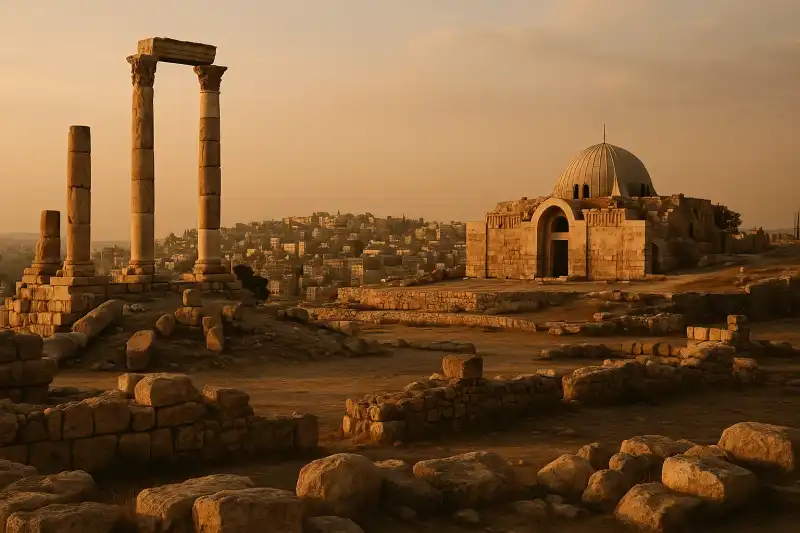
Amman Citadel Jordan Guide 2026: Temple of Hercules & Ancient Rabbah
Ammonite-Roman-UmayyadExplore Jordan's ancient citadel overlooking modern Amman. Discover the Temple of Hercules, Umayyad ...
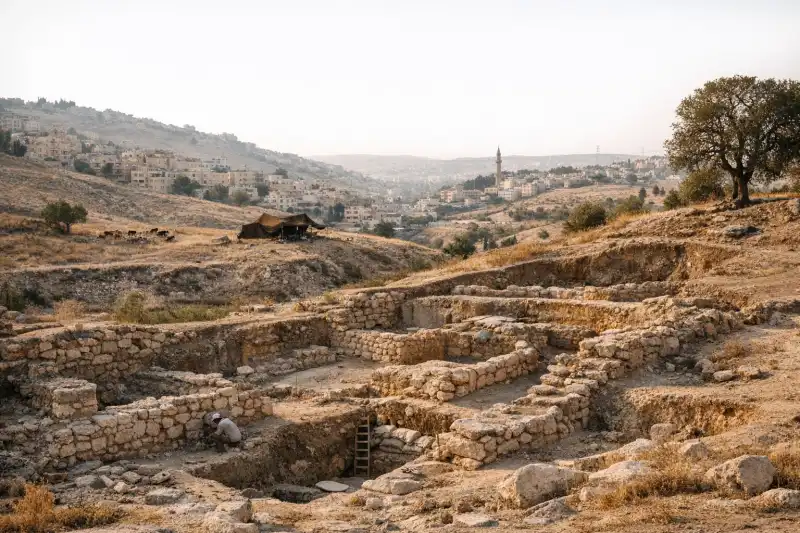
Ain Ghazal
Pre-Pottery Neolithic communities of the LevantDiscover Ain Ghazal, Jordan’s remarkable Neolithic settlement famed for its ancient plaster statues ...
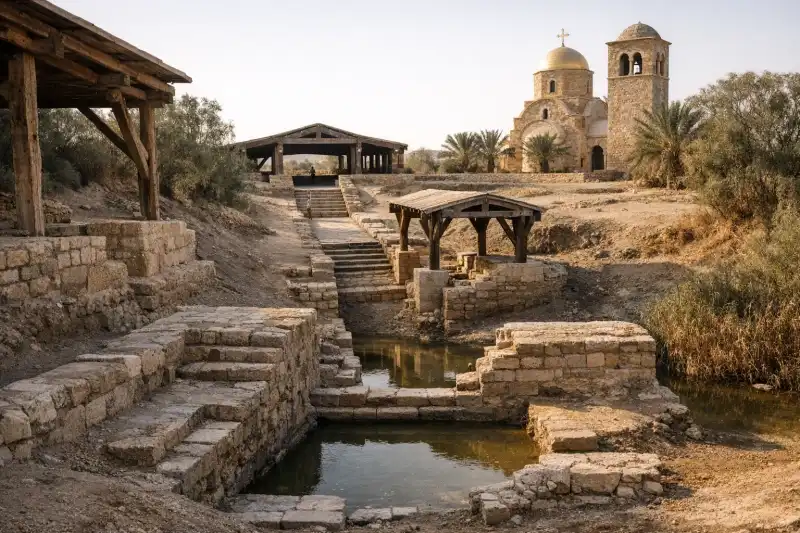
Bethany Beyond the Jordan
Bethany Beyond the Jordan in Jordan is an archaeological and religiously significant site believed t...
Deir Alla
Canaanite, Israelite-era, and regional Levantine culturesExplore Deir Alla in Jordan, an important Jordan Valley archaeological mound linked to Bronze and Ir...