Quick Info
At a glance
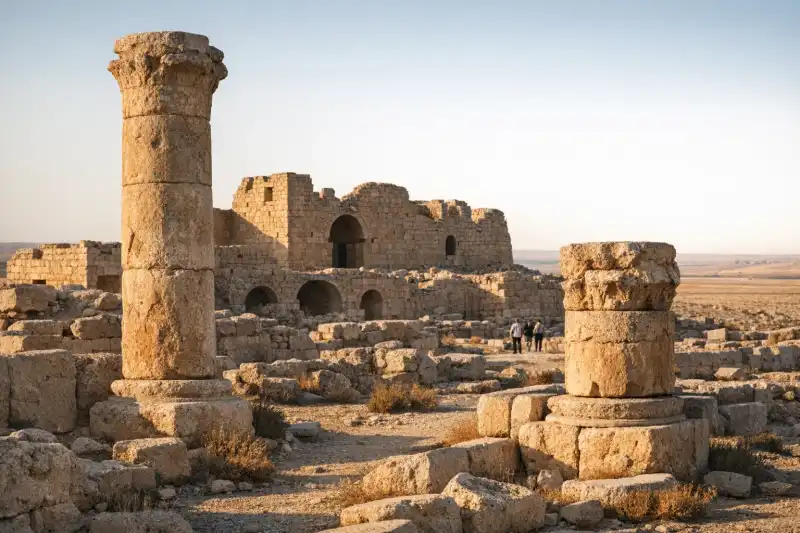
Qasr Al-Muwaqqar in Jordan stands on the dry plateau southeast of Amman, where the cultivated edge of the highlands gives way to open steppe and a wider desert horizon. Today the ruins are quiet and fragmentary, easy to miss if you are expecting a fully preserved palace, yet that understatement is part of their appeal. This is a place best appreciated not through monumental grandeur alone but through atmosphere, geography, and the historical questions that still cling to its stone remains. In the clear light of eastern Jordan, low walls, broken masonry, and traces of a once ambitious compound suggest a world in which caliphs, officials, builders, and local communities all intersected on the frontier between city and desert.
For travelers exploring Jordan’s early Islamic heritage, Qasr Al-Muwaqqar offers a rewarding detour from the country’s more famous classical and biblical sites. It belongs to the broader constellation of so-called desert castles associated with the Umayyad period, a network that blended political display, seasonal residence, estate management, and strategic control. Even in ruin, the site evokes that era of experimentation when a new Islamic empire adapted older Roman and Byzantine landscapes to fresh administrative and cultural purposes. Visiting here means reading the land as much as the architecture: the broad skies, sparse vegetation, and exposed stone all help explain why this seemingly remote place once mattered.
History
H3: The landscape before the palace
Long before Qasr Al-Muwaqqar took shape as an early Islamic complex, the surrounding region was already part of a lived-in and connected landscape. Eastern and southeastern Jordan were never empty margins. Routes linking Amman and the central highlands to the desert interior, Arabia, and the Dead Sea basin passed across these plateaus, and communities had learned for centuries how to exploit seasonal water, grazing zones, and agricultural pockets. Under Roman and Byzantine rule, many parts of Jordan saw intensive settlement, road building, and the spread of rural estates, churches, forts, and villages. The Umayyads inherited this layered territory rather than constructing a brand-new political geography from nothing.
That inheritance matters for understanding Qasr Al-Muwaqqar. Sites like this were often positioned where movement, resource management, and visibility all converged. They could draw on preexisting patterns of land use while projecting the authority of the new Islamic state. In that sense, the palace was part of continuity as well as change: a fresh statement built within a long-established human environment.
H3: Umayyad construction in the 8th century
Qasr Al-Muwaqqar is generally dated to the Umayyad period, most likely in the 8th century CE, when the Umayyad caliphs ruled from Damascus and oversaw a vast empire stretching from Iberia to Central Asia. Jordan, lying close to the Syrian heartland of the dynasty, became one of the regions where Umayyad architectural patronage was especially visible. Palatial compounds, baths, agricultural estates, and elite residences appeared across the steppe and semi-desert, now collectively described as desert castles.
Although the surviving remains at Qasr Al-Muwaqqar are incomplete, scholars usually interpret the site as part of this pattern of royal or aristocratic construction. The name “qasr” itself suggests a castle or palace, though in practice these complexes could perform multiple functions. They were not always military strongholds in the conventional sense. Some acted as seasonal lodges, some as administrative centers tied to estates, and some as statements of Umayyad legitimacy in landscapes frequented by tribal groups and mobile populations. Qasr Al-Muwaqqar likely served more than one role, combining residence, oversight of local production, and symbolic presence.
H3: Function, water, and estate management
One of the enduring questions about Qasr Al-Muwaqqar concerns how it operated within its environment. In Jordan’s drier zones, water systems were often as important as walls. Many Umayyad complexes depended on dams, cisterns, channels, or reservoirs to capture seasonal rainfall and make settlement viable. Even where architectural remains are modest, traces of hydraulic planning can reveal the true scale of investment.
At Al-Muwaqqar, the choice of location suggests an interest in managing the surrounding land rather than merely occupying it. The palace likely formed the focal point of a wider estate or controlled zone, perhaps linked to agricultural exploitation, taxation, grazing oversight, or route monitoring. This broader interpretation aligns well with other Umayyad desert sites, where architecture, water management, and rural economy were inseparable. The complex would have expressed elite culture while also functioning as a node in the practical business of governing a province.
H3: Decline after the Umayyads
The fall of the Umayyad dynasty in 750 CE altered the political landscape of the region. When the Abbasids took power and shifted the caliphal center eastward toward Iraq, many Umayyad-associated sites in Jordan lost their former importance. Some were abandoned, some were reused in more modest ways, and others gradually decayed as maintenance ceased. Qasr Al-Muwaqqar appears to have followed this broader trajectory.
Unlike cities that continued to grow through later centuries, small palace-estate complexes were especially vulnerable to political change. If their status depended on court patronage or a specific administrative function, they could become obsolete quickly. In the harsh climate of the Jordanian plateau, once roofs collapsed and water systems failed, erosion and stone robbing accelerated the decline. What survives today is therefore the residue of both historical transformation and environmental exposure.
H3: Rediscovery and archaeological interest
Modern scholarly interest in Jordan’s desert castles brought Qasr Al-Muwaqqar back into attention as part of a larger effort to understand Umayyad architecture beyond major urban centers. Researchers examining the site have focused on its plan, masonry, relation to nearby resources, and place within the network of early Islamic complexes across Jordan. While it is not as widely known as Qusayr ‘Amra or some of the eastern desert castles, Al-Muwaqqar contributes important evidence precisely because it is less polished and less monumental. It reminds archaeologists that the Umayyad building program was diverse, with sites ranging from lavish frescoed baths to more pragmatic rural compounds.
For visitors today, that history of rediscovery means approaching the ruins with informed imagination. Qasr Al-Muwaqqar may not present itself with interpretive drama, but it remains a valuable witness to the ways empire, landscape, and architecture met in early Islamic Jordan.
Key Features
What stands out first at Qasr Al-Muwaqqar is its setting. The site occupies open country where the broad plateau creates a sense of exposure and distance, even though Amman is not far away by modern standards. That contrast is central to the experience. You are close enough to the capital for a day trip, yet the atmosphere feels markedly different: quieter, windier, more spacious, and far less urban. The landscape helps explain why Umayyad patrons favored such places. A palace here could command views, stage elite presence, and remain connected to both settled and semi-nomadic worlds.
The architectural remains themselves are fragmentary, but they still communicate the outline of a formal complex. Visitors can observe portions of walls and foundations that indicate a planned enclosure rather than a random cluster of buildings. Even in ruin, the geometry of the place matters. Umayyad palace sites often used ordered layouts to express hierarchy and control, and Al-Muwaqqar appears to have belonged to that architectural language. As you walk the remains, it becomes easier to imagine courtyards, reception areas, domestic rooms, service spaces, and storage zones arranged within a coherent estate center.
Another notable feature is the surviving masonry, which ties the site visibly to its environment. The stone looks as though it rises out of the plateau itself, creating a close visual continuity between architecture and terrain. This is one reason the site can seem understated at first glance: the ruins do not dramatically contrast with the landscape but are embedded in it. Yet that quality can be especially rewarding for travelers interested in archaeology. You are not seeing a heavily reconstructed monument; you are reading traces in situ, where materials, topography, and weathering all remain part of the story.
The wider context of the desert castles also shapes how Qasr Al-Muwaqqar should be understood. Unlike a free-standing fortress designed only for defense, it belongs to a family of Umayyad sites where practicality and prestige overlap. Its features likely included provisions for residence, estate supervision, and water use. Even where specific elements are now hard to distinguish, the logic of the complex survives in its placement. It occupied a location that could support controlled movement, observation, and perhaps seasonal exploitation of local resources. The palace was therefore as much a landscape machine as an architectural object.
Visitors with an eye for historical texture will also appreciate the site’s incompleteness. Qasr Al-Muwaqqar does not overwhelm with polished surfaces or decorative survival; instead, it invites comparison and reconstruction. You begin noticing questions rather than only forms: where did water enter the complex, where might service areas have stood, how did residents move between open and enclosed spaces, and what kinds of authority were being projected here? In that sense, one of the site’s most important features is interpretive openness. It rewards slow looking.
Photography can be especially satisfying at Al-Muwaqqar because of the clean desert light and low profile of the ruins. Early morning and late afternoon bring stronger shadows that help reveal wall lines and masonry textures. The sky often occupies as much of the frame as the architecture, emphasizing the relationship between built form and emptiness. For many travelers, this atmospheric quality becomes the site’s most memorable feature. The ruin is modest, but the setting gives it scale.
Finally, Qasr Al-Muwaqqar has value as part of a broader itinerary. Seen after urban sites like the Amman Citadel or prehistoric places such as ‘Ain Ghazal, it highlights another layer of Jordan’s long past. It bridges the gap between city history and open-country archaeology, showing how state power extended beyond major settlements into managed rural landscapes. That wider interpretive role makes the site more significant than its surviving footprint alone might suggest.
Getting There
Qasr Al-Muwaqqar is most easily reached from Amman, which lies roughly to the northwest and serves as the practical base for almost all visitors. By private car, the drive usually takes around 45 minutes to 1 hour depending on traffic, route, and road conditions. Car rental in Amman often starts at about 25 to 40 JOD per day for a basic vehicle, with fuel extra. If you are already planning to visit several sites in a single day, self-driving gives the greatest flexibility.
A taxi from central Amman is another straightforward option. Expect a one-way fare in the range of roughly 20 to 30 JOD, though the final price depends on pickup point, waiting time, and whether the driver agrees to include return transport. For an out-and-back excursion with waiting time at the site, negotiating 35 to 50 JOD total is common and often more practical than trying to find transport on the return. Ride-hailing apps may work for the outbound leg in greater Amman, but they are less reliable for pickup near the ruins.
Public transport can get you toward Al-Muwaqqar town more cheaply, but it is not the easiest choice for visitors. Local buses or service taxis from Amman may cost only 1 to 3 JOD, yet schedules can be irregular and the final approach to the archaeological area may still require a taxi or a long walk. Because signage and visitor facilities are limited, downloading offline maps and confirming the exact location before departure is highly recommended. Bring water, especially in warmer months, as services around the ruins themselves may be minimal.
When to Visit
The best times to visit Qasr Al-Muwaqqar are spring and autumn, when Jordan’s plateau landscapes are most comfortable for walking. From March to May, temperatures are usually mild, skies are often clear, and the steppe may show brief touches of seasonal green after winter rains. This is an excellent season for combining the site with other day trips from Amman, as conditions are generally pleasant for both driving and exploring exposed ruins.
Autumn, especially from late September through November, is another strong choice. The heat of summer begins to ease, visibility is often good, and afternoons can be ideal for photography. The low-angle light at this time of year emphasizes the textures of stone and the subtle outlines of the surviving structures. For travelers interested in atmosphere rather than crowds, autumn offers some of the most rewarding conditions.
Summer visits are possible, but they require planning. From June through August, midday temperatures can become intense, and there is little shade at the site. If you go in summer, aim for early morning or the final hours before sunset, carry plenty of water, and wear a hat and sunscreen. Winter is cooler and sometimes very pleasant, but strong winds, cold snaps, and occasional rain can make the exposed plateau feel harsher than the thermometer suggests. After rain, some roads or tracks may also be less convenient.
For most travelers, the single best strategy is simple: arrive early or late in the day, avoid the hottest midday hours, and pair the visit with a clear-weather forecast. Qasr Al-Muwaqqar is a site where light and landscape matter as much as ruins, so timing can significantly improve the experience.
| Quick Facts | Details |
|---|---|
| Location | Al-Muwaqqar, southeast of Amman, Jordan |
| Region | Amman Governorate |
| Historical period | Early Islamic, primarily Umayyad |
| Likely date | 8th century CE |
| Site type | Desert palace / estate complex |
| Best base | Amman |
| Suggested visit length | 45 minutes to 1.5 hours |
| Best seasons | Spring and autumn |
| Access | Best by private car or taxi |
| What to bring | Water, sun protection, sturdy shoes, offline map |
Qasr Al-Muwaqqar is not a showpiece ruin in the conventional sense, and that is precisely why it can leave a lasting impression. It asks visitors to look beyond monumentality and consider how power operated across terrain: through estates, routes, water systems, and elite architecture adapted to marginal landscapes. In Jordan, where so many major attractions command immediate attention, this quieter Umayyad site offers a different reward. It makes the country’s history feel broader, more connected, and more human in scale. A visit here is less about checking off a famous landmark than about entering the historical logic of the plateau itself. For travelers willing to slow down, Qasr Al-Muwaqqar becomes not just a ruin near Amman, but a key to understanding how early Islamic Jordan was organized, inhabited, and imagined.
Guided tours: worth it?
A guide can be genuinely useful at Qasr Al-Muwaqqar, especially if you want help with transport, timing, tickets, or understanding a large site without losing half the day to logistics.
Best for
- First-time visitors who want context, not just photos
- Travelers who want transport, timing, or entry logistics handled
- Short visits where a planned route saves time
When to go self-guided
Go independently if you already have transport and tickets sorted, enjoy moving at your own pace, and are comfortable checking the latest official rules before you arrive.
What I’d avoid
Skip paid tours that bundle unrelated stops you do not actually want. The best option should either save meaningful planning time or add historical context you would miss on your own.
Amman Desert Castles Day Tours
Useful when: you want to compare guided formats before deciding
Jordan Umayyad Castles Tours
Useful when: you want to compare guided formats before deciding
Amman Private Historical Sites Tours
Useful when: you want flexible timing or a private guide
Some tour links are affiliate links, which may earn Ancient Travel a small commission at no extra cost to you. I try to surface options that make practical sense for the site—not just anything bookable.
Frequently Asked Questions
What is Qasr Al-Muwaqqar?
Qasr Al-Muwaqqar is an early Islamic archaeological site in Jordan, usually identified as an Umayyad desert palace or administrative complex southeast of Amman.
Where is Qasr Al-Muwaqqar located?
The site lies in Al-Muwaqqar in the Amman Governorate, on the plateau southeast of the capital and reachable by road from Amman.
Is Qasr Al-Muwaqqar easy to visit independently?
Yes, most visitors reach it by private car or taxi from Amman, though conditions on minor access roads can vary and planning transport in advance is wise.
How much time should I spend at Qasr Al-Muwaqqar?
Allow about 45 minutes to 1.5 hours for a focused visit, longer if you are interested in archaeology, photography, or combining it with other desert-castle stops.
What should I bring when visiting Qasr Al-Muwaqqar?
Bring water, sun protection, sturdy shoes, and a phone or map for navigation, as shade and visitor services at the site are limited.
Why is Qasr Al-Muwaqqar important?
It helps illustrate the Umayyad use of the Jordanian steppe for royal, agricultural, and administrative purposes, and it forms part of the wider story of Jordan's early Islamic desert complexes.
Nearby Ancient Sites
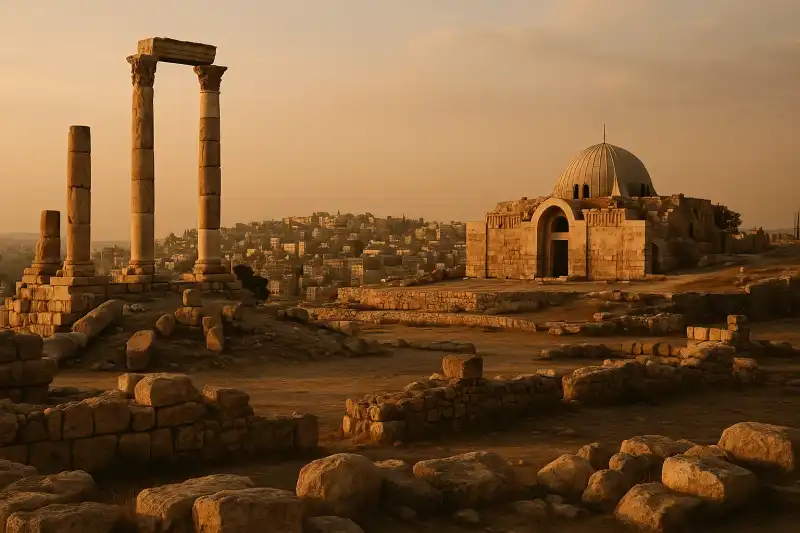
Amman Citadel Jordan Guide 2026: Temple of Hercules & Ancient Rabbah
Ammonite-Roman-UmayyadExplore Jordan's ancient citadel overlooking modern Amman. Discover the Temple of Hercules, Umayyad ...
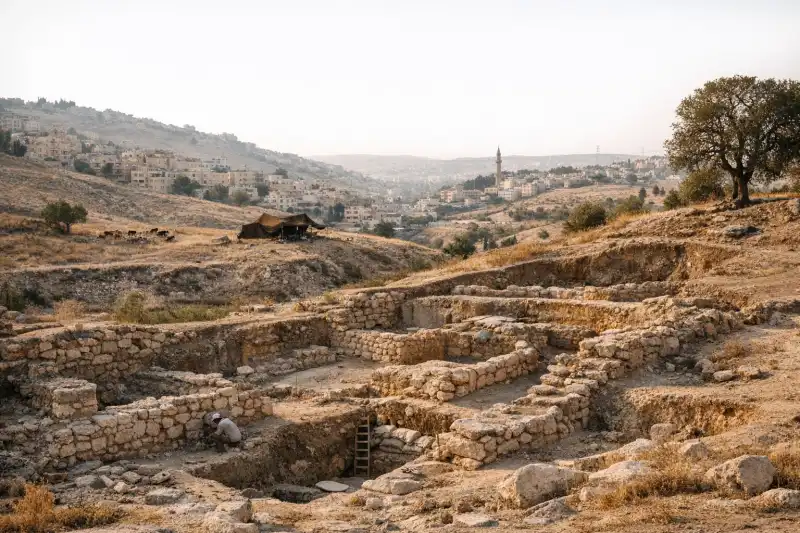
Ain Ghazal
Pre-Pottery Neolithic communities of the LevantDiscover Ain Ghazal, Jordan’s remarkable Neolithic settlement famed for its ancient plaster statues ...
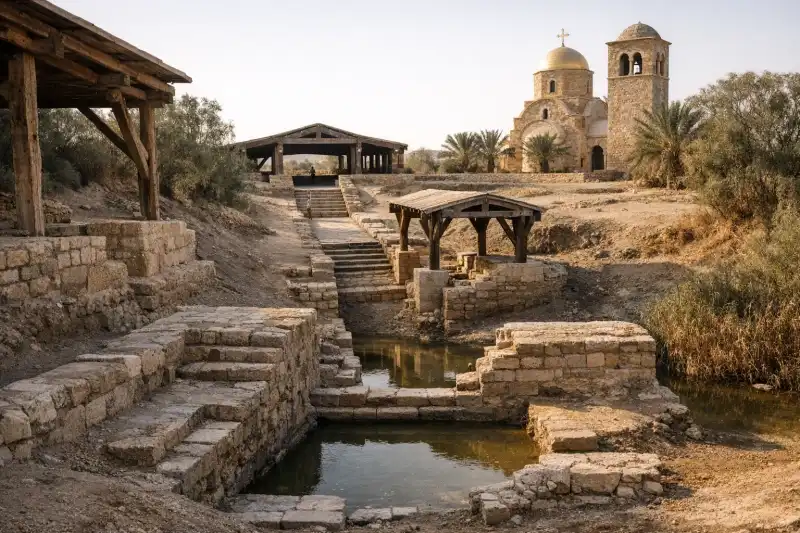
Bethany Beyond the Jordan
Bethany Beyond the Jordan in Jordan is an archaeological and religiously significant site believed t...
Deir Alla
Canaanite, Israelite-era, and regional Levantine culturesExplore Deir Alla in Jordan, an important Jordan Valley archaeological mound linked to Bronze and Ir...