Quick Info
At a glance
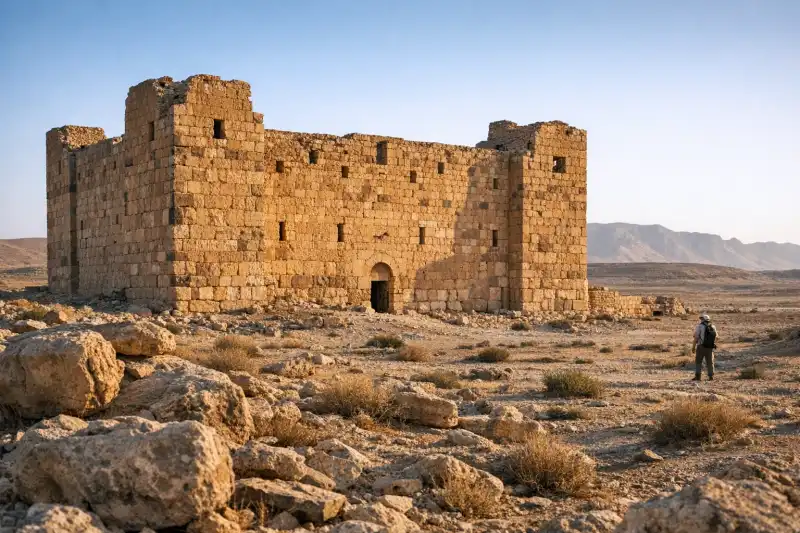
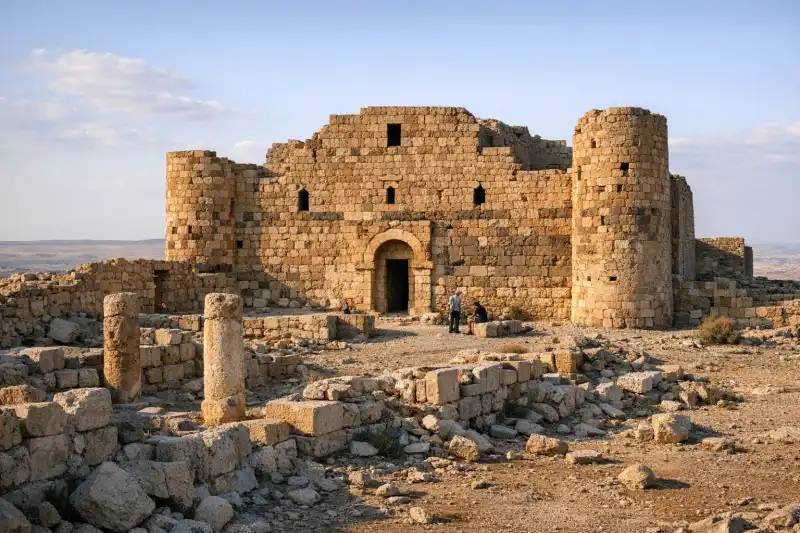
Qasr Bashir in Jordan rises from the steppe with a kind of austere confidence, its square walls and towers still startlingly complete against the pale desert horizon. Unlike the more decorated Umayyad desert palaces that attract many first-time visitors, this monument speaks in the stricter language of the Roman frontier: disciplined geometry, defensive strength, and practical adaptation to a harsh landscape. The fort’s isolation is part of its power. Reaching it, you feel the distances that ancient soldiers once monitored, the open ground they had to watch, and the logistical challenge of sustaining a garrison far from greener, denser centers of settlement.
Known in antiquity as Castra Praetorii Mobeni, Qasr Bashir belongs to the long story of Rome’s eastern defenses, when imperial power depended not only on famous cities and roads but also on small, tough outposts placed where mobility and surveillance mattered most. The fort is compact rather than monumental, but that intimacy is one of its greatest attractions. Visitors can easily read its plan, trace the perimeter, look up at surviving upper sections, and imagine the rhythms of military routine within its courtyard and chambers. For travelers based in Amman, it makes an especially rewarding detour into a less urban, more elemental side of Jordan’s past, where late Roman strategy, desert geography, and remarkable preservation meet in one unforgettable site.
History
Roman frontier strategy in eastern Jordan
Qasr Bashir was built during the late Roman period, most likely in the 4th century CE, when the empire was refining the network of forts, roads, and watchpoints that protected its eastern territories. By this time, Rome had long controlled the former Nabataean kingdom, organized as the province of Arabia after 106 CE. Yet imperial authority in this region was never just a matter of administering cities such as Gerasa, Philadelphia, or Petra. It also depended on securing movement through marginal landscapes, supervising trade routes, and responding quickly to shifting threats in the steppe and desert.
The fort’s ancient name, Castra Praetorii Mobeni, appears in inscriptions and links it to the Roman military system that spread across the arid interior of what is now Jordan. Its location suggests a practical purpose: to anchor control in a sparsely settled zone where patrols, communication, and local alliances mattered as much as direct force. Rather than standing as a massive legionary base, Qasr Bashir was part of a finer-grained frontier fabric. Small forts like this one helped monitor roads, support mounted units, and provide secure staging points in a landscape where exposure and distance could be as dangerous as armed conflict.
Construction and garrison life
The fort was built with a highly regular plan typical of Roman military architecture. Its square enclosure, corner towers, and central courtyard indicate a carefully engineered installation designed for order and efficiency. Inside, soldiers would have found barracks or service rooms arranged around the open center, with storage, accommodation, and controlled access through a defended gateway. The scale implies a relatively modest garrison, perhaps cavalry or light troops suited to rapid movement across the surrounding terrain.
Life at Qasr Bashir would have revolved around discipline and adaptation. Water supply was crucial in this environment, as were fodder, provisions, equipment maintenance, and coordination with other nearby stations. The fort was not an isolated fantasy of stone in the desert; it was a functioning node in a military and administrative network. Messages would have come and gone, patrols would have set out across the steppe, and soldiers would have spent long stretches in routine vigilance broken by moments of urgency. The architecture still conveys this balance between monotony and readiness. Thick walls offered security, but the broader purpose of the fort was outward-looking: to observe, move, and control.
Late antiquity and changing powers
By the later centuries of antiquity, the Roman world in the Near East was undergoing administrative, political, and religious transformations. The eastern provinces continued under Byzantine rule after the division of the empire, but military priorities shifted over time. Some forts remained active, some were adapted, and others lost importance as routes changed or new forms of regional power emerged. Qasr Bashir appears to have had a comparatively short military life, though dating and phases of occupation remain subjects of scholarly discussion.
What makes the site especially valuable is that it captures a specific frontier moment so clearly. It is less a palimpsest of many eras than a strongly preserved example of one type of late Roman installation. That clarity helps historians understand how imperial authorities organized security in the steppe and how architecture responded to strategic needs. Even when active use declined, the fort’s robust masonry allowed much of the structure to endure, preserving details that have disappeared elsewhere.
Rediscovery, archaeology, and modern significance
Modern scholars, travelers, and archaeologists have long taken interest in Jordan’s so-called desert castles and frontier installations. Qasr Bashir stands somewhat apart within this group because it is not primarily a palace, bath complex, or elite retreat. Its significance lies in military preservation. Survey work, inscriptions, and architectural study have confirmed its Roman character and helped place it within the broader limes system of the region.
Today, Qasr Bashir is valued not only as an archaeological monument but also as a site that broadens how visitors understand Jordan. The country’s ancient heritage is often associated with Nabataean grandeur, biblical landscapes, and classical urbanism. Qasr Bashir offers another perspective: the disciplined infrastructure of empire in a hard-edged environment. Its survival allows specialists to study construction techniques, defensive planning, and frontier logistics, while ordinary visitors can still experience the fort in an immediate, visual way. In that sense, the site bridges scholarship and travel beautifully. It rewards those who arrive with historical curiosity, but it also impresses anyone moved by silence, geometry, and the endurance of stone.
Key Features
The most striking feature of Qasr Bashir is its overall preservation. Many Roman forts survive only as foundations or fragmentary walls, requiring imagination and specialist knowledge to reconstruct mentally. Here, by contrast, the basic mass of the fort remains clear at first glance. The square enclosure is still legible, and the corner towers rise enough to give the structure an unexpectedly complete silhouette. In the bright light of Jordan’s steppe, the fort looks almost like a diagram of Roman military design translated into stone.
The entrance is especially evocative. Roman forts were built to control movement, and gateways were among their most important architectural statements. At Qasr Bashir, the surviving portal concentrates the themes of authority and security in one place. Passing through it, even as a modern visitor, you experience the transition from exposed exterior to organized interior. The threshold would once have framed arrivals, departures, sentry duty, and inspection. Its preservation helps turn abstract military history into something physical and immediate.
Inside, the central courtyard gives the fort a surprisingly open feeling. This space would have functioned as the heart of daily activity, a place where men, animals, and supplies circulated under close supervision. Around it, rooms and chambers reveal the practical character of the installation. Though not lavish, these spaces are deeply interesting because they express the Roman habit of structuring life through plan, repetition, and hierarchy. The fort was a machine for order, and its internal layout still communicates that purpose.
The towers are another major highlight. They break the fort’s mass into vertical accents and remind visitors that surveillance was central to its function. From elevated positions, soldiers could have watched the approaches, scanned for movement, and signaled to neighboring points in the defensive network. Even without climbing, the towers help you imagine lines of sight stretching across the steppe. Their presence also lends the fort a dramatic profile, making Qasr Bashir one of the most photogenic military sites in Jordan.
Material and setting are inseparable here. The stonework, weathered but durable, seems entirely at home in the arid landscape. There is little ornamental distraction. Instead, the fort’s beauty comes from proportion, texture, and the contrast between architecture and emptiness. In greener regions, ancient ruins can feel absorbed by later life. At Qasr Bashir, the surrounding land still amplifies its original purpose. The openness explains the need for vigilance; the remoteness explains the need for self-sufficiency. This environmental context is not just a backdrop but part of the monument’s meaning.
Another important feature is how readable the site remains for non-specialists. You do not need to be an archaeologist to understand what you are seeing. The corners define the perimeter, the gateway defines access, the courtyard defines circulation, and the surrounding rooms suggest accommodation and service functions. This clarity makes the fort especially rewarding for independent travelers interested in Roman history but less drawn to museum-style interpretation. Qasr Bashir teaches through space.
The fort also gains significance from its relationship to nearby desert sites. Travelers often combine it with Qasr al-Azraq or Qasr al-Hallabat, yet Qasr Bashir offers a distinct architectural and historical mood. Where other sites in Jordan’s desert circuit may feature later reuse, decorative programs, or more complex occupational histories, this fort feels compact, focused, and unmistakably martial. That contrast enriches a broader itinerary. It shows that Jordan’s eastern heritage is not one single story but a layered archive of Roman, Byzantine, and Islamic presence.
Finally, there is the experiential quality of visiting a place that remains relatively quiet. Qasr Bashir seldom has the crowds found at Jordan’s best-known attractions. That means you can often walk around the site in near silence, hearing only the wind and the crunch of gravel underfoot. Such stillness makes it easier to appreciate scale and function. It also deepens the emotional pull of the place. The fort is not simply an artifact to be checked off an itinerary; it is a setting in which isolation, endurance, and strategic intent still feel present.
Getting There
Qasr Bashir is most commonly visited from Amman, and the simplest option is to hire a private driver or join a day tour focused on Jordan’s desert castles. From central Amman, a private car and driver for a half-day or full-day excursion typically costs around 50 to 100 Jordanian dinars, depending on duration, the number of stops, and whether waiting time is included. Many travelers combine Qasr Bashir with Qasr al-Azraq and Qasr al-Hallabat to make the journey more economical and worthwhile.
Self-driving is also practical if you are comfortable on Jordanian roads. Rental cars in Amman often start around 25 to 40 JOD per day before fuel and insurance. Roads in the region are generally manageable, but signage near smaller archaeological sites can be inconsistent, so offline maps are useful. Fuel costs vary, but for a desert castles loop from Amman, many visitors should budget roughly 8 to 15 JOD in petrol depending on vehicle type and route.
Public transport is the least convenient option. There is no straightforward tourist-oriented bus directly to Qasr Bashir, and reaching it by service taxi or local minibus usually involves multiple changes plus some uncertainty. If you are determined to travel cheaply, you might spend under 10 to 15 JOD on shared transport to the broader area, but you will still likely need to arrange a taxi for the final stretch. Because the site is remote and facilities are limited, most visitors find that a tour, private car, or self-drive plan is far more reliable. Bring water, sun protection, and snacks, as there may be little to purchase nearby.
When to Visit
The best time to visit Qasr Bashir is in spring and autumn, when Jordan’s temperatures are milder and the desert light remains beautiful without becoming punishing. From March to May, the steppe can feel surprisingly pleasant, with cooler mornings, manageable afternoons, and clearer skies that flatter the fort’s pale stone. September through November offers similarly good conditions, especially for travelers combining the site with a wider Jordan itinerary.
Summer visits are possible, but they require planning. Temperatures in the open steppe can become intense, and there is very little shade at the site. If you travel between June and August, aim to arrive early in the morning or later in the afternoon, carry more water than you think you need, and avoid long exposure in the midday sun. Heat can make even a short stop tiring, especially if you are visiting several desert locations in one day.
Winter can be rewarding for photographers and travelers who prefer cooler air, though conditions can feel stark and windy. On some days, cloud cover softens the landscape and gives the fort a more somber, atmospheric quality. The key issue is not heavy tourism but weather comfort. Since Qasr Bashir is an exposed site rather than a sheltered urban monument, wind and chill can affect how long you want to stay.
In any season, the most memorable times are often early morning and late afternoon. The lower sun emphasizes the fort’s geometry, brings out the texture of the masonry, and creates stronger shadows in the towers and gateway. Midday is fine for visibility, but the site’s character is at its best when the light feels angled and dramatic. If photography matters to you, prioritize those edge-of-day hours.
| Quick Facts | Details |
|---|---|
| Location | Eastern Jordan, in the steppe southeast of Amman |
| Ancient name | Castra Praetorii Mobeni |
| Type | Late Roman military fort |
| Period | 4th century CE |
| Civilization | Roman |
| Best base city | Amman |
| Typical visit length | 30–60 minutes |
| Best season | Spring and autumn |
| Access | Best by private car, driver, or organized day tour |
| What to bring | Water, hat, sunscreen, sturdy shoes, offline maps |
Guided tours: worth it?
A guide can be genuinely useful at Qasr Bashir, especially if you want help with transport, timing, tickets, or understanding a large site without losing half the day to logistics.
Best for
- Travelers who want transport, timing, or entry logistics handled
- Short visits where a planned route saves time
When to go self-guided
Go independently if you already have transport and tickets sorted, enjoy moving at your own pace, and are comfortable checking the latest official rules before you arrive.
What I’d avoid
Skip paid tours that bundle unrelated stops you do not actually want. The best option should either save meaningful planning time or add historical context you would miss on your own.
Jordan Desert Castles Tours
Useful when: you want to compare guided formats before deciding
Amman to Desert Castles Day Trip
Useful when: transport or pickup logistics matter
Jordan Roman Sites Tour
Useful when: you want to compare guided formats before deciding
Some tour links are affiliate links, which may earn Ancient Travel a small commission at no extra cost to you. I try to surface options that make practical sense for the site—not just anything bookable.
Frequently Asked Questions
What is Qasr Bashir?
Qasr Bashir is a late Roman military fort in Jordan, also known historically as Castra Praetorii Mobeni, built to guard routes across the eastern steppe.
Where is Qasr Bashir located?
It stands in Jordan’s semi-desert southeast of Amman, in the wider steppe zone associated with the country’s desert castles.
Do I need a guide to visit Qasr Bashir?
A guide is not essential, but hiring a driver or joining a desert castles tour from Amman makes the remote site much easier to reach and understand.
How much time should I spend at Qasr Bashir?
Most travelers spend 30 to 60 minutes exploring the exterior, entrance, courtyard, and surviving architectural details.
Is Qasr Bashir suitable for casual visitors?
Yes, but facilities are limited and the ground can be uneven, so visitors should bring water, sun protection, and sturdy footwear.
What makes Qasr Bashir special?
It is one of the best-preserved Roman forts in Jordan, with impressive walls, corner towers, and a clear plan that helps visitors imagine frontier garrison life.
Nearby Ancient Sites
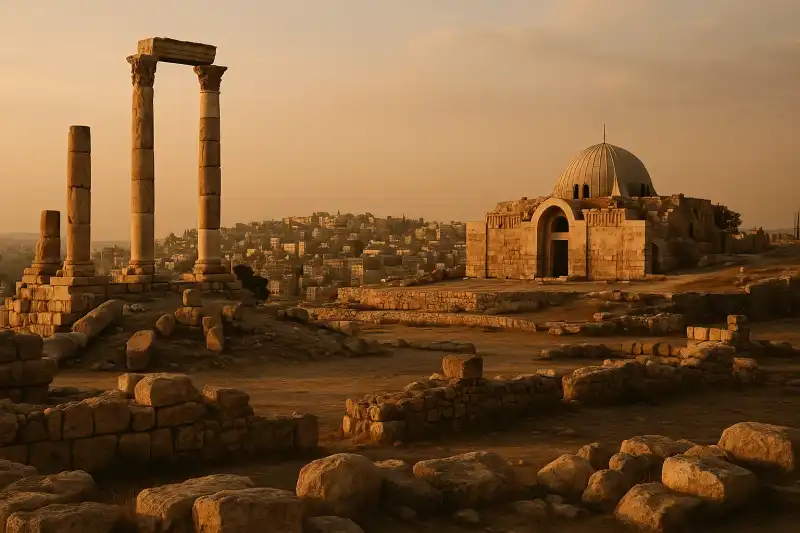
Amman Citadel Jordan Guide 2026: Temple of Hercules & Ancient Rabbah
Ammonite-Roman-UmayyadExplore Jordan's ancient citadel overlooking modern Amman. Discover the Temple of Hercules, Umayyad ...
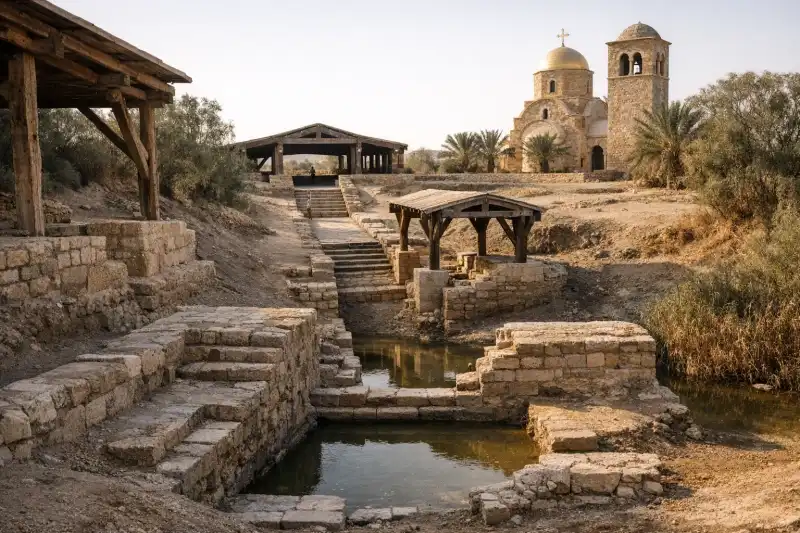
Bethany Beyond the Jordan
Bethany Beyond the Jordan in Jordan is an archaeological and religiously significant site believed t...
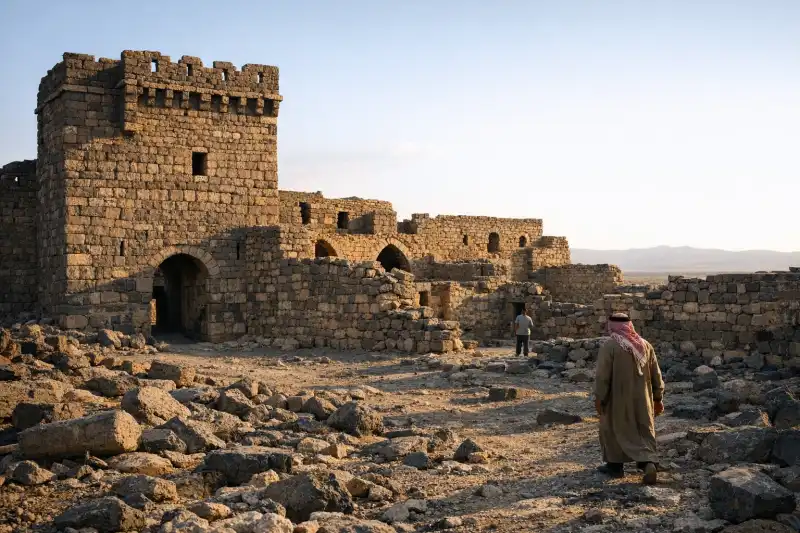
Desert Castles (Qasr al-Azraq)
Roman, Byzantine, Umayyad, OttomanQasr al-Azraq in Jordan is a striking basalt desert castle linked to Roman frontiers, Umayyad rule, ...
Desert Castles (Qasr al-Hallabat)
Roman and UmayyadExplore Qasr al-Hallabat, a striking Umayyad desert castle in Jordan with Roman roots, mosaics, and ...