Quick Info
At a glance
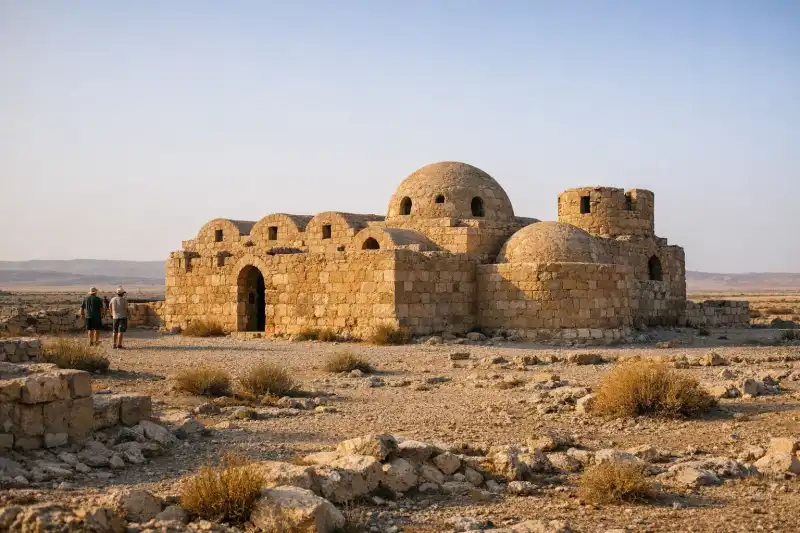
Qasr Hammam As Sarah in Jordan is one of those places that feels larger in atmosphere than in size. Set in the open steppe east of Amman, the site rises quietly from a hard, pale landscape where distance, sky, and silence are as much a part of the experience as the masonry itself. Travelers often come to Jordan for Petra, Jerash, or the Dead Sea, but the country’s eastern desert preserves another layer of history: a chain of early Islamic monuments usually called the desert castles. Within that world, Qasr Hammam As Sarah stands out for its intimacy. It is not a sprawling city ruin or a heavily monumental fortress. Instead, it offers something subtler: the remains of an Umayyad retreat whose bath complex and associated structures hint at comfort, ceremony, and sophisticated design in a place that now seems austere.
Visiting the site today means looking closely. The surviving walls, arches, and stonework reward patient attention, especially if you imagine the movement of water, the ritual of bathing, and the role of elite rural residences in the 8th century. Qasr Hammam As Sarah is often paired with nearby Qasr al-Hallabat, and together they help explain how Umayyad patrons shaped the Jordanian steppe into a network of estates, hunting grounds, agricultural installations, and seasonal residences. What appears isolated now was once connected by politics, roads, labor, and ideas. For travelers interested in archaeology, architecture, and the early Islamic period, this modest ruin can become one of the most memorable stops in Jordan.
History
Umayyad expansion into the Jordanian steppe
Qasr Hammam As Sarah belongs to the Umayyad period, when the caliphate ruled a vast territory stretching from the Iberian Peninsula to Central Asia. In the 7th and early 8th centuries, the Umayyads developed a series of structures across Bilad al-Sham, including present-day Jordan, Syria, Palestine, and surrounding regions. These buildings are often grouped under the popular label of desert castles, though they served many different purposes. Some were agricultural estates, some hunting lodges, some residences, and some administrative or ceremonial centers. Bathhouses were especially important because they reflected both practical and elite cultural needs.
The site appears to have been linked to the nearby complex of Qasr al-Hallabat, one of the most significant Umayyad-period installations in the region. Rather than functioning as an isolated building, Qasr Hammam As Sarah likely formed part of a wider estate landscape. That meant roads, water management systems, cultivated zones, herding routes, and a social hierarchy of patrons, workers, guests, and retainers. Its very location tells an important historical story: the Umayyads did not simply inherit cities, they also invested in marginal landscapes and turned them into meaningful political and cultural spaces.
Construction and use in the 8th century
Most scholars place Qasr Hammam As Sarah in the 8th century CE, during the height of Umayyad building activity. The term “hammam” in the name points to the bath function, and the surviving architecture confirms that bathing was central to the complex. In the early Islamic world, bathhouses were not merely utilitarian. They could serve hygienic, social, and symbolic roles. The inclusion of a bath in a rural or semi-rural retreat signaled refinement and access to resources, especially water and fuel.
Architecturally, the site reflects the blend that characterizes much Umayyad art and building practice. Roman, Byzantine, Sasanian, and local Levantine traditions all informed Umayyad design. In Jordan, that often meant adapting earlier regional construction methods while introducing new decorative tastes and courtly functions. At Qasr Hammam As Sarah, the remains suggest a carefully organized complex rather than improvised shelter. Even in ruin, the proportions and surviving vaults indicate that this was a planned elite environment.
The building probably served members of the Umayyad ruling sphere or regional administrators attached to them. It may have hosted seasonal visits, local oversight, hunting-related activity, and social gatherings. Because bathhouses required operation and maintenance, the site would also have depended on workers familiar with heating systems, water supply, and the upkeep of plastered interiors and stone structures.
Decline after the Umayyads
The Umayyad dynasty fell in 750 CE, replaced by the Abbasids. Political realignment shifted the center of imperial gravity eastward toward Iraq, and many Umayyad rural establishments in greater Syria lost their former prestige or support. Some sites were abandoned quickly; others continued in reduced or altered forms. Qasr Hammam As Sarah likely declined as the networks that sustained it weakened.
Environmental pressures may also have played a role. Any bath complex in a steppe environment depended on stable access to water, labor, and fuel. Once political patronage diminished, maintaining such an installation would have become harder. Over time, roof elements collapsed, decorative finishes disappeared, and the site was stripped back to its structural essentials. Like many archaeological places in Jordan’s open landscapes, it then entered a long afterlife as a ruin, visible but partly forgotten except by local communities and occasional travelers.
Rediscovery, archaeology, and modern appreciation
In modern scholarship, Qasr Hammam As Sarah has gained attention as part of the larger study of Jordan’s Umayyad desert monuments. Archaeologists and architectural historians have examined it not only as an isolated ruin but as a companion site to Hallabat and as evidence of how early Islamic elites organized rural space. Careful recording of masonry, plans, and surviving features has helped scholars reconstruct the layout and likely functions of the complex.
Today the site is appreciated most by travelers interested in Jordan beyond the headline attractions. It rarely receives the crowds seen at Petra or Jerash, and that relative quiet is part of its appeal. Modern visitors encounter it as a fragment of the Umayyad world: a place where power expressed itself through architecture, leisure, and command of resources in an environment that still feels demanding. Its survival, though partial, gives rare insight into the lived texture of elite life in early Islamic Jordan.
Key Features
The most compelling feature of Qasr Hammam As Sarah is the bathhouse itself. Even when only parts of the structure remain, the logic of the plan can still be sensed. Umayyad baths drew on long-established bathing traditions in the eastern Mediterranean and Near East, often organizing rooms in sequence according to temperature and function. As you move through the remains, you can imagine the progression from entrance to changing or reception space, then onward to heated chambers. This arrangement reveals a concern not only for comfort but also for choreography. Bathing was an experience shaped by architecture.
Stone construction dominates the surviving ruin, and the quality of the masonry is one of the reasons the site remains visually striking. In the clear desert light, edges and textures become pronounced. Arches and fragments of vaulting hint at the original enclosed character of the bath spaces. These structural elements matter because they help distinguish the building from simpler utilitarian installations. Qasr Hammam As Sarah was designed with a sense of form and presence. Even stripped of plaster, fittings, and decoration, it conveys a controlled architectural language rooted in elite patronage.
Another notable feature is the site’s relationship to Qasr al-Hallabat. The two are often understood together, and that connection adds interpretive depth to a visit. Hallabat offers the scale of a larger compound, while Hammam As Sarah provides insight into the complementary role of bathing and perhaps more intimate residential or service functions. Seen as parts of one broader estate or coordinated landscape, the sites reveal how Umayyad power worked outside major cities. This was not wilderness in the political sense. It was managed territory, articulated through buildings that balanced utility, status, and retreat.
The setting itself is also a key feature. Qasr Hammam As Sarah sits within Jordan’s basalt-fringed and semi-arid eastern landscape, a zone that can appear empty at first glance. Yet that apparent emptiness is deceptive. Ancient builders selected such locations carefully, often in relation to roads, seasonal movement, water control, or agricultural exploitation. Standing at the site, visitors can appreciate how architecture transformed the steppe into a cultural landscape. The horizon remains broad, the wind often uninterrupted, and the contrast between built stone and open land sharpens the sense of historical distance.
Details visible on site, though modest, can be rewarding for attentive visitors. Wall thicknesses, room proportions, surviving openings, and traces of heating-related arrangements all help explain how the complex worked. Because the ruin is not overloaded with signage or reconstruction, interpretation depends partly on observation and imagination. For some travelers, that makes the experience more engaging. The site invites slow looking rather than checklist tourism.
Photographers also tend to appreciate Qasr Hammam As Sarah for the way low sun picks out the surfaces of the stone. Early morning and late afternoon are especially effective for capturing the ruins against the soft desert tones. Unlike monumental sites where scale overwhelms detail, here the camera can focus on transitions: the curve of an arch, the shadow inside a chamber, the isolated geometry of walls against open sky. It is a site where atmosphere comes from restraint.
Finally, one of its most important features is precisely its relative obscurity. Qasr Hammam As Sarah offers a different model of heritage travel in Jordan. Instead of crowds and spectacle, it provides context, texture, and historical layering. It helps visitors understand the early Islamic period not as an abstract dynasty in a textbook, but as a lived world of estates, baths, movement across landscapes, and architectural ambition in unlikely places.
Getting There
Qasr Hammam As Sarah is usually reached from Amman, which makes the capital the most practical base for a visit. By car, the drive generally takes around 1 to 1.5 hours depending on traffic, route, and whether you combine the trip with nearby Qasr al-Hallabat and other desert castles. A rental car is the simplest option. Daily rental prices in Amman commonly start around 25 to 45 JOD for a basic vehicle, with fuel extra. Roads to the broader desert castle area are generally manageable, but using offline maps is wise because signage can be inconsistent.
A private driver is another convenient choice, especially for travelers who want flexibility without self-driving. From Amman, expect a half-day or full-day private excursion to cost roughly 60 to 120 JOD depending on vehicle type, waiting time, and how many sites are included. Many drivers can build a circuit including Hallabat, Qusayr Amra, and other eastern desert monuments. If you value historical context, a guide can significantly improve the experience, since Qasr Hammam As Sarah is visually subtle and benefits from explanation.
Organized tours from Amman to the desert castles are also widely available. Group day tours often begin around 40 to 80 JOD per person, while private tours may be higher. These are efficient if you do not want to navigate remote areas yourself.
Public transport is the least reliable method. While buses and service taxis can reach parts of Zarqa Governorate, they typically do not deliver visitors directly to the ruins, and onward transport can be difficult. For most travelers, public transit alone is impractical. Bring water, snacks, cash, and sun protection, since facilities near the site can be limited or absent.
When to Visit
The best time to visit Qasr Hammam As Sarah is during spring and autumn, when Jordan’s temperatures are milder and the desert steppe is more comfortable for walking and exploring. In March, April, October, and November, daytime conditions are often pleasant, with enough softness in the light to make photography especially rewarding. Spring can also bring brief touches of green to the wider landscape, which adds contrast to the stone ruins.
Summer visits are possible, but they require planning. From June through August, temperatures in Jordan’s eastern desert can climb sharply by midday. Because shade at the site is minimal, early morning is the safest and most enjoyable time to go. If you visit in summer, carry more water than you think you will need, wear a hat, and avoid relying on nearby services. The ruins are open and exposed, so the heat can feel stronger than it does in urban areas.
Winter offers a different mood. The light can be beautiful, and the site is often quiet, but temperatures may be cool, especially with wind across the steppe. Rain is not constant, yet occasional wet weather can make the landscape feel bleak and the ground uneven in places. A layered jacket is useful from December to February.
In terms of time of day, morning and late afternoon are the clear winners. Midday light tends to flatten architectural details, while lower sun brings out texture in the masonry and creates more dramatic shadows in the surviving chambers. If you are combining Qasr Hammam As Sarah with other desert castles, aim to start early from Amman and build in time for unhurried stops rather than rushing between monuments.
| Quick Facts | Details |
|---|---|
| Location | Eastern Jordan, in Zarqa Governorate |
| Historical Period | Early Islamic, Umayyad |
| Date | 8th century CE |
| Type of Site | Desert palace and bath complex |
| Best Known For | Its Umayyad bathhouse and connection to Qasr al-Hallabat |
| Nearest Major Base | Amman |
| Typical Visit Length | 20 to 45 minutes |
| Best Season | Spring and autumn |
| Access | Best by rental car, private driver, or organized day tour |
| What to Bring | Water, sun protection, sturdy shoes, offline navigation |
Guided tours: worth it?
A guide can be genuinely useful at Qasr Hammam As Sarah, especially if you want help with transport, timing, tickets, or understanding a large site without losing half the day to logistics.
Best for
- First-time visitors who want context, not just photos
- Travelers who want transport, timing, or entry logistics handled
- Short visits where a planned route saves time
When to go self-guided
Go independently if you already have transport and tickets sorted, enjoy moving at your own pace, and are comfortable checking the latest official rules before you arrive.
What I’d avoid
Skip paid tours that bundle unrelated stops you do not actually want. The best option should either save meaningful planning time or add historical context you would miss on your own.
Jordan Desert Castles Tour
Useful when: you want to compare guided formats before deciding
Amman to Desert Castles Day Trip
Useful when: transport or pickup logistics matter
Jordan Umayyad Desert Castles
Useful when: you want to compare guided formats before deciding
Some tour links are affiliate links, which may earn Ancient Travel a small commission at no extra cost to you. I try to surface options that make practical sense for the site—not just anything bookable.
Frequently Asked Questions
What is Qasr Hammam As Sarah?
Qasr Hammam As Sarah is a small Umayyad-period desert complex in eastern Jordan, best known for its bath building and its connection to the broader network of Jordan's so-called desert castles.
Where is Qasr Hammam As Sarah located?
The site lies in Jordan's eastern steppe, in the Zarqa Governorate, not far from Qasr al-Hallabat and within day-trip reach of Amman.
Is Qasr Hammam As Sarah a true castle?
Like many Jordanian 'desert castles,' it is not a medieval fortress in the usual sense. It is better understood as an Umayyad rural retreat or service complex with baths, residential elements, and agricultural or administrative functions.
How much time should I allow for a visit?
Most travelers spend 20 to 45 minutes at the ruins themselves, though a longer stop makes sense if you are combining it with nearby desert castle sites and want time for photography.
Can you visit Qasr Hammam As Sarah independently?
Yes, many visitors go by rental car from Amman. However, because public transport is limited in the eastern desert, an organized day tour or private driver is often the easiest option.
What should I bring when visiting?
Bring water, sun protection, sturdy shoes, and a charged phone or offline map. Services in the area are sparse, and shade at the ruins is limited.
Nearby Ancient Sites
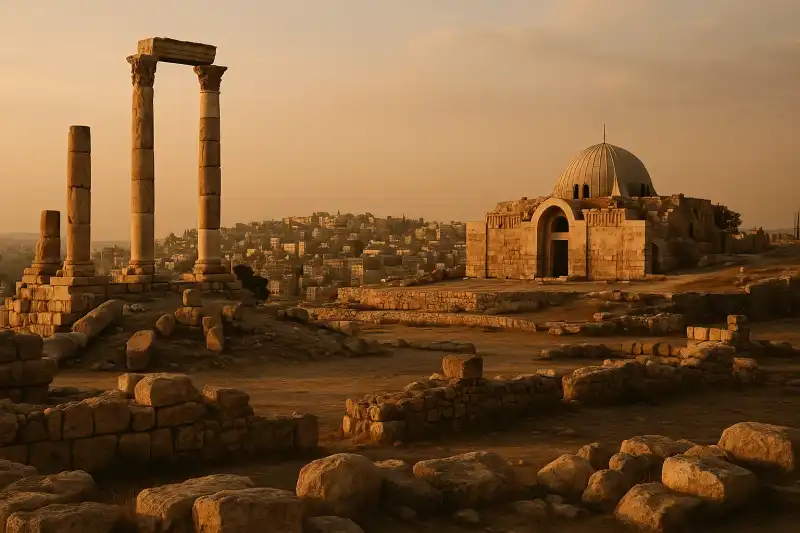
Amman Citadel Jordan Guide 2026: Temple of Hercules & Ancient Rabbah
Ammonite-Roman-UmayyadExplore Jordan's ancient citadel overlooking modern Amman. Discover the Temple of Hercules, Umayyad ...
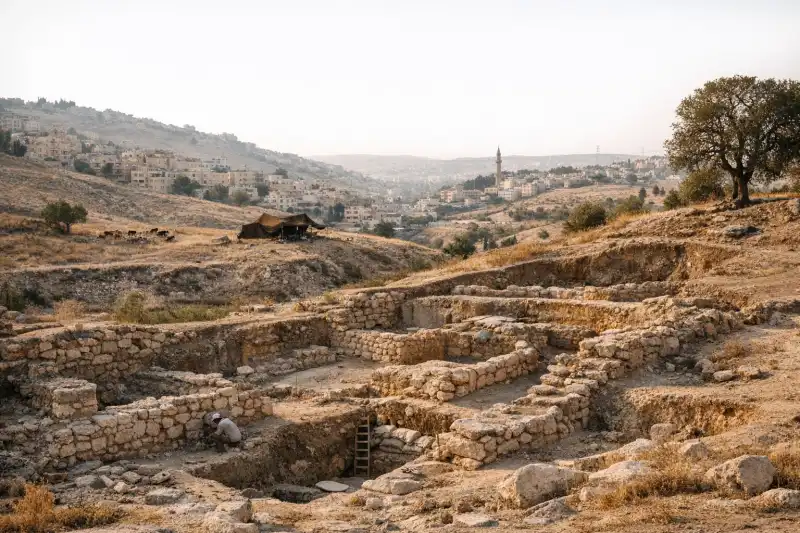
Ain Ghazal
Pre-Pottery Neolithic communities of the LevantDiscover Ain Ghazal, Jordan’s remarkable Neolithic settlement famed for its ancient plaster statues ...
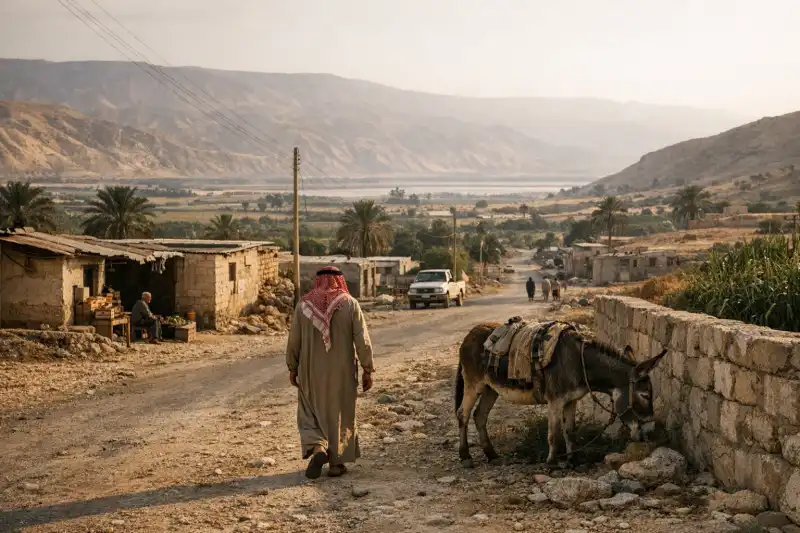
Deir Alla
Canaanite, Israelite-era, and regional Levantine culturesExplore Deir Alla in Jordan, an important Jordan Valley archaeological mound linked to Bronze and Ir...
Bethany Beyond the Jordan
Bethany Beyond the Jordan in Jordan is an archaeological and religiously significant site believed t...