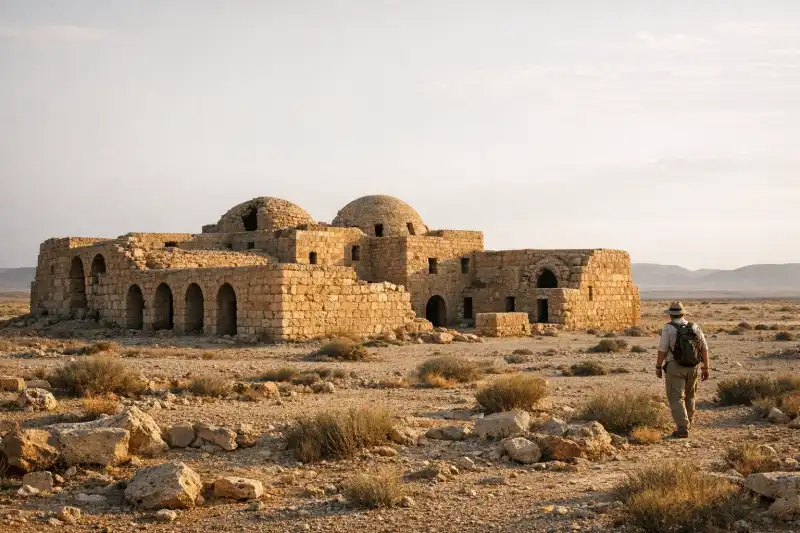
Quick Info
At a glance
Qasr Tuba in Jordan rises from the open desert with the quiet drama of a place half-finished and half-remembered. Far from the urban bustle of Amman and removed even from the more frequently visited desert-castle circuit, this Umayyad complex feels less like a polished monument and more like an encounter with history interrupted. Its broken walls, exposed masonry, and wide emptiness are part of the experience. You do not come here for crowds, elaborate visitor centers, or a tightly curated route. You come for atmosphere, for the sensation of standing where ambition once reached across the steppe and then abruptly stopped.
That unfinished quality is exactly what makes Qasr Tuba so compelling. Many ancient sites present a completed vision softened by erosion. Qasr Tuba instead reveals process: foundations of power, decorative intention, engineering choices, and the marks of a project left incomplete. The palace belongs to the celebrated family of Jordan’s so-called desert castles, yet it has a character all its own. More isolated than many of its peers, it sits in a landscape that underscores the Umayyad desire to project authority, cultivate retreat, and anchor elite life beyond the old urban centers. Visiting today means tracing architecture against silence. The desert wind, the pale stone, and the long horizon all sharpen the sense that this was once meant to be something grand. Even in ruin, Qasr Tuba remains eloquent.
History
Umayyad ambition in the desert
Qasr Tuba was built during the Umayyad period, most likely in the first half of the 8th century CE, when the Umayyad Caliphate governed a vast realm stretching from the Iberian Peninsula to Central Asia. The dynasty’s political center lay in Damascus, but its architectural footprint spread across the Levant in both cities and desert margins. Jordan preserves several of these desert residences, hunting lodges, agricultural estates, and fortified retreats, often grouped together under the convenient label of “desert castles.”
The purpose of these complexes was not singular. They could function as seasonal residences, administrative outposts, symbols of dynastic prestige, rural estates, and places for receiving guests or conducting business away from major cities. In this context, Qasr Tuba was part of a broader pattern of Umayyad patronage that fused practical desert adaptation with elite court culture. Its remote location may seem surprising now, but in the early Islamic period these landscapes were connected by movement, tribal networks, trade, and strategic routes that made the steppe an active frontier rather than a void.
Construction and the unfinished plan
What distinguishes Qasr Tuba most clearly is that it appears never to have been completed. The surviving remains suggest an ambitious rectangular palace with a carefully organized layout and distinctive decorative treatment. Archaeologists and historians generally associate the site with the reign of the Umayyad caliph al-Walid II, who ruled briefly in 743–744 CE and is linked to several desert palaces in the region. Whether he initiated the project directly or inherited it within a broader building program, Qasr Tuba seems to belong to the final phase of Umayyad royal construction.
Its fabric shows the intention to combine rough local stone with more refined decorative masonry, creating visual contrast on the exterior. Some of the carved or dressed elements point to a sophisticated aesthetic that drew on late antique, Byzantine, Sasanian, and emerging Islamic artistic traditions. Yet the palace did not reach a fully realized state. Sections remained incomplete, and the overall plan was never finished to the degree seen at some other elite complexes.
The reason for this halt is almost certainly political. In 744 and the years immediately after, the Umayyad state entered a period of escalating instability. Internal succession struggles weakened the dynasty, and by 750 the Abbasid Revolution ended Umayyad rule in the central Islamic lands. A building project dependent on caliphal patronage, labor organization, and supply lines would have been highly vulnerable in such conditions. Qasr Tuba may therefore preserve, in architectural form, the very moment when Umayyad authority unraveled.
After the Umayyads
Following the fall of the Umayyads, many desert palaces lost their original role. Some continued to be used in altered ways; others declined, were quarried, or simply stood abandoned as routes and political priorities changed. Qasr Tuba’s remoteness likely contributed both to its neglect and to its survival. Without sustained reuse or intensive rebuilding, the site gradually entered the long afterlife of ruin.
Environmental conditions shaped this process. The desert climate helped preserve parts of the masonry, but exposure, seismic activity, and the collapse of unfinished sections all altered the original appearance. Over centuries, the palace became less a functioning residence than an archaeological record of interrupted construction. Fragments of decoration, wall alignments, and surviving elevations now tell a story that later historical occupation never fully erased.
Modern study and heritage value
Modern scholarly interest in Jordan’s desert castles brought Qasr Tuba into wider historical discussion. Researchers recognized it as a crucial example of late Umayyad architecture, particularly because it captures a building phase rather than only a completed result. For historians of early Islamic art and architecture, that matters enormously. Qasr Tuba reveals planning methods, structural priorities, and decorative intentions in a way that polished monuments sometimes obscure.
Today the site is valued not simply as an isolated ruin, but as part of a network that illuminates early Islamic statecraft in Jordan. It helps explain how the Umayyads engaged with the desert landscape and how they used architecture to express prestige, leisure, and control. Its unfinished state, once perhaps a sign of failure, has become one of its greatest interpretive strengths. Qasr Tuba is a reminder that history is often preserved not only in what was completed, but in what was interrupted.
Key Features
The first thing many visitors notice at Qasr Tuba is the sheer scale suggested by the surviving footprint. Even in ruin, the complex communicates ambition. The outline of the palace, with its rectilinear planning and enclosed spaces, reflects the formal vocabulary of Umayyad elite architecture. Yet unlike more restored or compact sites, Qasr Tuba feels expansive and open-ended, as though the landscape has flowed back into the building. This creates a vivid sense of archaeology in situ rather than architecture separated from its environment.
Its masonry is among the site’s most striking qualities. Builders used local stone in combination with more refined worked blocks, creating both structural solidity and decorative contrast. This was not a purely utilitarian desert installation. It was meant to impress. Surviving details suggest a carefully considered exterior treatment, with visual rhythms that would have animated the long façade. Even fragments can convey the refinement intended for the finished palace. The juxtaposition of rougher walling and better-cut stone offers insight into Umayyad design choices and construction logistics in a remote setting.
The plan itself appears to have followed the broad logic seen in other desert residences: a fortified-looking outer form containing more private and ceremonial internal spaces. At Qasr Tuba, however, the incompleteness of the structure allows visitors to read the anatomy of the building more directly. Instead of seeing only finished surfaces, you see transitions, breaks, and clues to how the palace was assembled. Walls stop where expansion may have continued. Architectural relationships remain visible in raw form. For anyone interested in building history, that is one of the site’s greatest pleasures.
Another important feature is the atmosphere of isolation. This is not a decorative accessory to the monument; it is central to its meaning. Qasr Tuba’s desert setting helps explain why the Umayyads built places like this at all. The open steppe offered seclusion, hunting grounds, access to tribal territories, and a stage on which caliphal power could be displayed outside older urban frameworks. Standing amid the ruins, you can imagine the palace not as an anomaly but as a deliberate intervention in a landscape that held strategic and social significance.
The site also offers a useful comparison point within Jordan’s broader desert-castle tradition. Visitors familiar with better-known complexes may recognize common themes: enclosure, royal or aristocratic residence, and artistic experimentation shaped by multiple cultural influences. But Qasr Tuba’s unfinished condition makes those themes feel less settled and more dynamic. It preserves intention more than completion, blueprint more than final polish. That lends the ruins a particular poignancy.
Small details matter here. The texture of stone under changing light, the geometry of remaining walls, and the contrast between human design and desert space all reward slow observation. Morning and late-afternoon visits can be especially beautiful, when shadows emphasize the surviving massing of the structure. Photographers often appreciate how the ruin sits low yet confidently on the land, neither dominating the desert nor disappearing into it.
Perhaps the most distinctive “feature” of Qasr Tuba is interpretive openness. Because so much was left incomplete, visitors are invited to imagine the palace in different stages: as a worksite, as a nearly realized royal retreat, and as the ruin it eventually became. Few sites so effectively embody all three conditions at once. That layered identity gives Qasr Tuba an intellectual appeal beyond its visual one. It is a place where architecture, politics, and landscape remain visibly entangled.
Getting There
Qasr Tuba is reached most easily from Amman, but this is not a casual urban excursion. The site lies in Jordan’s eastern desert, and the journey usually requires a private car, hired driver, 4x4 in some conditions, or a customized desert-castles tour. Public transportation does not typically provide a practical direct route to the ruins. If you are based in Amman, the drive can take roughly 2.5 to 3.5 hours each way depending on route, road conditions, and stops.
A private taxi or hired driver from Amman is the simplest option for independent travelers. Expect a full-day hire to vary widely, but a realistic range is about 70 to 140 Jordanian dinars depending on vehicle type, waiting time, and whether other desert sites are included. Negotiating the itinerary in advance is wise. Some drivers know the desert-castle circuit well, while others may need precise directions or GPS coordinates.
Organized day tours focusing on Jordan’s desert castles can also be a convenient choice, especially if you want historical context and fewer logistical worries. Prices vary by group size and comfort level, but many private tours from Amman start around 90 to 180 dinars per person for small groups, with transport included. Always confirm whether Qasr Tuba is specifically on the itinerary, as not every desert-castle tour goes this far.
If self-driving, rent a reliable vehicle in Amman and fill up before leaving populated areas. Daily car rental can start around 25 to 45 dinars for a standard vehicle, not including fuel. Carry water, snacks, and offline navigation, as services near the site are sparse. The remoteness is part of the appeal, but it means preparation is essential.
When to Visit
The best time to visit Qasr Tuba is generally during spring and autumn, when Jordan’s desert climate is at its most manageable. From March to May, temperatures are often warm rather than punishing, and the light can be especially clear. This season makes walking around exposed ruins much more comfortable, especially if you plan to combine Qasr Tuba with other sites on a long day trip. Autumn, particularly from October to November, offers similarly favorable conditions with cooler mornings and pleasant afternoons.
Summer visits are possible, but they require care. From June through August, daytime temperatures in the eastern desert can become intense, and there is little natural shade at the site. If traveling in summer, aim to arrive early in the morning, bring more water than you think you need, and avoid extended time in direct sun around midday. Heat exposure can turn a fascinating visit into an exhausting one very quickly.
Winter has its own advantages. The desert can be beautiful under soft winter light, and visitor numbers are usually low. However, mornings and evenings may be cold, winds can be sharp, and weather can shift unexpectedly. Rain is less common than in western Jordan but should not be ignored, especially if road conditions become uncertain.
For photography, early morning and late afternoon are ideal year-round. The angled light emphasizes the texture of the stonework and the subtle topography of the site. Midday light tends to flatten details. Whenever you go, try to avoid rushing. Qasr Tuba is less about ticking off a famous landmark and more about absorbing the mood of a remote monument whose silence is part of its historical force.
| Quick Facts | Details |
|---|---|
| Site name | Qasr Tuba |
| Location | Eastern desert, Amman Governorate, Jordan |
| Historical period | Early Islamic period |
| Civilization | Umayyad Caliphate |
| Date | 8th century CE |
| Type | Desert palace / desert castle |
| Known for | Unfinished Umayyad architecture and remote desert setting |
| Best base | Amman |
| Suggested visit length | 45 minutes to 1.5 hours |
| Best seasons | Spring and autumn |
| Access | Best by private car, driver, or organized tour |
| What to bring | Water, sun protection, sturdy shoes, offline maps |
Guided tours: worth it?
A guide can be genuinely useful at Qasr Tuba, especially if you want help with transport, timing, tickets, or understanding a large site without losing half the day to logistics.
Best for
- First-time visitors who want context, not just photos
- Travelers who want transport, timing, or entry logistics handled
- Short visits where a planned route saves time
When to go self-guided
Go independently if you already have transport and tickets sorted, enjoy moving at your own pace, and are comfortable checking the latest official rules before you arrive.
What I’d avoid
Skip paid tours that bundle unrelated stops you do not actually want. The best option should either save meaningful planning time or add historical context you would miss on your own.
Jordan Desert Castles Day Tours
Useful when: you want to compare guided formats before deciding
Amman to Desert Castles Private Tour
Useful when: you want flexible timing or a private guide
Jordan Archaeology and Historic Sites Tours
Useful when: you want to compare guided formats before deciding
Some tour links are affiliate links, which may earn Ancient Travel a small commission at no extra cost to you. I try to surface options that make practical sense for the site—not just anything bookable.
Frequently Asked Questions
What is Qasr Tuba?
Qasr Tuba is an unfinished Umayyad desert palace in eastern Jordan, built in the early 8th century and associated with the wider network of Jordan’s desert castles.
Where is Qasr Tuba located?
Qasr Tuba stands in Jordan’s eastern desert, within the administrative area of Amman Governorate, far from major towns and usually reached by private vehicle or specialist tour.
Can you visit Qasr Tuba independently?
Yes, but conditions are remote and services are limited. Most visitors find it easier and safer to go with a driver, guide, or organized desert-castles excursion from Amman.
How much time should I allow for a visit?
Allow around 45 minutes to 1.5 hours at the site itself, plus substantial travel time from Amman depending on road conditions and whether you combine it with other desert sites.
What should I bring to Qasr Tuba?
Bring water, sun protection, sturdy shoes, snacks, a charged phone, and cash for transport needs. There are few facilities nearby, so self-sufficiency is important.
Why is Qasr Tuba important?
The site is important for understanding Umayyad architecture, elite desert residences, and the transition of early Islamic building traditions in the Levant.
Nearby Ancient Sites
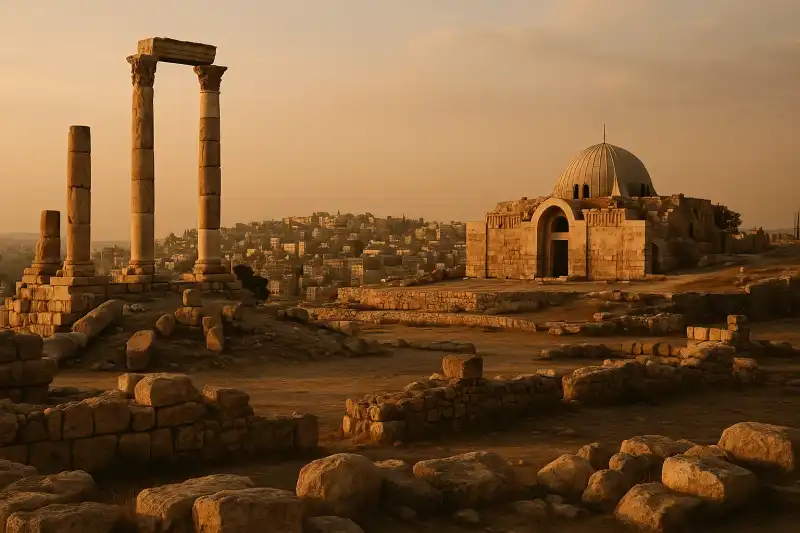
Amman Citadel Jordan Guide 2026: Temple of Hercules & Ancient Rabbah
Ammonite-Roman-UmayyadExplore Jordan's ancient citadel overlooking modern Amman. Discover the Temple of Hercules, Umayyad ...
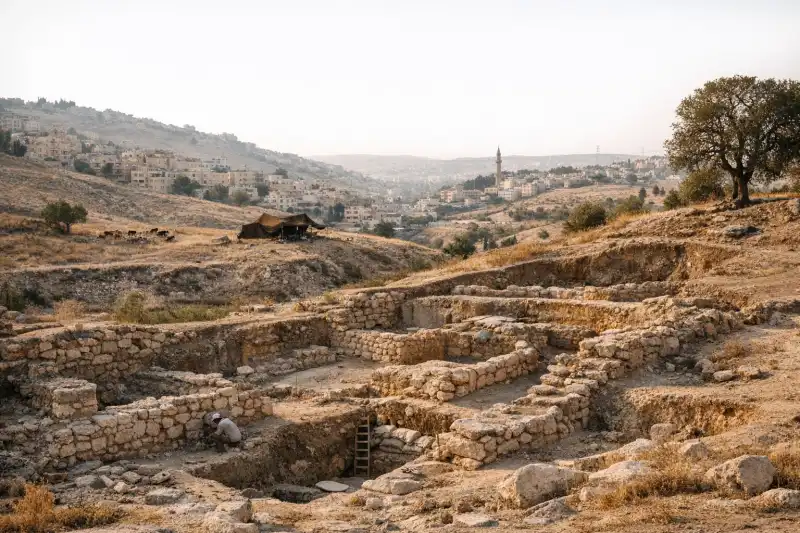
Ain Ghazal
Pre-Pottery Neolithic communities of the LevantDiscover Ain Ghazal, Jordan’s remarkable Neolithic settlement famed for its ancient plaster statues ...
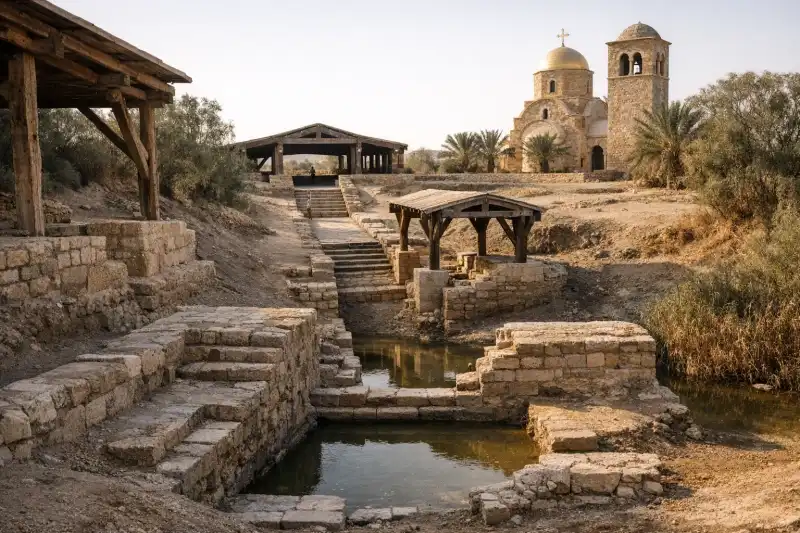
Bethany Beyond the Jordan
Bethany Beyond the Jordan in Jordan is an archaeological and religiously significant site believed t...
Deir Alla
Canaanite, Israelite-era, and regional Levantine culturesExplore Deir Alla in Jordan, an important Jordan Valley archaeological mound linked to Bronze and Ir...