Quick Info
Curated Experiences
Sanxingdui Museum & Ruins Day Tour from Chengdu
Sanxingdui and Dujiangyan Combo Tour
Private Sanxingdui Ruins Archaeological Tour
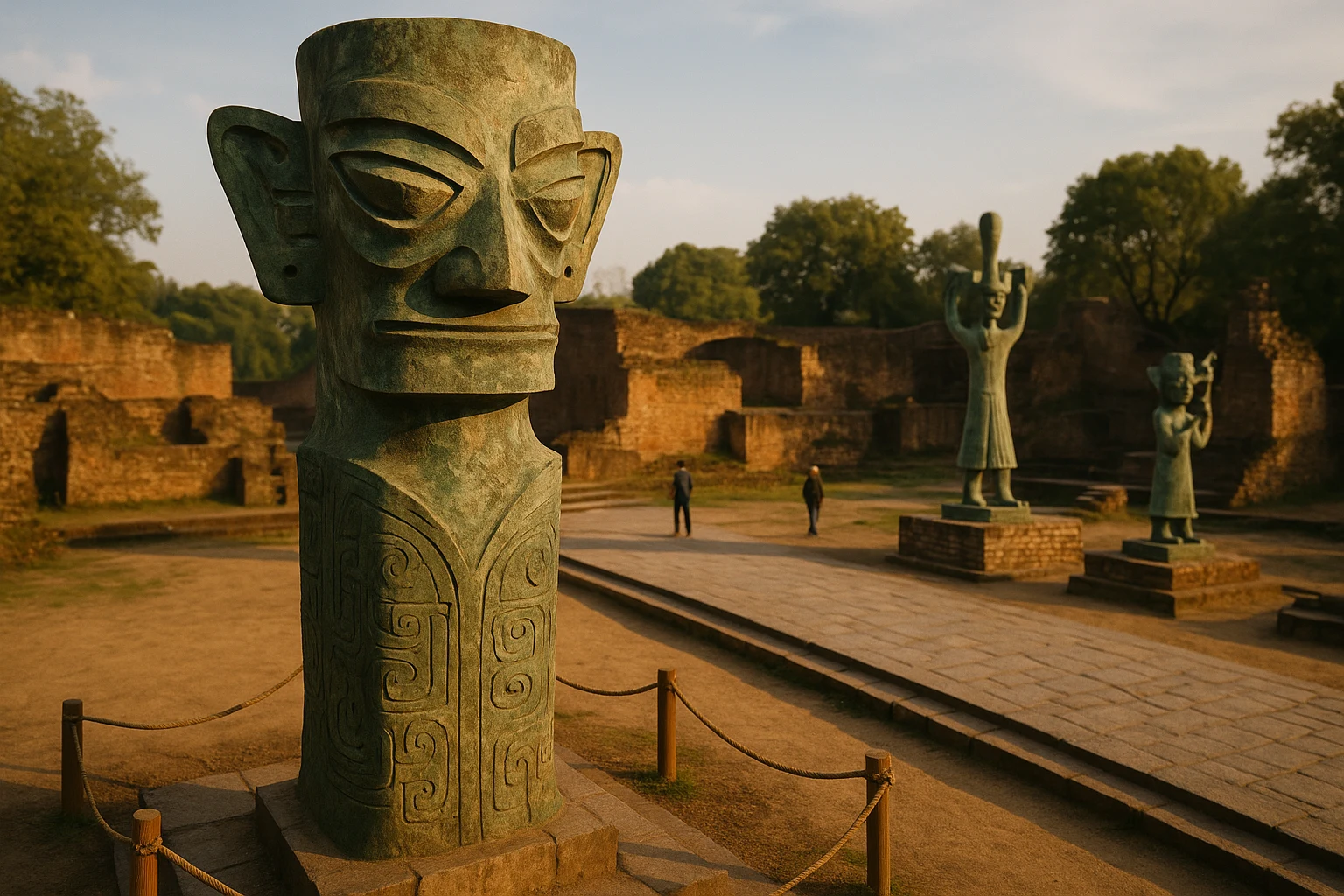
Deep in the Chengdu Plain of Sichuan province, China, an archaeological site sits quietly beside the Mamu River and quietly overturns everything historians thought they knew about ancient Chinese civilization. The Sanxingdui Ruins — whose name translates loosely as “Three Star Mounds” — preserve the remains of a Bronze Age city that flourished for centuries, then vanished from history without a trace, leaving behind no written records, no explanatory myths, and no obvious descendants. What it did leave behind stunned the world: a cache of bronze artifacts so technically sophisticated, so iconographically alien, and so aesthetically unlike anything produced by the contemporaneous Shang Dynasty that scholars still struggle to account for them. Giant masks with bulging cylindrical eyes stare out from museum cases. Sacred bronze trees over four metres tall branch into elaborate tiers hung with birds and fruit. Gold foil covers ritual objects shaped like nothing found anywhere else in the ancient world. Sanxingdui does not simply add a chapter to Chinese history; it complicates the entire narrative, suggesting that Bronze Age China contained multitudes — parallel civilizations developing in artistic and spiritual directions that only chance discovery has allowed us to glimpse.
History
Discovery and First Excavations
The modern story of Sanxingdui begins not in an archaeologist’s office but in a farmer’s field. In 1929, a local farmer digging an irrigation ditch near Guanghan struck a cache of jade and stone objects, and the find circulated quietly among collectors for years without prompting systematic investigation. It was not until 1934 that the Huayang County Museum conducted the first formal excavations, uncovering pottery and stone artifacts that hinted at something unusual beneath the plain. World War Two and the subsequent decades of political upheaval pushed the site to the margins of Chinese archaeological attention.
The 1986 Breakthrough
Everything changed in the summer of 1986. Workers at a local brick factory accidentally broke into two large sacrificial pits within the ancient city boundaries. Archaeologists rushed to the scene and excavated more than a thousand bronze, gold, jade, and ivory objects from these pits — artifacts of a quality and strangeness that instantly made international headlines. The bronzes were unlike anything in the established canon of Shang or Western Zhou art: a standing human figure nearly two metres tall with oversized hands; masks with ears that extended horizontally beyond human proportion; a sacred tree bristling with birds on every branch. The two pits had clearly been deliberately filled — the objects had been broken or burned before burial, suggesting some kind of ritual destruction — but the identity of the people who performed these rites remained entirely mysterious.
The Shu Kingdom Connection
The Sanxingdui culture is now broadly associated with the ancient Shu Kingdom that Chinese historical texts mention only in passing and in terms tinged with the fantastical. Classical sources describe the Shu people as living in isolation from the Central Plains civilization of the Yellow River valley, ruled by semi-legendary kings with names like Silkworm Mulberry and Fisherman. Sanxingdui suggests these descriptions were grounded in real difference: here was a literate-adjacent culture that chose not to write, a Bronze Age society of formidable technical skill that oriented its artistic energy toward ritual and religion rather than court record-keeping. The city that surrounded the sacrificial pits covered roughly twelve square kilometres and was enclosed by massive earthen walls, indicating a politically organized society of considerable size.
New Pits and Twenty-First Century Revelations
Excavation continued in subsequent decades, and the revelations have accelerated into the 2020s. Between 2020 and 2023, archaeologists opened six additional sacrificial pits and recovered thousands of additional artifacts, including an extraordinary bronze altar adorned with figures, more sacred trees, and objects inlaid with turquoise. Crucially, some pit contents were found to overlap in type and date with artifacts from the contemporaneous Jinsha site in Chengdu, suggesting that Sanxingdui’s culture did not simply end but possibly migrated or transformed rather than disappearing entirely. Carbon dating places the main sacrificial pits between roughly 1200 and 1000 BCE, meaning they postdate the city’s apparent height — whatever event caused the ritual burning and burying of the bronzes remains one of archaeology’s most compelling unsolved questions.
Key Features
The Bronze Masks and Standing Figure
The objects that define Sanxingdui in the public imagination are its bronze masks. The largest, known as the Grand Mask, measures 138 centimetres wide and 85 centimetres tall, with eyes that project outward in dramatic cylindrical forms unlike any naturalistic human face. Scholars have proposed that the exaggerated eyes represent divine sight, or supernatural perception, or perhaps a specific ruler or deity of the Shu religious tradition. A separate category of mask features dramatically flared ears and a mouth fixed in what looks like a ritual smile. Alongside the masks stands the celebrated bronze standing figure — a nearly two-metre human form with hands shaped into wide, clasping circles that once held some organic object (ivory or a ceremonial staff, most likely) now lost to decomposition. The figure’s costume is rendered in meticulous detail, its layered robes displaying motifs that recur across Sanxingdui’s decorative vocabulary.
The Sacred Bronze Trees
Among the most technically astonishing finds are the sacred bronze trees, of which Tree Number One is the largest: at 3.96 metres in height (its top portion remains missing), it would have stood well over four metres complete. The tree is cast in sections and assembled on a base decorated with coiling dragons. Its three tiers of branches each support birds perched at their tips, and from the branches hang stylized fruits, bells, and chains. A dragon coils down the trunk. The sacred tree motif recurs in later Chinese mythology — the Fusang tree of the eastern sea, where ten suns roost — but Sanxingdui’s trees are far older than any surviving text describing these myths, suggesting the symbols predate the stories.
Gold Foil Objects and the Gold Staff
Gold at Sanxingdui appears in forms that further emphasize the culture’s distinctiveness from contemporaneous Central Plains civilization, which used bronze as its primary prestige material and reserved gold for modest ornament. At Sanxingdui, a hollow gold staff nearly 1.4 metres long and sheathed in gold foil was found in Pit One, decorated with incised images of fish, birds, and human heads. A separate gold face mask, likely applied over a bronze backing, is so thin and precisely worked that it challenges assumptions about the technical limits of Bronze Age metalworking. Gold foil covered the eyes of certain bronze heads, possibly to activate their divine sight for ritual purposes.
The Excavation Pits and Museum Buildings
The Sanxingdui Museum consists of two major buildings — the original structure opened in 1997, which houses Pit One and Pit Two finds, and an ambitious new crescent-shaped museum building opened in 2023 that was designed specifically to display the six new pits discovered from 2020 onward. The new building allows visitors to view ongoing excavation work through glass panels, making the site unusual among the world’s great archaeological museums in offering genuine live science rather than simply finished display. The outdoor area surrounding the museum includes reconstructed city wall sections and walking paths across the broader site.
Getting There
The most practical base for visiting Sanxingdui is Chengdu, Sichuan’s capital, which sits approximately 40 kilometres to the south and is served by an international airport with connections to most major Chinese cities and several international hubs.
From Chengdu’s Xindu or Chengdu North railway stations, high-speed trains reach Guanghan Station in roughly 20 minutes, with tickets typically priced at 15–20 RMB (around US $2). From Guanghan Station, metered taxis to the Sanxingdui Museum cost approximately 15–20 RMB and take 10 minutes. Several tour operators run direct shuttle buses from Chengdu’s Xinnanmen Bus Terminal that drop visitors at the museum entrance; these typically depart in the morning and cost 30–50 RMB one way.
Renting a car or booking a private driver from Chengdu is a popular option for visitors combining Sanxingdui with Dujiangyan or other sites in a single day. The drive from central Chengdu takes 40–60 minutes depending on traffic. Ride-hailing services via the DiDi app are also available from Guanghan and represent a convenient alternative to taxis. The museum has a large free car park for self-drivers.
Admission to the museum costs 90 RMB (approximately US $12) per adult. The museum is open Tuesday through Sunday from 8:00 AM to 6:00 PM; it is closed on Mondays except during national holiday periods. Audio guides in English are available at the entrance counter.
When to Visit
Sichuan’s climate is shaped by the Sichuan Basin’s tendency to trap moisture and haze, giving Chengdu and the surrounding plain a reputation for cloudy, humid days even in what would elsewhere be considered summer. Sanxingdui’s museum is indoors and therefore largely weather-independent, but the surrounding outdoor areas benefit considerably from drier conditions.
Spring (March–May) brings mild temperatures between 14 and 22 degrees Celsius, green fields around the site, and moderate crowds. This is arguably the most pleasant season: comfortable for both the outdoor sections and the long museum walks, and before the summer peak in domestic tourism.
Summer (June–August) is hot and humid, with temperatures regularly reaching 32–35 degrees Celsius and frequent afternoon thunderstorms. The outdoor elements of the site become uncomfortable between 11 AM and 4 PM, though the air-conditioned museum buildings provide relief. Summer coincides with Chinese school holidays and sees the highest visitor numbers.
Autumn (September–November) mirrors spring in its comfortable temperatures and is generally considered the ideal window for visiting, with harvest-season light and thinner crowds after the summer rush subsides. October’s Golden Week national holiday (1–7 October) is an exception — visitor numbers spike dramatically and advance ticket booking is strongly advised.
Winter (December–February) is cool and frequently foggy, with temperatures around 5–10 degrees Celsius. The outdoor areas lose some appeal, but museum visits are entirely pleasant, crowds are minimal, and accommodation in Chengdu reaches its lowest prices of the year.
| Quick Facts | |
|---|---|
| Location | Guanghan, Sichuan province, China |
| Coordinates | 30.9964° N, 104.1833° E |
| Civilization | Sanxingdui Culture / Ancient Shu Kingdom |
| Period | c. 1700–1100 BCE |
| Site Type | Ancient city ruins with museum |
| Admission | 90 RMB (~US $12) |
| Opening Hours | Tue–Sun, 8:00 AM – 6:00 PM |
| Nearest City | Guanghan (10 min); Chengdu (40–60 min) |
| Language | Mandarin Chinese; English audio guides available |
| Best Season | Spring (Mar–May) or Autumn (Sep–Nov) |
| UNESCO Status | Candidate; national protection at highest level |
Few places in the world deliver the particular sensation that Sanxingdui produces: the feeling that something enormous has been hiding in plain sight, that the past is far stranger and more varied than the stories we inherited about it. The Shang kings of the Yellow River valley were not the only sophisticated civilization of Bronze Age China — they were simply the one whose written records survived. Sanxingdui speaks in a different register entirely, through the mute eloquence of its staring bronze faces, through trees cast in metal to hold up a sky no one can now name, through gold-sheathed eyes still watching after three thousand years. To walk through the museum’s great halls is to confront the productive discomfort of genuine mystery — the kind that does not resolve neatly into meaning but instead opens outward, reframing what you thought you understood about human history and the civilizations that shaped it.
Frequently Asked Questions
Where is Sanxingdui located?
Sanxingdui is located near the city of Guanghan in Sichuan province, approximately 40 kilometres north of Chengdu. The site and its associated museum sit beside the Mamu River in the Chengdu Plain.
What was discovered at Sanxingdui?
Excavations have uncovered thousands of extraordinary bronze artifacts including towering sacred trees, enormous ritual masks with protruding eyes, gold foil objects, jade blades, elephant tusks, and pottery. The finds suggest a highly sophisticated Bronze Age civilization with no known parallels in ancient China.
How old is the Sanxingdui civilization?
The Sanxingdui culture is estimated to have flourished between approximately 1700 and 1100 BCE, placing it in China's Bronze Age and broadly contemporaneous with the Shang Dynasty. The site itself may have been occupied for several centuries before its culture abruptly vanished.
Is Sanxingdui a UNESCO World Heritage Site?
Sanxingdui is not yet officially inscribed as a UNESCO World Heritage Site, though China has submitted it as a candidate. The site is recognized as one of the most significant archaeological discoveries of the twentieth century and holds the highest level of national cultural heritage protection in China.
How do I get from Chengdu to Sanxingdui?
From Chengdu, high-speed trains run to Guanghan station in approximately 20 minutes, from where taxis or shuttle buses reach the museum in about 10 minutes. Alternatively, direct tourist buses depart from Chengdu's Xinnanmen Bus Station. The total journey typically takes 45–60 minutes.
How long should I plan to spend at Sanxingdui?
Allow a minimum of three hours for the museum alone, and four to five hours if you want to walk the outdoor excavation zone and surrounding park. The two museum buildings are large and the artifact collections dense, rewarding slow, attentive visits.
What is the Sanxingdui Museum admission fee?
As of 2025, the Sanxingdui Museum charges 90 RMB (approximately US $12) for general admission. Audio guides are available for an additional fee. The site occasionally offers free admission on national holidays, and Chinese citizens over 60 receive discounts.
Nearby Ancient Sites
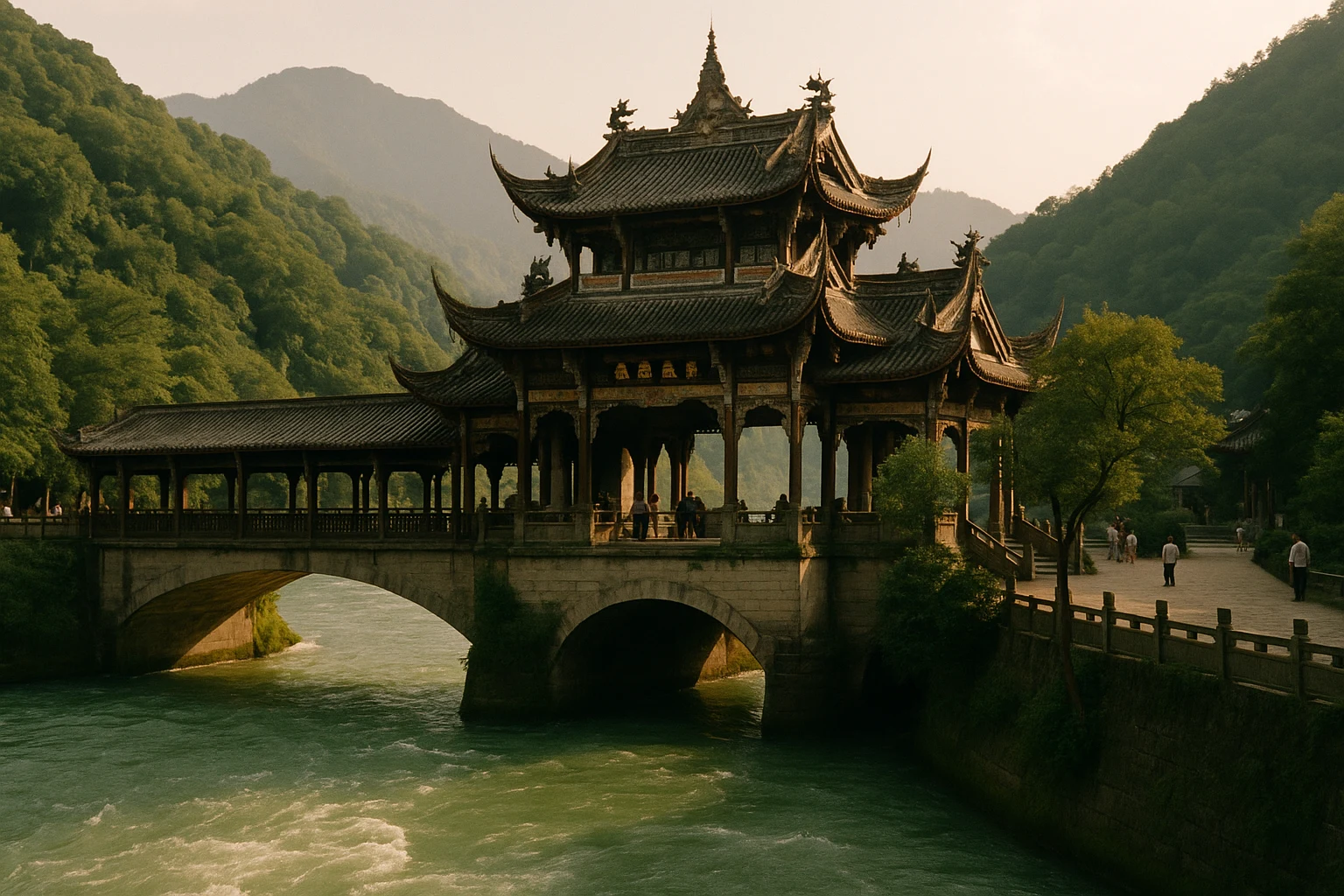
Dujiangyan Irrigation System
Explore Dujiangyan, the world's oldest functioning irrigation system, built in 256 BCE by engineer L...
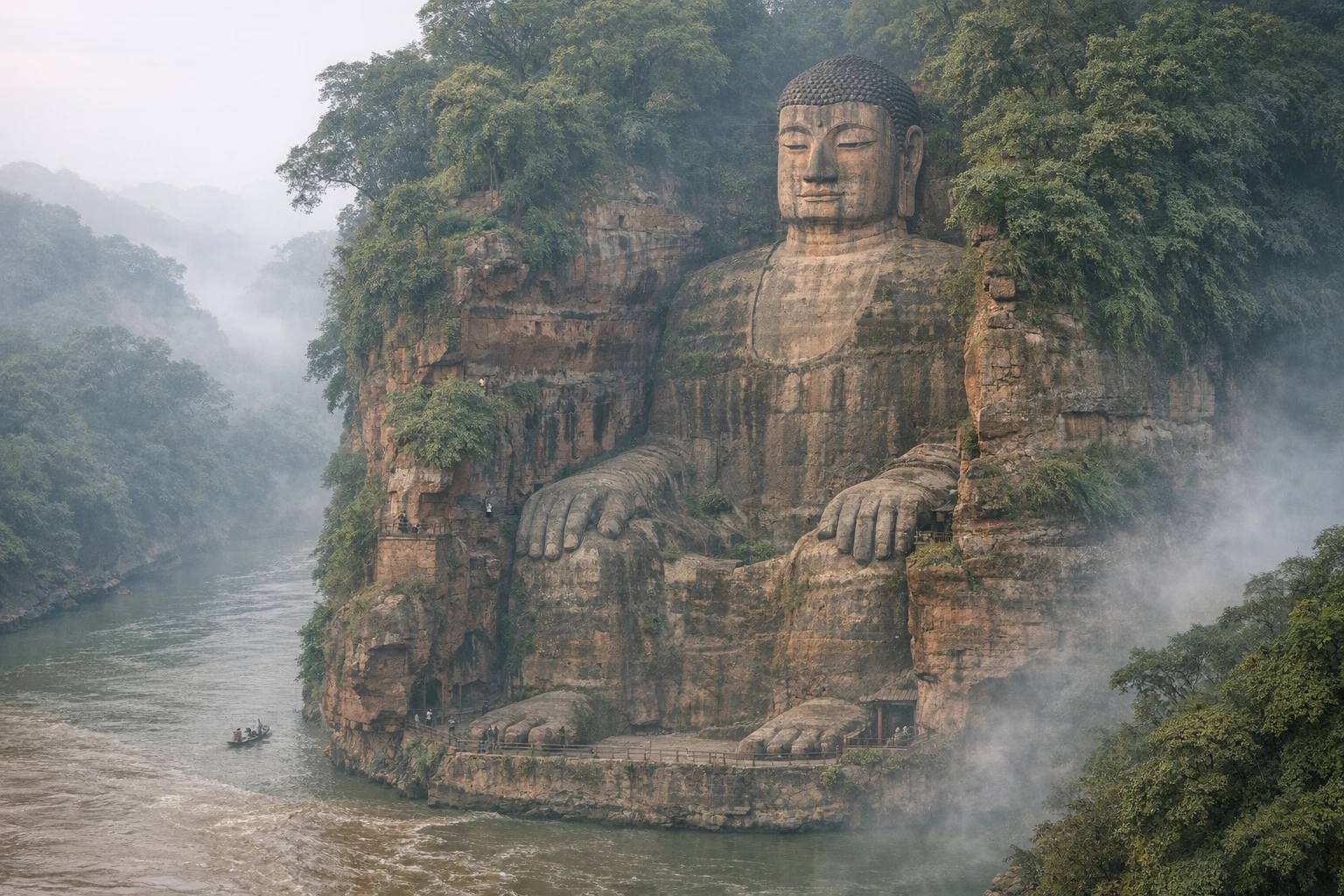
Leshan Giant Buddha
Tang Dynasty ChinaThe world's tallest pre-modern stone Buddha, carved into a clifftop in Sichuan, China, overlooking t...
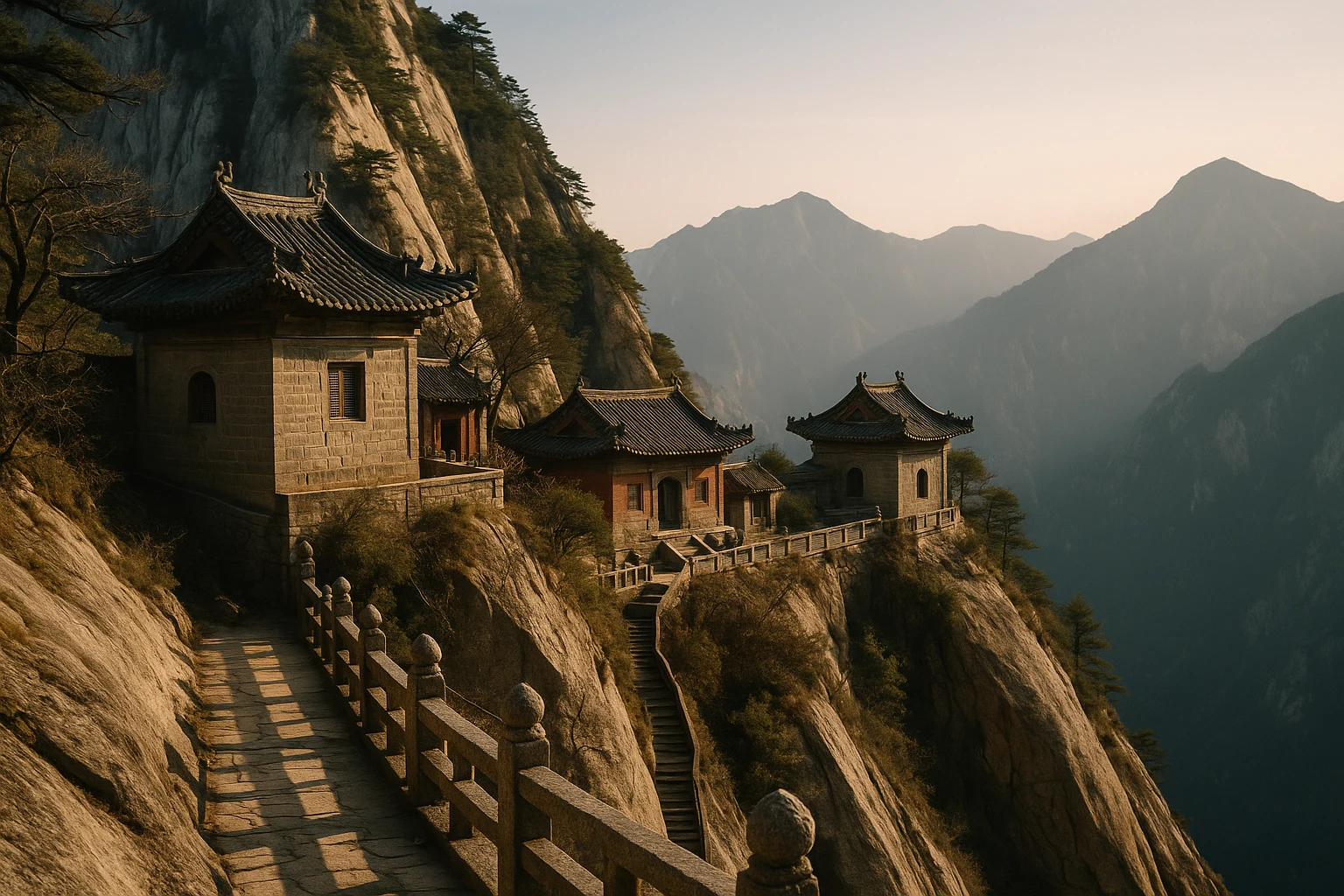
Mount Huashan Ancient Temples
Discover the sacred Daoist temples clinging to the sheer granite cliffs of Mount Huashan, one of Chi...