Quick Info
At a glance
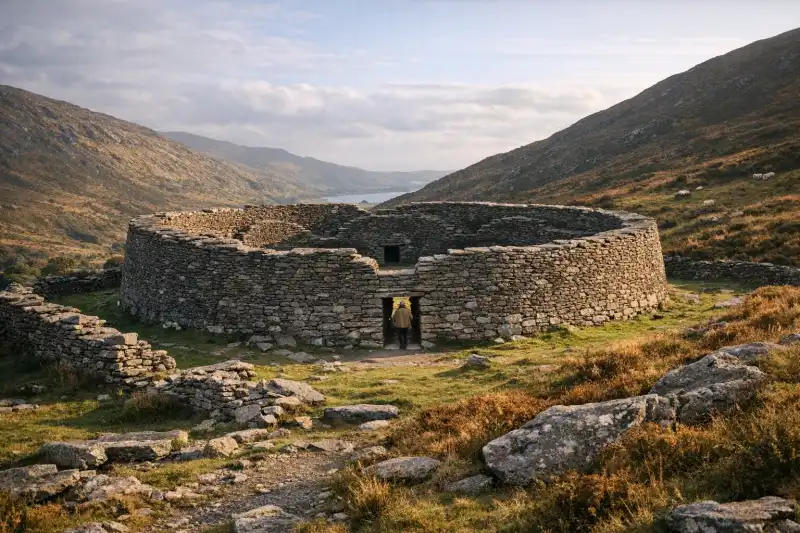
Staigue Stone Fort in Ireland rises from the hills of County Kerry with a quiet authority that can take visitors by surprise. Reached by winding rural roads and framed by green slopes, stone walls, and Atlantic weather, it does not announce itself with grand ticket halls or elaborate interpretation centers. Instead, it appears almost as an extension of the landscape itself: a massive circular structure of unmortared stone, standing firm through centuries of rain, wind, and changing human use. Its survival is part of what makes the site so affecting. Here, in a comparatively remote part of southwest Ireland, you encounter not a ruin reduced to fragments, but a place whose shape, scale, and craftsmanship remain powerfully legible.
For travelers interested in ancient Ireland, Staigue Stone Fort offers something especially memorable. It is one of the finest surviving stone ringforts in the country, and while scholars still debate exact dates and functions, the monument communicates an immediate sense of defensive strength, social prestige, and technical skill. The thick dry-stone walls curve in a near-perfect circle, enclosing an open interior and preserving traces of stairways and internal ledges. Yet the site’s appeal is not only archaeological. It also lies in the experience of arrival: the narrow lanes, sheep-dotted fields, shifting cloud cover, and broad silence of the Iveragh Peninsula. Staigue feels deeply tied to its setting, as if the fort and the Kerry landscape have been in conversation for a very long time.
History
Early origins in Iron Age Ireland
Staigue Stone Fort is generally considered to date from the late Iron Age or perhaps the opening centuries of the early medieval period, with many estimates placing its construction somewhere between the 3rd and 6th centuries CE. That broad dating reflects a common challenge in Irish archaeology: stone forts often lack the kinds of inscriptions or easily datable building materials that allow precise chronological certainty. Instead, archaeologists rely on construction style, comparisons with similar monuments, and evidence from the wider settlement landscape.
What is clear is that Staigue was built in a world where ringforts were common features of the Irish countryside. Most were earthen enclosures, but in rocky western regions, stone was often the preferred material. Staigue stands apart because of its scale and sophistication. Its walls are exceptionally thick and high, constructed entirely by dry-stone methods without mortar. That level of engineering implies organized labor, access to resources, and a community with both the need and the prestige to erect such a substantial monument. Whether it was primarily defensive, residential, symbolic, or a combination of all three, the fort represented status.
The people who built Staigue lived in a landscape of kin groups, local kings, agricultural holdings, and shifting alliances. Power in Ireland at the time was fragmented rather than centralized. A site like this may have served an elite family or local ruler, providing a secure enclosure for residence, storage, and livestock while also projecting authority over nearby territory.
Use and adaptation in the early medieval era
By the early medieval period, ringforts formed part of the everyday settlement pattern across much of Ireland. Staigue may have continued in active use during this era, even if its original construction slightly predated it. The interior would likely have contained timber buildings, perhaps houses, workshops, and spaces for domestic activity, though such structures have not survived above ground. The stone enclosure itself was the enduring shell; the life within it would have changed over generations.
Its position in the wider south Kerry landscape suggests that it belonged to a functioning agricultural and social network rather than existing as an isolated outpost. Nearby land could support grazing and small-scale farming, while local routes connected communities across the peninsula. In this context, the fort may have balanced practical concerns with social display. A strong enclosure offered protection, but it also marked a household of significance.
Some scholars have noted that very substantial ringforts in Ireland may have had ceremonial or prestige dimensions beyond simple defense. Staigue’s monumental walls seem almost too impressive for ordinary farmstead needs alone. This does not mean it was a ritual site in the narrow sense, but it likely communicated rank. In societies where authority was local and competitive, architecture could serve as a durable statement of influence.
Decline, survival, and local memory
Like many early Irish settlement sites, Staigue eventually fell out of its original use. Changes in settlement patterns, political structures, and building traditions meant that the fort ceased to function as a primary residence. Timber buildings inside the enclosure disappeared, while the stone circuit remained. Unlike castles later built with mortar and cut stone, ringforts often blended gradually back into the rural environment once abandoned.
Staigue survived in part because of its robust construction and in part because of its relative remoteness. County Kerry’s rural landscape preserved many traces of earlier habitation, but few monuments are as visually complete as this one. Local people would have known the site for generations, and like many ancient monuments in Ireland, it likely acquired layers of folk memory, storytelling, and practical familiarity. Even where exact historical origins were forgotten, the fort remained a landmark.
Antiquarians and early investigators in the 18th and 19th centuries helped bring broader attention to such sites, recording dimensions and speculating about their builders. Some older theories linked monuments like Staigue to much earlier prehistoric eras or to dramatic invasions and lost peoples. Modern archaeology has replaced many of those romantic ideas with more careful contextual study, situating the fort within the late Iron Age and early medieval world of Ireland.
Modern preservation and interpretation
Today, Staigue Stone Fort is valued as one of Ireland’s finest examples of a stone ringfort. Its preservation allows visitors to appreciate both engineering skill and the social world that produced it. While interpretation remains cautious where evidence is uncertain, the monument’s significance is undisputed. It demonstrates how local communities in ancient Ireland transformed available materials into enduring architecture of remarkable strength and elegance.
Modern conservation has focused on maintaining structural stability while allowing public access. Because dry-stone monuments are vulnerable to erosion, vegetation pressure, and damage from climbing or stone displacement, respectful visitation matters. The fort’s accessibility has made it a favorite stop for travelers exploring the Ring of Kerry and the quieter roads of South Kerry, yet it still retains a sense of discovery. That balance between visibility and atmosphere is part of its charm. Staigue is not merely an object of study; it is a lived encounter with Ireland’s deep rural past.
Key Features
The first thing most visitors notice at Staigue Stone Fort is the extraordinary wall. Rising to roughly 5.5 meters in places and measuring about 4 meters thick at the base, it is one of the most imposing dry-stone structures in Ireland. Built entirely without mortar, the wall depends on the careful placement and balance of thousands of stones. This method gives the fort a tactile, almost organic quality. The masonry does not look polished or formal in the way of later castles; instead, it appears deeply rooted in the landscape, as though assembled by a profound understanding of stone, gravity, and weather.
The fort’s circular plan is another striking feature. From the outside, the ring feels compact and powerful, but once you pass into the interior, the enclosed space opens up in a surprisingly calm and harmonious way. The circle creates a sense of order and protection. Even without reconstructed buildings inside, it is easy to imagine how life may once have unfolded here: smoke rising from timber roofs, animals brought in at night, people working, storing food, and watching the approaches from the wall. The open center also draws attention to the architecture itself, encouraging visitors to look closely at how the enclosure was conceived.
Among the most interesting details are the stairways built into the thickness of the wall. These internal steps allowed access to the upper levels or wall walk, showing that the structure was not simply a barrier but a usable built environment. There are also small wall chambers and galleries, created within the massive stone fabric. Features like these reveal a high degree of planning. The builders were not piling stones into a rough circle; they were shaping a complex and durable monument with circulation, vantage points, and internal spaces.
The entrance, though modest compared with the total bulk of the fort, is an important part of the experience. It channels movement from the surrounding countryside into the enclosed interior and reminds visitors that access was once controlled. In defensive terms, a narrow doorway in a thick wall would have been easier to protect than a wide opening. In symbolic terms, crossing that threshold still feels meaningful. You move from open fields into a space deliberately bounded by human labor, a place that once separated insiders from outsiders.
Staigue’s setting contributes as much to its character as the stonework itself. The fort stands amid the rolling hills of the Iveragh Peninsula, not far from the coast yet sheltered enough to feel intimately rural. The surrounding landscape is full of textures familiar to southwest Ireland: grassy slopes, exposed rock, low vegetation, and changing light. Mist, rain, and sudden sunlight can alter the atmosphere within minutes. On a gray day, the fort can seem stern and ancient; under bright skies, it feels almost serene. This responsiveness to weather is part of what makes a visit memorable.
Another key feature is the absence of excessive modern intrusion. While basic access and visitor support exist, the monument has largely been left to speak for itself. This is not a heavily staged heritage attraction. For some travelers, that simplicity is a major advantage. It allows space for imagination and close observation. Rather than following a rigid route through reconstructed scenes, you encounter the fort directly: its scale, its engineering, its weathered surfaces, and its relation to the land around it.
The monument also rewards visitors who pay attention to details of construction. The dry-stone technique depends on weight distribution and interlocking placement, and Staigue demonstrates how sophisticated such building could be. Looking carefully at the stones, you can see that the wall is not random rubble. It has coherence, rhythm, and a practical intelligence shaped by experience. The slight inward batter of the wall, the use of larger foundation stones, and the integration of passages and stairs all suggest a tradition of building that was both local and highly skilled.
Perhaps the most compelling feature of all is the fort’s completeness. Many ancient sites are evocative because they survive in fragments; Staigue is powerful because it survives in mass. Its walls still define space in a way that is immediate and physical. You do not need specialist knowledge to feel its impact. At the same time, those with an interest in archaeology can appreciate how unusual it is to encounter such a well-preserved example of an Irish stone ringfort. Staigue succeeds on both levels: as a place of atmosphere and as a monument of exceptional historical value.
Getting There
Staigue Stone Fort is in a rural part of County Kerry on the Iveragh Peninsula, and most visitors reach it by car. The easiest base is usually Kenmare, which lies about 35 to 45 minutes away by road depending on traffic and route conditions. From Kenmare, a rental car offers the greatest flexibility, especially if you plan to combine the visit with other scenic stops along the Ring of Kerry or quieter South Kerry backroads. Car rental from Kerry Airport or Cork can vary widely, but expect roughly €35 to €80 per day for a standard vehicle in most seasons, with higher rates in summer.
Driving is straightforward in theory but slow in practice, as many local roads are narrow and winding. Allow extra time, especially if you are unused to rural Irish roads. Limited parking is typically available near the site. If you are coming from Killarney, the journey usually takes around 1.5 to 2 hours by car.
Public transport to Staigue is limited. You can take regional buses to larger nearby towns such as Kenmare or Cahersiveen, but there is generally no direct frequent service to the fort itself. A bus fare from Killarney to Kenmare is often in the €10 to €15 range each way, depending on operator and route. From there, a taxi is the most practical final leg, though costs can be significant in rural areas; expect perhaps €40 to €70 each way depending on distance and local rates.
Day tours covering the Ring of Kerry occasionally include heritage stops in the broader region, though Staigue is not always guaranteed. If seeing the fort is a priority, a self-drive itinerary or private driver is the safest option.
When to Visit
Staigue Stone Fort can be visited year-round, but the experience changes noticeably with the seasons. Late spring through early autumn, especially May to September, offers the best combination of milder weather, longer daylight hours, and easier road conditions. In these months, the Kerry landscape is at its greenest and most inviting, and you are more likely to enjoy broad views across the surrounding hills between spells of cloud and rain. Summer also brings the greatest number of travelers, so while Staigue is rarely crowded on the scale of Ireland’s major urban attractions, you may encounter more tourers and drivers on the approach roads.
Spring is an especially good choice for visitors who want a balance of fresh scenery and relative quiet. Wildflowers begin to appear, fields are lively, and the weather, though still unpredictable, can be crisp and bright. Autumn is another excellent season, with softer light, fewer people, and a mood that suits the ancient stonework particularly well.
Winter visits are possible and can be atmospheric, but they require more planning. Days are short, roads may be slick in wet conditions, and Atlantic weather can shift quickly from manageable to unpleasant. Strong winds and heavy rain can make the site feel exposed. If you go in winter, aim for a late morning or early afternoon visit and check conditions in advance.
Whatever the season, the best advice is to arrive prepared for changing weather. Waterproof layers, sturdy shoes, and realistic timing will make the experience much more enjoyable. Early morning or late afternoon often provides the quietest and most dramatic light.
| Quick Facts | Details |
|---|---|
| Location | County Kerry, Ireland |
| Site Type | Stone ringfort |
| Date | c. 300-600 CE |
| Cultural Context | Late Iron Age to early medieval Ireland |
| Best Base | Kenmare |
| Typical Visit Length | 30-60 minutes |
| Access Style | Best reached by car |
| Famous For | Massive dry-stone circular walls and exceptional preservation |
| Family Friendly | Yes, with care on uneven ground |
| Best Season | Late spring to early autumn |
Staigue Stone Fort is one of those rare places that manages to feel both monumental and intimate. It does not overwhelm with size alone, nor does it depend on extensive reconstruction or spectacle. Instead, its power comes from preservation, craftsmanship, and setting. In a single stop, visitors can see how ancient communities in Ireland shaped their environment into something practical, impressive, and enduring. The thick walls, hidden stairways, and circular interior all suggest a world that is distant in time yet still understandable on a human scale.
For anyone exploring County Kerry beyond its famous scenic drives, Staigue offers a deeper encounter with the region’s past. It is a site that rewards curiosity, patience, and a willingness to let the landscape speak alongside the archaeology. Whether you are tracing Ireland’s Iron Age heritage, seeking memorable stops off the main tourist routes, or simply drawn to places where stone and weather seem inseparable, Staigue Stone Fort is an essential visit.
Guided tours: worth it?
Most travelers can visit Staigue Stone Fort independently. Compare a tour only if you want a tighter history-focused visit, easier logistics, or a guide who can answer questions on the spot.
Best for
- Short visits where a planned route saves time
When to go self-guided
Go independently if you prefer setting your own pace, reading as you go, and checking official hours or ticket rules directly before you arrive.
What I’d avoid
Skip paid tours that bundle unrelated stops you do not actually want. The best option should either save meaningful planning time or add historical context you would miss on your own.
Ring of Kerry and Ancient Sites Tours
Useful when: you want to compare guided formats before deciding
County Kerry Archaeology and Heritage Tours
Useful when: you want to compare guided formats before deciding
Kenmare and South Kerry Day Trips
Useful when: transport or pickup logistics matter
Some tour links are affiliate links, which may earn Ancient Travel a small commission at no extra cost to you. I try to surface options that make practical sense for the site—not just anything bookable.
Frequently Asked Questions
What is Staigue Stone Fort?
Staigue Stone Fort is a large circular dry-stone ringfort in County Kerry, Ireland, usually dated to the late Iron Age or early medieval period.
Do you need a ticket to visit Staigue Stone Fort?
Access is generally free, though parking and local arrangements can change, so it is wise to check current visitor information before traveling.
How long should I spend at Staigue Stone Fort?
Most visitors spend 30 to 60 minutes exploring the fort, walking around the walls, and enjoying the surrounding Kerry landscape.
Can you go inside Staigue Stone Fort?
Yes, visitors can usually enter the interior and walk around the enclosure, but care is needed on uneven ground and near ancient stonework.
Is Staigue Stone Fort suitable for families?
Yes, it can be a rewarding family stop, though surfaces are uneven and children should be supervised closely around the stone walls.
What is the best nearby town for visiting Staigue Stone Fort?
Kenmare is one of the most convenient nearby bases, offering accommodation, restaurants, and access to scenic routes in County Kerry.
Nearby Ancient Sites
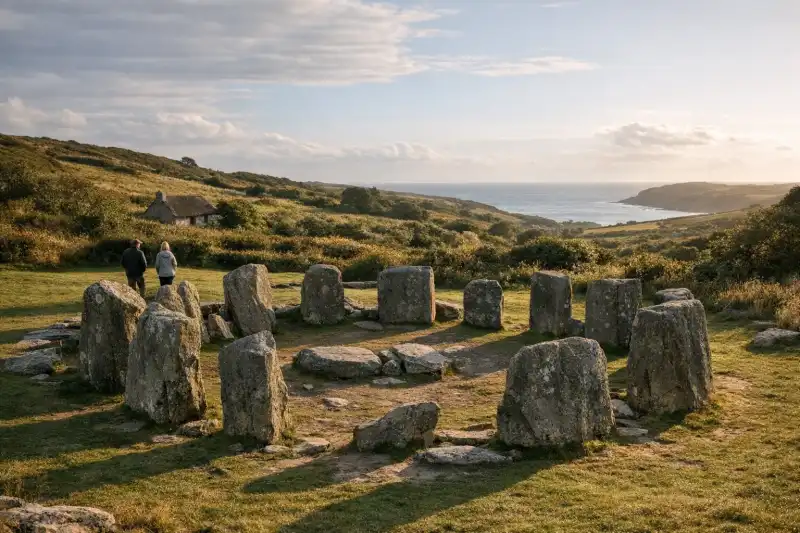
Drombeg Stone Circle
Bronze Age communities of prehistoric IrelandExplore Drombeg Stone Circle in Ireland, a remarkably preserved Bronze Age monument set in the rolli...
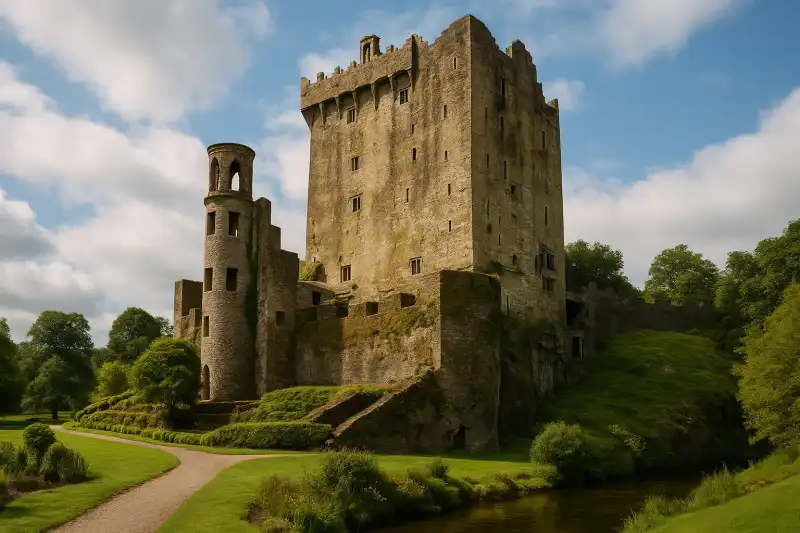
Blarney Castle Travel Guide 2026: Cork Day-Trip Timing, Gardens, and Stone Access
Medieval IrelandPlan a practical first visit to Blarney Castle with timing for the Stone queue, garden route priorit...
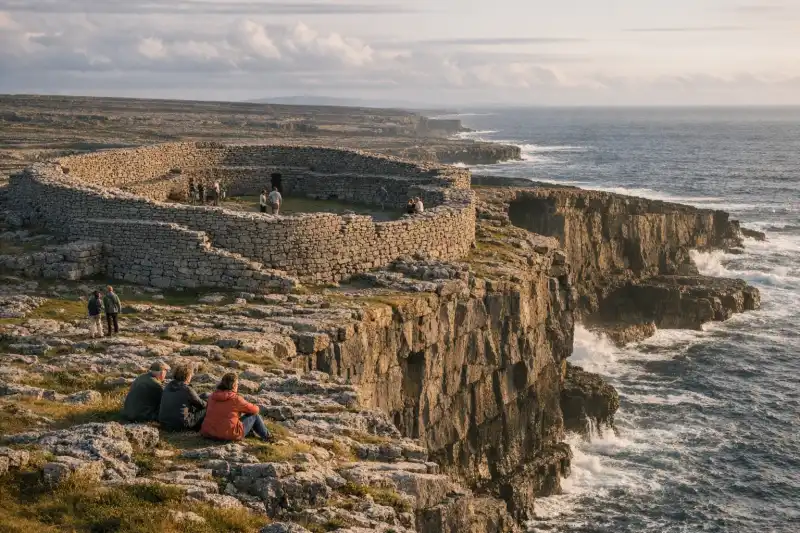
Aran Islands Stone Forts
Prehistoric and early medieval IrishExplore the dramatic prehistoric stone forts of Ireland’s Aran Islands, where Atlantic cliffs and an...