Quick Info
At a glance
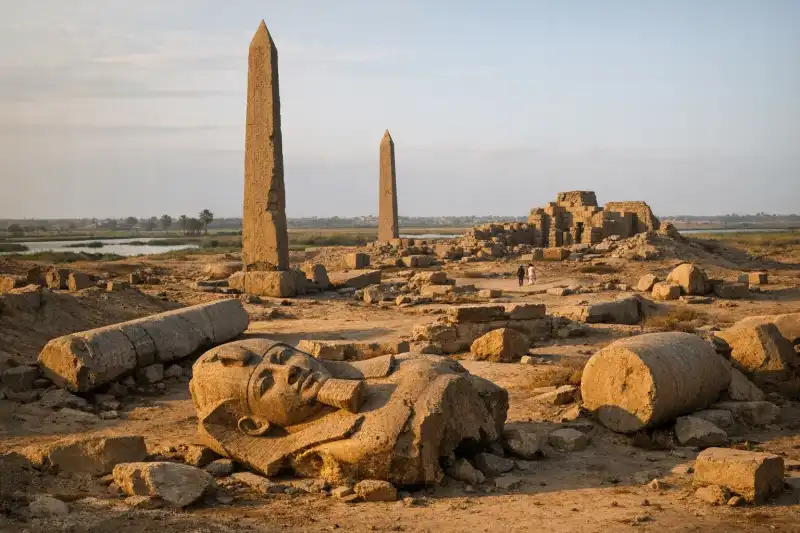
Tanis in Egypt rises from the flat green-brown landscape of the northeastern Nile Delta with a strange and memorable dignity. Here, amid fields, canals, and villages, enormous blocks of granite, toppled obelisks, broken colossi, and weathered temple walls lie scattered across a wide archaeological zone that once formed one of the most important royal cities in the country. Unlike the enclosed and polished experience of some famous monuments farther south, Tanis feels open, windswept, and quietly monumental. The ruins do not overwhelm with soaring architecture still standing intact; instead, they impress through scale, atmosphere, and the realization that this remote Delta capital once rivaled older centers of Egyptian power.
For many travelers, Tanis is also a place of surprise. It is less visited than Luxor, Giza, or Abu Simbel, yet it played a major political and religious role, especially during the Third Intermediate Period, when pharaohs ruled from the Delta and filled the city with reused monuments, temple complexes, and royal burials. Walking across the site today, you encounter colossal statues emerging from grass, inscriptions half-buried in soil, and the remains of sacred architecture built and rebuilt over centuries. The result is a destination that feels both archaeological and poetic: a city not frozen in one moment, but layered by reuse, ambition, and decline. For visitors interested in ancient Egypt beyond the standard circuit, Tanis offers one of the country’s most evocative journeys into a forgotten capital.
History
Origins in the Delta
The area of Tanis, known in modern Arabic as San El-Hagar, occupied a strategic place in the eastern Nile Delta, a region shaped by shifting branches of the Nile, fertile farmland, and routes connecting Egypt with the Levant. Although the city is most famous for its later prominence, the wider region had long been inhabited and tied into the economic and political life of the Delta. Its rise was linked not only to geography but also to environmental change. As river channels shifted and some older centers declined, new urban and religious hubs emerged.
Tanis appears to have gained importance after the weakening of Pi-Ramesses, the great royal residence associated with Ramesses II and the Ramesside kings. As the branch of the Nile serving Pi-Ramesses silted up, the practical and political focus of the region moved. Monuments from older Delta capitals were transported or reused at Tanis, giving the city an architectural richness that connected it with the glory of earlier dynasties.
Rise as a Royal Capital
Tanis came into its own during the Third Intermediate Period, especially under the 21st and 22nd Dynasties, when it served as a major royal center in northern Egypt. This was a complex era in Egyptian history, marked by divided authority, regional power bases, and shifting relationships between kings in the Delta and high priests in Thebes. Yet it was far from a purely decadent age. Tanis became the setting for energetic building programs, court life, religious ritual, and royal burial.
The kings of the 21st Dynasty, including Psusennes I, Amenemope, and others, invested heavily in the city. They expanded temple precincts and established Tanis as a political and sacred center dedicated above all to Amun, though other deities were also worshipped there. In many ways the city consciously echoed Thebes, the southern religious capital, while adapting that prestige to a northern setting. Rulers reused blocks, statues, and obelisks from Pi-Ramesses and perhaps other sites, both as practical building material and as a statement of legitimacy.
Temples, Tombs, and Power
One of Tanis’s most remarkable distinctions is that it combined a major temple complex with a royal necropolis. This makes it unusual in comparison with many Egyptian capitals, and it contributes greatly to the site’s modern fame. The royal tombs discovered here belong to some of the most significant rulers of the period and transformed scholarly understanding of the age. Far from being obscure or impoverished, the kings buried at Tanis were interred with rich grave goods, silver coffins, jewelry, masks, and elaborate funerary equipment.
The city continued to matter into the 22nd Dynasty and beyond, even as power shifted again and Egypt faced new internal and external pressures. Libyan-descended rulers and later kings maintained the site’s importance, adding to its temples and preserving its role in Delta politics. Tanis thus remained a living city over centuries rather than a brief royal experiment.
Decline, Burial, and Rediscovery
As with many Delta sites, Tanis suffered from environmental transformation as much as from political decline. Changes in river courses, silting, and the accumulation of alluvial deposits gradually altered the landscape. Urban life contracted, monumental structures collapsed, and the city’s visible remains were slowly buried beneath mud, debris, and later settlement. Unlike stone-built desert-edge sites in Upper Egypt, Delta cities often vanished more completely from view because of moisture, agriculture, and the continuous reuse of materials.
Modern archaeology restored Tanis to prominence. Nineteenth-century travelers and scholars recognized the importance of the ruins, but the most celebrated work came in the twentieth century through excavations by the French archaeologist Pierre Montet. Between 1929 and 1939, Montet uncovered the royal necropolis and several intact or nearly intact tombs, an extraordinary discovery often compared, in importance if not in global publicity, to the treasures of Tutankhamun. Because these finds coincided with the tense years preceding World War II, they never achieved the same public fame, yet among Egyptologists they remain among the great archaeological discoveries of the century.
Today Tanis is understood not as a marginal ruin but as a key site for understanding the political geography of ancient Egypt, the transitions after the New Kingdom, and the enduring ability of Egyptian kingship to reinvent itself in changing landscapes.
Key Features
The first impression of Tanis is one of scale. The archaeological zone is broad, open, and strewn with monumental fragments that hint at a city of enormous ceremonial ambition. Rather than moving through a tightly bounded temple preserved in elevation, visitors traverse a terrain of broken but powerful remains. This scattered quality is part of Tanis’s appeal. Huge granite blocks, inscribed architraves, fallen obelisks, sphinxes, and statues lie across the ground like the disassembled vocabulary of pharaonic power.
At the heart of the site is the great temple precinct, associated primarily with the worship of Amun. The surviving remains reveal repeated phases of construction and reuse. Massive stone elements from earlier royal cities were incorporated into later buildings, so Tanis becomes almost a museum of political memory in architectural form. Looking closely at inscriptions, visitors can sometimes see the names of Ramesside kings alongside later rulers who reinscribed, relocated, or repurposed the monuments. This layering makes the site unusually rewarding for travelers interested in how Egyptian rulers claimed continuity with the past.
The colossal statues are among the most visually striking features. Even in damaged condition, they dominate the plain. Some stand partially upright; others lie where they fell, their faces weathered but still imposing. These fragments communicate the theatrical scale of ancient temple entryways and courtyards. In the Delta’s low horizon, a granite colossus feels all the more dramatic, because there are few cliffs or high desert backdrops to compete with it. The monuments seem to rise directly from the earth and fields.
Tanis is also famous for its royal tomb area, though what visitors experience on the ground is more archaeological than spectacular in the way of painted chambers. The significance here lies in what was found rather than in lavishly decorated interiors still visible in situ. The necropolis yielded the burials of rulers such as Psusennes I, whose funerary treasures demonstrated that elite craftsmanship and royal wealth continued well into periods once thought comparatively impoverished. Knowing that these tombs lay beneath this quiet Delta ground gives the site a powerful hidden dimension. It is a place where Egypt’s history was not only built upward in temples, but also sealed below in stone burial chambers.
The atmosphere of the landscape itself is another key feature. Tanis differs sharply from desert-edge monuments like those at Saqqara or Luxor. The Delta environment gives it a softer horizon, agricultural surroundings, and changing light shaped by moisture and open sky. In winter and early morning, the site can feel serene and almost dreamlike. In summer, heat and glare flatten the landscape, making the granite stand out in bold, harsh contrast. Photographers often appreciate this interplay between ruin and plain, monument and field.
A further point of interest is how under-visited the site remains. For some travelers, this is one of Tanis’s greatest luxuries. You may walk among major royal ruins with relatively few other visitors around. That quiet allows time to absorb details, read inscriptions, and imagine the city’s former ceremonial avenues and pylons. It also means that Tanis often feels closer to an active archaeological landscape than a fully curated tourism destination. Signage and interpretation can be limited compared with Egypt’s most famous sites, so a knowledgeable guide or prior reading greatly enriches the experience.
Finally, Tanis matters because it broadens the story of ancient Egypt. Many itineraries focus on pyramids, New Kingdom tombs, or Ptolemaic temples, but Tanis shows the resilience of kingship in the Delta and reveals a chapter of Egyptian history that is politically intricate and materially impressive. It is not a site of perfect preservation; it is a site of historical depth. Its grandeur survives in fragments, and those fragments are enough to make it unforgettable.
Getting There
Tanis is usually reached from Cairo, which remains the most practical base for most international visitors. The site lies in the northeastern Nile Delta near San El-Hagar in Sharqia Governorate. By private car or taxi, the journey from central Cairo typically takes around 3 to 4 hours each way, depending on traffic and your exact starting point. A full-day private car with driver often costs roughly EGP 3,500 to 6,500, depending on vehicle type, waiting time, and whether guiding is included. For couples or small groups, this is usually the simplest and most comfortable option.
Organized private tours from Cairo are another convenient choice, especially because Tanis is less straightforward than headline attractions. These tours commonly include hotel pickup, transport, and an Egyptologist guide. Prices often start around USD 90 to 180 per person for a private day trip, with higher rates for premium vehicles or multi-site Delta itineraries.
Public transport is possible but less convenient. Travelers may take a bus or train toward Delta towns such as Zagazig or nearby regional hubs, then continue by local taxi or microbus toward San El-Hagar. This is cheaper, often under EGP 300 to 600 in total transport costs, but it can be time-consuming and requires flexibility, Arabic navigation skills, and patience with changing schedules. Once in the area, local taxis are usually necessary for the final approach to the ruins.
Because facilities around the site are limited, it is best to bring water, snacks, cash, and sun protection before arriving. If you want context on what you are seeing, arranging a guide in advance is highly recommended.
When to Visit
The best time to visit Tanis is from late October through March, when temperatures in the Nile Delta are milder and walking across the exposed archaeological ground is far more comfortable. Winter days are typically pleasant rather than cold, making this the ideal season for slow exploration, photography, and reading inscriptions without intense heat. Morning visits are especially rewarding, as lower-angle light gives the granite monuments shape and texture while the site remains quiet.
Spring, particularly March and April, can also be a good period, though occasional wind and dust may affect visibility. Temperatures begin to rise, but conditions are often still manageable for a half-day visit. If you travel in spring, plan an early start and avoid the hottest middle hours.
Summer, from roughly June through September, is the least comfortable season. Although the Delta is not as brutally hot as some southern Egyptian sites, Tanis has little shade and large open areas of reflective stone and packed earth. Midday heat can become exhausting quickly. If summer is your only option, arrive as early as possible, carry plenty of water, wear a hat, and keep expectations realistic about how long you will want to stay outdoors.
Autumn is an excellent compromise. The fields around the site can look particularly vivid after the harshest heat has passed, and daytime temperatures are generally more forgiving. Rain is uncommon but not impossible in the Delta; even light showers can affect ground conditions, so sturdy footwear is helpful year-round.
In practical terms, weekday mornings often provide the calmest experience. Because Tanis is not one of Egypt’s busiest tourist sites, crowding is rarely a major issue, but local holidays, school visits, or group tours can briefly increase activity.
| Quick Facts | Details |
|---|---|
| Location | San El-Hagar area, Sharqia Governorate, Egypt |
| Ancient Role | Royal capital and temple center in the Nile Delta |
| Best Known For | Third Intermediate Period kings, temple ruins, royal tomb discoveries |
| Main Deity Worshipped | Amun, alongside other Egyptian gods |
| Famous Archaeologist | Pierre Montet |
| Typical Visit Length | 2 to 3 hours |
| Best Season | October to March |
| Nearest Major Base | Cairo |
| Site Character | Open-air archaeological ruins with scattered monumental remains |
| Ideal For | History enthusiasts, archaeology lovers, repeat visitors to Egypt |
Guided tours: worth it?
Self-guided works here, but a guide can add real value if you want the ruins explained as a living place rather than just a sequence of monuments.
Best for
- First-time visitors who want context, not just photos
- Short visits where a planned route saves time
When to go self-guided
Go independently if you prefer setting your own pace, reading as you go, and checking official hours or ticket rules directly before you arrive.
What I’d avoid
Skip paid tours that bundle unrelated stops you do not actually want. The best option should either save meaningful planning time or add historical context you would miss on your own.
Tanis Egypt day tours
Useful when: you want to compare guided formats before deciding
Cairo to Tanis private tour
Useful when: you want flexible timing or a private guide
Egypt Delta archaeological tours
Useful when: you want to compare guided formats before deciding
Some tour links are affiliate links, which may earn Ancient Travel a small commission at no extra cost to you. I try to surface options that make practical sense for the site—not just anything bookable.
Frequently Asked Questions
Where is Tanis located?
Tanis is in Egypt's northeastern Nile Delta, in modern Sharqia Governorate, not far from the town of San El-Hagar.
Why is Tanis important?
Tanis became a major royal capital during the Third Intermediate Period and is known for its large temple precinct and remarkable royal tomb discoveries.
Can you visit Tanis on a day trip from Cairo?
Yes, Tanis is usually visited as a long day trip from Cairo by private car or organized tour, though travel times can vary with traffic and road conditions.
How much time do you need at Tanis?
Most travelers need two to three hours on site to see the main temple ruins, statues, obelisks, and the area associated with the royal necropolis.
Is Tanis suitable for casual travelers or mainly specialists?
Tanis rewards both, but it is especially appealing to travelers interested in archaeology, ancient Egyptian history, and quieter sites away from the busiest tourist circuits.
What should visitors bring to Tanis?
Bring sun protection, water, sturdy shoes, cash for transport or tips, and ideally a guide or background reading because the site is wide, open, and less interpretively developed than major Egyptian monuments.
Nearby Ancient Sites
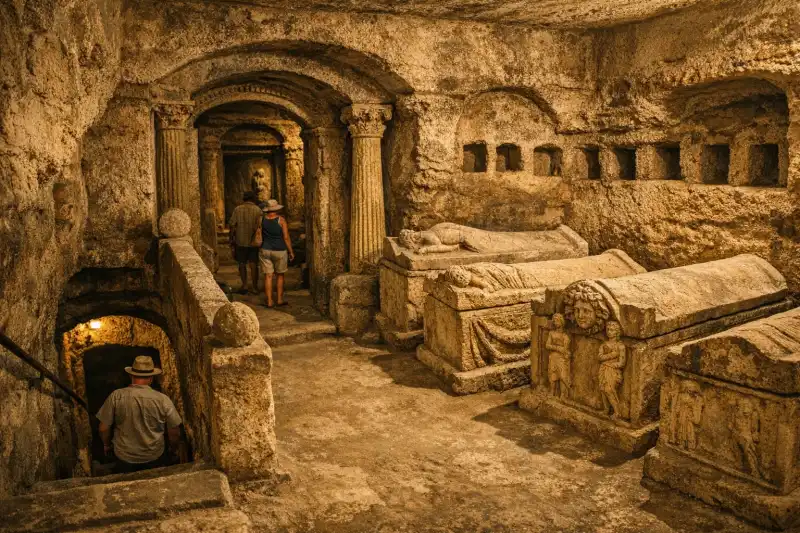
Alexandria Catacombs
Greco-Roman EgyptExplore Alexandria Catacombs in Egypt, a remarkable Roman-era underground necropolis blending Egypti...
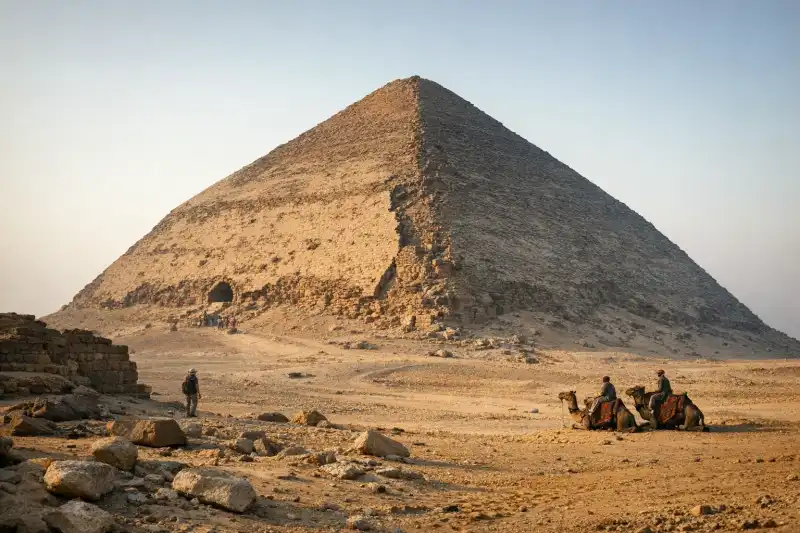
Bent Pyramid
Ancient EgyptianThe Bent Pyramid in Egypt is a rare Old Kingdom monument where a dramatic change in angle reveals th...
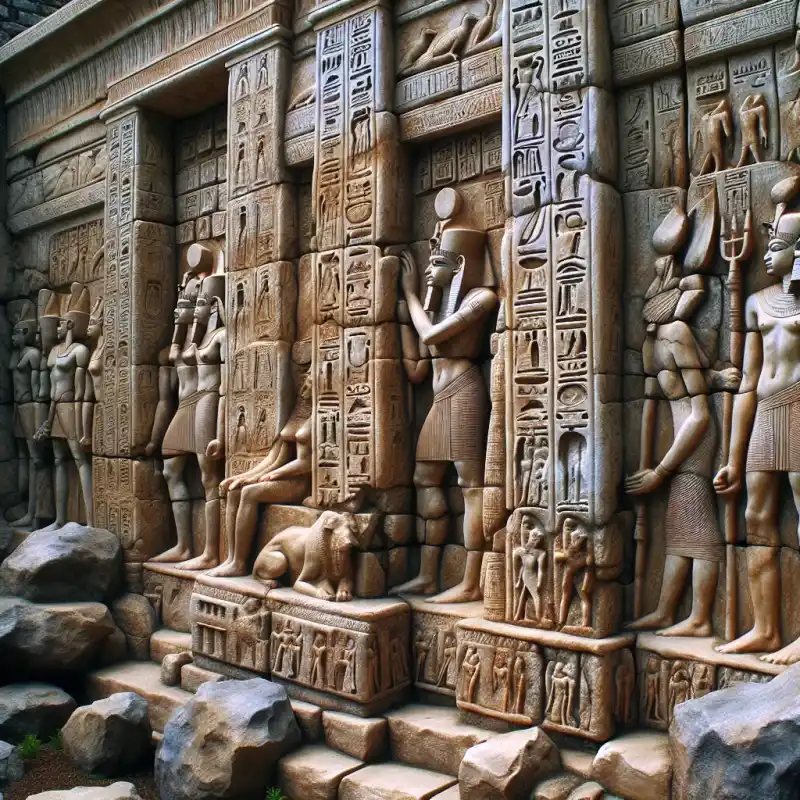
Abydos Temple Egypt Guide 2026: Temple of Seti I & King List
New Kingdom-PtolemaicAbydos Temple near Luxor: magnificent Temple of Seti I with war reliefs, ancient king list, and vibr...