Quick Info
At a glance
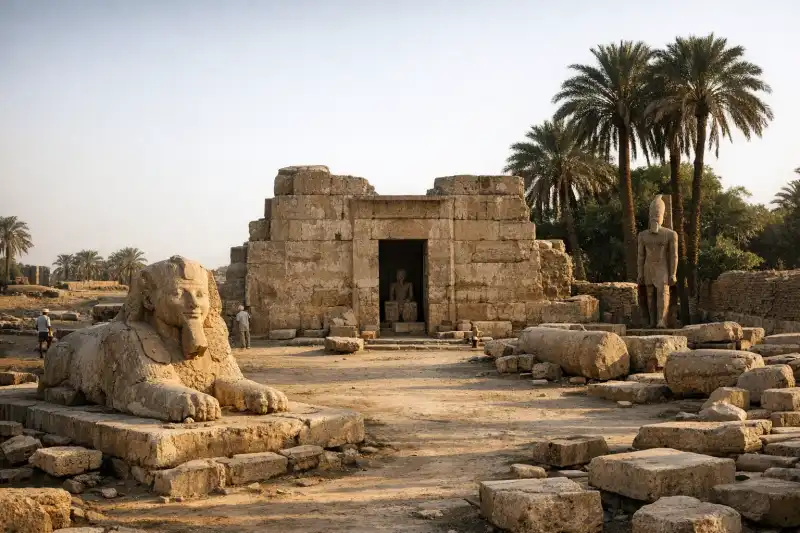
The Temple of Ptah (Memphis) in Egypt stands in the quiet fields and palms of Mit Rahina, where fragments of one of the ancient world’s most revered sanctuaries still lie close to the earth that buried them for centuries. At first glance, the site can seem understated compared with the towering pyramids farther into the desert, yet that modest first impression is exactly what makes Memphis so affecting. Here you are not looking at an isolated monument but at the remains of a city that once helped define kingship, theology, craftsmanship, and royal ceremony in pharaonic Egypt.
Memphis was among the earliest great capitals of the Egyptian state, strategically placed near the meeting point of Upper and Lower Egypt. In that political and sacred landscape, the Temple of Ptah was central. Ptah, god of artisans, builders, and creation, was not a minor local deity but one of the intellectual and religious anchors of ancient Egyptian thought. Priests, rulers, and foreign visitors knew this sanctuary by reputation. Pharaohs expanded it, restored it, and adorned it with colossal images and inscriptions meant to tie their reigns to divine legitimacy. What survives today is only a portion of the original complex, but broken walls, massive stone pieces, statues, and excavated courts still offer a powerful sense of the temple’s former importance. A visit here is less about spectacle alone and more about reading layers of memory in stone.
History
Early Memphis and the rise of Ptah’s sanctuary
The history of the Temple of Ptah is inseparable from the history of Memphis itself. Founded in the early dynastic period, probably around the unification of Egypt, Memphis occupied a strategic location at the apex of the Nile Delta. It was ideally placed to control movement between the north and south, and it quickly became a center of administration, military organization, and royal ideology. In this setting, Ptah emerged as the chief god of the city.
Ptah’s cult was especially significant because he was associated with craftsmanship, creation, and the shaping power of thought and speech. This theological role gave the temple unusual prestige. Memphis was not only a seat of political power but also a place where ideas about kingship and divine creation were articulated. The sanctuary would have served both ritual and symbolic purposes, tying the pharaoh to cosmic order while anchoring the city’s identity.
Although the earliest temple phases are difficult to reconstruct in full, archaeological and textual evidence suggests that a sacred precinct existed here from very early in Egyptian history. Like many Egyptian temples, the complex likely began in mudbrick and was rebuilt, enlarged, and embellished over many centuries. Its long life makes it less a single-period monument than a cumulative religious landscape.
Expansion under the New Kingdom
The temple reached new heights of grandeur during the New Kingdom, when Memphis regained major prominence as an administrative and military center. Pharaohs such as Amenhotep III, Seti I, and Ramesses II were especially active in building and restoration. Their contributions transformed the sanctuary into a monumental complex befitting an empire at its peak.
Ramesses II in particular left a strong mark on Memphis. He filled Egypt with colossal images of himself, and Memphis was no exception. The famous colossal statue found at the site reflects both the scale of royal patronage and the importance of the city in his reign. Such monuments were not mere decoration; they proclaimed that the king was pious, victorious, and approved by the gods. The Temple of Ptah thus functioned as a stage on which royal authority was repeatedly renewed.
Ancient writers later described Memphis as a place of wealth and ceremonial activity, and the temple would have been at the center of many of those impressions. Priests attached to the sanctuary formed an influential institution, and festivals held there connected local worship with national religious life. During this era, the temple precinct likely included pylons, courtyards, shrines, storage rooms, workshops, and processional spaces.
Late Period importance and foreign dynasties
Even after political power shifted elsewhere, Memphis retained religious and strategic significance. During the Third Intermediate Period and Late Period, rulers continued to invest in the city and its sacred buildings. This was also an era when Egypt experienced Libyan, Nubian, Assyrian, and Persian interventions, and Memphis often became a key prize because of its location and prestige.
Successive rulers used construction and restoration at major temples to legitimize their authority. The Temple of Ptah remained one of the places where such legitimacy could be performed. Additions, repairs, and reused stone from different reigns testify to the sanctuary’s long and complex life. The city’s resilience is notable: even when dynasties changed, the religious value of Memphis endured.
Greek and later Roman observers also knew Memphis well. Though Alexandria eventually eclipsed it in political and economic importance, Memphis still possessed deep cultural authority. Pilgrims, officials, and curious travelers encountered an ancient center whose sacred reputation had already lasted for millennia.
Decline, burial, and rediscovery
Like many ancient Egyptian sites, the Temple of Ptah did not vanish in a single moment. Its decline was gradual. Changes in political geography, shifts in religious practice, flooding, sedimentation, and stone quarrying all contributed to its deterioration. Over time, parts of ancient Memphis sank beneath accumulated silt or were dismantled for reusable building materials.
By the medieval and early modern periods, much of the once-great temple complex had disappeared from view. What remained above ground gave only hints of the city’s former scale. Systematic archaeological work in the nineteenth and twentieth centuries began to reveal buried walls, sculptures, and architectural fragments. Excavators identified features of the Ptah precinct and clarified the relationship between Memphis and its surrounding necropolis, including Saqqara and Dahshur.
Today the temple survives in a fragmentary state, yet those fragments are historically rich. They represent not a ruin of a single era but the compressed remains of thousands of years of worship, rebuilding, political ambition, and eventual abandonment. That long timeline is one of the site’s greatest rewards for visitors willing to look closely.
Key Features
The most striking aspect of the Temple of Ptah is not a single intact structure but the way the site preserves the footprint of an immense sacred complex. Walking through Memphis, you encounter low walls, excavated courts, fallen stone blocks, and scattered architectural pieces that together suggest a temple once vast enough to dominate the ancient city. This is a place where imagination is essential, but it is supported by enough surviving material to make reconstruction mentally vivid.
One of the best-known discoveries associated with Memphis is the colossal statue of Ramesses II, found near the temple precinct. Even though it is displayed separately from its original standing context, it remains one of the clearest reminders of the monumentality that once defined the site. The statue’s scale reflects the theatrical nature of temple architecture in the New Kingdom, when giant royal images turned sacred space into a statement of dynastic power. In Memphis, such sculpture would have framed entrances and courtyards, reinforcing the bond between king and god.
Another memorable feature is the surviving layout of the sacred area itself. Visitors can trace sections of enclosure walls and foundations that reveal how Egyptian temples organized movement through increasingly holy zones. Processional ways, gateways, open courts, and sanctuaries were arranged to lead worshippers from public space toward more restricted divine chambers. Even where columns and roofs are gone, the logic of the plan is still readable. This makes Memphis especially rewarding for travelers interested in architecture rather than only standing monuments.
The association with Ptah gives the site an additional intellectual depth. Ptah was patron of craftsmen, sculptors, builders, and artisans, which makes it fitting that the temple now survives through broken but eloquent pieces of worked stone. Relief fragments, reused blocks, and inscribed remains all speak to a long tradition of skilled labor carried out under divine patronage. In ancient Egyptian thought, creation itself could be understood as an act of shaping and making, and the temple embodied that concept physically.
The wider Memphis archaeological zone also enhances the experience. Palm groves, cultivated fields, village edges, and open sky create a contrast between the modern rural landscape and the ancient urban center hidden beneath it. Unlike sites enclosed by dramatic cliffs or deep desert, Memphis feels embedded in the Nile world that originally sustained it. That setting helps explain why the city rose here in the first place: access to waterways, fertile land, and routes between regions made it ideal for both government and worship.
Visitors often pair the Temple of Ptah with the open-air remains and museum displays at Mit Rahina, where additional sculptures and objects from Memphis give context to the ruin field. These pieces help bridge the gap between foundation-level archaeology and the splendor the complex once possessed. Together they show that the temple was never an isolated shrine but part of a dense religious and political capital, linked to royal burial grounds nearby and to Egypt’s larger sacred geography.
What makes the site especially compelling is its atmosphere of partial recovery. You are not confronted with a monument fully restored for easy consumption. Instead, you see archaeology in dialogue with loss. That can be more moving than total preservation. The temple’s surviving lines, blocks, and statues invite careful attention and reward anyone interested in how ancient places evolve through use, decay, excavation, and interpretation.
Getting There
The Temple of Ptah is located at Mit Rahina, roughly 25 to 30 kilometers south of central Cairo, making it one of the easier ancient sites to visit on a day trip from the capital. The simplest option is a private taxi or ride-hailing service. From central Cairo or Giza, fares commonly range from about EGP 350 to 800 one way depending on traffic, pickup point, and whether you negotiate waiting time. If you want the driver to remain with you and continue onward to Saqqara or Dahshur, agree on a half-day or full-day rate in advance, often from EGP 1,200 to 2,500.
Private guided tours are the most convenient choice for many travelers because Memphis is often visited together with nearby necropolis sites. These tours usually include hotel pickup, transport, and a guide, with prices varying widely by group size and inclusions. Shared tours may start around $25 to $50 per person, while private experiences can be significantly higher.
Budget travelers can use microbuses or local transport from Greater Cairo toward the Memphis and Saqqara area, but this takes more time and can be confusing if you do not speak Arabic or are unfamiliar with local routes. Costs are low, often under EGP 100 in total, but connections are less straightforward and may involve additional tuk-tuks or short taxi rides from drop-off points.
Traffic is the main variable. A drive may take 45 minutes in light conditions or much longer during peak hours. Starting early is wise, especially if you plan to combine Memphis with Saqqara or Dahshur. Bring water and small cash notes for tickets, tips, and incidental transport.
When to Visit
The best time to visit the Temple of Ptah is from October through April, when Egypt’s temperatures are milder and walking around exposed archaeological ground is far more comfortable. In these months, daytime conditions are usually pleasant, especially in the morning. Winter is the most popular season for international travelers, so you may encounter more tour groups, but Memphis generally feels less crowded than headline sites such as Giza.
Late autumn and early spring often offer the best balance of manageable weather and moderate visitor numbers. Light jackets may be useful on winter mornings, but by midday the sun can still feel strong. Even in cooler months, a hat, sunscreen, and water are advisable because shade on site is limited.
Summer, from roughly May to September, can be intensely hot, particularly from June through August. Visiting is still possible, but it is much more comfortable if you arrive early in the day and keep your itinerary short. Midday heat can make exposed stone surfaces and open ground tiring, especially if you continue on to Saqqara or Dahshur. If summer is your only option, choose a private car, carry extra water, and avoid the hottest afternoon hours.
For photography, early morning and late afternoon produce the most attractive light, giving the low ruins texture and warmth. Morning also tends to be quieter and cooler, making it ideal for appreciating subtle architectural remains. Since Memphis is more about atmosphere and archaeological reading than dramatic vertical monuments, soft angled light helps bring out details in the stone and ground plan.
| Quick Facts | Details |
|---|---|
| Site | Temple of Ptah (Memphis) |
| Location | Mit Rahina, ancient Memphis, Egypt |
| Region | Giza Governorate |
| Nearest major city | Cairo |
| Main deity | Ptah |
| Cultural context | Ancient Egyptian |
| Earliest origins | Early Dynastic period, with later rebuilding |
| Best visit length | 1–2 hours |
| Common combined itinerary | Memphis, Saqqara, and Dahshur |
| Best season | October to April |
| Access style | Day trip by car, taxi, or guided tour |
| Visitor experience | Excavated ruins, statues, temple remains, open-air archaeological landscape |
A visit to the Temple of Ptah rewards a different kind of traveler’s attention than Egypt’s more instantly dramatic sites. It asks you to imagine a capital before Thebes or Alexandria dominated the historical narrative, to think about a god of makers at the center of a civilization built by extraordinary technical skill, and to appreciate ruins that survive in traces rather than totality. That quiet complexity is precisely its appeal. Memphis may no longer stand in full, but in the remains of Ptah’s sanctuary you can still feel the reach of one of Egypt’s oldest and most influential sacred cities.
Guided tours: worth it?
Self-guided works here, but a guide can add real value if you want the ruins explained as a living place rather than just a sequence of monuments.
Best for
- First-time visitors who want context, not just photos
- Trips where tickets, circuits, or timed entry can shape the day
- Short visits where a planned route saves time
When to go self-guided
Go independently if you prefer setting your own pace, reading as you go, and checking official hours or ticket rules directly before you arrive.
What I’d avoid
Skip paid tours that bundle unrelated stops you do not actually want. The best option should either save meaningful planning time or add historical context you would miss on your own.
Memphis Egypt Day Tours
Useful when: you want to compare guided formats before deciding
Saqqara Memphis and Dahshur Tours
Useful when: you want to compare guided formats before deciding
Cairo to Memphis Private Tour
Useful when: you want flexible timing or a private guide
Some tour links are affiliate links, which may earn Ancient Travel a small commission at no extra cost to you. I try to surface options that make practical sense for the site—not just anything bookable.
Frequently Asked Questions
Where is the Temple of Ptah located?
The Temple of Ptah lies within the archaeological zone of ancient Memphis near Mit Rahina in Egypt, south of Cairo in modern Giza Governorate.
What is the Temple of Ptah famous for?
It was the principal sanctuary of Ptah, creator god and patron of craftsmen, in one of ancient Egypt’s earliest capitals and most important religious centers.
Can you still see the full temple today?
No. Much of the temple survives only in foundations, scattered blocks, statues, and excavated remains, but the site still conveys the scale and importance of the original complex.
How much time should I allow for a visit?
Most visitors spend 1 to 2 hours at Memphis itself, often as part of a longer day trip that also includes Saqqara and Dahshur.
Is the Temple of Ptah suitable as a day trip from Cairo?
Yes. Memphis is an easy day trip from Cairo by taxi, private car, or guided tour, usually combined with nearby pyramid and necropolis sites.
What should I bring when visiting?
Bring water, sun protection, comfortable walking shoes, and cash for tickets or local transport, especially in warmer months when shade is limited.
Nearby Ancient Sites
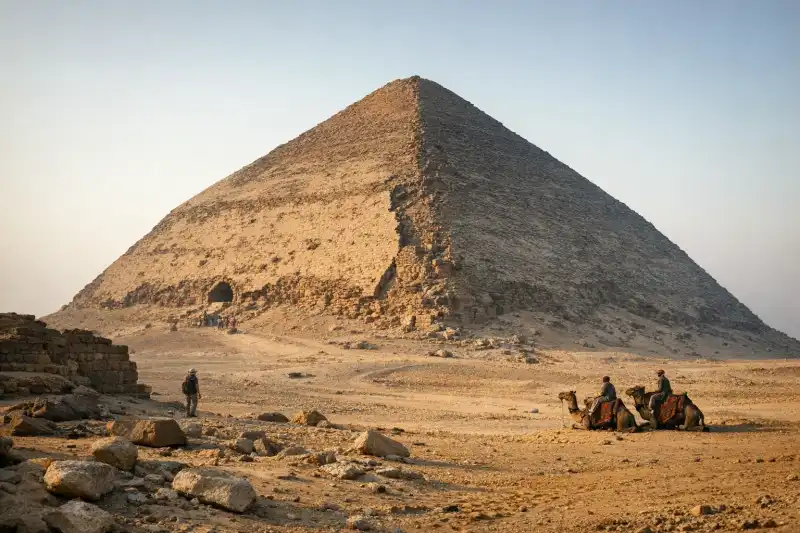
Bent Pyramid
Ancient EgyptianThe Bent Pyramid in Egypt is a rare Old Kingdom monument where a dramatic change in angle reveals th...
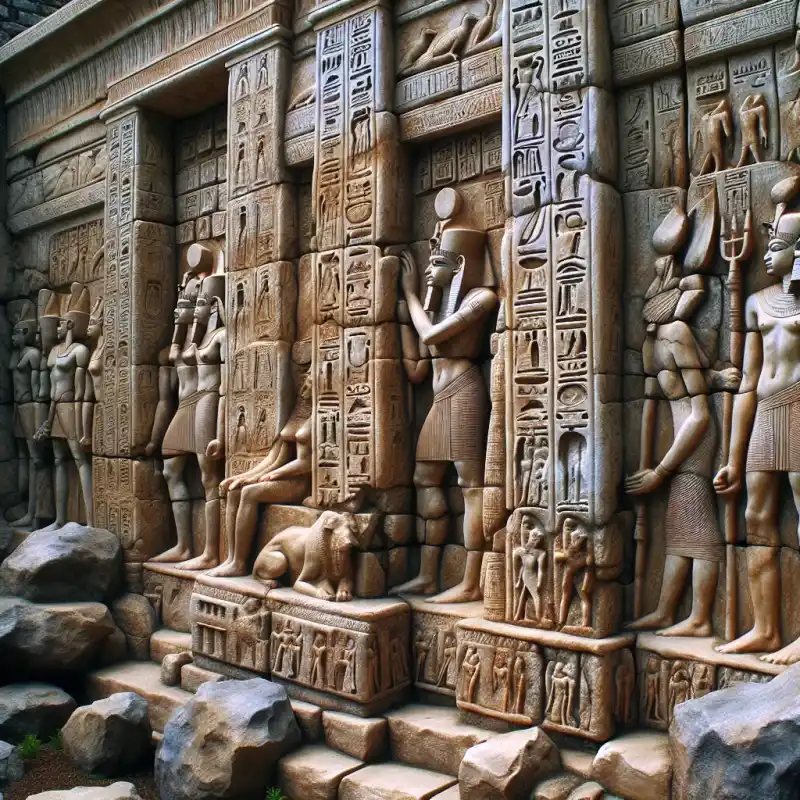
Abydos Temple Egypt Guide 2026: Temple of Seti I & King List
New Kingdom-PtolemaicAbydos Temple near Luxor: magnificent Temple of Seti I with war reliefs, ancient king list, and vibr...
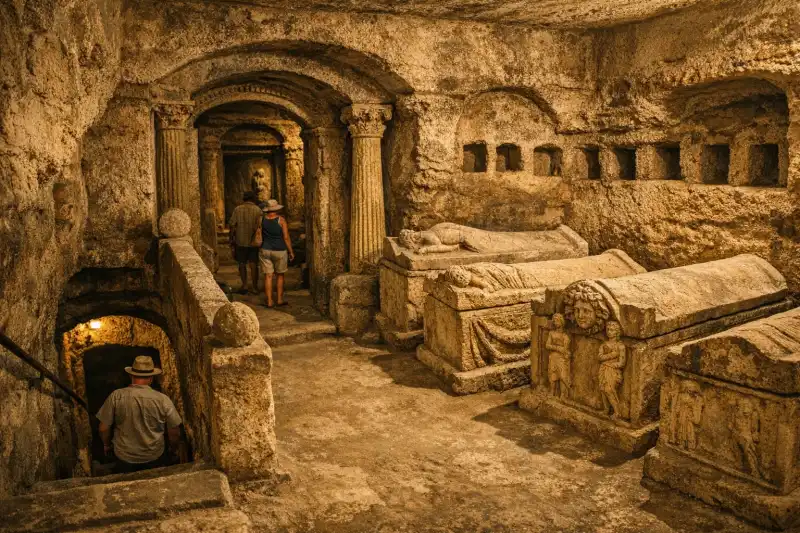
Alexandria Catacombs
Greco-Roman EgyptExplore Alexandria Catacombs in Egypt, a remarkable Roman-era underground necropolis blending Egypti...