Quick Info
At a glance
In the flat, fertile Nile Delta of Egypt, the Tombs of the Kings of Tanis stand in a landscape very different from the desert settings most travelers imagine when they think of pharaonic burial grounds. Here, amid fields, canals, and low mounds of ancient stone, the remains of a royal necropolis tell the story of a political center that rose to prominence in the north while Thebes still held immense religious authority in the south. The site is quieter and less monumental at first glance than places such as Luxor or Giza, yet that understatement is part of its power. Tanis rewards visitors who appreciate archaeology, atmosphere, and the sense of discovery that comes from standing where some of Egypt’s most surprising royal burials were unearthed.
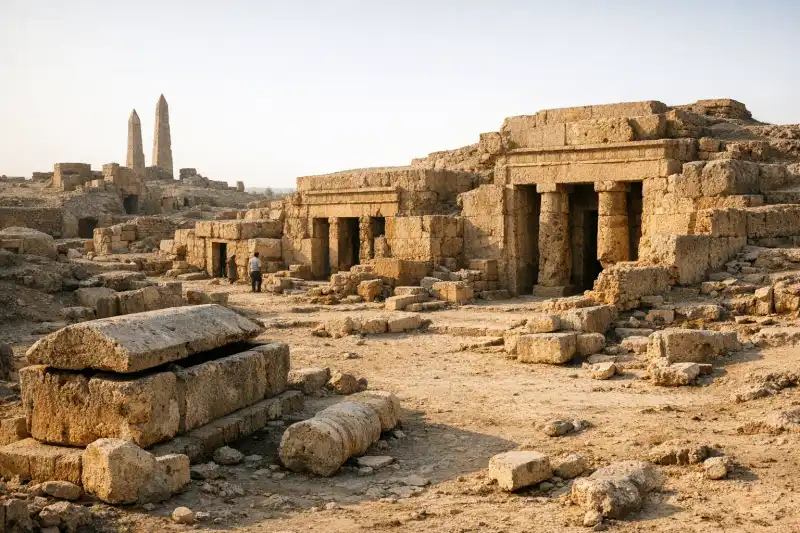
For many years, Tanis was known chiefly to specialists and readers of excavation reports. Then the fame of its royal tombs grew because several burials from the 21st and 22nd Dynasties were found with precious funerary objects still in place, a rarity in Egyptian archaeology. Although most spectacular artifacts now reside in museums, the site itself remains deeply evocative. Broken columns, reused blocks bearing the names of earlier pharaohs, temple foundations, and the funerary zone all combine to reveal a city that once projected royal legitimacy in the Delta. Visiting Tanis is less about seeing one dramatic monument and more about understanding a historical landscape where kings were buried, memory was curated, and the north of Egypt asserted its place in the long story of pharaonic power.
History
Tanis and the rise of a Delta capital
Tanis emerged as a major center during the later phases of ancient Egyptian history, especially in the Third Intermediate Period. Its prominence followed the decline of Pi-Ramesses, the earlier royal residence in the eastern Delta. As the branch of the Nile that supported Pi-Ramesses shifted and silted up, monuments, statues, and masonry were transported and reused at Tanis. This practice is one reason the site contains inscriptions and architectural elements associated with earlier kings, including Ramesside rulers, even though many of those pieces were not originally created there.
By the 21st Dynasty, roughly in the 11th century BCE, Tanis had become a royal seat in Lower Egypt. Egypt at this time was politically complex. Kings based in the north governed from Tanis, while high priests of Amun at Thebes exercised enormous religious and regional power in Upper Egypt. Rather than a simple collapse, this period reveals a negotiated balance between centers of authority. Tanis was therefore not a marginal city, but one of the key places from which kingship was articulated and displayed.
The rulers of Tanis invested in temples, administration, and funerary structures. Their choice to build and be buried there underlined the city’s importance. In a country where royal burial traditions had often been associated with distinct landscapes like the Valley of the Kings, the Tanite necropolis represents a different model: royal tombs integrated into the sacred and political heart of a Delta capital.
The royal necropolis of the 21st and 22nd Dynasties
The tombs at Tanis are especially associated with kings of the 21st and 22nd Dynasties, including Psusennes I, Amenemope, and Shoshenq II. Their burials help historians reconstruct a period once considered obscure compared with the Old, Middle, and New Kingdoms. These were not minor local chiefs but pharaohs who consciously adopted the symbols and rituals of kingship, even as they ruled in changing political circumstances.
One of the most remarkable aspects of Tanis is that several of its royal burials survived with extraordinary funerary goods. Due in part to the waterlogged conditions of the Delta and the tomb architecture, some chambers were less vulnerable to the kinds of ancient looting that devastated many other Egyptian royal tombs. While humidity damaged organic materials, metals, stone sarcophagi, jewelry, and ceremonial objects survived in enough quantity to transform scholarly understanding of the period.
Psusennes I, in particular, became famous through the discovery of an intact silver coffin and richly adorned burial equipment. Silver was rarer than gold in ancient Egypt, making this find especially significant. The Tanis tombs showed that the rulers of the Third Intermediate Period commanded considerable wealth and maintained sophisticated burial traditions. They also complicated older assumptions that the era was merely one of decline.
Discovery in the modern era
The modern rediscovery of the royal tombs is inseparable from the work of French archaeologist Pierre Montet, who excavated at Tanis in the early 20th century. In 1939 and the years immediately around that date, Montet uncovered royal tombs whose importance rivaled the great discoveries elsewhere in Egypt. Yet the timing was unfortunate from a publicity perspective. With Europe entering the turmoil of the Second World War, the finds never achieved quite the same global fame as the discovery of Tutankhamun’s tomb.
Nevertheless, among Egyptologists the importance of Tanis has always been clear. The excavations demonstrated that royal burials in the Delta could preserve historical information of the highest order. Inscriptions, burial assemblages, architectural contexts, and reused monuments all expanded knowledge of northern Egypt in the first millennium BCE. The finds also underscored how much the ancient Delta, often harder to preserve and excavate than desert sites, still had to reveal.
Tanis today
Today, the archaeological site of Tanis presents visitors with a layered landscape rather than a fully reconstructed monument. The royal tombs, temple remains, and scattered colossal fragments testify to centuries of reuse, adaptation, and excavation. Much of the portable treasure is now displayed in museums, where it can be protected from environmental damage. At the site itself, the appeal lies in seeing the place in its original geographic setting: a Delta center shaped by waterways, agriculture, and the shifting fortunes of dynasties.
For travelers interested in ancient Egypt beyond the standard circuit, Tanis offers a more contemplative experience. Its history is not only about buried wealth but also about resilience, political reinvention, and the survival of royal ideology in a changing world.
Key Features
The defining feature of the Tombs of the Kings of Tanis is the royal necropolis itself, a cluster of tombs embedded within the sacred precinct of the city. Unlike the dramatic cliff-cut burial landscapes of Upper Egypt, the tombs here are part of a flatter urban-religious environment. This different topography changes how the site is experienced. Instead of approaching a single imposing façade, visitors move through an archaeological field where tombs, temple structures, and reused stone blocks are read together. The result is a more forensic and immersive sense of history, as if the city and its burials are still being pieced back into coherence.
The tomb chambers are historically important because they belonged to kings who ruled during the Third Intermediate Period, especially Psusennes I and related royal figures. Though the site no longer holds the glittering grave goods discovered during excavation, standing at the necropolis allows visitors to appreciate the context of those finds. It becomes easier to imagine how sarcophagi, nested coffins, jewelry, ritual vessels, and funerary masks once fit into a carefully planned ceremonial world. Knowing that some of these burials were found in comparatively intact condition gives the area a quiet intensity. You are not simply at another ruin; you are at one of the places that reshaped modern understanding of late pharaonic kingship.
Another striking element of Tanis is the widespread reuse of older monuments. Throughout the site, blocks, statues, and inscriptions reveal how Tanite rulers appropriated the legacy of earlier dynasties. This was not random scavenging alone. In ancient Egypt, reusing monumental stone could also be a political act, linking current rulers with the prestige of revered predecessors. As visitors encounter pieces bearing Ramesside names in a later Delta capital, they glimpse how historical memory was physically assembled into architecture. Tanis thus becomes a lesson in royal image-making as much as in burial archaeology.
The temple remains are equally important to the overall experience. The city was not only a cemetery; it was a ritual and administrative center. The sacred enclosure, columns, gateways, and colossal fragments suggest a once-impressive ceremonial landscape, even if much survives only at foundation level or as displaced debris. The temple precinct helps explain why kings chose to be buried here. Burial near a major cult center reinforced sacred legitimacy. It placed the dead ruler within a landscape of worship, royal display, and cosmic order. At Tanis, the line between city of the living and city of the dead feels particularly thin.
The environmental character of the Nile Delta is itself a feature worth noticing. Tanis lacks the stark, cinematic desert vistas associated with many Egyptian sites. Instead, its surroundings are green, cultivated, and humid by Egyptian standards. This setting reminds travelers that ancient Egypt was not culturally or geographically uniform. The Delta had its own political priorities, logistical networks, and ecological challenges. Those conditions affected construction, preservation, and burial practices. They also explain why Tanis can feel both less monumental and more mysterious than sites built against desert cliffs.
Perhaps the most memorable quality of Tanis is its atmosphere of incomplete revelation. Broken stone lit by soft Delta sun, birds crossing over fields, and low mounds concealing centuries of human intervention all create a sense that the site is still half-emerging from the ground. For travelers who enjoy archaeology as an act of interpretation rather than passive sightseeing, this is a major part of the appeal. Tanis asks you to imagine, connect evidence, and read absence as carefully as presence. That intellectual engagement is one of its greatest rewards.
Getting There
The Tombs of the Kings of Tanis are usually reached from Cairo, which remains the most practical base for most travelers. Tanis lies in the northeastern Nile Delta near the modern village of San El-Hagar in Sharqia Governorate. Because the site is relatively remote and public transport is not especially visitor-friendly, the easiest option is to hire a private car and driver for the day. From Cairo, the journey generally takes around 2.5 to 3.5 hours each way depending on traffic and your starting point. A full-day private car arrangement often costs roughly $70 to $140 USD, depending on vehicle type, waiting time, and whether you book through a hotel, local operator, or independent driver.
Guided tours are less common than for Egypt’s major attractions, but private archaeology-focused day trips can sometimes be arranged from Cairo. These may cost from about $120 to $250 USD per person if transport, guide, and site coordination are included. For travelers who value historical context, this is often worth it, since signage and visitor facilities at the site can be limited.
Public transport is possible but more complicated. You may need to combine a train or bus from Cairo to a Delta town with a local taxi or minibus onward to San El-Hagar. Costs can be low, sometimes under $15 to $25 USD total one way, but the trade-off is time, uncertainty, and language barriers. Once in the area, a local taxi for the final leg may add a modest fare, often negotiable.
Bring water, sun protection, cash for small local expenses, and offline maps. If you are arranging your own trip, confirm opening expectations locally before departure.
When to Visit
The best time to visit the Tombs of the Kings of Tanis is between October and April, when daytime temperatures across northern Egypt are milder and walking the exposed archaeological area is far more comfortable. Winter in the Delta is generally pleasant rather than cold, with many days ideal for slow exploration. This is the season when the site feels most inviting, especially for travelers coming from Cairo on a day trip. The softer light can also be good for photography, giving the stone remains and low-lying ruins more texture.
Late spring, especially April into May, can still be manageable, but temperatures begin to rise and the open site offers limited shelter. Summer, from roughly June through September, is the least comfortable period. Although the Delta is not as intensely hot as southern Egypt, heat and humidity can still make midday exploration tiring. If you must visit in summer, aim to arrive as early as possible, wear a hat, and carry more water than you think you need.
Autumn is another excellent choice, particularly in October and November, when temperatures ease after summer and fields around the site can add to the atmosphere. Seasonal agricultural activity in the surrounding landscape sometimes makes the Delta especially beautiful at this time.
As with many archaeological sites, weekday visits may feel quieter than weekends or public holidays, though Tanis is generally far less crowded than Egypt’s headline monuments. Morning visits are best for cooler conditions, gentler light, and a calmer experience.
| Quick Facts | Details |
|---|---|
| Location | San El-Hagar area, Sharqia Governorate, Egypt |
| Ancient significance | Royal necropolis and capital center of Tanis |
| Main period | 21st and 22nd Dynasties, Third Intermediate Period |
| Best known for | Royal tombs of kings including Psusennes I |
| Famous discovery | Richly furnished royal burials excavated by Pierre Montet |
| Best base | Cairo |
| Time needed | Half day on site; full day from Cairo |
| Best season | October to April |
| Site character | Open-air archaeological ruins in the Nile Delta |
| Ideal for | History lovers, archaeology enthusiasts, repeat Egypt travelers |
A visit to the Tombs of the Kings of Tanis is not about ticking off Egypt’s most instantly recognizable monument. It is about entering a less-visited chapter of ancient history and seeing how power adapted when capitals shifted, landscapes changed, and royal identity had to be renewed in a different setting. The site rewards patience, background reading, and curiosity. If you come expecting a polished, heavily interpreted attraction, Tanis may feel understated. If you come seeking authenticity, historical depth, and the rare chance to stand in a place where pharaonic burials were found against the odds, it can be unforgettable.
In that sense, Tanis offers one of the most meaningful kinds of travel experience: the chance to move beyond familiar images and encounter Egypt as a larger, more varied civilization than the usual postcard version suggests. Here in the Delta, among fragments of temples and the graves of kings, ancient Egypt feels both more complex and more human.
Guided tours: worth it?
Most travelers can visit Tombs of the Kings of Tanis independently. Compare a tour only if you want a tighter history-focused visit, easier logistics, or a guide who can answer questions on the spot.
Best for
- Short visits where a planned route saves time
When to go self-guided
Go independently if you prefer setting your own pace, reading as you go, and checking official hours or ticket rules directly before you arrive.
What I’d avoid
Skip paid tours that bundle unrelated stops you do not actually want. The best option should either save meaningful planning time or add historical context you would miss on your own.
Egypt Delta and Tanis Archaeology Tours
Useful when: you want to compare guided formats before deciding
Day Trips from Cairo to Ancient Egyptian Sites
Useful when: transport or pickup logistics matter
Private Egypt Archaeological Tours
Useful when: you want flexible timing or a private guide
Some tour links are affiliate links, which may earn Ancient Travel a small commission at no extra cost to you. I try to surface options that make practical sense for the site—not just anything bookable.
Frequently Asked Questions
Where are the Tombs of the Kings of Tanis located?
The royal tombs are at ancient Tanis in Egypt's Nile Delta, in modern Sharqia Governorate, northeast of Cairo.
Why are the Tombs of the Kings of Tanis important?
They are among the most significant royal burials discovered in Egypt because several tombs of the 21st and 22nd Dynasties were found with rich grave goods and relatively intact contents.
Can you visit the Tombs of the Kings of Tanis independently?
Independent visits are possible in principle, but many travelers find a private driver or guided tour from Cairo easier because public transport connections are limited and the site is remote.
How much time should you spend at Tanis?
Allow at least half a day on site, or a full day from Cairo including travel time, to explore the ruins and understand the royal necropolis.
Are treasures from the Tanis tombs still at the site?
Most major treasures uncovered in the tombs were transferred to museums for preservation, so visitors mainly see the archaeological remains and setting rather than the portable artifacts.
What is the best time of year to visit Tanis?
The coolest and most comfortable season is from October to April, when temperatures are milder and walking around the exposed ruins is easier.
Nearby Ancient Sites
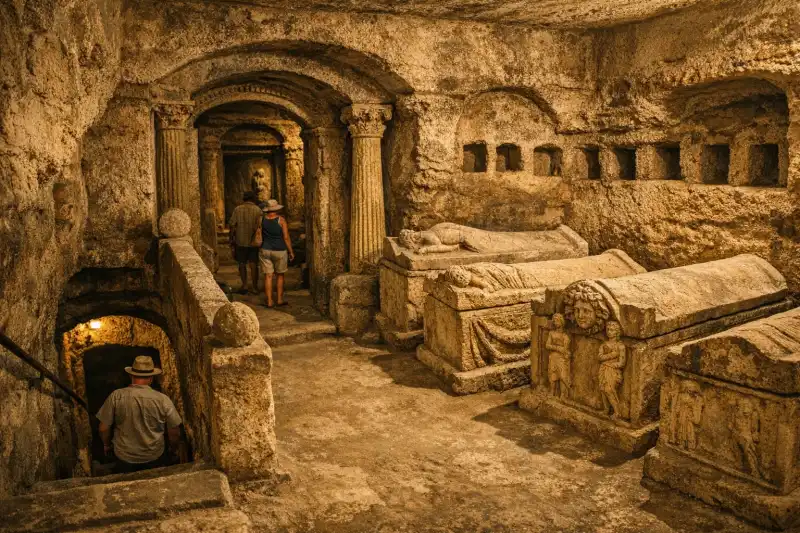
Alexandria Catacombs
Greco-Roman EgyptExplore Alexandria Catacombs in Egypt, a remarkable Roman-era underground necropolis blending Egypti...
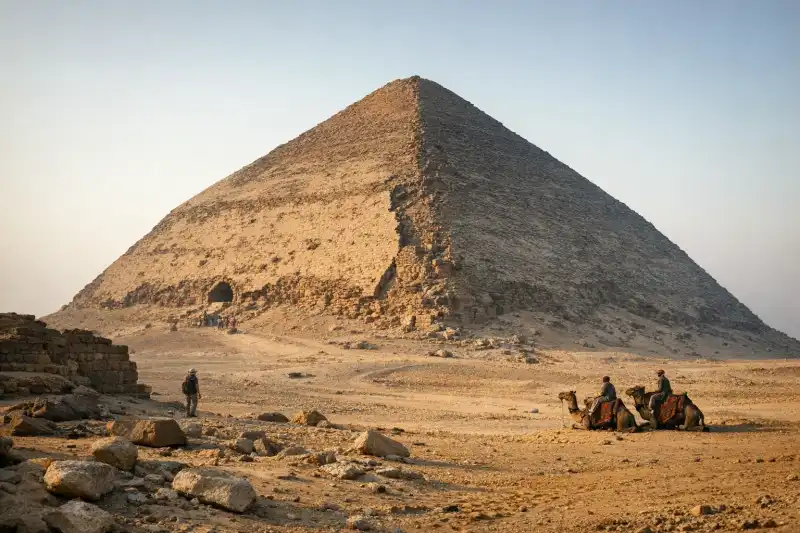
Bent Pyramid
Ancient EgyptianThe Bent Pyramid in Egypt is a rare Old Kingdom monument where a dramatic change in angle reveals th...
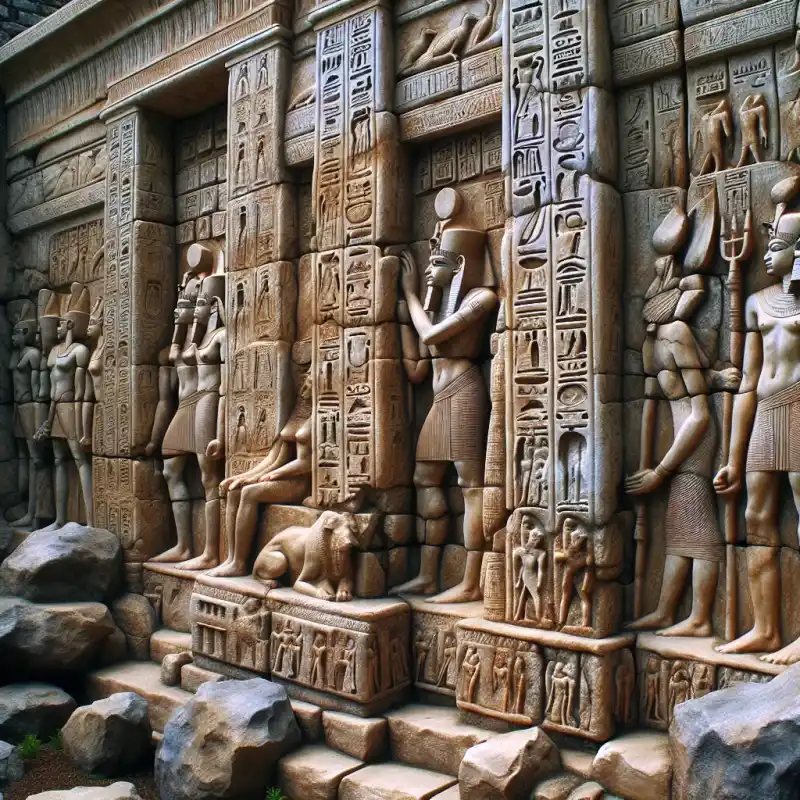
Abydos Temple Egypt Guide 2026: Temple of Seti I & King List
New Kingdom-PtolemaicAbydos Temple near Luxor: magnificent Temple of Seti I with war reliefs, ancient king list, and vibr...