Quick Info
Curated Experiences
Tower of London and Crown Jewels Guided Tour
London Historic Landmarks Walking Tour with Tower Entry
Private Tower of London Experience
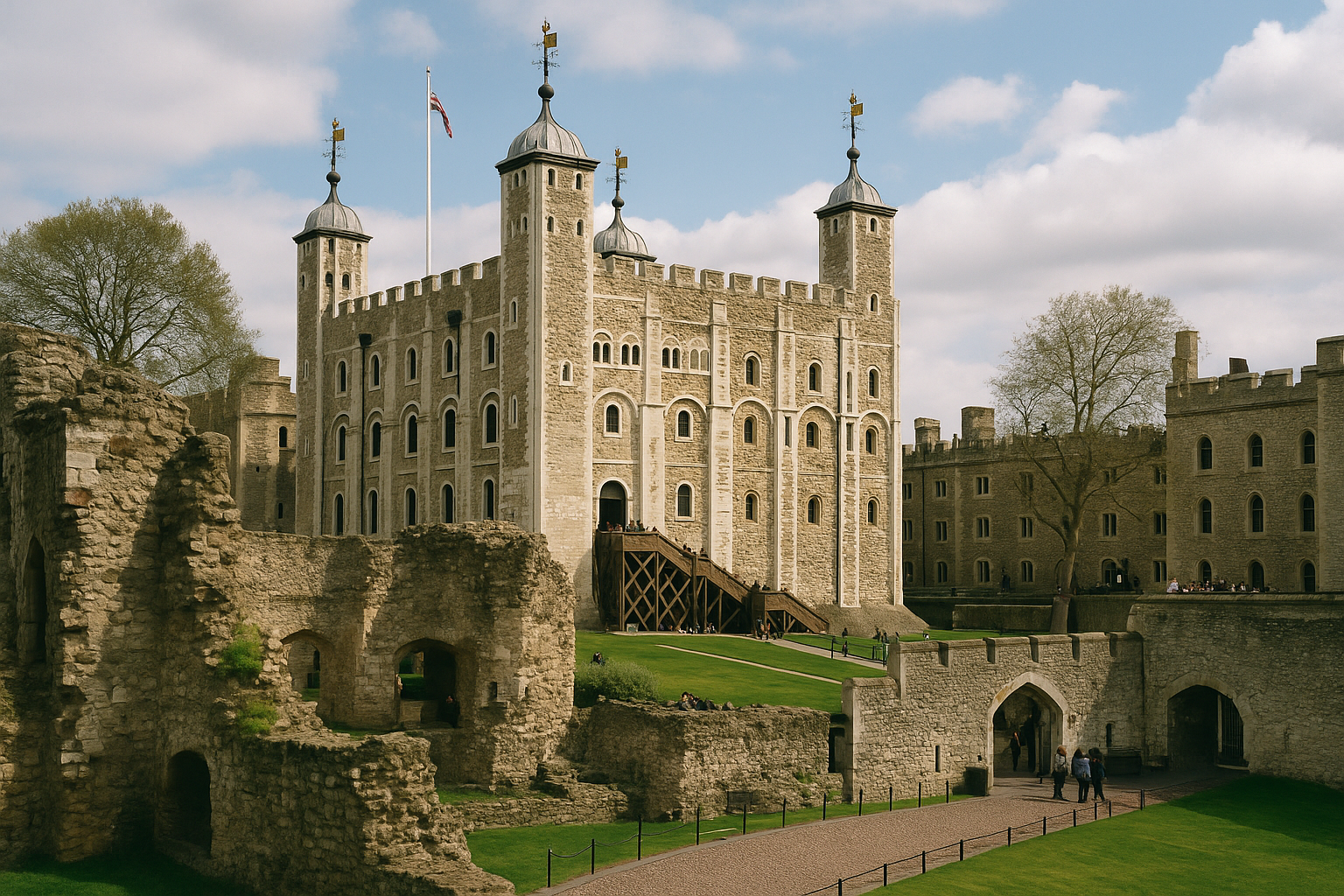
You smell the Thames before you see the walls. Then you round the corner from Tower Hill station and the fortress is simply there, a mass of pale stone and dark turrets rising from the riverbank, looking exactly the way it has for the better part of a thousand years. The scale is wrong for modern London — the White Tower sits low and broad against the glass towers of the City, a building designed to terrify a medieval population that now shares a skyline with the Shard. But walk through the outer gate, cross the bridge over the dry moat, and the 21st century falls away with surprising speed. The cobblestones underfoot are worn smooth by centuries of boots.
The Tower of London is one of those rare sites where history is not abstract. People were crowned here, imprisoned here, tortured and executed here — sometimes all three in the same generation. The Crown Jewels sit in a vault a short walk from the scaffold site on Tower Green. Ravens patrol the lawns under a superstition that if they ever leave, the kingdom will fall. Yeoman Warders in Tudor dress live inside the walls and tell the stories with the dark humor of people who know every ghost in every corridor. Nearly a thousand years of English power, pageantry, and violence are compressed into a single riverside fortress, and unlike many famous landmarks, the Tower delivers on every layer of that promise.
For first-time visitors to London, the Tower is the single best place to anchor a day. Budget at least three hours, go straight for the Crown Jewels at opening, then let a Beefeater tour give you the narrative threads to follow as you explore on your own.
Historical Context
William the Conqueror began construction of the White Tower in 1078, barely a dozen years after the Battle of Hastings. The structure was not subtle. Built from pale Caen stone imported from Normandy, it was the tallest building in London for centuries, visible from every approach to the city and designed to communicate a simple message to its Saxon population: new management has arrived, and it is not leaving. The White Tower remains the oldest intact part of the complex and the architectural centerpiece visitors see today.
Successive monarchs expanded the fortifications dramatically. Henry III added the inner curtain wall and transformed the complex into a royal residence during the 13th century. Edward I constructed the outer wall and filled the moat, creating the concentric defensive layout that defines the site. By Edward’s reign, the Tower had also become England’s primary state prison — a role it would hold for nearly five hundred years. The menagerie (royal zoo) arrived around the same time, housing exotic animals gifted by foreign rulers; the last animals were transferred to the newly founded London Zoo in 1835.
The Tower’s most infamous chapters belong to the Tudor era. Henry VIII imprisoned and executed two of his wives within these walls — Anne Boleyn in 1536 and Catherine Howard in 1542. The young princes Edward and Richard vanished inside the Tower in 1483, a mystery that still generates scholarly argument and popular fascination in roughly equal measure. Lady Jane Grey, queen for nine days, was executed on Tower Green in 1554. Sir Walter Raleigh spent thirteen years imprisoned in the Bloody Tower, where he wrote his History of the World.
By the 17th century, the Tower’s function shifted toward ceremony, storage, and symbolic authority, though it held prisoners as late as World War II. Rudolf Hess was briefly detained here in 1941, and the last execution on Tower grounds — that of a German spy — took place in 1941 as well. Today the Tower operates as a museum, a ceremonial garrison, and the permanent home of the Crown Jewels, attracting roughly three million visitors per year.
What to See
The Crown Jewels
The Crown Jewels are the Tower’s biggest draw and the source of its longest queues. The collection, housed in the Jewel House, includes the Imperial State Crown (set with 2,868 diamonds, 17 sapphires, 11 emeralds, and 269 pearls), the Sovereign’s Orb, and the Sovereign’s Sceptre containing the 530-carat Cullinan I, the largest clear-cut diamond in the world. The display is well-designed, with historical context panels leading to a darkened vault where a moving walkway carries you past the main pieces at a steady pace. On a first pass, you take in the sheer volume of gold and gemstone; on a second (you can loop back), you start to appreciate the craftsmanship and the ceremonial function of each object. Go here first at opening — by mid-morning the line can stretch to 45 minutes or more.
The White Tower
The Norman keep is the architectural and historical heart of the complex. Inside, the Royal Armouries collection spans centuries of arms and armor, from medieval broadswords to a suit of armor made for a young Henry VIII and another made later in his life, noticeably larger around the middle. The Chapel of St. John the Evangelist on the upper floor is one of the finest surviving examples of early Norman church architecture — barrel-vaulted, unadorned, and built to impress through mass rather than decoration. It has been in continuous use for nearly a thousand years. Allow 45 minutes to an hour for the White Tower, and do not skip the top floor, where the views from the windows reward the stair climb.
Yeoman Warder Tours
These guided walks are among the best free interpretation experiences at any heritage site in England. The Yeoman Warders (Beefeaters) are retired senior military personnel who live on-site with their families — there are roughly 35 of them, plus one Chief Warder. Their tours last about 60 minutes, depart regularly from near the main entrance, and cover the complex’s major stories with polished delivery and a dark sense of humor honed by thousands of repetitions. The tours are entertaining, informative, and also functional: they orient you geographically so that your independent exploration afterward is more efficient. Catch one early in your visit.
Tower Green and the Chapel Royal
Tower Green is the site of private executions — a privilege, in the grim logic of the period, reserved for high-status prisoners who were spared the public spectacle of Tower Hill. Only seven people were executed here, including Anne Boleyn and Catherine Howard. A glass memorial by artist Brian Catling marks the spot today. The adjacent Chapel Royal of St. Peter ad Vincula contains the remains of those executed figures, buried beneath the altar and the nave floor. Access to the chapel is typically through a Yeoman Warder tour or during the final hour before closing, when you can enter independently.
The Medieval Palace and Battlements
The reconstructed rooms of Edward I’s medieval palace offer a tangible sense of royal domestic life within the fortress — a recreated throne room, bedchamber, and chapel with period furnishings. The wall walk along the southern battlements delivers views over the Thames, Tower Bridge, and the modern City skyline. This stretch is the quietest part of the site and the one most visitors skip, which makes it the best place to pause, absorb the scale of the complex, and remind yourself that the Tower was not only a prison but a functioning seat of government for centuries.
The Bloody Tower and Ravens
The Bloody Tower is where the two young princes were last seen alive in 1483, and where Sir Walter Raleigh was later imprisoned. The displays inside reconstruct Raleigh’s surprisingly comfortable study. Nearby, keep watch for the Tower’s resident ravens — at least six are maintained at all times by the Ravenmaster, a dedicated Yeoman Warder whose full-time job is caring for the birds. The ravens are large, intelligent, and accustomed to visitors. They are also, according to a tradition dating to the reign of Charles II, essential to the survival of the monarchy.
Timing and Seasons
The Tower opens at 9:00 AM Tuesday through Saturday and at 10:00 AM on Sundays and Mondays. Last admission is 4:30 PM in winter (November through February) and 5:30 PM in summer. The site closes one hour after last admission.
Summer (June through August) brings the heaviest crowds, school holiday groups, and warm but often overcast weather in the 18-25°C range. The first hour after opening and the final 90 minutes before closing are your best windows. Spring (April to May) and autumn (September to October) offer the ideal balance: milder temperatures around 12-18°C, manageable crowds, and the best chance of clear weather for battlement views. Winter visits (November through March) are underrated — the complex is atmospheric in cold weather, crowds thin significantly on weekdays, and the queues for the Crown Jewels drop to near zero.
Weekdays are always less crowded than weekends. Avoid bank holidays and half-term school breaks if possible.
Tickets, Logistics and Getting There
Standard adult admission is approximately $40 (GBP 33.00 as of 2026), with discounts for children (5-15), students, and seniors. Children under 5 enter free. Family tickets are available. Book online in advance at the Historic Royal Palaces website — this secures a timed entry slot and avoids the walk-up ticket queue, which can add 15-20 minutes during peak season. Members of Historic Royal Palaces enter free and skip the main queue entirely; an annual membership pays for itself in two visits.
The nearest Underground station is Tower Hill (Circle and District lines), a three-minute walk from the main entrance. Tower Gateway on the DLR is equally close. London Bridge station (Northern and Jubilee lines) is a 10-minute walk via Tower Bridge. River bus services stop at Tower Pier, directly adjacent to the fortress. If arriving by car, there is no dedicated parking; use nearby NCP lots or the Congestion Charge zone public parking options.
Allow time for airport-style security screening at the entrance — bags are scanned and large luggage is not permitted. There is a small luggage storage facility near the ticket office.
Practical Tips
- Wear sturdy, flat shoes. The grounds include cobblestones, uneven medieval paving, and narrow spiral staircases inside the towers. Heels and smooth-soled shoes are a genuine hazard on wet stone.
- Bring layers. Much of the site is outdoors or inside unheated stone buildings where temperatures drop noticeably, even in summer.
- A compact umbrella is wise in any season. London’s weather does not respect forecasts.
- Photography is permitted everywhere except inside the Crown Jewels vault.
- The onsite cafe (New Armouries) serves hot meals, sandwiches, and coffee at London tourist prices. For better value, eat before or after your visit at one of the restaurants along St. Katharine Docks, a five-minute walk east.
- Audio guides are available for roughly $7 and provide good context if you prefer self-guided exploration over the Yeoman Warder tour.
- The gift shop is well-stocked and actually worth browsing; the books on Tudor history and the Tower’s own past are curated with more care than typical museum retail.
Suggested Itinerary
9:00 AM — Arrive at opening (Tuesday-Saturday). Clear security and head directly to the Jewel House for the Crown Jewels before the queue builds. Allow 20-30 minutes.
9:30 AM — Join the next available Yeoman Warder tour near the entrance. The walk takes about 60 minutes and ends near the Chapel Royal of St. Peter ad Vincula.
10:30 AM — Explore the White Tower independently. Spend 45 minutes with the Royal Armouries collection and the Chapel of St. John.
11:15 AM — Visit the Bloody Tower, then walk to the boat sheds at the ancient watergate (Traitors’ Gate) and along the southern battlements for Thames views and the Medieval Palace rooms.
12:00 PM — Loop back through Tower Green. If you missed the Chapel Royal on the Warder tour, enter independently during this window. Spend remaining time with the ravens and any secondary exhibits (the Fusiliers Museum, the torture exhibit in the basement of the Wakefield Tower).
12:30 PM — Exit and walk across Tower Bridge for lunch on the South Bank, or east to St. Katharine Docks.
Nearby Sites
Stonehenge is roughly 90 miles southwest of London and reachable by car in about two hours, or by train to Salisbury followed by a shuttle bus. The prehistoric monument complex offers a fundamentally different chapter of British history — megalithic construction predating the Tower by three thousand years. A day trip from London is feasible but long; consider an overnight in Salisbury.
Roman Baths, Bath lies about 115 miles west, an easy 90-minute train ride from London Paddington. The remarkably preserved thermal complex shows the infrastructure of Roman Britain, the occupying power that preceded the Normans by a millennium.
Sutton Hoo in Suffolk, roughly two hours northeast by car, preserves the Anglo-Saxon royal burial ground that fills in the gap between Roman withdrawal and the Norman conquest that produced the Tower itself. The landscape is quiet and atmospheric — a useful counterpoint to the Tower’s urban density.
Hadrian’s Wall runs across northern England, about four to five hours by car or three hours by train to Newcastle. The Roman military frontier is best experienced over two or three days with a car, walking sections of the wall and visiting the fort museums at Housesteads and Vindolanda.
Final Take
The Tower of London is not a place to rush. Its power lies in accumulation — conquest layered on ceremony layered on imprisonment layered on spectacle, all compressed into a riverside fortress that has been in continuous use since the 1070s. Arrive at opening, see the Crown Jewels before the queues build, take a Yeoman Warder tour to connect the narrative threads, and give yourself enough time to walk the battlements and discover the quieter corners where the weight of history settles most heavily.
Treated with that kind of attention, the Tower is not merely one of London’s best attractions. It is one of the most historically dense sites in Europe, a place where nearly a thousand years of English power and drama remain legible in stone, iron, and the polished facets of the Crown Jewels themselves.
Discover More Ancient Wonders
- Stonehenge — Britain’s most iconic prehistoric monument, 90 miles from London
- Roman Baths, Bath — The best-preserved Roman thermal complex in northern Europe
- Hadrian’s Wall — The Roman Empire’s northernmost frontier, spanning 73 miles across England
- Sutton Hoo — Anglo-Saxon royal burial ground bridging the gap between Rome and the Normans
- Explore our complete United Kingdom Ancient Sites Guide for more historic destinations
Quick Facts
| Attribute | Details |
|---|---|
| Location | London, United Kingdom |
| Country | United Kingdom |
| Region | London |
| Civilization | Norman and Medieval English |
| Historical Period | 11th century CE onward |
| Established | 1078 CE |
| UNESCO Status | World Heritage Site (1988) |
| Annual Visitors | ~3 million |
| Coordinates | 51.5081, -0.0759 |
Frequently Asked Questions
How long do you need at the Tower of London?
Most visitors should budget 2.5 to 4 hours depending on queue times and whether you join a Yeoman Warder talk.
What is the best time to see the Crown Jewels?
Go early at opening or later in the afternoon to reduce queue time, especially during peak tourist seasons.
Is the Tower of London suitable for kids?
Yes. The site includes dramatic architecture, armor displays, and stories that engage older children, though some exhibits involve dark historical themes.
Nearby Ancient Sites
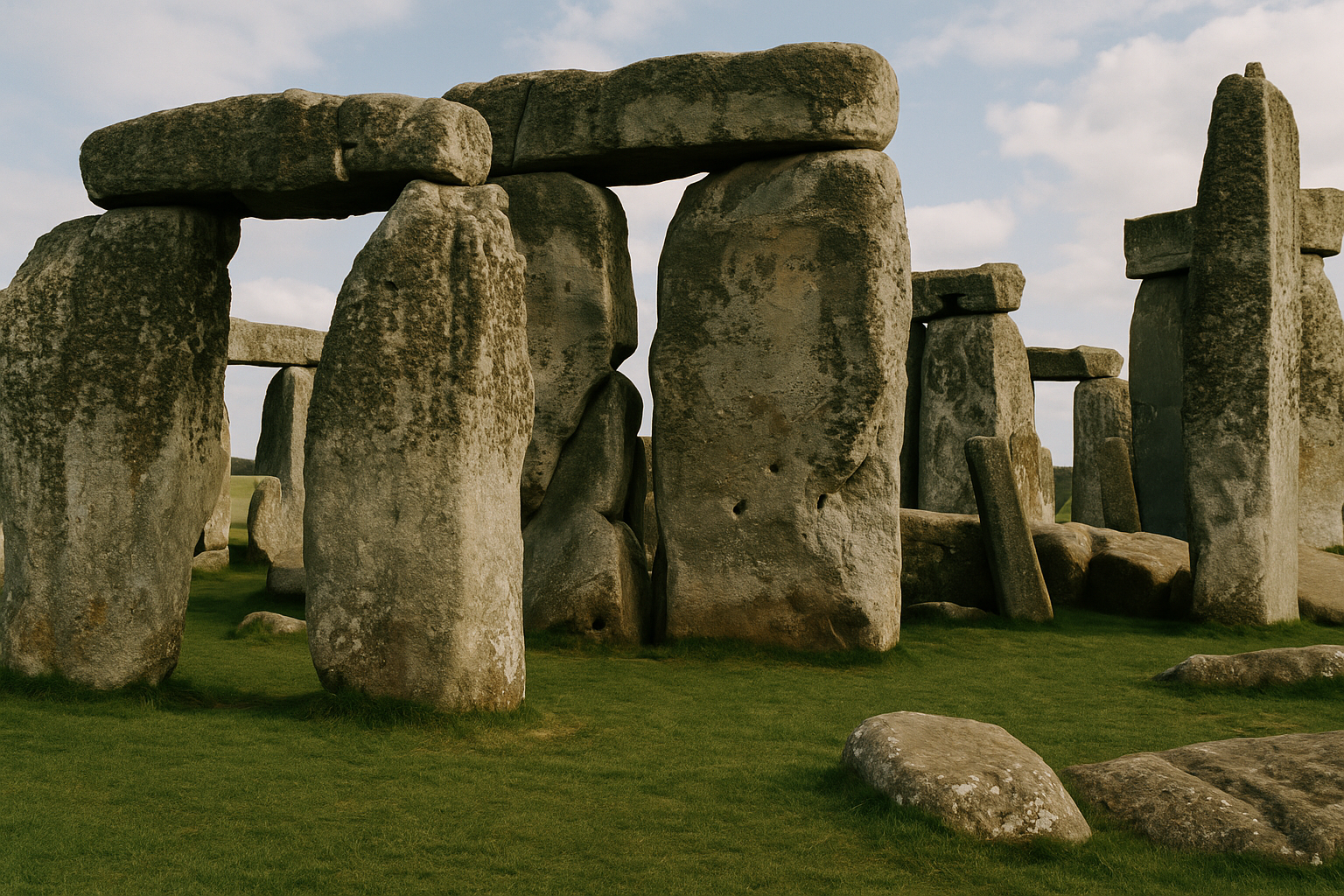
Stonehenge Travel Guide 2026: Solstice History, Tickets, and Day-Trip Planning
Neolithic and Bronze Age BritainPlan a smooth visit to Stonehenge with practical ticket timing, transport options from London and Ba...
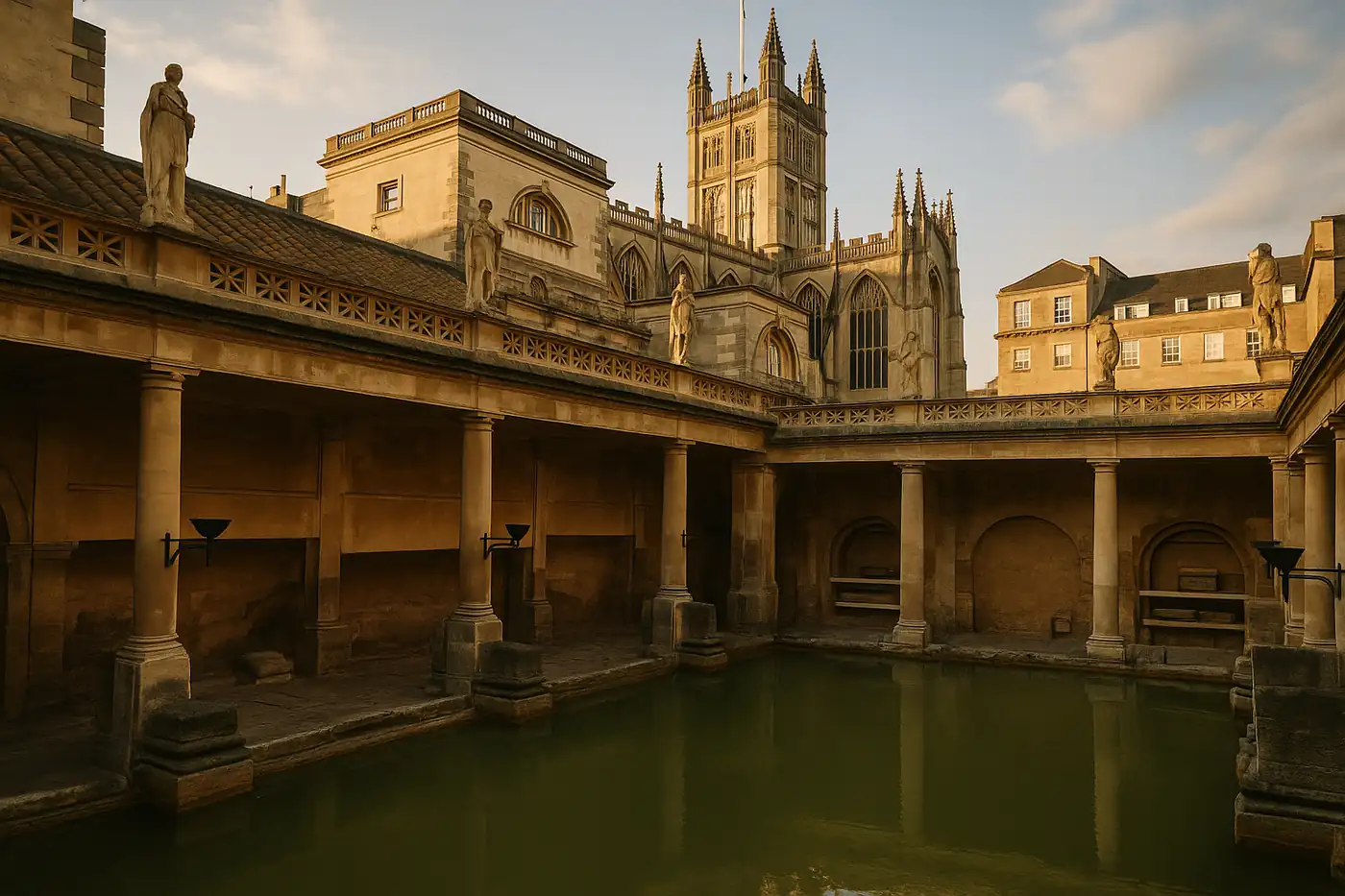
Roman Baths Bath Travel Guide 2026: Tickets, History, and Smart Visit Tips
Roman BritainPlan a better visit to the Roman Baths in Bath with clear ticket strategy, historical context, and p...
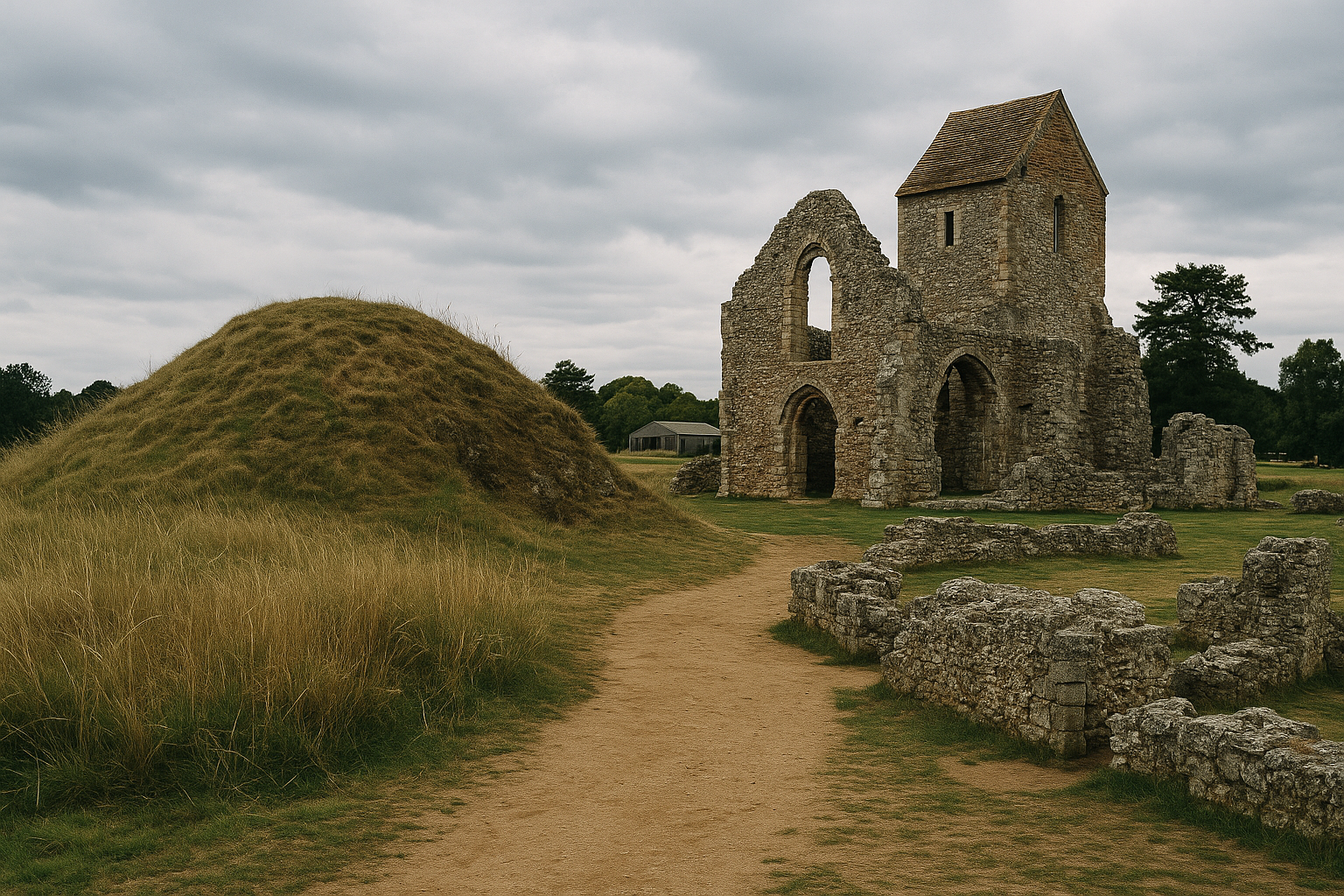
Sutton Hoo Travel Guide 2026: Anglo-Saxon Burial Site, Museum Highlights, and Suffolk Planning Tips
Anglo-Saxon Kingdom of East AngliaPlan your Sutton Hoo visit with practical museum advice, burial mound context, and itinerary tips fo...