Quick Info
Curated Experiences
Tucume Pyramids and Royal Tombs of Sipan Museum in Chiclayo
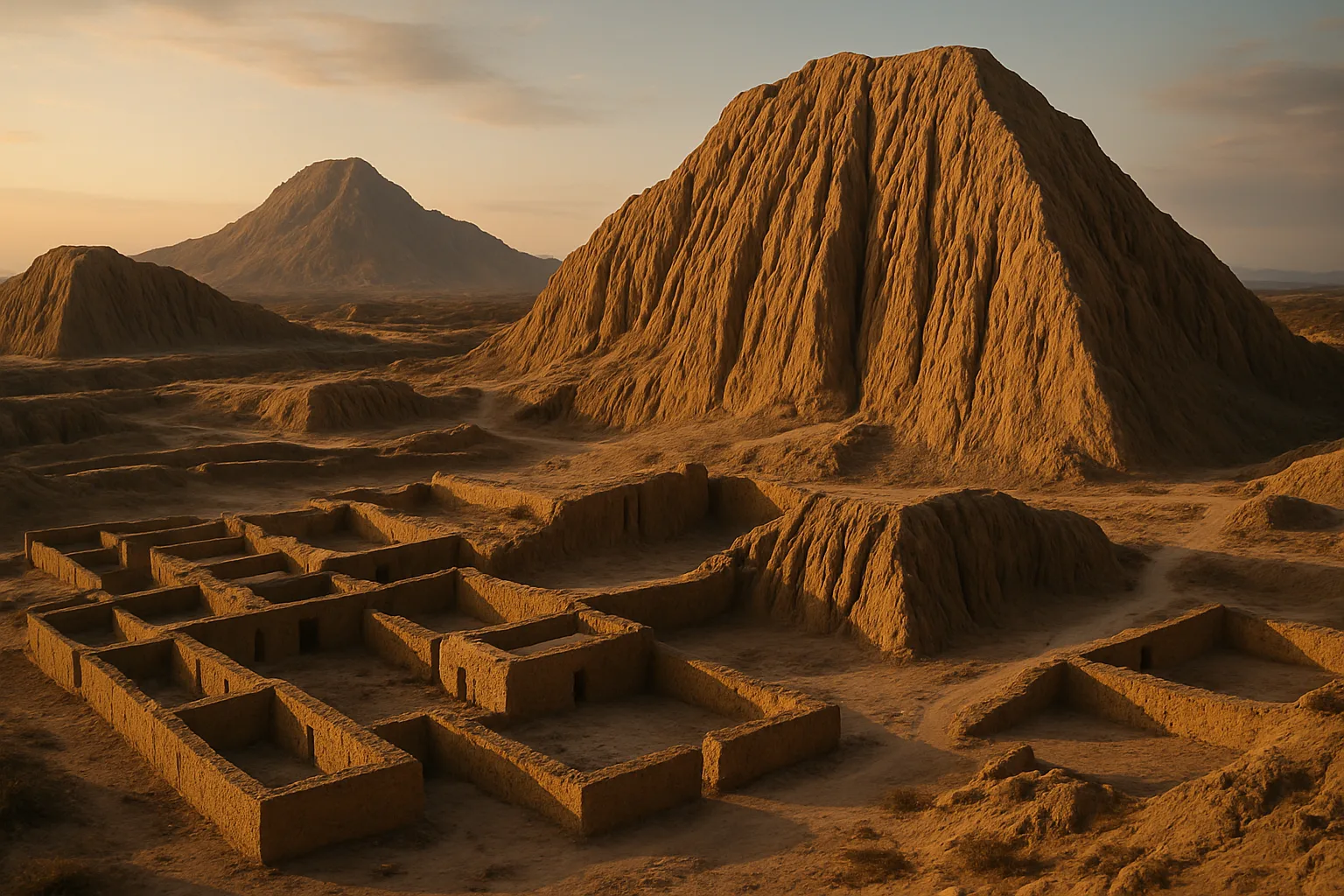
In the Lambayeque Valley of northern Peru, 26 adobe pyramids rise from the coastal desert in a cluster so dense and so massive that the site’s popular name — the Valley of the Pyramids — understates rather than exaggerates the spectacle. Tucume, built by the Lambayeque civilization around 1000 CE and later occupied by the Chimu and the Inca, is one of the most visually commanding archaeological sites in the Americas, yet it receives only a fraction of the visitors who make the more publicized journeys to Machu Picchu or Chan Chan. Standing on the mirador above the valley floor and looking across a landscape of eroded pyramids stretching toward the horizon — some reaching 30 meters in height, all constructed from millions of individually hand-molded adobe bricks — it is difficult to reconcile the scale of what you see with the near-invisibility of Tucume on most traveler itineraries.
The site covers approximately 220 hectares and represents one of the most concentrated expressions of monumental adobe architecture ever created in pre-Columbian America. The Lambayeque people (also called the Sican culture), who built the earliest pyramids here, were sophisticated metallurgists, weavers, and hydraulic engineers whose canal networks transformed this coastal desert into productive agricultural land. Their successors — the Chimu around 1375 CE and the Inca after 1470 CE — each recognized Tucume’s strategic and religious importance and built upon it rather than abandoning it. This guide covers the site’s layered history, its key monuments, practical logistics from Chiclayo, and the best strategies for combining Tucume with the region’s other extraordinary archaeological sites.
History: Three Empires on One Valley Floor
Lambayeque origins (c. 1000–1375 CE)
The Lambayeque civilization, also known as the Sican culture, established Tucume as a major ceremonial and administrative center around 1000 CE, following their earlier capital at Batan Grande to the east. Lambayeque tradition traces their origins to the mythical lord Naylamp, who arrived by sea on a raft of balsa logs and founded a dynasty that would dominate Peru’s north coast for centuries. The Lambayeque were master metallurgists — their gold and silver alloy work (tumbaga) represents some of the finest pre-Columbian metalwork ever recovered — and Tucume’s pyramids served as platforms for elite ritual, storage, and administration organized around the authority of divine rulers. The site’s location at the convergence of the La Leche and Lambayeque Rivers was no accident: controlling the valley’s water supply meant controlling its agricultural and political power.
Chimu incorporation (c. 1375–1470 CE)
Chimu Empire forces from their coastal capital at Chan Chan conquered the Lambayeque region around 1375 CE, absorbing Tucume into the largest pre-Inca state in South America. Rather than razing the existing pyramids, Chimu administrators modified and expanded them, adding their own signature architectural elements — including the elaborate mud plaster friezes of fish, birds, and geometric wave patterns identical to those found at Chan Chan. The Huaca de la Piedra Sagrada preserves the clearest evidence of this Chimu building phase: a frieze program covering the pyramid’s lower terrace walls that remained buried and protected until excavations in the late 20th century. Chimu rule at Tucume lasted less than a century before the next imperial transformation arrived from the south.
Inca conquest and use (1470–1532 CE)
Emperor Tupac Inca Yupanqui incorporated the Lambayeque region into Tawantinsuyu around 1470 CE, and Tucume’s pyramids entered a new administrative chapter. The Inca superimposed their own architectural vocabulary — rectangular enclosures (canchas), storage structures, and ritual platforms — onto the existing Lambayeque and Chimu foundations. Excavations on Huaca Larga have recovered Inca-period ceramics, textiles in the highland Inca style, and evidence of the ritual feasting and state ceremony that the Inca used to integrate conquered peoples into the imperial system. The site was still in active use when Spanish forces arrived on Peru’s north coast in the 1530s.
Archaeological rediscovery
Tucume received little systematic scientific attention until Thor Heyerdahl, the Norwegian explorer famous for the Kon-Tiki voyage, led excavations from 1988 to 1994 in collaboration with Peruvian archaeologist Gustavo Alfaro Rotondo. Heyerdahl was drawn to the site by theories connecting Lambayeque seafaring traditions to Polynesian migration, but the excavations produced findings of broader significance: intact frieze panels, elite burials with gold and silver grave goods, and stratigraphic sequences documenting the Lambayeque-Chimu-Inca succession in unprecedented detail. The on-site Tucume Site Museum, opened in 1992, was built using traditional adobe construction in deliberate reference to the pyramids it interprets.
The Key Monuments: What to See at Tucume Pyramids
Huaca Larga
The dominant structure at Tucume is Huaca Larga, measuring approximately 700 meters in length, 280 meters in width, and rising to 30 meters at its highest point. By volume, it ranks among the largest adobe constructions ever built in the Americas, requiring an estimated 300 million individual adobe bricks produced and laid over centuries of sustained effort. The pyramid’s enormous footprint encompasses multiple distinct building phases representing Lambayeque, Chimu, and Inca construction episodes stacked upon each other. The Inca added a summit platform to Huaca Larga’s northern end, creating a formal enclosure used for state ceremony — a pattern the Inca repeated at other conquered ceremonial centers throughout the Andes. Walking the base of Huaca Larga provides an immediate sense of the monument’s sheer scale: the earthen walls tower overhead for hundreds of meters, dwarfing visitors in a way that photographs consistently fail to convey. The best photography of Huaca Larga’s full length comes from the mirador summit, where a wide-angle lens captures the pyramid in relation to the valley and the remaining 25 mounds spread behind it.
The mirador (viewpoint)
A moderate trail ascends El Purgatorio — the rocky natural outcrop at the site’s eastern edge — to a viewpoint that provides the defining visual experience of Tucume. From the summit, all 26 pyramids are simultaneously visible, arranged across the valley floor in a pattern that reveals the deliberate spatial organization of the ceremonial center: the largest pyramids grouped at the core, smaller mounds radiating outward, and the entire complex oriented in relation to the surrounding valley and the distant Andean foothills. This is one of the most striking panoramas available at any archaeological site in Peru, yet it requires only a 15-minute uphill walk from the site entrance. The ascent is steep toward the summit and the rocky path has no guardrails; sturdy footwear is advisable. Arrive by 09:00 to complete the ascent before midday heat and to catch the eastern light casting sharp shadows across the pyramid faces — the ideal conditions for both appreciation and photography.
Huaca de la Piedra Sagrada
The Huaca de la Piedra Sagrada (Pyramid of the Sacred Rock) preserves the best-surviving frieze panels at Tucume, protected under a modern roofing structure that shields the mud plaster decoration from coastal rain and humidity. The Chimu-period friezes here depict the characteristic marine iconography of the north coast tradition: rows of fish, pelicans in flight, geometric net patterns, and wave forms in high-relief mud plaster directly comparable to the famous friezes of Chan Chan’s Tschudi ciudadela. The “sacred rock” for which the pyramid is named is a natural stone formation incorporated into the monument’s design — the Lambayeque builders treated it as a huaca (a sacred object or place with inherent spiritual power) and organized the pyramid’s architecture around its presence. The combination of natural sacred feature and constructed monument is characteristic of Andean religious architecture and is rarely as clearly legible as it is here. Photography of the friezes is permitted and produces striking close-up detail of the relief work.
The Tucume Site Museum
The Tucume Site Museum sits at the site entrance and rewards 40–45 minutes of careful attention before entering the pyramids. The collections document all three occupation phases through ceramics, textiles, metalwork, and burial assemblages recovered during the Heyerdahl excavations. Outstanding objects include Lambayeque-period gold ear spools with the characteristic crescent form associated with elite Sican burials, painted Chimu ceramics depicting marine deities, and fragments of fine Inca tapestry weaving recovered from the Huaca Larga summit platform. The museum’s architectural choice — adobe construction using traditional north-coast techniques — makes the building itself a quiet argument for the continuity of building traditions that the pyramids represent. Photographs and site maps documenting the Heyerdahl expedition are displayed throughout, providing archaeological context that makes the site’s stratigraphic layering considerably more legible when you walk through the valley afterward.
Getting There: Transportation and Access
Tucume sits approximately 35 kilometers north of Chiclayo, making the Lambayeque regional capital the obvious base for a visit.
From Chiclayo city center
Chiclayo is the fourth-largest city in Peru, served by domestic flights from Lima (1 hour) and long-distance buses from Trujillo (3 hours) and Lima (12–14 hours overnight).
- Taxi: 40–60 PEN ($11–16 USD) one-way, approximately 35–45 minutes from central Chiclayo. Negotiate return pickup or arrange for the driver to wait (80–120 PEN / $22–33 USD round-trip including waiting time).
- Combi (shared minibus): Combis toward Tucume town depart from Chiclayo’s Epsel terminal for 3–5 PEN ($0.80–1.40 USD), approximately 45–55 minutes. Alight at Tucume town and take a mototaxi 2 km to the site entrance (3–5 PEN / $0.80–1.40 USD).
- Organized day tour: Full-day tours from Chiclayo combining Tucume with the Royal Tombs of Sipan Museum cost 45–70 USD ($165–260 PEN) per person all-inclusive, with guide commentary at both sites.
From Trujillo
Trujillo lies approximately 200 kilometers south of Chiclayo. Overland travel by bus takes 3–4 hours; domestic flights connect in under an hour. Most visitors based in Trujillo access Tucume as a separate overnight to Chiclayo, combining it with the Sipan Museum and the Bruning Museum of Lambayeque for a focused two-day northern coast circuit.
Admission and Hours
Site entry costs 15 PEN (~$4 USD) per person, paid at the entrance kiosk. The site is open 08:00–17:00 daily. The on-site museum is included in the admission price. Local guides can be hired at the entrance for approximately 50–80 PEN ($14–22 USD) per group — highly recommended given limited English signage within the site. Cash is required; no card payment is accepted at the entrance.
When to Visit: Seasonal Considerations
Spring (September–November)
September through November is the ideal season for Tucume. The coastal garúa fog that characterizes the Lambayeque winter lifts reliably by mid-morning, temperatures settle at a comfortable 20–25°C (68–77°F), and afternoon light on the pyramids is warm and angled. Crowds are minimal compared to the December–March summer season. October is particularly pleasant — cool enough for extended walking and circuit hiking, clear enough for the full mirador panorama without coastal haze.
Summer (December–March)
The coastal summer brings higher temperatures of 25–32°C (77–90°F) and the most intense sunshine of the year. This is also the period of greatest El Niño risk — heavy rains from El Niño events cause significant erosion damage to the site’s unprotected adobe surfaces. In normal years, December through March offers excellent weather for the Lambayeque region, but early arrival (by 08:30) is essential to complete the mirador ascent before midday heat. Bring at least 1.5 liters of water per person; the site has limited shade and no on-site water sales.
Autumn (April–May)
April and May offer transitional conditions as temperatures cool toward the garúa season. Crowds thin considerably after Semana Santa, and the site is at its most peaceful through May. A light layer is useful for morning visits, when coastal humidity can make the air feel cool before the sun rises high enough to warm the valley floor.
Winter (June–August)
The garúa season — a persistent cool coastal fog — blankets the Lambayeque coast from June through September. Temperatures fall to 17–21°C (63–70°F), and the pyramids take on an atmospheric grey-blue quality in morning light before the fog burns off around noon. Diffuse garúa light can produce striking photographs of the adobe surfaces without harsh shadows. This is the lowest-crowd period of the year and an excellent time for a focused archaeological visit if the cool, overcast conditions don’t deter you.
Combining Tucume with Chiclayo’s Archaeological Circuit
The Lambayeque region around Chiclayo contains the densest concentration of pre-Inca archaeological sites on Peru’s north coast, and Tucume is best experienced as part of a coordinated circuit rather than an isolated destination.
The ideal full-day sequence begins at Tucume itself by 08:30, taking advantage of the morning light for the mirador ascent and cooler temperatures for the valley-floor circuit. Spend the first 45 minutes in the site museum for chronological grounding, then walk to Huaca Larga’s base and complete the main pyramid circuit before ascending the mirador by 10:00. Allow 30 minutes at the summit — the panorama across all 26 pyramids rewards unhurried attention. By 11:30, you have covered Tucume’s essential experience and can transfer south toward Chiclayo.
The afternoon belongs to the Museo Tumbas Reales de Sipán (Royal Tombs of Sipan Museum) in Lambayeque town, 20 minutes by taxi. The museum houses the complete excavated contents of the Lord of Sipan burial — the richest intact royal tomb ever discovered in the Americas — including gold and silver headdresses, ear ornaments, shell pectorals, and the skeletal remains of the Lord surrounded by sacrificed court attendants. After Tucume’s vast monumental landscape, the Sipan Museum’s intimate gold work brings the human scale of northern Peru’s civilizations into sharp focus. Return to Chiclayo by 17:00 for dinner at one of the city’s celebrated cebicherias — Chiclayo’s seafood, particularly its ceviche de conchas negras (black clam ceviche), is among the finest on Peru’s coast.
Visitors with an extra half day should add the Bruning Museum in Lambayeque, which contextualizes Lambayeque and Chimu culture across a broader chronological range, or travel south to the El Brujo Complex near Trujillo — two hours away — where the Lady of Cao, a female Moche ruler buried in the 4th century CE, provides essential pre-Lambayeque context for understanding the north coast’s layered civilizational sequence.
Why Tucume Pyramids Matter
The Valley of the Pyramids stands as one of the most underappreciated archaeological landscapes in the Americas. At a time when the narrative of pre-Columbian Peru is still dominated by the Inca — by Cusco, by Machu Picchu, by Tawantinsuyu’s extraordinary highland road network — Tucume insists on a different history: coastal, hydraulic, maritime, and organized around the ocean rather than the mountains. The Lambayeque civilization that built these pyramids was drawing water from distant Andean rivers to sustain cities in a desert, casting gold objects of extraordinary refinement, and navigating the Pacific with sufficient confidence that their mythology remembered the ocean as the origin point of civilization itself.
What Tucume reveals, standing on the mirador and looking across the valley at 26 eroded mounds arranged against the brown coastal plain, is the depth and diversity of Andean urbanism. These pyramids are not lesser monuments because they are constructed from mud rather than stone; they represent a different architectural logic adapted to different environmental conditions, answering different religious priorities, and sustaining a different relationship between rulers and the sacred. The three successive civilizations that used this valley — Lambayeque, Chimu, Inca — each understood that something irreplaceable had been built here, worth preserving and worth building upon. Walking through it today, that accumulated recognition remains the most powerful thing the site communicates: an ancient place that was always recognized as ancient, always treated as worth keeping, and still yielding secrets to excavation teams working beneath the valley floor.
Quick Facts
| Attribute | Details |
|---|---|
| Location | Tucume, Lambayeque Region, Peru |
| Distance from Chiclayo | ~35 km / 35–45 min by taxi |
| Civilization | Lambayeque–Chimu–Inca |
| Period | c. 1000–1532 CE |
| Established | c. 1000 CE (Lambayeque ceremonial center) |
| Number of Pyramids | 26 major adobe huacas |
| Entry Fee | 15 PEN (~$4 USD) |
| Hours | 08:00–17:00 daily |
| Best Time | May–November; early mornings |
| Suggested Stay | 2–3 hours (site); full day with Sipan Museum |
Explore More Peru
- Sipan Royal Tombs: The richest intact royal tomb in the Americas, 20 minutes from Tucume in Lambayeque
- El Brujo Complex: Moche pyramid and the tomb of the Lady of Cao near Trujillo
- Chan Chan: The largest pre-Columbian city in the Americas, Chimu capital near Trujillo
Plan your complete Peru archaeological journey with our Peru Ancient Sites Guide.
Frequently Asked Questions
How much time do I need at Tucume Pyramids?
Allow 2–3 hours for the main circuit: the Huaca Larga base trail, the mirador viewpoint, and the on-site museum. Combining Tucume with the Royal Tombs of Sipan Museum in Chiclayo makes an excellent full day — most organized tours run 7–9 hours for the pair.
What is the best time to visit Tucume?
May through November offers the clearest conditions on Peru's north coast. Early morning visits (08:00–10:00) avoid the midday heat and catch the pyramids in low golden light. The site has limited shade, so morning arrival is essential from December through March when temperatures reach 30°C (86°F).
How do I get from Chiclayo to Tucume?
Tucume is approximately 35 km north of Chiclayo. Taxis cost 40–60 PEN ($11–16 USD) one-way from central Chiclayo (35–45 minutes). Shared combis depart from Chiclayo's Epsel terminal toward Tucume town for 3–5 PEN ($0.80–1.40 USD) but require a short walk to the site entrance. Organized tours from Chiclayo are the most convenient option and typically include the Sipan Museum.
What will I see at Tucume Pyramids?
Key highlights include Huaca Larga (one of the largest adobe structures in the Americas), the elevated mirador with panoramic views across all 26 pyramids, the Huaca de la Piedra Sagrada with intact Chimu-period friezes, and the Tucume Site Museum displaying textiles, ceramics, and gold work from Lambayeque, Chimu, and Inca occupation phases.
Is Tucume suitable for children and older visitors?
The main circuit trail across the valley floor is mostly flat and manageable for all fitness levels. The mirador ascent involves a moderate uphill path of about 15 minutes — challenging for visitors with limited mobility, though the summit view justifies the effort for most. Bring water and sun protection; the desert site has very little shade.
Who excavated Tucume Pyramids?
Norwegian explorer Thor Heyerdahl led the first systematic excavations at Tucume from 1988 to 1994, working with Peruvian archaeologist Gustavo Alfaro Rotondo. Heyerdahl was drawn to Tucume's possible connections to pre-Columbian seafaring traditions. The on-site museum commemorates the project with photographs and artifact displays.
Nearby Ancient Sites
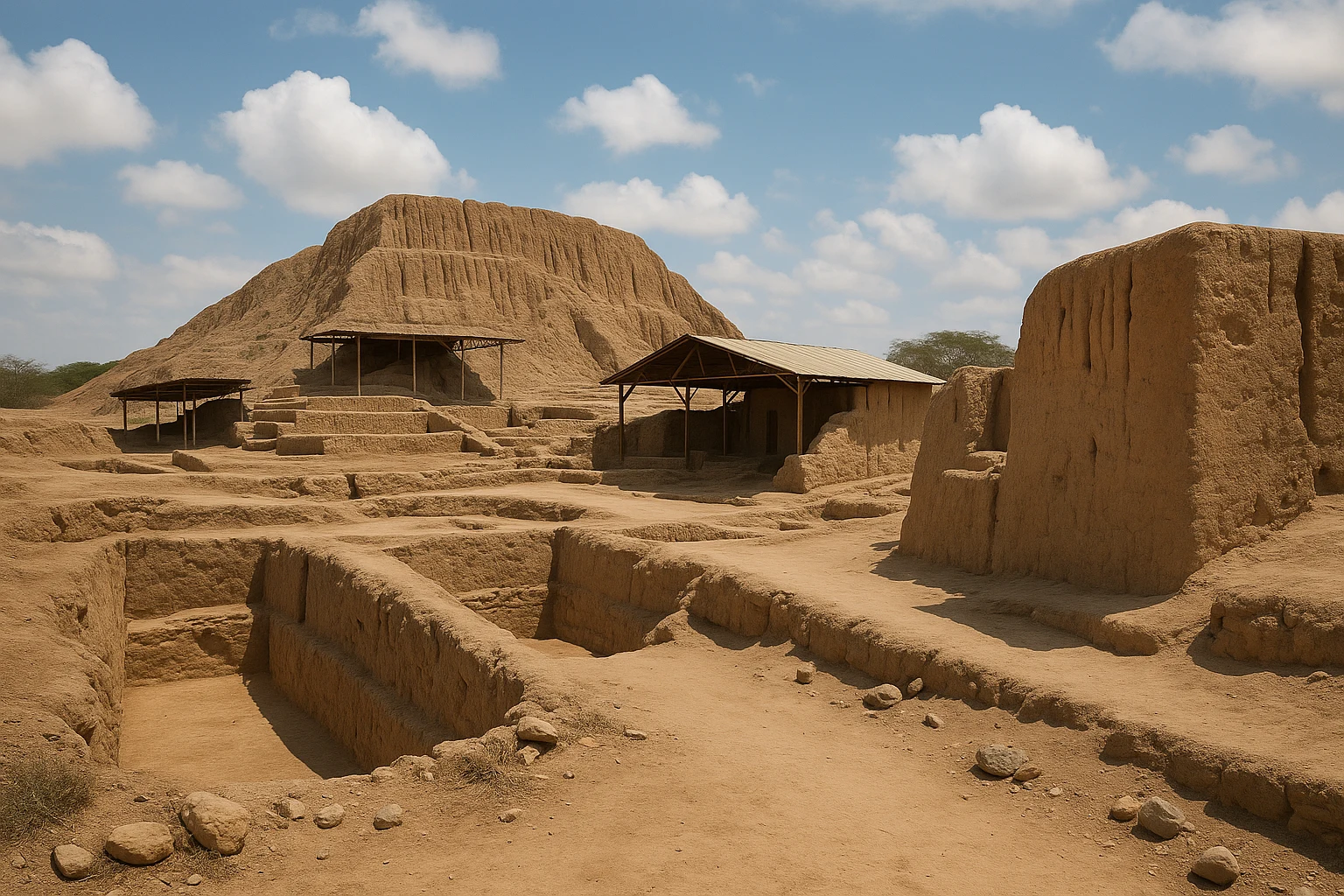
Sipan Royal Tombs Peru Guide 2026: Lord of Sipán & Moche Gold
Cupisnique-Moche-Lambayeque-Inca-Spanish ColonialVisit Peru’s Sipán Royal Tombs to see Moche elite burials, museum treasures, and practical tips for ...
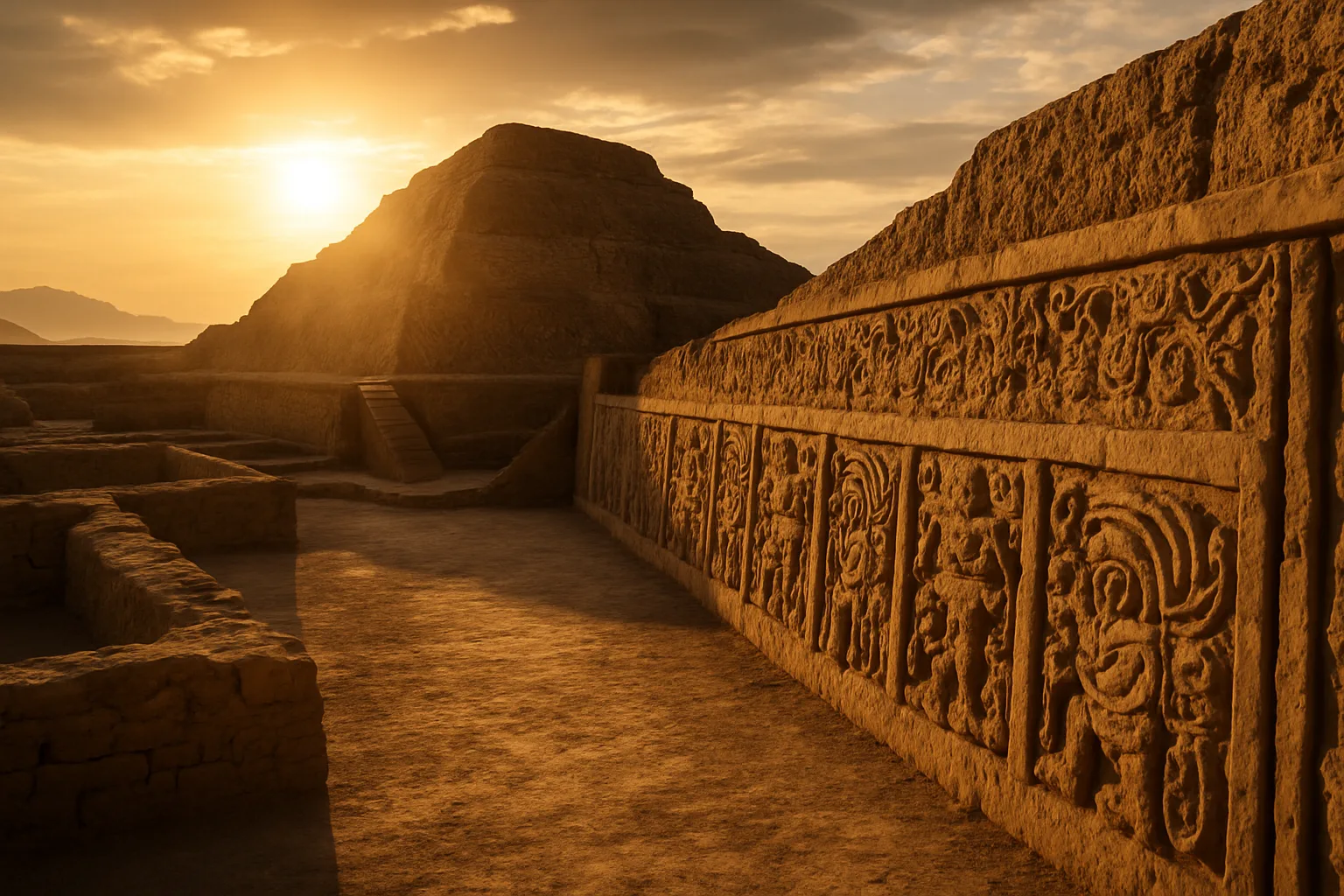
El Brujo Complex Peru Guide 2026: Lady of Cao & Moche Pyramids
Moche-ChimuVisit El Brujo Complex near Trujillo, Peru: Huaca Cao Viejo, the Lady of Cao tomb, and Moche murals....
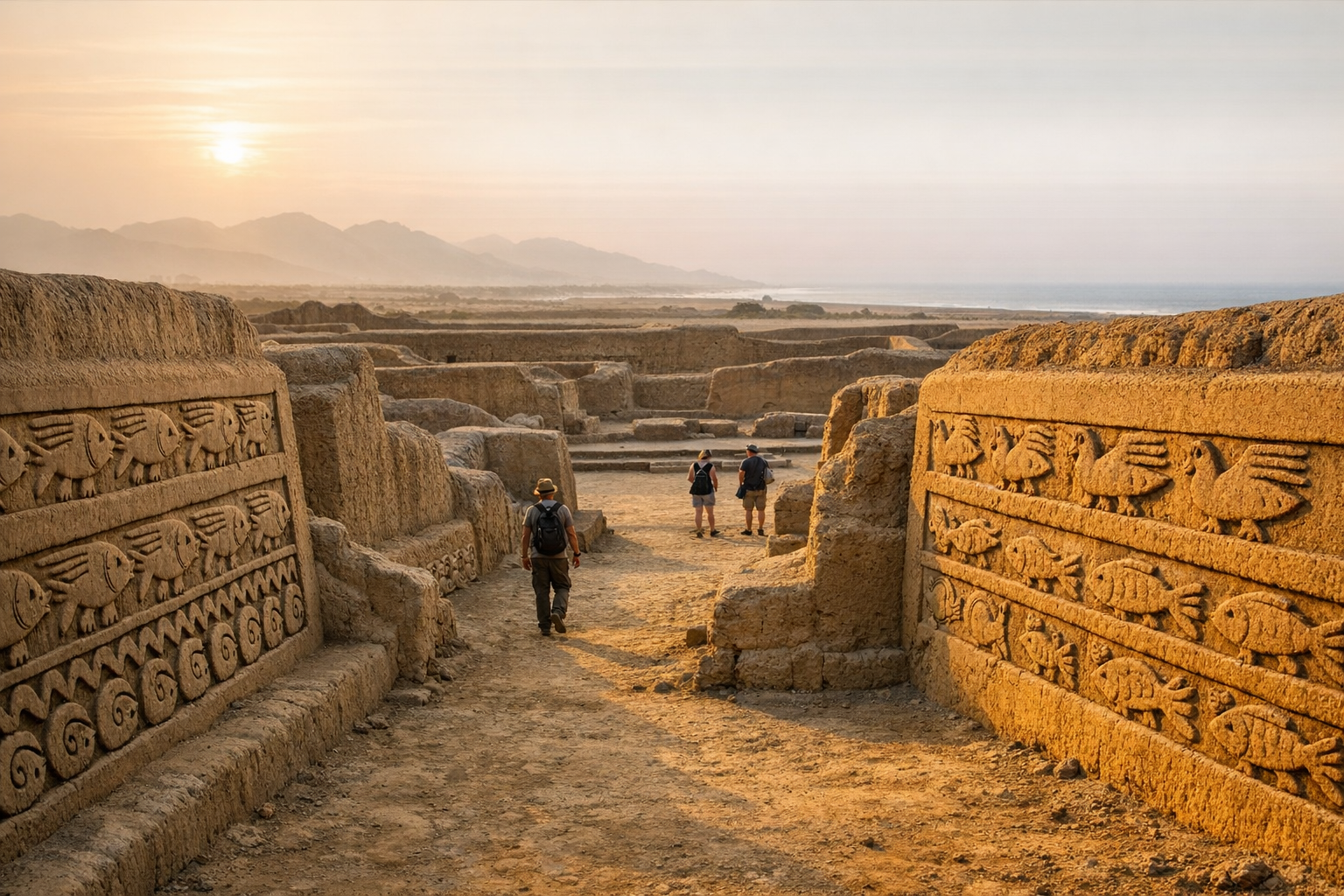
Chan Chan Peru Guide 2026: Chimu Capital & Adobe Citadels
ChimuExplore Chan Chan near Trujillo — the largest pre-Columbian city in the Americas. Discover the Chimu...