Quick Info
At a glance
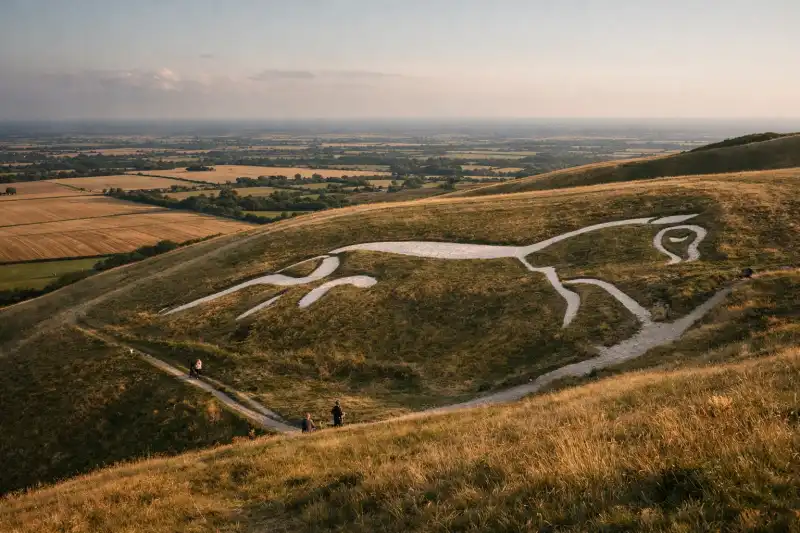
Uffington White Horse in the United Kingdom is one of those rare ancient monuments that feels both unmistakably human and almost impossibly large, as if an image had been sketched onto the land itself by a civilization thinking on a landscape scale. Cut into the chalk slope of White Horse Hill in Oxfordshire, this elegant figure has watched over the Vale of White Horse for millennia, its long curving lines standing out against the green hillside with a clarity that seems startlingly modern. It is not a statue, not a standing stone, and not a ruin in the conventional sense. Instead, it is an act of shaping the earth, a prehistoric design that can only truly be understood when you move around it, look back from a distance, and imagine the generations who kept it bright.
The site is more than a single image on a hill. Around it lies a remarkable ceremonial and defensive landscape that includes the Iron Age hillfort of Uffington Castle, the enigmatic mound known as Dragon Hill, and sweeping views across open countryside. Visiting today combines archaeology, walking, and a kind of visual puzzle: up close, the horse dissolves into abstract trenches of white chalk; from afar, it becomes a masterful composition. That tension between detail and scale is part of what makes Uffington so memorable. Even in a country crowded with ancient monuments, the White Horse remains unlike anything else, both mysterious in origin and enduring in presence.
History
Bronze Age or Early Iron Age Origins
For centuries, people speculated about when the Uffington White Horse was created and by whom. Older theories linked it to the medieval period, local legends, or tribal emblems from later antiquity. Modern scientific investigation, however, has transformed understanding of the monument. Optically stimulated luminescence dating carried out on sediments from the chalk figure suggests that it was made sometime between the late Bronze Age and early Iron Age, roughly 1380 to 550 BCE. That makes it by far the oldest known hill figure in Britain.
This dating matters because it places the horse in a prehistoric world of earthworks, ridgeway routes, ritual landscapes, and emerging hilltop communities. The area around Uffington was already significant long before the Roman conquest. The Ridgeway, an ancient route running nearby, connected communities across southern Britain, and the dramatic escarpment offered visibility, defensibility, and symbolic prominence. In that context, the White Horse may have functioned as a territorial marker, a sacred image, a tribal emblem, or a monument connected to beliefs now lost to us. Its refined, flowing design suggests deliberate artistry rather than casual marking of the land.
The Figure in an Ancient Landscape
The horse does not stand alone. Nearby is Uffington Castle, an Iron Age hillfort whose earthworks enclose the summit of White Horse Hill. Though the White Horse may predate the hillfort, the two became part of the same monumental landscape. Dragon Hill, a distinctive terraced mound below the horse, adds another layer of intrigue. Later folklore claimed that Saint George slew the dragon there and that the bare patch on the hilltop marked the dragon’s blood, but the site itself is likely much older than the legend.
The relationship between these landmarks remains debated. Archaeologists have not found definitive evidence explaining whether they formed a unified ritual complex or developed significance over different phases of prehistory. Yet their proximity is unlikely to be accidental in a broad cultural sense. This ridge was clearly a place where people built, gathered, traveled, and looked outward across the surrounding lowlands. The White Horse, visible from afar, would have announced the importance of the place to anyone moving through the vale.
Maintenance Through the Centuries
One of the most remarkable aspects of the Uffington White Horse is not just its creation but its survival. A chalk hill figure only remains visible if it is maintained. Left alone, grass and soil quickly reclaim the trenches. The horse endured because generation after generation renewed it by “scouring” the figure, cleaning and recutting the chalk to preserve its bright outline.
Historical records from later centuries describe communal scouring festivals, especially from the early modern period onward. These were not merely maintenance tasks. They were social events involving games, gatherings, local identity, and shared labor. Through such traditions, the monument stayed active in cultural memory even as its original meaning faded. In effect, each generation inherited not only an ancient image but also a duty to keep it visible.
By the 18th and 19th centuries, antiquarians were documenting the White Horse with increasing interest. Drawings and descriptions circulated, though not always accurately, and sometimes restoration efforts altered small details in the figure’s lines. Even so, the essential shape remained consistent enough to preserve its extraordinary stylized form, unlike many later hill figures that have more naturalistic outlines.
Modern Protection and Interpretation
In the modern era, the site passed from local tradition into formal heritage protection. Archaeological research, conservation management, and landscape stewardship have helped secure the future of the White Horse and its surroundings. Today the area is managed in partnership with heritage organizations and landowners, with the National Trust playing a major role in access and preservation.
Contemporary interpretation emphasizes both the monument itself and the wider setting. Visitors are encouraged to understand the horse not as an isolated curiosity but as part of an ancient chalkland environment shaped by movement, memory, and repeated care. The enduring mystery of its purpose remains part of its appeal. Unlike monuments that come with inscriptions or written histories, the Uffington White Horse asks visitors to accept uncertainty. Its age can be estimated, its lines measured, and its landscape mapped, but its original message remains just out of reach.
Key Features
The most striking feature of the Uffington White Horse is its design. At approximately 110 meters long, it is enormous, yet it does not attempt realism. The figure is composed of sweeping curves and tapered lines that create an impression of speed and vitality. The neck extends forward with a dynamic elegance, the legs are reduced to angular strokes, and the body seems almost to glide rather than stand. Many first-time visitors are surprised by how modern it looks. Instead of a clumsy prehistoric outline, the horse has the confidence of a sophisticated emblem, almost abstract in its economy.
That impression changes depending on where you stand. One of the peculiar pleasures of the site is that the horse is difficult to comprehend up close. Walking beside it, you see trenches of exposed white chalk cut into the grass, but the complete image disappears. To understand its full form, you need distance and elevation from elsewhere on the slope or from viewpoints across the vale. This shifting experience is part of the monument’s power. It was made not simply to exist on the hill, but to be seen across the landscape.
The chalk itself is central to the effect. The Berkshire Downs and the neighboring escarpments are places where the geology naturally lends itself to monumental marking. The bright white chalk contrasts sharply with green turf, especially on clear days or after maintenance. In certain light, the horse almost glows, while in overcast weather it can seem ghostly and subdued. Seasonal growth, weather conditions, and conservation work all subtly alter how vivid the figure appears.
Above the horse lies Uffington Castle, whose broad earth ramparts form one of the best-preserved Iron Age hillforts in the region. It is not a castle in the medieval sense but a large enclosed hilltop defended by banks and ditches. The earthworks are gentle rather than dramatic, yet the enclosure’s scale becomes clear as you walk its perimeter. From here, the views are exceptional. The vale opens below in a wide spread of fields and villages, and the monument’s placement begins to make strategic and symbolic sense. A hilltop like this was not chosen at random.
Just below the horse is Dragon Hill, a small but visually distinctive mound with a flattened top. The legend attached to it gives the landscape a mythic afterlife, showing how ancient places continue to attract new stories long after their original meanings are forgotten. Whether or not the hill had ritual significance in prehistory, it contributes to the sense that this is a landscape of layered imagination as much as archaeology.
The broader setting is another key feature. The site sits close to the ancient Ridgeway, one of Britain’s oldest routeways. This matters because the White Horse was never simply a hidden local marker. It stood beside a corridor of movement. Traders, herders, pilgrims, warriors, and local communities would all have passed through or near this upland route across centuries. The monument belonged to a lived landscape, not an isolated wilderness.
Visitors should also notice how open and exposed the site is. There are no enclosing walls, no museum roof, and no theatrical staging. Wind, cloud, and distance shape the experience as much as archaeology does. This openness can make the visit feel more intimate with the land than many better-known ancient sites. You do not just look at Uffington White Horse; you walk through the environment that gives it meaning.
Getting There
The Uffington White Horse is in rural Oxfordshire, near the village of Uffington and not far from Wantage, Faringdon, and Swindon. Most visitors arrive by car, which is the simplest option. The main access point is usually the National Trust car park at White Horse Hill, reached via country roads. Parking charges can change, but expect roughly £4 to £6 for several hours if you are not a National Trust member. From the car park, it is a short but uneven walk across open ground to the viewpoints, hillfort, and horse.
By train, the nearest practical rail hub for many travelers is Swindon. From London Paddington to Swindon, advance fares can often range from about £20 to £45 return, depending on timing and booking. From Swindon, you can take a taxi to White Horse Hill; fares are typically around £25 to £40 each way. Didcot Parkway and Oxford are also possible rail gateways, though onward transport can be less direct.
Public bus access exists but is limited and usually requires planning around village services, often followed by a walk of several kilometers. If you are relying on buses, check current local routes to Uffington, Wantage, or nearby settlements before setting out. For walkers, the Ridgeway National Trail offers an appealing approach, especially for those combining the site with a countryside hike.
Because the final approach includes grassy slopes, uneven paths, and exposed terrain, sturdy shoes are strongly recommended. Bring water, especially in warmer weather, since facilities on the hill itself are limited. The site is best treated as a countryside excursion rather than an urban monument visit.
When to Visit
Spring and early summer are excellent times to visit the Uffington White Horse. The chalk downland is green, the air is often clear, and the long views across the vale are especially rewarding. Wildflowers can add color to the surrounding grassland, and temperatures are usually comfortable for walking. This is a particularly good season if you want to combine the horse with time at Uffington Castle and along the Ridgeway.
Summer brings the longest daylight hours, which helps if you want to linger, photograph the landscape, or explore nearby sites on the same day. However, the hill is very exposed, so hot spells can feel warmer than expected and there is little shade. Early morning and late afternoon are often the most atmospheric times, when lower sunlight emphasizes the contours of the land and softens the scene.
Autumn is another strong choice, especially on crisp, bright days. The light can be beautiful, and the countryside often feels quieter after peak summer travel. Visibility is frequently good, making it easier to appreciate the monument from a distance. The main caution is that paths may become muddy after rain.
Winter visits can be dramatic, with stark skies and a powerful sense of isolation, but conditions are less predictable. Wind on the ridge can be severe, and fog or low cloud may obscure long-distance views, which are central to the experience. If visiting in winter, choose a dry, calm forecast and dress for exposed hilltop weather. Overall, the best balance of scenery, comfort, and visibility is usually found from April through October.
| Quick Facts | Details |
|---|---|
| Location | White Horse Hill, near Uffington, Oxfordshire, England |
| Country | United Kingdom |
| Estimated date | c. 1380-550 BCE |
| Type | Prehistoric chalk hill figure |
| Length | About 110 meters |
| Best known for | Britain’s oldest known hill figure |
| Nearby landmarks | Uffington Castle, Dragon Hill, the Ridgeway |
| Typical visit length | 1-2 hours |
| Access | Short walk from White Horse Hill car park |
| Managed by | National Trust and heritage partners |
The Uffington White Horse rewards visitors who arrive expecting more than a quick photo stop. Its real impact comes from time spent walking the hillside, tracing the curves of the chalk, looking back from different angles, and absorbing the wider prehistoric setting. It is a monument that resists easy explanation. No surviving text tells us why it was made, and no single theory fully unlocks its meaning. Yet that uncertainty is part of the experience. What remains beyond doubt is the skill of its design, the ambition of its placement, and the extraordinary continuity of care that has kept it visible for thousands of years.
In a country rich with stone circles, burial mounds, Roman ruins, and medieval abbeys, the Uffington White Horse stands apart because it is both image and landscape, artwork and earthwork. It asks visitors to think not only about ancient people, but about ancient ways of seeing. From the ridge above the Vale of White Horse, with the wind moving across the downs and the chalk bright underfoot, it becomes easier to understand why this place still captures attention. The horse is not simply on the hill. In every meaningful sense, it is part of the hill, and part of the long human story of marking places that matter.
Guided tours: worth it?
Most travelers can visit Uffington White Horse independently. Compare a tour only if you want a tighter history-focused visit, easier logistics, or a guide who can answer questions on the spot.
Best for
- Short visits where a planned route saves time
When to go self-guided
Go independently if you prefer setting your own pace, reading as you go, and checking official hours or ticket rules directly before you arrive.
What I’d avoid
Skip paid tours that bundle unrelated stops you do not actually want. The best option should either save meaningful planning time or add historical context you would miss on your own.
Uffington White Horse day tours
Useful when: you want to compare guided formats before deciding
Oxford countryside and Uffington White Horse tours
Useful when: you want to compare guided formats before deciding
Ancient sites near Avebury and Uffington White Horse
Useful when: you want to compare guided formats before deciding
Some tour links are affiliate links, which may earn Ancient Travel a small commission at no extra cost to you. I try to surface options that make practical sense for the site—not just anything bookable.
Frequently Asked Questions
What is the Uffington White Horse?
The Uffington White Horse is a large prehistoric hill figure cut into the chalk hillside of White Horse Hill in Oxfordshire, England. It depicts a highly stylized horse and is one of Britain's oldest and most distinctive landscape monuments.
How old is the Uffington White Horse?
Scientific dating suggests the figure was created in the late Bronze Age or early Iron Age, roughly between 1380 and 550 BCE, making it around 2,500 to 3,000 years old.
Is there an entrance fee to visit the Uffington White Horse?
Access to the hill figure and surrounding National Trust land is generally free, though parking at nearby car parks may require a fee.
Can you see the whole horse from the ground?
Not easily. Because of its scale and the slope of the hill, the full shape is best appreciated from a distance, from opposite viewpoints, or from aerial images rather than while standing directly beside it.
How long does it take to visit the Uffington White Horse?
Most visitors spend 1 to 2 hours walking from the car park, viewing the figure, and exploring nearby landmarks such as Dragon Hill and Uffington Castle.
Is the Uffington White Horse suitable for children?
Yes, many families visit, but the site involves open countryside, uneven paths, and exposed hilltop terrain, so sturdy footwear and supervision are important.
Nearby Ancient Sites
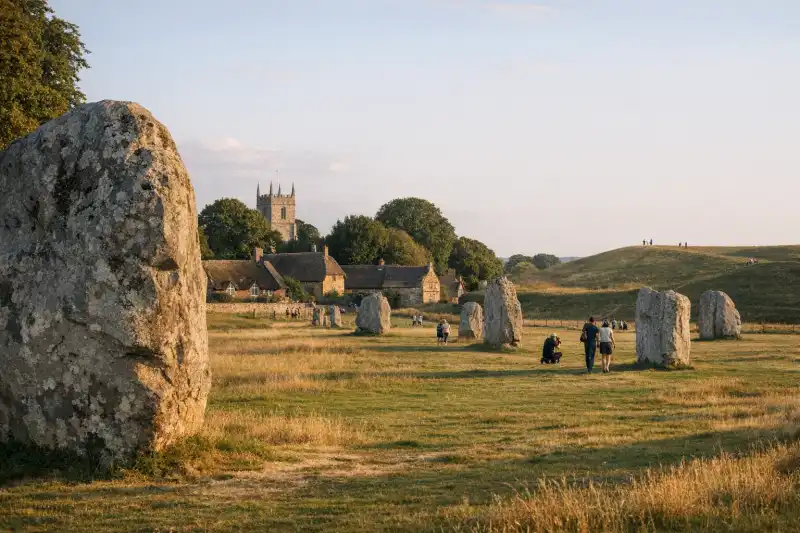
Avebury
Neolithic BritainExplore Avebury in the United Kingdom, a vast prehistoric stone circle and ritual landscape in the h...
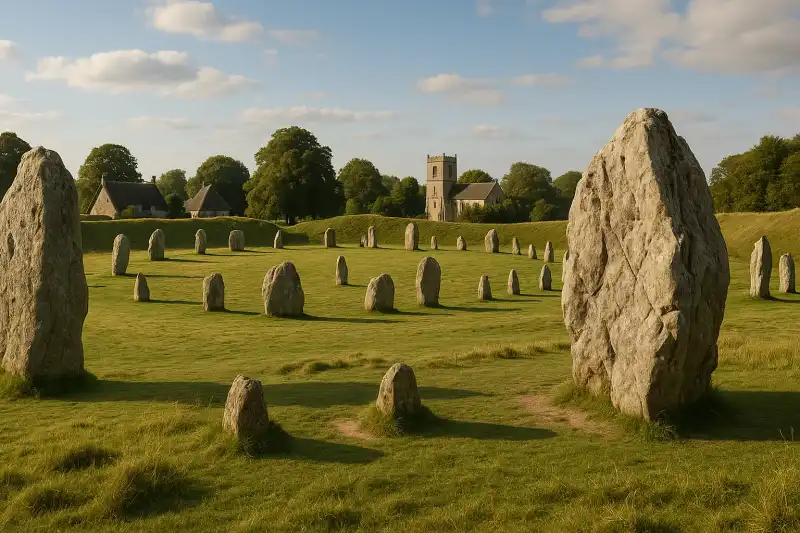
Avebury Stone Circle Travel Guide 2026: Best Walk Routes, History, and Visit Planning
Neolithic BritainPlan a stronger visit to Avebury Stone Circle with practical walking routes, landscape context, and ...
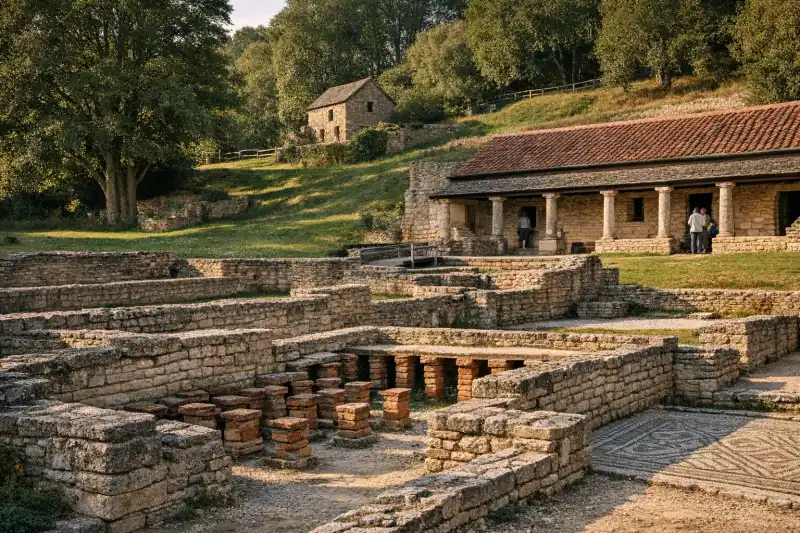
Chedworth Roman Villa
RomanExplore Chedworth Roman Villa, a remarkably preserved Roman countryside estate in the United Kingdom...