Quick Info
At a glance
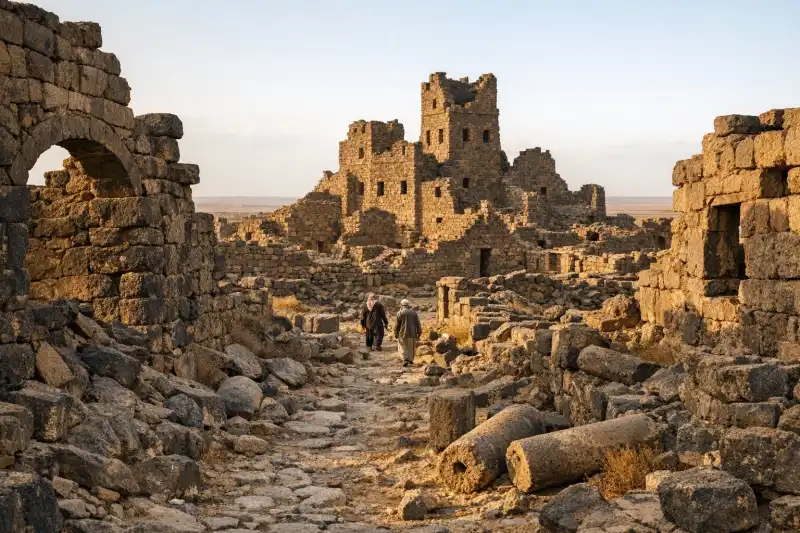
Umm el-Jimal, Jordan, rises from the volcanic plain of the north like a city built from shadow and light. At first glance the settlement seems almost monochrome: dark walls, dark towers, dark door lintels, all cut from the region’s distinctive basalt. Yet the longer you stand among its streets, courtyards, and roofed chambers, the more nuanced it becomes. This is not a lone monument in the desert but the remains of a whole town, a place where people lived, traded, worshipped, stored water, and adapted to a harsh frontier environment over many centuries. The visual effect is strikingly different from the pale limestone and sandstone ruins more commonly associated with the Middle East. Here, architecture feels heavy, practical, and resilient.
That resilience is part of what makes Umm el-Jimal so memorable. Located in Jordan’s Hauran region, it preserves one of the best surviving basalt-built settlements in the Levant. Visitors encounter Roman military planning, Byzantine churches, domestic compounds, and traces of early Islamic continuity rather than a simple story of abrupt collapse. The site rewards slow exploration: a doorway framing open sky, a staircase leading nowhere, a cistern tucked into the urban fabric, a church apse standing beside village houses. Umm el-Jimal may not receive the crowds of Jordan’s more famous destinations, but that quiet is part of its power. It feels spacious, atmospheric, and unexpectedly intimate, a ruined town that still communicates the rhythms of ordinary life.
History
Early settlement and frontier origins
The area around Umm el-Jimal was inhabited long before the town reached its architectural peak. Its position in the basalt lands of northern Jordan placed it within routes linking southern Syria, the Jordanian steppe, and the settled agricultural zones farther west. In antiquity, this was a frontier landscape: not a hard border in the modern sense, but a shifting zone where pastoral mobility, farming, commerce, and imperial power met.
By the 1st century CE, the settlement had begun to take recognizable shape under the influence of the Roman world, likely building on earlier Nabataean and local foundations. After Rome annexed the Nabataean Kingdom in 106 CE and created the province of Arabia, places like Umm el-Jimal gained strategic importance. They helped support communication and security in a region that connected larger urban centers while also facing the steppe. The Roman state was interested in order, taxation, and movement, and frontier settlements often developed both civilian and military functions.
The black basalt architecture that defines Umm el-Jimal reflects local geology as much as political history. Builders used what the landscape provided in abundance. Basalt is difficult to shape compared with softer stone, but it is durable, and the people of the Hauran became expert at using it for walls, corbelled roofs, doors, and upper stories. That practical adaptation gave the town its distinctive appearance and helped preserve it.
Roman growth and urban development
During the Roman period, Umm el-Jimal developed into a substantial rural-urban settlement. It was not a metropolis like Gerasa, but neither was it a tiny outpost. Archaeological remains suggest a community with organized streets, defensive features, water systems, and sizable domestic compounds. Some scholars connect its expansion to imperial frontier policy, especially during the 2nd and 3rd centuries CE, when Rome invested in roads, forts, and regional administration across Arabia and adjacent territories.
The town’s prosperity depended on more than military presence. Northern Jordan and the Hauran could support agriculture when rainfall was adequate, and communities here also benefited from trade and caravan movement. Houses in Umm el-Jimal were often large and multifunctional, suggesting mixed domestic, storage, and economic uses. The built environment indicates a settlement of households with some means and stability rather than a temporary encampment.
Late Roman pressures affected the region as they did much of the Near East. Political instability, shifting defense priorities, and changing trade patterns all played a role. Yet Umm el-Jimal did not simply vanish when one imperial phase ended. Its history is notable precisely because it continued and adapted.
Byzantine flourishing
The 5th and 6th centuries CE were a major period of transformation and visible prosperity for Umm el-Jimal. Under Byzantine rule, the town expanded, churches were built, and earlier structures were modified or reused. Christianity became a major force in the civic landscape, and the site today preserves several church remains integrated into the urban fabric rather than isolated from it. This is one of the reasons Umm el-Jimal is so informative: it shows how religious, domestic, and communal architecture overlapped in a living town.
The Byzantine era also seems to have brought investment in housing and local infrastructure. Multi-story basalt buildings, courtyards, reservoirs, and church complexes point to a community that was still functioning with confidence. Inscriptions found at the site have helped archaeologists date some buildings and trace patterns of patronage and identity. They suggest a society that was locally rooted but connected to broader Byzantine religious and administrative culture.
This flourishing was not without environmental and regional challenges. Earthquakes, periodic instability, and changing economic conditions affected all towns in the Levant. Still, Umm el-Jimal remained active into the early 7th century, and unlike some sites that are presented as frozen snapshots of one moment, it reflects continuity across political transitions.
Early Islamic continuity and later decline
After the Muslim conquests of the 7th century, Umm el-Jimal was not immediately abandoned. Archaeological evidence points to continued occupation and reuse into the Umayyad period. This continuity is important because it complicates older narratives that treated the Byzantine-to-Islamic transition as a sudden rupture. At Umm el-Jimal, people kept living among existing buildings, adapting structures to new conditions and maintaining a settlement that still served local needs.
Over time, however, the town declined. Several factors likely contributed: environmental stress, reduced regional importance, seismic activity, and shifts in settlement patterns. By the later medieval period, substantial urban life had faded, and the basalt structures gradually entered the long afterlife of ruins. Even so, the durability of the stone meant that walls, arches, and roofed spaces survived in unusual abundance.
Modern archaeological study has brought Umm el-Jimal renewed attention. Researchers have documented not just monumental remains but also ordinary architecture, water management, and patterns of habitation. Today the site is recognized as one of Jordan’s most significant archaeological landscapes, valued not only for beauty but for what it reveals about frontier society, resilience, and long-term continuity in the ancient Near East.
Key Features
What makes Umm el-Jimal exceptional is the sense of walking through an entire built environment rather than approaching a single headline monument. The town spreads across the basalt plain with an almost architectural density, and much of its impact comes from the cumulative experience of streets, doorways, compounds, towers, and churches appearing one after another. Because the stone is so dark, sunlight transforms the site through the day, casting sharp contrasts in the morning and a softer metallic glow in late afternoon.
The most immediately striking feature is the basalt architecture itself. In many ancient sites, upper stories and roofs have disappeared, leaving a skeletal plan at ground level. At Umm el-Jimal, however, basalt construction has preserved substantial vertical elements. Some buildings still stand several stories high, and visitors can easily imagine enclosed rooms, staircases, and storage spaces. Corbelled roofing methods allowed builders to span interiors with stone slabs and carefully stepped masonry, an engineering adaptation that feels both ingenious and severe. The result is a townscape that looks unusually complete.
Among the settlement’s most important remains are its churches from the Byzantine period. These structures are not grand in the imperial urban sense, but they are deeply informative. Their apses, nave spaces, entrances, and reused masonry reveal a community where Christianity was woven into local daily life. At Umm el-Jimal, churches stand alongside domestic quarters rather than apart from them, emphasizing the integrated nature of the town. Inscriptions and architectural details found in these religious buildings have helped scholars understand patronage, chronology, and social change.
Domestic architecture is equally compelling. Large courtyard houses suggest extended family occupation and flexible use of space. Many buildings likely combined residential rooms with areas for animals, storage, and work. Thick basalt walls kept interiors relatively stable in temperature, while upper levels expanded usable space. As you move through the site, it becomes clear that Umm el-Jimal was shaped as much by practical household needs as by administrative or religious concerns. It is one of the best places in Jordan to grasp how ordinary people might have inhabited an ancient settlement over generations.
Water management is another key feature. The surrounding landscape is dry, and a town of this scale could not survive without careful collection and storage. Cisterns, reservoirs, and channels formed a critical hidden infrastructure beneath and between the visible buildings. These systems remind visitors that survival here depended on planning and collective effort. The impressive architecture above ground was only possible because water was captured and managed efficiently.
The site also includes defensive and communal elements linked to its frontier context. Gates, towers, and substantial outer walls speak to concerns about security, though they also had symbolic and organizational roles. Umm el-Jimal was not simply a fortress, but its architecture reflects a settlement aware of vulnerability and mobility in the surrounding steppe. This balance between openness and protection is part of the town’s character.
One of the greatest pleasures of visiting is the atmosphere created by partial preservation. You may find a freestanding lintel carved with simple detail, a staircase climbing into empty air, or a window opening onto modern village life beyond the archaeological zone. The ancient and contemporary landscapes are close together, and that proximity prevents the site from feeling abstract. Umm el-Jimal is a ruin, but it still reads as a place made for use: for shade, storage, worship, conversation, and watchfulness.
Photographers often love the site because basalt responds so dramatically to changing light, but the visual appeal is only part of the experience. The deeper fascination lies in the way Umm el-Jimal preserves continuity across eras. Roman foundations, Byzantine churches, and early Islamic occupation are not neatly separated. They overlap in masonry, plans, and reused blocks. This layering gives the town its intellectual richness. It is less about one golden age than about adaptation over time, and that makes it especially rewarding for travelers interested in how ancient communities actually functioned.
Getting There
Umm el-Jimal is most easily reached from Amman by car or hired driver. The journey is usually around 1.5 to 2 hours depending on traffic and your route, covering roughly 85 kilometers northeast of the capital. For independent travelers, a rental car is the simplest choice because signage in northern Jordan is generally manageable and the roads are straightforward. Expect to pay about 25–45 JOD per day for a basic rental car, plus fuel. Hiring a private driver for a half-day or full-day northern Jordan itinerary often costs around 70–130 JOD depending on the vehicle, waiting time, and whether you combine the visit with Jerash or Umm Qais.
Public transport is possible but less convenient. You can usually find buses or service taxis from Amman to Mafraq, with fares often in the range of 2–4 JOD. From Mafraq, reaching Umm el-Jimal may require a local taxi, which could cost roughly 10–20 JOD each way depending on negotiation and time of day. Because return options can be irregular, this method works best for flexible travelers who are comfortable arranging transport on the spot.
Many visitors choose to visit as part of a private northern Jordan day trip. This is especially useful if you want historical context without the hassle of logistics. If you are driving yourself, bring water, charge your phone in advance, and avoid relying on frequent nearby services. The site is not remote in an extreme sense, but it is quieter and less commercialized than Jordan’s top tourist circuits, which is part of its appeal.
When to Visit
Spring and autumn are the best times to visit Umm el-Jimal. From March to May, temperatures are generally mild, the light is excellent for photography, and the surrounding plain may show a little seasonal green after winter rains. September through November is similarly pleasant, with warm days, cooler mornings, and more comfortable conditions for walking among exposed ruins. These seasons make it easier to spend two or three hours on site without fatigue from heat or wind.
Summer can still be rewarding, especially for photographers who like strong light and clear skies, but midday temperatures can be intense. The black basalt absorbs and radiates heat, which can make the site feel hotter than the air temperature suggests. If you visit in June, July, or August, aim for early morning or the last few hours of daylight. Bring more water than you think you need, wear a hat, and use sturdy footwear since the ground is uneven.
Winter offers a quieter atmosphere and sometimes dramatic skies. Northern Jordan can be cold, windy, and occasionally wet, so layered clothing is useful. On overcast days the basalt architecture takes on an especially somber beauty, though rain can make surfaces slippery and soften visibility across the site.
In terms of daily timing, morning and late afternoon are ideal year-round. The lower sun reveals texture in the masonry, and the site’s dark stone becomes much more expressive than it does under a flat midday glare. If you want a calm, reflective visit, these are the hours when Umm el-Jimal feels most evocative.
| Quick Facts | Details |
|---|---|
| Location | Northern Jordan, Mafraq Governorate |
| Nearest city | Mafraq |
| Distance from Amman | About 85 km northeast |
| Main periods | Roman, Byzantine, Early Islamic |
| Built from | Local black basalt |
| Best visit length | 1.5 to 3 hours |
| Best seasons | Spring and autumn |
| Best for | Archaeology, architecture, photography, off-the-beaten-path history |
| Terrain | Uneven stone paths and open exposed ground |
| What to bring | Water, sun protection, sturdy shoes, camera |
Guided tours: worth it?
Most travelers can visit Umm el-Jimal independently. Compare a tour only if you want a tighter history-focused visit, easier logistics, or a guide who can answer questions on the spot.
Best for
- Short visits where a planned route saves time
When to go self-guided
Go independently if you prefer setting your own pace, reading as you go, and checking official hours or ticket rules directly before you arrive.
What I’d avoid
Skip paid tours that bundle unrelated stops you do not actually want. The best option should either save meaningful planning time or add historical context you would miss on your own.
Northern Jordan Archaeology Tours
Useful when: you want to compare guided formats before deciding
Jerash and Umm Qais Day Tours from Amman
Useful when: transport or pickup logistics matter
Jordan Private Tours from Amman
Useful when: you want flexible timing or a private guide
Some tour links are affiliate links, which may earn Ancient Travel a small commission at no extra cost to you. I try to surface options that make practical sense for the site—not just anything bookable.
Frequently Asked Questions
Where is Umm el-Jimal located?
Umm el-Jimal is in northern Jordan, in Mafraq Governorate, near the Syrian border and roughly 85 kilometers northeast of Amman.
What is Umm el-Jimal known for?
The site is famous for its extensive black-basalt ruins, including houses, churches, gates, reservoirs, and streets dating mainly to the Roman, Byzantine, and early Islamic periods.
How much time should I allow for a visit?
Most travelers should allow 1.5 to 3 hours to explore the main ruins at a relaxed pace, though archaeology enthusiasts may want longer.
Can I visit Umm el-Jimal as a day trip from Amman?
Yes. Umm el-Jimal is commonly visited as a day trip from Amman, often combined with Jerash, Umm Qais, or other sites in northern Jordan.
Is Umm el-Jimal suitable for independent travelers?
Yes, but having your own car or a hired driver is the easiest option because public transport connections are limited and schedules can be irregular.
What should I wear at Umm el-Jimal?
Wear sturdy walking shoes, sun protection, and modest lightweight clothing. The basalt ground can be uneven, and summer heat can be intense.
Nearby Ancient Sites
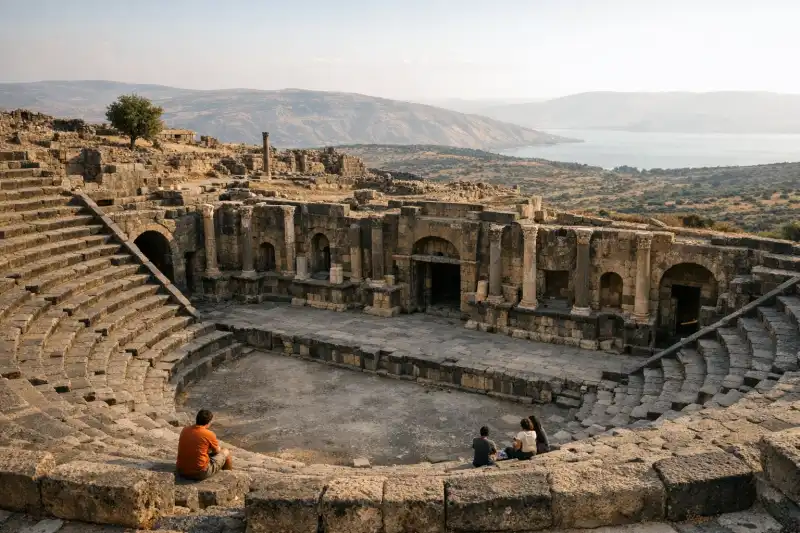
Gadara Theater (Umm Qais)
Greco-Roman, Byzantine, Early IslamicExplore Gadara Theater at Umm Qais in Jordan, a black-basalt Roman theater with sweeping views over ...
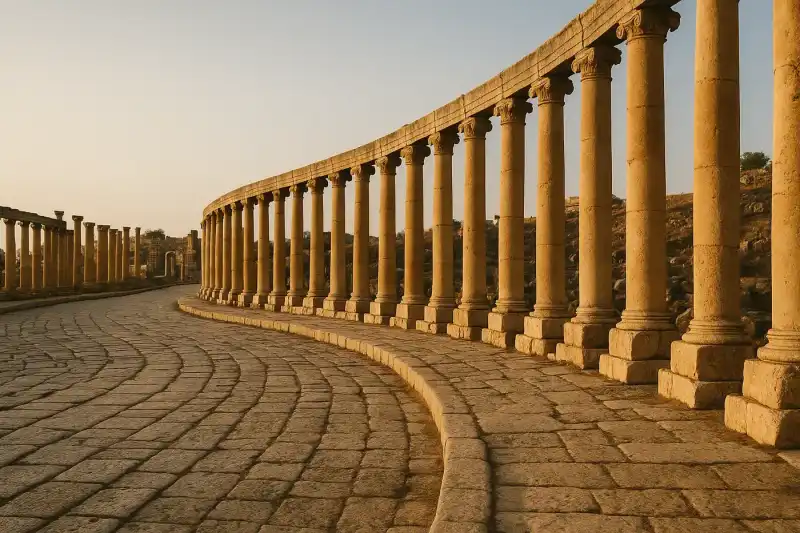
Jerash: The Pompeii of the East and Jordan's Best-Preserved
Roman / NabataeanDiscover Jerash, Jordan's remarkable Roman ruins. Walk the colonnaded streets of ancient Gerasa, exp...
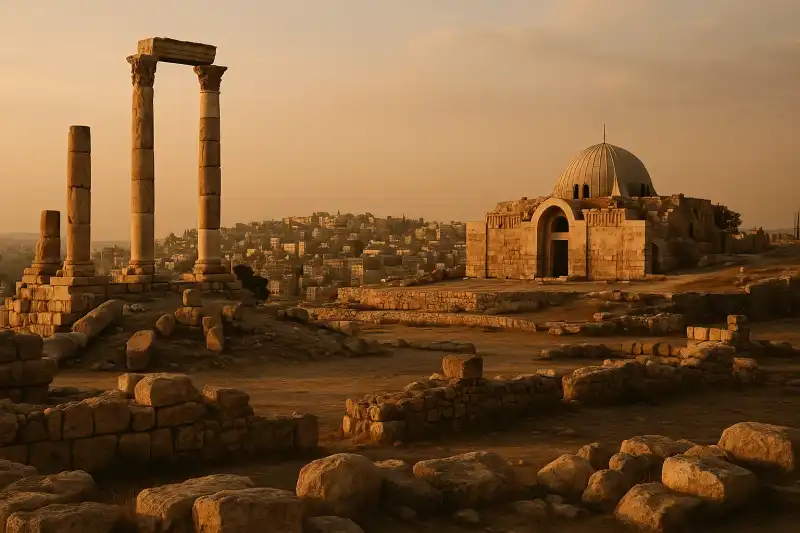
Amman Citadel Jordan Guide 2026: Temple of Hercules & Ancient Rabbah
Ammonite-Roman-UmayyadExplore Jordan's ancient citadel overlooking modern Amman. Discover the Temple of Hercules, Umayyad ...
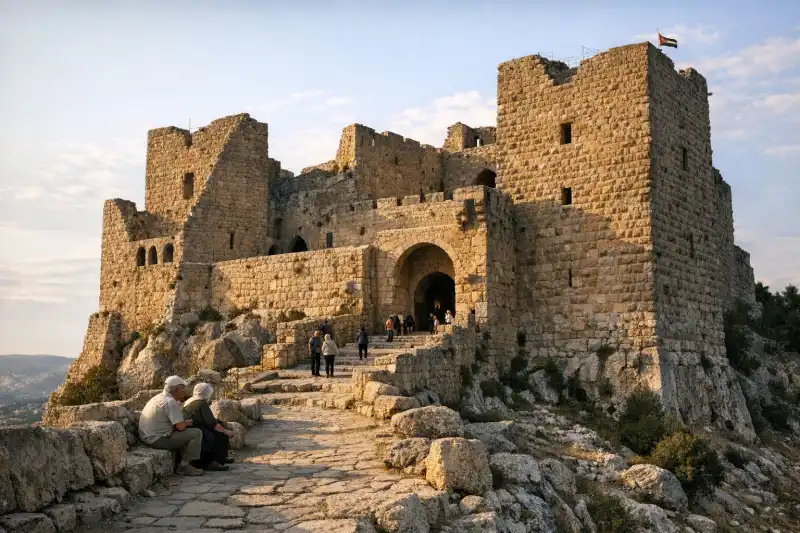
Ajloun Castle
Ajloun Castle in Jordan is a 12th-century Muslim fortress renowned for its strategic hilltop locatio...