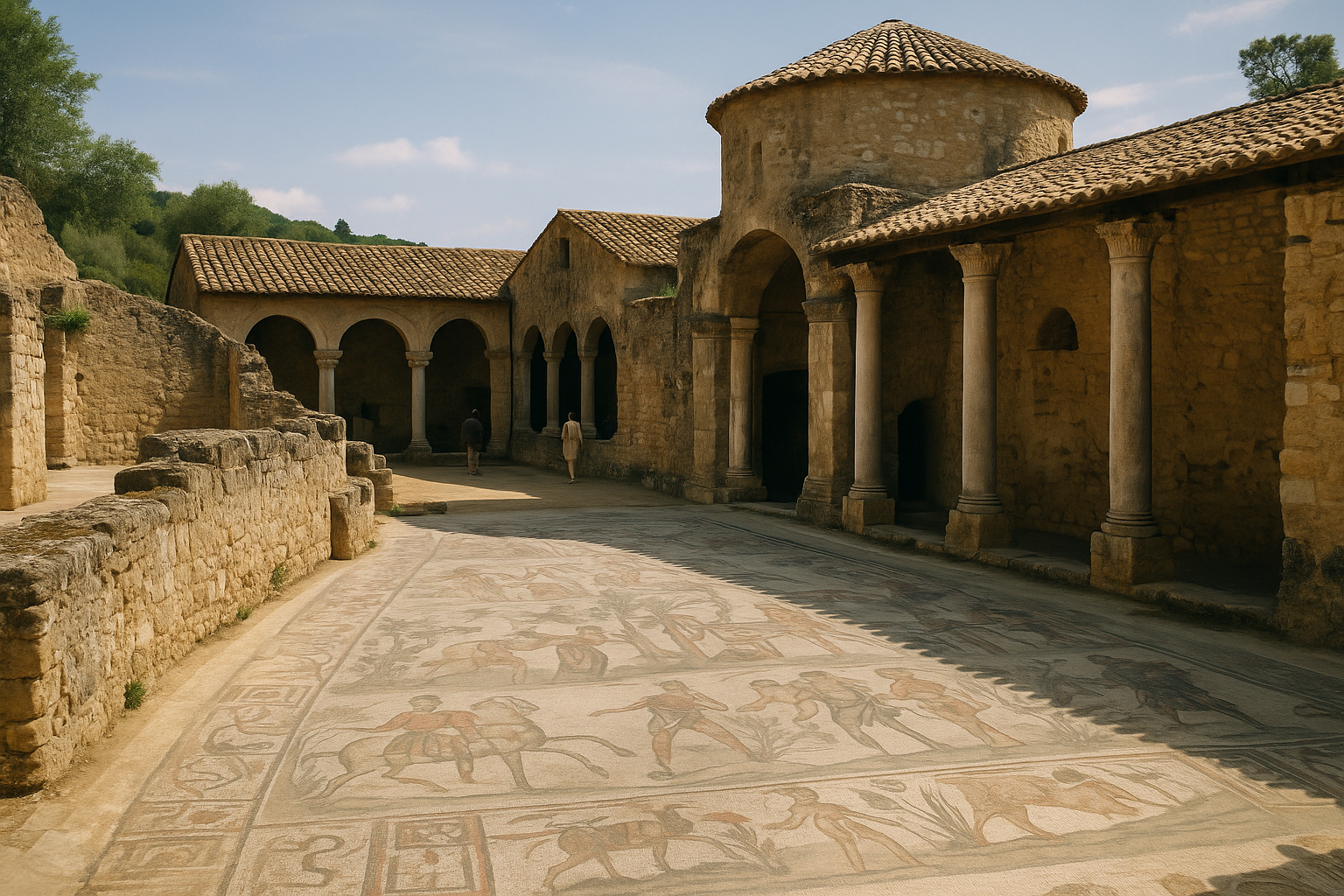
Quick Info
Curated Experiences
Villa Romana del Casale Guided Mosaic Tour
Central Sicily Archaeology Day: Casale + Morgantina
The walkway takes you out over the first mosaic floor and you stop walking. Below the metal grating, a procession of hunters, horses, exotic animals, and mythological figures stretches across the room in tesserae so dense and so precisely colored that the scene reads like a painted canvas, not a floor. Then you look up and realize this is just the entrance. The Great Hunt corridor is 200 feet ahead. The basilica hall with its Hercules cycle is beyond that. And beyond that are 40 more rooms, each with its own mosaic program, each telling a different story about wealth, power, nature, and the Roman elite imagination.
Villa Romana del Casale is not a ruin you walk through quickly. It is the most extensive surviving ensemble of late Roman mosaic art anywhere in the world, spread across roughly 3,500 square meters of in-situ floor decoration in a sprawling country estate near Piazza Armerina in central Sicily. The mosaics are not fragments behind museum glass. They are complete programs, room after room, threshold after threshold, preserved in the exact architectural context where they were designed to be experienced.
For travelers who have seen Roman temples, amphitheaters, and forum ruins, Villa Romana del Casale adds the missing dimension: the private world of the ultra-wealthy, where art served as both decoration and political statement, and where every guest who crossed the threshold was meant to understand exactly how much power the owner commanded.
Historical Context
The villa was constructed primarily in the first half of the 4th century CE, during the late Roman Empire, a period of significant political and economic transformation across the Mediterranean. Its owner remains debated among scholars, but the leading candidates include members of the senatorial aristocracy or possibly someone connected to the imperial administration — a co-emperor, a provincial governor, or a wealthy landowner with close ties to Rome’s ruling class. The sheer cost of the mosaic program, almost certainly produced by specialist North African workshops renowned for their skill and scale, signals someone near the very top of the Roman economic hierarchy.
The complex functioned as a villa rustica — a rural estate combining agricultural production with residential luxury. But this was no simple country house. The architectural plan reveals a highly programmed sequence of spaces: a monumental entrance with a triumphal arch, a large peristyle courtyard for social display, a basilica-shaped audience hall for formal reception and power projection, private residential apartments, elaborate thermal baths, and extensive service quarters. The layout mirrors the social rituals of Roman elite life, where controlled access, staged progression through increasingly impressive rooms, and calibrated visual overwhelm were tools of political influence.
After the fall of the Western Roman Empire, the villa was gradually buried by landslides and alluvial sediment from the surrounding hills. This burial, which would have looked like catastrophe at the time, turned out to be the mosaics’ salvation. Meters of protective earth sealed the floors away from the quarrying, burning, and repurposing that destroyed mosaic work at virtually every other comparable Roman site. Excavations began in the late 19th century, continued through major 20th-century campaigns, and the site was designated a UNESCO World Heritage Site in 1997.
Modern protective structures now cover the ruins, allowing visitors to walk above the mosaics on elevated metal walkways. This elevated perspective is actually advantageous for reading the large-scale narrative compositions, though it can make smaller details harder to appreciate without binoculars or a zoom lens.
The villa’s mosaic program represents the most complete surviving visual record of late Roman elite self-representation. Its iconographic range — hunting, mythology, athletics, nature, domestic life — offers an encyclopedia of the themes that mattered to the Roman ruling class in the final centuries of imperial power.
What to See
The Great Hunt Corridor
The Great Hunt is the villa’s masterpiece and one of the most ambitious single mosaic compositions to survive from antiquity. Stretching nearly 200 feet along a corridor connecting the main peristyle to the basilica hall, it depicts the capture and transport of exotic animals from across the Roman world — Africa, Asia, and Europe — for arena spectacles in Rome. The narrative unfolds geographically: you can identify specific regions by landscape details, animal species, and the dress of the hunters. Ships load captured beasts at Mediterranean ports. Mounted hunters track leopards through bush terrain. The detail is extraordinary at every scale, from the individual tesserae that define a leopard’s spots to the composition-wide rhythms that move your eye along the full corridor length. Give this space at least 20 minutes, and plan to return for a second pass after you have seen the rest of the villa.
Practical tip: The elevated walkway through the Great Hunt corridor is narrow and tour groups can create bottlenecks. Visit this corridor first at opening time, before the organized tours arrive around 10:00 AM.
The Basilica and Reception Rooms
The large basilica hall was the villa’s formal power center, where the owner received visitors, conducted business, and projected authority. The apse at the far end would have held the owner’s seat or throne, elevated above the mosaic floor. Surrounding reception rooms contain mythological cycles — Hercules, Odysseus, Orpheus — that functioned as cultural credentials, signaling the owner’s education, philosophical sophistication, and alignment with Greco-Roman literary tradition. Pay close attention to how the thresholds between rooms use geometric mosaic patterns to frame transitions between narrative subjects. This is not random decoration. It is a visual architecture of social hierarchy.
Practical tip: Stand at the entrance of each reception room before walking through. The mosaics were designed to be read from the doorway as a first impression. That is the vantage point the original designers intended.
The “Bikini Girls” (Room of the Ten Maidens)
The most widely reproduced image from the villa shows ten young women exercising in what appear to be two-piece garments remarkably similar to modern bikinis. They run, lift weights, throw a discus, and play ball, depicted with an energy and specificity that made this mosaic famous long before it was fully understood. The room likely depicts athletic competitions associated with festival celebrations, though the exact context remains debated. The mosaic is well preserved and the figures are vivid, but the room is relatively small and can feel crowded. In the context of the full villa, this is one panel in a much larger story.
Practical tip: The Bikini Girls room is the most photographed space in the villa, so expect clusters. Move through with the flow, then return later in your visit when the crowd has shifted to other sections.
The Private Apartments and Baths
The residential quarters and bath complex reveal the domestic and leisure dimensions of elite Roman life. The bath mosaics feature marine scenes with playful imagery — dolphins, sea creatures, tritons — that contrast markedly with the formal grandeur of the reception rooms. The private apartment mosaics shift to more intimate subjects: children at play, household scenes, and genre imagery that feels surprisingly personal. These spaces are crucial for understanding the villa as a functioning household, not just a display gallery. The thermal circuit in particular — cold room, warm room, hot room — follows standard Roman bath design and provides a good opportunity to explain the practical engineering that supported these luxury installations.
Practical tip: The bath complex rooms are smaller and less dramatic than the main halls, so many visitors rush through. Slow down here. The marine mosaics are some of the best-preserved in the villa, and the shift in tone from public to private is part of the villa’s designed experience.
The Peristyle and Entrance Sequence
The main peristyle courtyard, with its central garden and surrounding colonnaded walkway, was the villa’s organizing hub. Mosaic medallions depicting animal heads ring the walkway, and the courtyard’s proportions were calibrated to impress visitors the moment they entered from the monumental approach. Start your visit by pausing at the entrance sequence and tracing the path a Roman guest would have followed: through the triumphal arch, into the peristyle, and then outward to the reception halls and private quarters. Understanding this circulation logic makes the entire villa more readable.
Practical tip: On your second circuit of the villa, return to the peristyle and trace the guest route again. Knowing what lies in each direction transforms the courtyard from a pleasant arcade into a legible social machine.
Timing and Seasons
Spring (April through May) is the best season for visiting Villa Romana del Casale. Central Sicily’s inland location means temperatures are milder than the coast, typically 61 to 77°F (16 to 25°C), and the surrounding countryside is green and pleasant for the drive. Crowds are present but manageable outside Easter week.
Summer (June through August) brings heat that the protective roof structures can trap, creating greenhouse-like conditions over the walkways. Expect 82 to 95°F (28 to 35°C) with high humidity inside the covered areas. Morning visits starting at opening (typically 9:00 AM) are essential in summer. By midday, the heat and crowd density can make the narrow walkways uncomfortable.
Autumn (September through October) is the second-best window, with temperatures settling into the 64 to 82°F (18 to 28°C) range and tourist volume declining. The light is good for photography through the protective roof panels.
Winter (November through February) is cool and quiet, with daytime temperatures around 46 to 57°F (8 to 14°C). The site can feel empty on weekdays, which allows unhurried examination of every room. Occasional rain makes the surrounding roads wet but does not affect the covered villa interior.
The best time of day is the first hour after opening. By 10:30 AM, organized tours from Catania and Palermo begin arriving, and the narrow walkways — especially in the Great Hunt corridor and the Bikini Girls room — become congested.
Tickets, Logistics, and Getting There
Admission is approximately $12 to $15 USD (10 to 13 euros). Combined tickets with the nearby Morgantina archaeological site are sometimes available. Hours are typically 9:00 AM to approximately 5:00 or 6:00 PM, depending on season, with later closing in summer.
By car (recommended): The villa sits about 3 miles (5 kilometers) southwest of Piazza Armerina, in the rural hills of central Sicily. From Catania, the drive takes roughly 1.5 hours via the E932. From Palermo, allow 2 to 2.5 hours. From Agrigento, about 1.5 to 2 hours. Rental car is strongly recommended for central Sicily travel; the flexibility is essential for timing your arrival at opening.
By bus: Infrequent bus service connects Piazza Armerina to the villa site. From Piazza Armerina’s main square, local buses run a few times daily, but schedules are unreliable. A taxi from Piazza Armerina costs approximately $10 to $15 USD each way.
Organized tours: Full-day guided tours from Catania or Taormina typically include transport, guide, and entrance for $80 to $140 USD per person. These remove the logistics burden but limit your time at the villa to roughly 2 hours, which may feel rushed for detail-oriented visitors.
Parking: Free parking is available at the site entrance. The lot fills on busy spring and summer mornings, so arriving by 9:15 AM is wise.
Practical Tips
- Binoculars or a camera with a good zoom lens significantly improve the experience. The elevated walkways place you several feet above the mosaics, and many of the finest details — individual tesserae colors, facial expressions, animal textures — reward close examination.
- Carry water. The protective structures trap heat in warm months, and there is limited refreshment inside the site. A small cafe and shop operate near the entrance.
- Wear comfortable walking shoes. The metal walkways are generally smooth but some sections include steps and transitions between levels.
- A basic guide to Roman mosaic iconography, read before your visit, will dramatically improve comprehension. Knowing what a Hercules cycle or a Dionysus scene represents turns decorative images into readable narratives.
- Budget for two circuits. The villa is complex enough that a single pass leaves you overwhelmed by visual density. A second, slower circuit focused on your favorite rooms is significantly more rewarding.
- Photography is permitted without flash. The walkway gratings can create shadow patterns on the mosaics in photographs; adjusting your angle or waiting for overhead light helps.
Suggested Itinerary
Morning Villa Visit (2.5 to 3.5 hours): Arrive at 9:00 AM. Begin at the entrance sequence and peristyle to orient yourself to the villa’s social geography. Move directly to the Great Hunt corridor before crowds arrive (20 to 30 minutes). Continue through the basilica and reception rooms (30 minutes). Visit the Bikini Girls room and surrounding athletic-themed spaces (15 minutes). Explore the private apartments and bath complex (30 minutes). Return for a second focused pass through the Great Hunt and your favorite reception rooms (30 to 45 minutes).
Midday Extension to Piazza Armerina (1 hour): Drive or taxi to Piazza Armerina’s hilltop center for lunch. The town has a pleasant medieval core with a few good trattorias serving Sicilian inland cuisine — pasta with wild fennel, grilled meats, local cheese.
Afternoon Pairing Option — Morgantina (2 hours): If you have a full day and a car, drive 40 minutes northeast to the archaeological site of Morgantina, an ancient Sikel-Greek city with a well-preserved agora, theatre, and residential quarter. Morgantina provides the broader urban context that the villa, as a private estate, cannot supply. The combination of elite private luxury at Casale and public civic life at Morgantina gives you a remarkably complete picture of ancient life in inland Sicily.
Nearby Sites
Syracuse Archaeological Park is approximately 2 hours east by car. Its Greek theatre, Roman amphitheatre, and quarry caves represent Syracuse’s public face — the civic infrastructure that supported the kind of wealth displayed in private at Villa Romana del Casale. The two sites illuminate opposite sides of the same social system.
Valley of the Temples, Agrigento is roughly 1.5 to 2 hours southwest by car. Agrigento’s monumental Greek temples predate the villa by nearly a millennium, but the pairing shows the full chronological arc of elite power display in Sicily, from sacred public architecture to private domestic splendor.
Segesta lies about 2.5 hours northwest by car. Its Elymian temple and Hellenistic theatre add yet another cultural layer to a Sicily archaeology route that already includes Greek, Roman, and late imperial dimensions.
Morgantina is the nearest complementary site, roughly 40 minutes northeast by car. The Sikel-Greek city provides the urban, public-architecture counterpart to the villa’s private luxury and makes the best same-day pairing.
Final Take
Villa Romana del Casale is not a ruin you walk through quickly and check off a list. It is one of the very few places where Roman domestic art survives at a scale that lets you understand the visual world of the empire’s wealthiest citizens. These are not fragments recovered from a collapsed building and arranged in a museum. They are complete programs laid across an entire residential complex, room connecting to room, threshold leading to threshold, telling stories about power, nature, mythology, and the rituals of daily life in exactly the configuration their creators intended.
The Great Hunt corridor alone contains more narrative mosaic content than most national museum collections. And it is surrounded by 40 more rooms, each with its own visual argument. If you are building a Sicily itinerary around ancient history, this inland detour is not optional. It is essential.
Discover More Ancient Wonders
- Syracuse Archaeological Park — Greek theatre, Roman amphitheatre, and quarry caves in eastern Sicily
- Valley of the Temples, Agrigento — Monumental Greek sacred architecture on Sicily’s southern ridge
- Segesta — Elymian temple and hilltop theatre in western Sicily
- Italy Ancient Sites Hub — Plan your complete Italian archaeology route
- Budget Travel Guide — Affordable strategies for ancient-world travel in Sicily
Quick Facts
| Attribute | Details |
|---|---|
| Location | Piazza Armerina, Sicily, Italy |
| Country | Italy |
| Region | Sicily |
| UNESCO Status | World Heritage Site (1997) |
| Civilization | Roman |
| Historical Period | Late Roman Empire (4th century CE) |
| Mosaic Area | Approximately 3,500 square meters |
| Entry Fee | ~$12-$15 USD (€10-13) |
| Hours | ~9:00 AM to 5:00-6:00 PM (seasonal) |
| Best Time | Spring; first hour after opening |
| Suggested Visit | 2.5-3.5 hours |
| Coordinates | 37.3667, 14.3661 |
Frequently Asked Questions
Why is Villa Romana del Casale so famous?
It preserves one of the world's most extensive and sophisticated ensembles of late Roman floor mosaics in near-continuous narrative and decorative programs.
How much time should you plan for the site?
Most visitors need 2 to 3.5 hours to cover the main circuits carefully; photography and interpretation can extend that.
Is this a realistic day trip from Catania or Palermo?
Yes, but it is route-heavy; many travelers prefer private transport or organized tours to reduce transfer friction.
What should first-time visitors prioritize?
Prioritize major mosaic halls and circulation paths first, then revisit favorite sectors for detail once you understand the villa's layout.
Nearby Ancient Sites
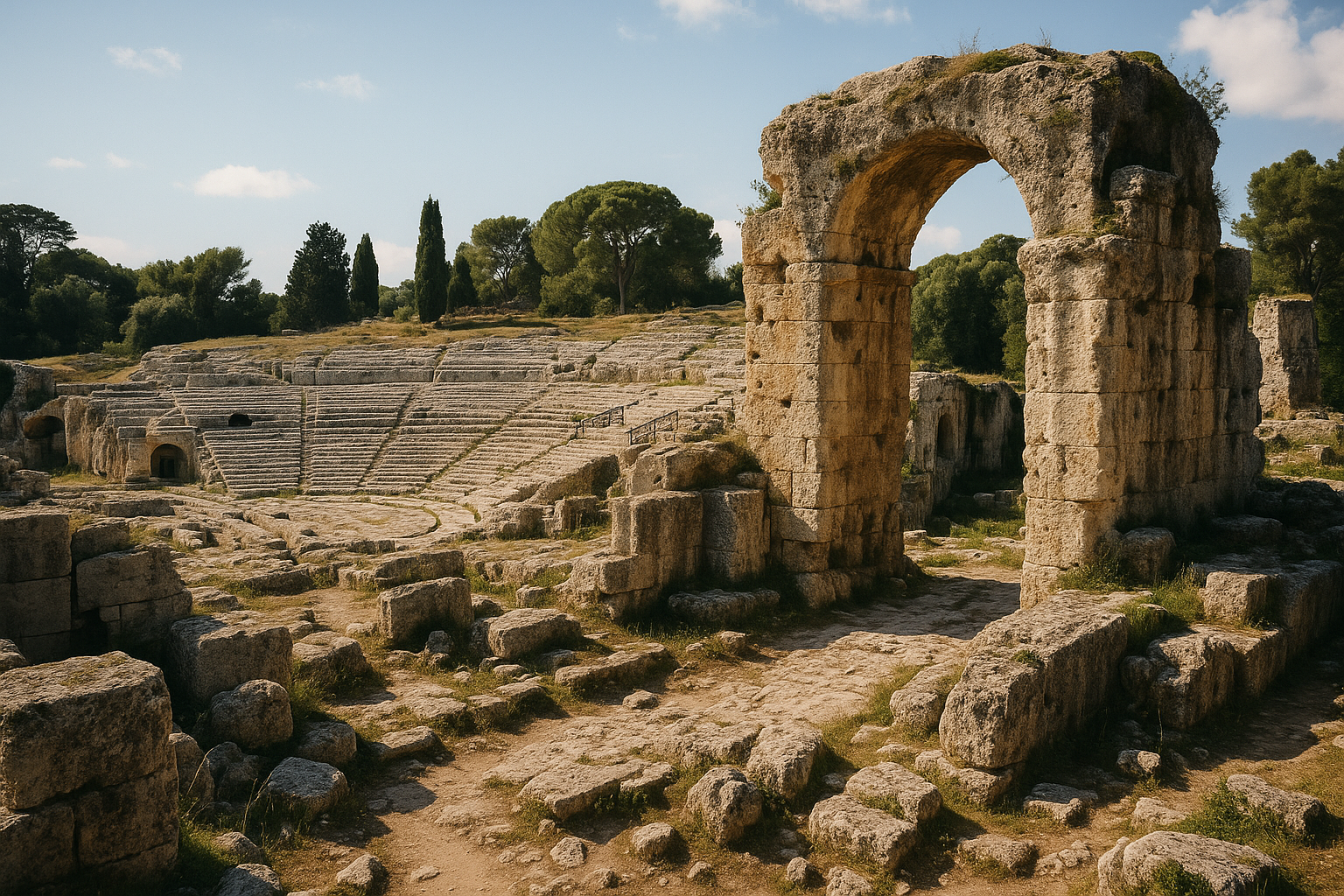
Syracuse Archaeological Park (Neapolis) Guide 2026
Greek-Roman-ByzantinePlan your visit to Syracuse Archaeological Park in Sicily with theatre highlights, Ear of Dionysius ...
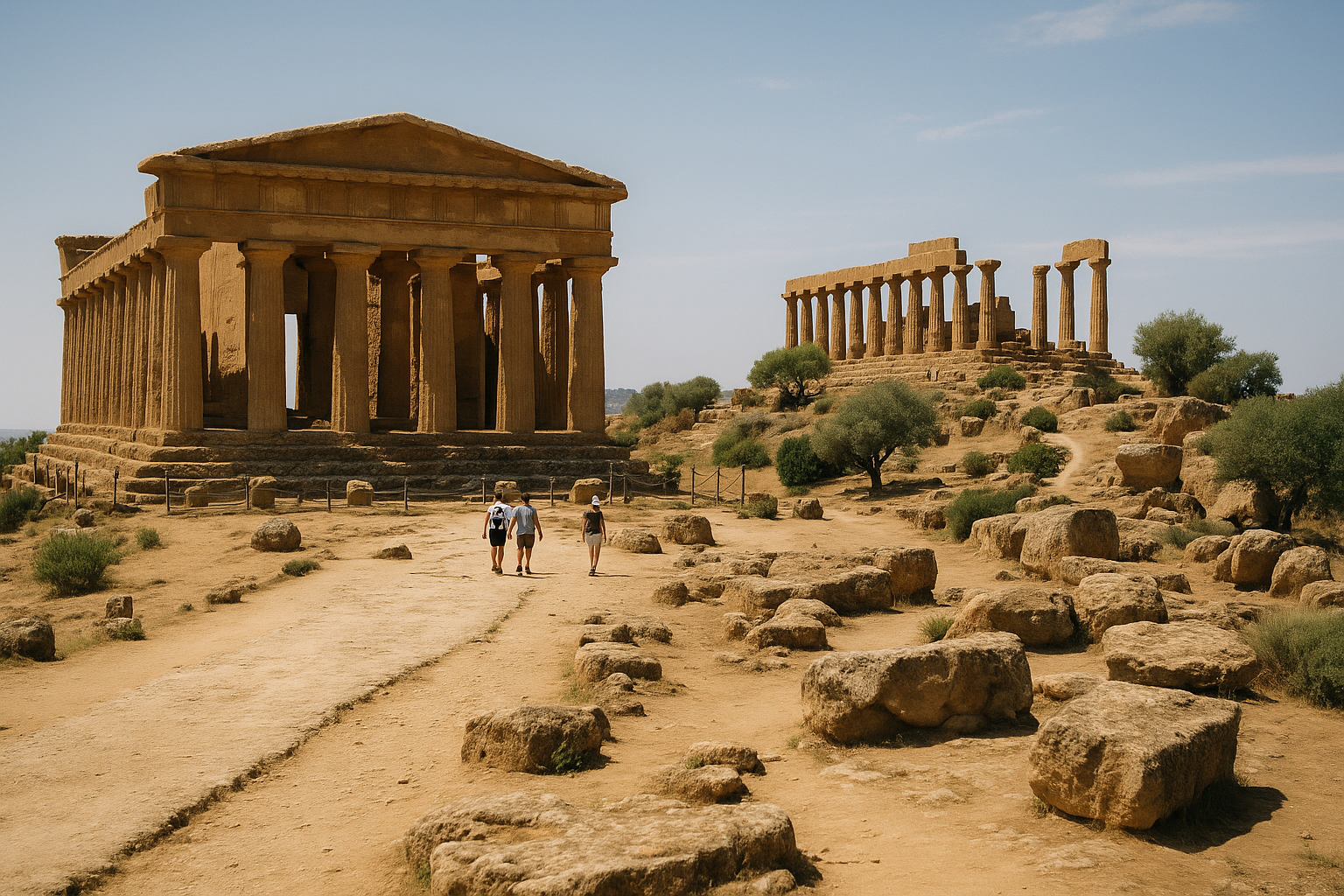
Valley of the Temples Agrigento Guide 2026: Concordia & Juno
Greek-Roman-NormanPlan your Agrigento Valley of the Temples visit with temple highlights, tickets, transport, and prac...
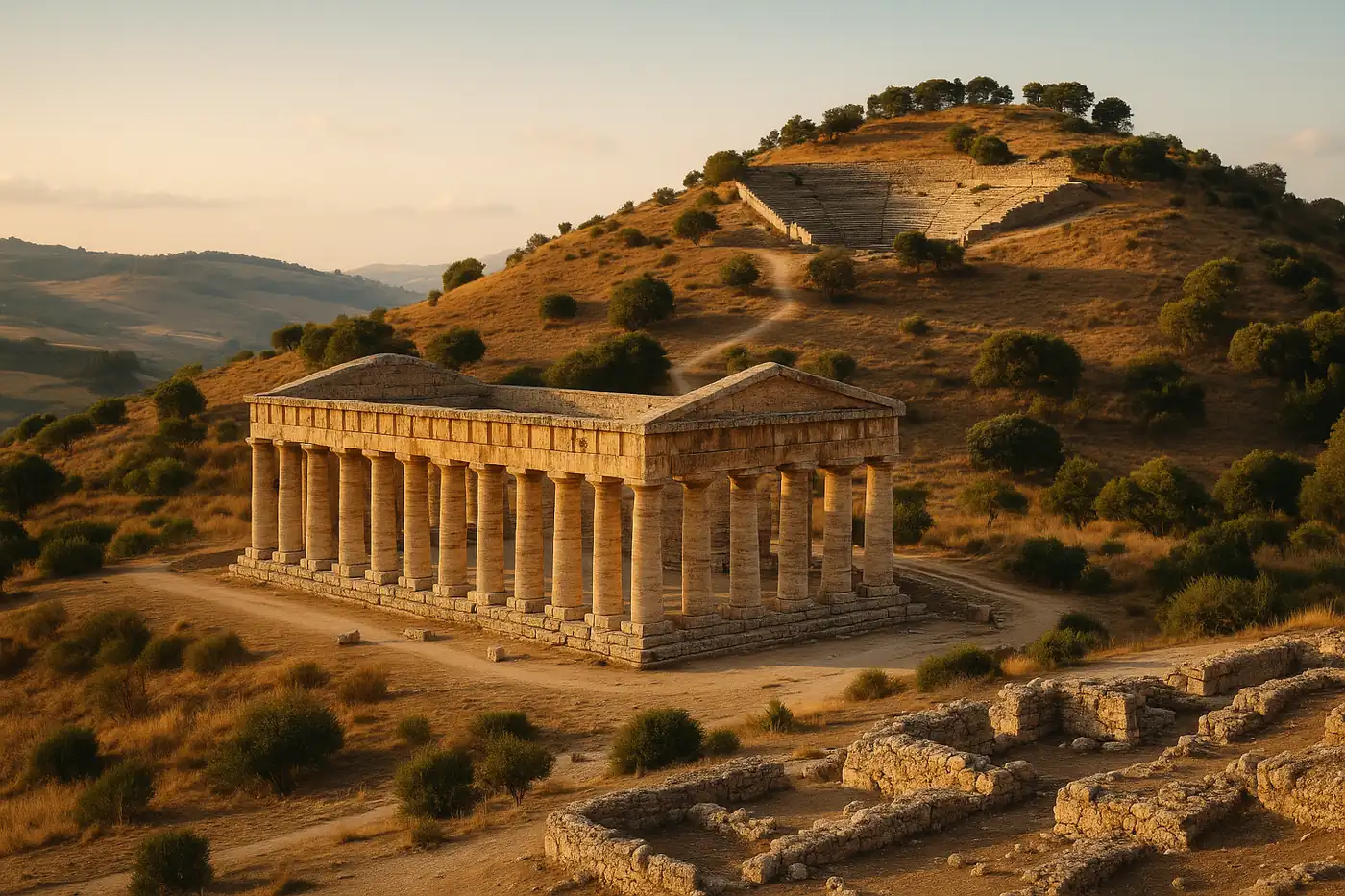
Segesta Archaeological Site: Sicily's Unfinished Temple and Hilltop Theatre
Elymian / Greek / RomanPlan your visit to Segesta in western Sicily: temple, theatre, shuttle logistics, timing, and practi...
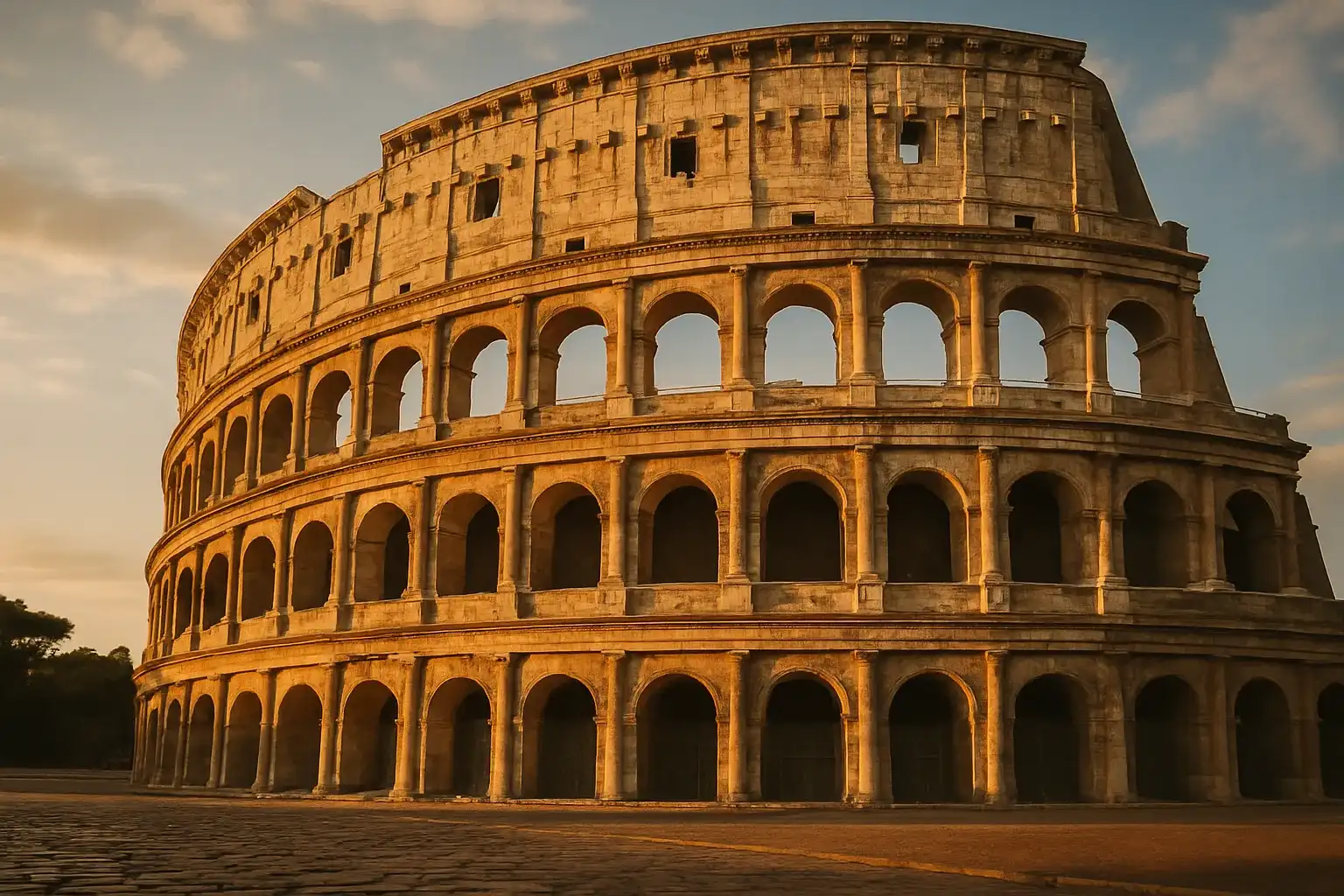
Colosseum Rome: Complete 2026 Guide to Arena Floor, Tickets, and Timing
Roman EmpirePlan the perfect Colosseum visit with timed-entry strategy, Arena Floor and underground access tips,...