Quick Info
At a glance
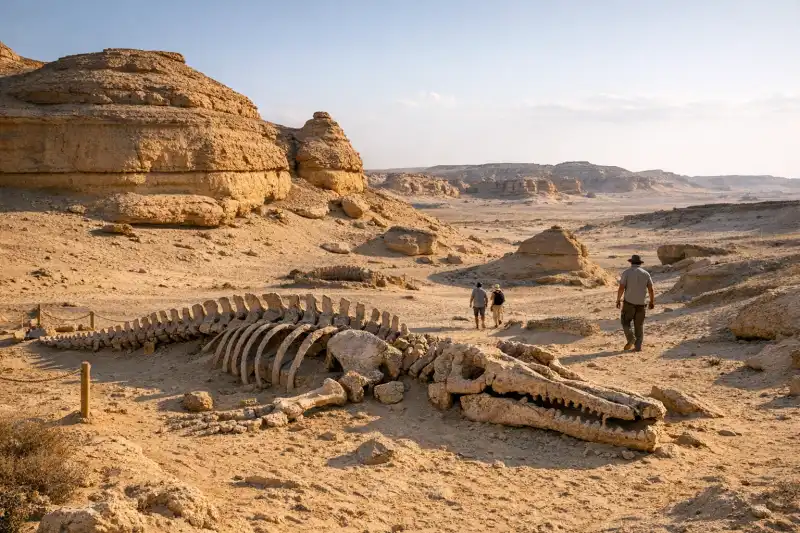
Wadi el-Hitan (Valley of Whales) in Egypt is one of those rare places where the desert seems to remember an ocean. In the sun-bleached emptiness of the Western Desert, amid ridges of sandstone and wind-shaped hills, lie the fossilized remains of creatures that once swam through warm prehistoric seas. The contrast is startling and unforgettable: whale skeletons resting in a landscape now defined by silence, dust, and light.
The site sits within the protected area of Wadi El Rayan in Faiyum Governorate, southwest of Cairo, and at first glance it can feel almost otherworldly. The horizon opens wide, the air is dry and clean, and the ground itself appears to tell a story in layers. Visitors do not come here for monumental architecture or royal tombs, but for something even older: evidence of deep time. Wadi el-Hitan preserves one of the most important fossil records anywhere in the world for understanding how whales evolved from land mammals into fully aquatic animals.
That scientific importance is what earned the valley UNESCO World Heritage status, but the site’s appeal goes beyond paleontology. Walking among exposed vertebrae, ribs, and skull fragments in the middle of the desert creates a powerful sense of perspective. Human history feels brief here. Wadi el-Hitan invites travelers to look far beyond dynasties and empires and consider a much older Egypt, when this dry basin lay beneath a shallow tropical sea and the ancestors of modern whales were still learning how to live in water.
History
Ancient seas in the Eocene
The story of Wadi el-Hitan begins not with human settlement but with a radically different environment during the Late Eocene, roughly 37 to 40 million years ago. At that time, the region that is now the Faiyum Depression lay beneath a shallow coastal sea. Sediments accumulated on the sea floor, and marine life flourished in warm waters rich with fish, turtles, crocodiles, sea cows, sharks, and early whales. When these animals died, many of their remains were buried by mud and sand, beginning a fossilization process that would preserve them for millions of years.
What makes the valley especially significant is the abundance and quality of archaeocete fossils, the ancient whales that represent a transitional stage in evolution. These animals had already adapted strongly to aquatic life, yet some species still retained small hind limbs. In a scientific sense, Wadi el-Hitan records one of the great transformations in natural history: the movement of a mammalian lineage from land back into the sea. The geological layers here preserve not only bones but also the environmental context in which that transformation unfolded.
Exposure through erosion
Over immense spans of time, the sea retreated and the landscape changed. Tectonic shifts, sediment compaction, and climatic transformation gradually turned this marine basin into desert. Wind erosion then did what archaeologists and paleontologists elsewhere often struggle to achieve: it removed covering sediments and exposed fossil beds across the valley floor. Skeletons that had been entombed for tens of millions of years emerged in dramatic and often nearly complete form.
Unlike isolated fossil finds discovered by chance, Wadi el-Hitan contains entire concentrations of ancient marine remains within a coherent landscape. This allows scientists to study not just individual animals but a broader ecosystem. The surrounding rock formations, sediment patterns, and fossil distribution all contribute to understanding how these whales lived and how they died. The valley became, in effect, a natural open-air archive of evolutionary history.
Scientific recognition in the modern era
The broader Faiyum area had attracted scientific attention from the nineteenth and early twentieth centuries, when European and Egyptian researchers began documenting important fossil localities in the region. As paleontological study advanced, the remains found at Wadi el-Hitan became increasingly central to research on whale evolution. Fossils of genera such as Basilosaurus and Dorudon provided striking evidence of transitional anatomy, including vestigial hind limbs and elongated bodies adapted for marine movement.
By the late twentieth century, the valley had become recognized internationally as one of the most important paleontological sites in the world. Researchers appreciated not only the fossils themselves but also the scale of preservation and the relative integrity of the desert setting. At a time when many major fossil sites were threatened by development, looting, or poorly managed tourism, Wadi el-Hitan remained unusually complete.
Protection and UNESCO status
Egypt moved to protect the area as part of the Wadi El Rayan Protected Area, helping preserve both its scientific value and fragile landscape. Conservation efforts sought to regulate access, reduce damage to exposed fossils, and promote responsible visitation. This was especially important because surface fossils, while visually accessible and appealing to travelers, are also vulnerable to accidental trampling and deliberate removal.
In 2005, UNESCO inscribed Wadi el-Hitan as a World Heritage Site. The designation emphasized its outstanding universal value as the most important known site for demonstrating the evolution of whales. UNESCO also noted the site’s natural beauty and the remarkable way its desert environment frames the exposed remains of ancient marine life. Since then, visitor facilities, interpretive signage, and management plans have improved the experience while trying to maintain the integrity of the valley.
Today Wadi el-Hitan stands at an unusual crossroads of science, conservation, and travel. It is not an ancient city, temple, or necropolis, yet it belongs firmly among Egypt’s great heritage destinations. Its history is measured not in dynasties but in epochs, and that is precisely what makes it unforgettable.
Key Features
The most extraordinary feature of Wadi el-Hitan is the visible presence of whale fossils across the desert floor. In many places, bones seem to emerge naturally from the earth, as though the landscape itself were in the process of revealing its secrets. Some skeletons are partial, with lines of vertebrae leading across the sand; others preserve skulls, ribs, and body outlines clearly enough that even non-specialists can grasp their form. Seeing these remains in situ, rather than behind museum glass, gives the site a rare immediacy.
Among the best-known fossils are those of Basilosaurus and Dorudon, two archaeocete whales that help explain an important stage in whale evolution. Basilosaurus was long-bodied and fully marine in adaptation, while Dorudon was smaller and more streamlined. The famous presence of tiny hind limbs in some of these early whales is one reason the site is so important scientifically. They show that the ancestors of modern whales did not begin as sea creatures but evolved from terrestrial mammals over time. Wadi el-Hitan makes that story tangible in a way few places on earth can.
The setting itself is just as memorable as the fossils. The valley lies in a broad desert basin marked by low ridges, rounded outcrops, layered sediments, and warm golden tones that shift with the sun. The terrain is open, but not flat in a monotonous sense; it has shape, rhythm, and geological drama. The exposed rock tells its own story, with sedimentary layers recalling the marine environments in which the fossils formed. For photographers, the best moments often come in early morning or late afternoon, when long shadows reveal the texture of the land.
A visitor center and fossil museum help frame the experience. Before heading into the open valley, travelers can gain essential context about the region’s geology, the main fossil species, and the broader evolutionary significance of the site. The exhibits are particularly useful because Wadi el-Hitan is not a place where every feature explains itself at first glance. What may appear to be scattered stone fragments can actually be vertebrae, ribs, or ancient marine sediments. A good introduction allows visitors to read the landscape more intelligently.
Marked trails are another important feature. Rather than encouraging unrestricted wandering, the site is designed so visitors can move along defined paths that protect fragile remains while still providing excellent views. Boardwalks and walking routes lead to key fossil concentrations and scenic points. This organization makes Wadi el-Hitan accessible even for travelers without scientific training, while also supporting conservation. The sense of discovery remains strong, but it is guided discovery rather than uncontrolled access.
The broader protected environment adds depth to the visit. Wadi el-Hitan is often experienced together with nearby desert attractions in the Faiyum region, especially Wadi El Rayan, known for its lakes, waterfalls, and dune landscapes. That combination helps travelers appreciate just how varied Egypt’s natural heritage can be. Many arrive expecting only pharaonic monuments and leave with a new understanding of the country’s geological richness.
Perhaps the valley’s most striking feature, though, is emotional rather than physical. There is a peculiar stillness here. The desert seems almost too quiet for a place that once held sea life, and that tension creates the site’s atmosphere. Standing beside a fossil whale spine under an open sky, it becomes easy to imagine vanished waters, ancient coastlines, and evolutionary experiments unfolding over millions of years. Wadi el-Hitan offers not spectacle in the usual tourist sense, but perspective. It reminds visitors how landscapes transform, how species change, and how much history exists beyond the human story.
Getting There
Most travelers reach Wadi el-Hitan from Cairo or from accommodation in the Faiyum area. The journey from Cairo usually takes around 3.5 to 4.5 hours depending on traffic and road conditions. Public transport alone is not practical all the way to the site, because the final section involves desert tracks inside a protected area. The most reliable option is to book a guided day trip or hire a private car with a driver and, for the last stretch, a 4x4 vehicle.
From Cairo, a private day tour commonly costs about $60 to $150 per person depending on group size, vehicle type, and whether other stops such as Wadi El Rayan are included. Budget-conscious travelers can first take a minibus or shared service taxi to Faiyum for roughly 50 to 100 EGP, then arrange a local driver or jeep excursion from there. A dedicated 4x4 trip from Faiyum to Wadi el-Hitan and nearby desert sights often ranges from 1,500 to 3,500 EGP per vehicle, depending on duration and negotiation.
Entrance and protected area fees can change, so carry cash in Egyptian pounds. It is also wise to confirm whether museum access, local guide services, or conservation fees are included in your transport package. Independent self-driving is possible only for experienced desert drivers with an appropriate vehicle, and it is generally not the easiest or safest choice for first-time visitors.
Because facilities are limited once you leave the main roads, bring water, sun protection, snacks, and a fully charged phone. Visiting with a driver who knows the route is the simplest way to make the trip smooth and enjoyable.
When to Visit
The best time to visit Wadi el-Hitan is from October through April, when desert temperatures are relatively mild and walking outdoors is much more comfortable. During these months, daytime conditions are usually pleasant enough for exploring trails, pausing at fossil sites, and enjoying the landscape without feeling overwhelmed by heat. Winter, especially from December to February, can be ideal for longer visits, though mornings may be cool and evenings chilly.
Spring and autumn are often the most balanced seasons. In October, November, March, and early April, you are likely to get clear skies, warm light, and manageable temperatures. These shoulder months are especially good for photography, since the lower sun enhances the texture of the rock formations and creates strong desert colors.
Summer, from roughly May to September, is far less forgiving. Midday heat can become intense, and the exposed setting offers very little shade. If you must visit in summer, go as early as possible in the morning, carry extra water, and keep walking times short. The site remains impressive, but physical comfort becomes a much bigger factor.
Weekdays are usually quieter than weekends and public holidays, especially when domestic tourism increases in nearby Faiyum. If you want a more contemplative experience, aim for an early start and avoid peak vacation dates. Sunrise and late afternoon are the most atmospheric times of day, not only for the softer temperatures but also for the way the changing light brings the valley’s geology into sharp relief.
| Quick Facts | Details |
|---|---|
| Location | Wadi El Rayan Protected Area, Faiyum Governorate, Egypt |
| UNESCO Status | World Heritage Site |
| Famous For | Fossils of ancient whales and evidence of whale evolution |
| Geological Age | Late Eocene, about 37–40 million years old |
| Best Time to Visit | October to April |
| Nearest Major Base | Faiyum or Cairo |
| Typical Visit Length | Half day to full day |
| Access | Best by guided tour or 4x4 vehicle |
| Terrain | Desert tracks, sand, and marked walking paths |
| What to Bring | Water, hat, sunscreen, sturdy shoes, cash |
Wadi el-Hitan is one of Egypt’s most unusual and profound destinations. It does not impress through colossal walls or carved inscriptions, yet it leaves a lasting mark on almost everyone who visits. In a country celebrated for human civilization, this valley reveals an older chapter entirely, one written in sediment, bone, and vanished seas. The fossils tell a precise scientific story, but the place itself communicates something broader: that the world is always changing, and that even the driest desert may once have been full of life.
For travelers willing to go beyond the standard Nile itinerary, Wadi el-Hitan offers a deeply rewarding detour. It combines natural beauty, scientific significance, and a sense of remoteness that is increasingly rare. Whether you arrive as a fossil enthusiast, a photographer, or simply a curious visitor, the experience tends to expand your idea of what heritage can be. Here, in the silence of Egypt’s desert, the ancestors of whales still rest where an ancient sea left them behind.
Guided tours: worth it?
A guide can be genuinely useful at Wadi el-Hitan (Valley of Whales), especially if you want help with transport, timing, tickets, or understanding a large site without losing half the day to logistics.
Best for
- Travelers who want transport, timing, or entry logistics handled
- Short visits where a planned route saves time
When to go self-guided
Go independently if you already have transport and tickets sorted, enjoy moving at your own pace, and are comfortable checking the latest official rules before you arrive.
What I’d avoid
Skip paid tours that bundle unrelated stops you do not actually want. The best option should either save meaningful planning time or add historical context you would miss on your own.
Wadi El Hitan Egypt Tours
Useful when: you want to compare guided formats before deciding
Fayoum Desert and Valley of Whales Tours
Useful when: you want to compare guided formats before deciding
Wadi El Rayan and Wadi El Hitan Day Trips
Useful when: transport or pickup logistics matter
Some tour links are affiliate links, which may earn Ancient Travel a small commission at no extra cost to you. I try to surface options that make practical sense for the site—not just anything bookable.
Frequently Asked Questions
What is Wadi el-Hitan famous for?
Wadi el-Hitan is famous for its exceptionally preserved fossils of ancient whales, especially Archaeoceti, which show a key stage in whale evolution from land-dwelling mammals to ocean-going animals.
Where is Wadi el-Hitan located?
Wadi el-Hitan lies in Egypt’s Western Desert within the protected area of Wadi El Rayan in Faiyum Governorate, southwest of Cairo.
Do I need a guide or 4x4 vehicle to visit?
Yes, most visitors reach Wadi el-Hitan with a driver, organized tour, or local guide using a 4x4 vehicle because the final approach crosses desert tracks and protected terrain.
How much time should I spend at Wadi el-Hitan?
A half day is enough for the museum, marked trails, and main fossil viewpoints, but many travelers combine it with Wadi El Rayan and spend a full day in the area.
Is Wadi el-Hitan suitable for children?
Yes, older children who enjoy nature, fossils, and short walks often find it fascinating, though the desert heat and remote setting mean families should bring water, sun protection, and snacks.
When is the best time to visit Wadi el-Hitan?
The best time to visit is from October to April, when temperatures are milder and walking the trails is far more comfortable than during the intense summer heat.
Nearby Ancient Sites
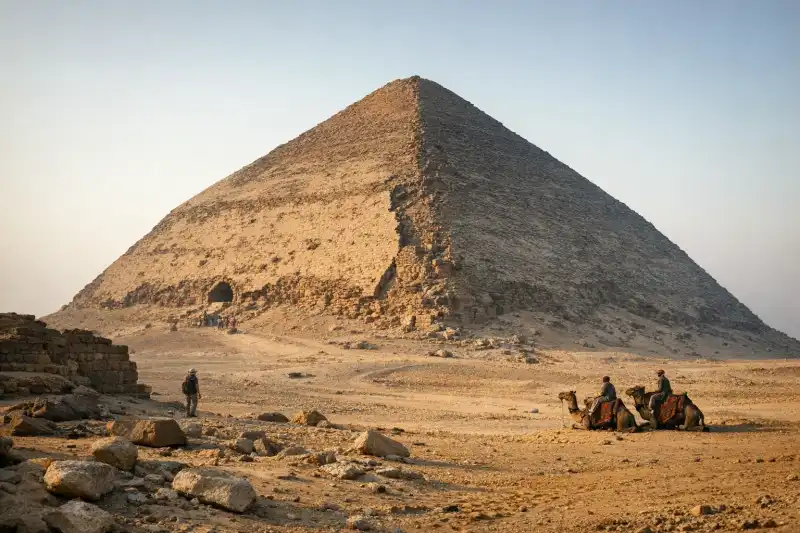
Bent Pyramid
Ancient EgyptianThe Bent Pyramid in Egypt is a rare Old Kingdom monument where a dramatic change in angle reveals th...
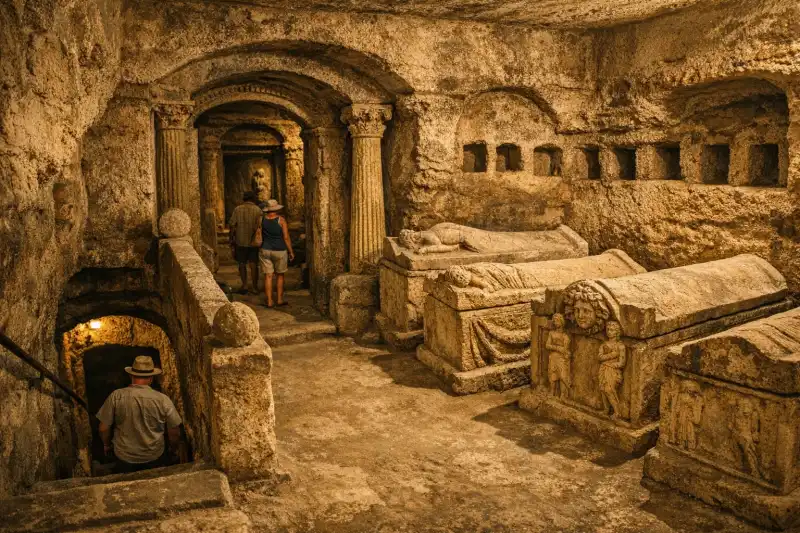
Alexandria Catacombs
Greco-Roman EgyptExplore Alexandria Catacombs in Egypt, a remarkable Roman-era underground necropolis blending Egypti...
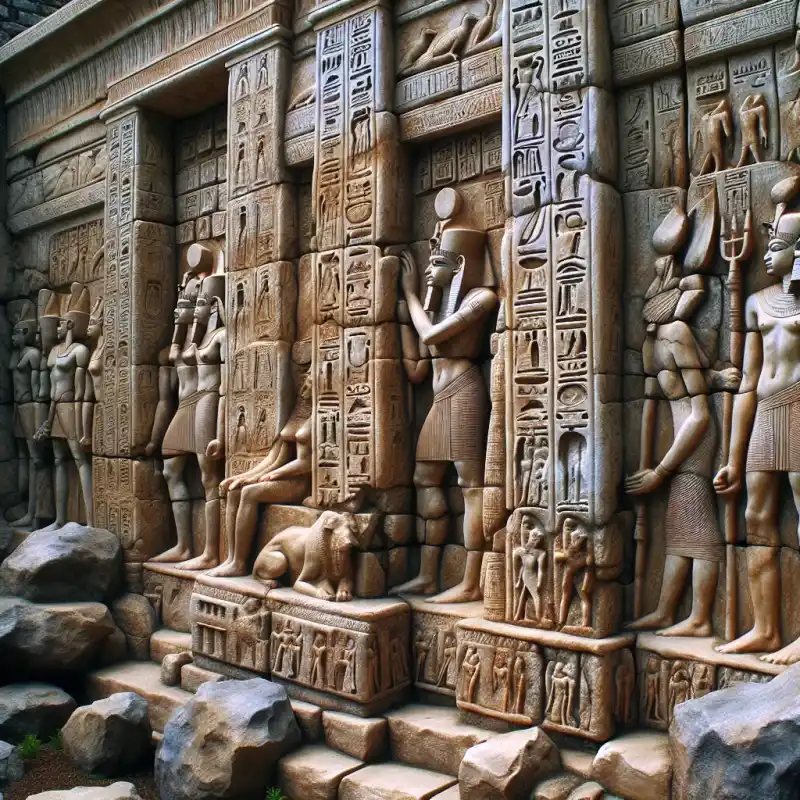
Abydos Temple Egypt Guide 2026: Temple of Seti I & King List
New Kingdom-PtolemaicAbydos Temple near Luxor: magnificent Temple of Seti I with war reliefs, ancient king list, and vibr...