Quick Info
At a glance
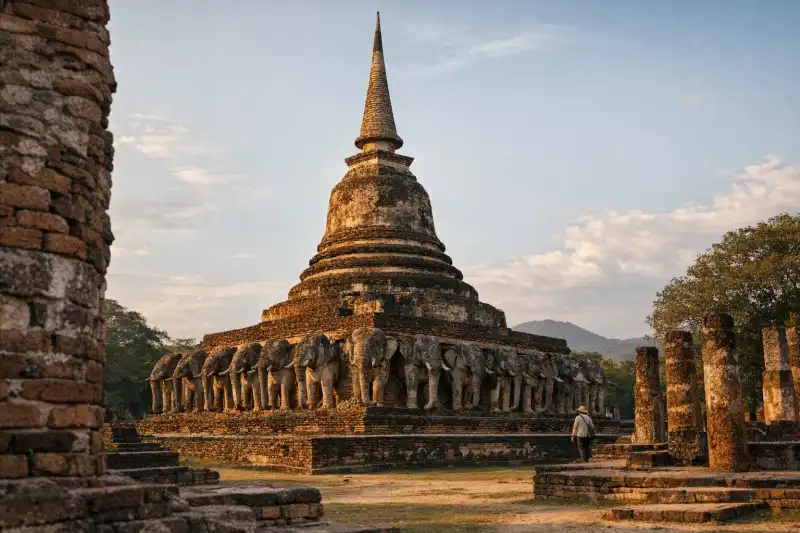
Wat Chang Lom in Thailand rises from the old landscape of Si Satchanalai with a kind of quiet authority that makes even first-time visitors slow their pace. Set within one of the most important historic zones of the former Sukhothai world, the temple is not a sprawling complex built to overwhelm. Instead, its power lies in proportion, detail, and atmosphere: a rounded chedi, weathered brickwork, traces of stucco, and the unforgettable ring of elephants that appear to support the monument from below. Surrounded by trees, open ground, and the wider remains of a once-thriving sacred and urban center, the site offers a sense of both ceremonial grandeur and stillness.
For travelers interested in Thailand beyond beaches and modern cities, Wat Chang Lom is one of the clearest windows into the artistic confidence of the Sukhothai era. The monument embodies a moment when Buddhism, royal patronage, and regional craftsmanship were producing forms that were distinctly Thai while also drawing on older Sri Lankan and mainland Southeast Asian influences. Visiting today, you can appreciate it on several levels at once: as a religious monument, as a masterpiece of sculptural design, and as part of a UNESCO-listed cultural landscape. Even if you have already seen the better-known ruins in Sukhothai proper, Wat Chang Lom feels different—more intimate, more sculptural, and in some ways more memorable because its defining image is so singular.
History
Foundations in the Sukhothai Age
Wat Chang Lom was built during the period when Si Satchanalai served as one of the most significant urban centers of the Sukhothai Kingdom. While precise dating for every phase of the temple remains debated, the monument is generally placed in the late 13th or early 14th century, when Sukhothai political authority and Buddhist culture were flourishing in north-central Thailand. Si Satchanalai was not simply a provincial outpost. It was a major companion city to Sukhothai, closely tied to royal administration, craft production, and religious patronage.
The temple’s name, which means roughly “Temple Surrounded by Elephants,” comes from the sculpted elephants placed around the base of the principal chedi. This design was not merely decorative. In Buddhist and courtly symbolism, elephants conveyed strength, dignity, cosmic support, and royal association. Their placement around the stupa-like structure suggests a sacred monument made to appear stable, elevated, and protected. The form also reflects wider artistic exchanges across the Theravada Buddhist world, especially with Sri Lankan models that influenced Sukhothai religious architecture.
Religious Role and Artistic Development
As with many temples of the era, Wat Chang Lom was likely founded as a site for merit-making, ritual devotion, and the enshrinement of relics or sacred objects within the chedi. The central stupa was the heart of the complex, but the monument would have existed within a broader ritual environment that included assembly spaces, monks’ quarters, and processional movement. The surviving remains today emphasize the chedi, yet in its active life the temple would have been animated by chanting, offerings, festivals, and regular monastic routines.
The Sukhothai period is often celebrated for its refined Buddha images and balanced architectural forms, and Wat Chang Lom fits squarely within that artistic achievement. Brick construction covered with stucco allowed builders to create both mass and delicacy. The chedi’s profile, the elephant sculptures, and the now-fragmentary niches and decorative surfaces all reveal a mature visual language. Rather than relying on monumental scale alone, the temple uses repetition and rhythm: elephant after elephant, curve after curve, creating a sacred geometry that remains legible centuries later.
Later Transformations and Decline
Like many historic sites in Thailand, Wat Chang Lom did not remain unchanged. Political shifts, changes in trade routes, and the eventual decline of Sukhothai’s independent power altered the fortunes of Si Satchanalai. As Ayutthaya rose and regional centers were reorganized, some older temples continued to receive patronage while others lost prominence. Over time, structures decayed, wooden components disappeared, roofs collapsed, and brick cores were exposed to rain, vegetation, and erosion.
The temple’s religious significance may have persisted in local memory even when its physical condition worsened. This is common across mainland Southeast Asia, where sacred geography often survives periods of abandonment. Even as formal institutional support weakened, ruins such as Wat Chang Lom remained part of the cultural landscape—recognized, named, and remembered.
Archaeology, Conservation, and UNESCO Recognition
Modern interest in Wat Chang Lom grew alongside the broader preservation of Sukhothai and its associated historic towns. Archaeological surveys, conservation work, and site clearance in the 20th century helped stabilize the temple and make its architectural form readable again. Restoration at the site focused on preserving the core structure, recovering the visual impact of the elephant-ringed base, and situating the monument within the protected area of Si Satchanalai Historical Park.
Its inclusion within the UNESCO World Heritage property known as the Historic Town of Sukhothai and Associated Historic Towns elevated international awareness of the site. This recognition matters because Wat Chang Lom is not just an isolated ruin; it is part of a wider network of religious and urban monuments that together illustrate the development of early Thai civilization. Today, visitors encounter a monument that has been carefully conserved without being stripped of age. The cracks, softened lines, and weathered surfaces are not flaws but evidence of continuity—proof that this sacred structure has endured through centuries of devotion, neglect, rediscovery, and respectful preservation.
Key Features
The defining feature of Wat Chang Lom is its central chedi, a bell-shaped monument that rises on a substantial base and instantly distinguishes the site from other temple ruins in Thailand. Even before you notice finer details, the overall silhouette catches the eye. It is poised and symmetrical, with the kind of architectural calm that marks the best Sukhothai work. The structure conveys stability rather than vertical drama, and that makes the design feel deeply meditative. It does not thrust upward so much as gather itself into a complete and balanced sacred form.
What most visitors remember, however, are the elephants. Around the base of the chedi, sculpted elephant figures emerge as if stepping out from the brick and stucco itself. They are not freestanding statues lined up in a separate row; they are integrated into the architecture. This gives the whole monument a sculptural vitality. The elephants seem to bear the sacred weight above them, turning a static base into an image of living support. Some of the original detailing has been softened by time, but the effect remains powerful. Their trunks, heads, and bodies create alternating shadows and highlights, especially in angled morning or late afternoon light.
The chedi also reflects a layering of artistic influences. Scholars frequently note the relationship between Sukhothai stupas and Sri Lankan Buddhist forms, particularly in the rounded bell and proportional clarity of the structure. Yet Wat Chang Lom is not a copy of an imported model. Its elephant motif and local execution are part of a regional adaptation that became distinctly tied to Thai artistic identity. Standing close to the monument, you can see how local materials and techniques shaped that adaptation. Brick provides the structural mass, while stucco once carried the more delicate finish and decorative detail.
Surrounding remains add depth to the visit. Fragments of walls, bases, and secondary structural elements hint at a larger sacred enclosure. Even if the complex is no longer complete, these traces help you imagine how worshippers once approached the chedi, circled it, and experienced the temple as a sequence of sacred spaces. The openness of the grounds today can make the site feel minimal at first glance, but this sparseness is part of its appeal. It allows the main monument to dominate visually while also making the surviving ruins easier to read.
Another important feature is the setting within Si Satchanalai Historical Park. Wat Chang Lom is best appreciated not as a standalone postcard image but as part of a wider archaeological landscape of roads, temple zones, and old urban memory. Trees and lawns soften the scene, creating a contrast between natural growth and human-made geometry. Depending on the season, the greenery can frame the brick and stucco with intense color, making the pale elephants and warm earthen tones stand out even more vividly.
There is also a tactile quality to the site, even though visitors must of course respect barriers and preservation rules. The weathered surfaces communicate age in a direct way. You see where stucco has worn away, where brick courses remain strong, and where restoration has stabilized forms that might otherwise have vanished. Unlike highly polished monuments, Wat Chang Lom still feels archaeological. It is beautiful, but it has not been turned into something overly neat or theatrical. That balance is one of its greatest strengths.
Photographically, the temple rewards patience. Wide shots can capture the full ring of elephants and the elegant mass of the chedi, while closer views reveal texture and craftsmanship. The monument also changes character with the light. In midday sun it appears stark and graphic; in softer light it becomes more atmospheric, with the elephants seeming to emerge more gently from the shadows. For many travelers, this shifting visual mood is part of what makes Wat Chang Lom more than a quick stop. It becomes a site to observe rather than merely tick off a list.
Getting There
Wat Chang Lom is located within Si Satchanalai Historical Park in Sukhothai Province, and most travelers reach it from either Sukhothai town, Si Satchanalai district, or nearby regional transport hubs. If you are already visiting Sukhothai Historical Park, remember that Si Satchanalai is a separate site farther north, so it usually requires a half-day or full-day excursion rather than a casual add-on.
From Sukhothai town, the most convenient option is a private car or taxi. The journey generally takes around 1 to 1.5 hours depending on traffic and your starting point. A hired car for the round trip with waiting time often costs about 1,500 to 2,500 THB, depending on negotiation, vehicle type, and whether you combine several stops. Some hotels can help arrange transport.
Budget travelers can use local buses or songthaews toward Si Satchanalai, though schedules may be limited and services less convenient for international visitors. Bus fares are typically inexpensive, often in the range of 40 to 80 THB each way, but you may still need a short tuk-tuk or local ride from the drop-off point to the historical park. Renting a motorbike in Sukhothai is another option for experienced riders; daily rates are often around 250 to 400 THB, plus fuel.
Entry to Si Satchanalai Historical Park may require a separate ticket, commonly around 100 THB for foreign visitors, though fees can change. Once inside the park, walking and cycling are pleasant ways to move between monuments if bicycles are available for rent locally, usually for roughly 30 to 60 THB. The roads and paths are generally manageable, and the slower pace suits the archaeological setting.
When to Visit
The best time to visit Wat Chang Lom is during Thailand’s cooler and drier season, usually from November to February. During these months, daytime temperatures are more comfortable for exploring open-air ruins, skies are often clearer, and the softer weather makes it easier to combine the temple with other sites in Si Satchanalai Historical Park. Early mornings can feel especially pleasant, and the lower angle of the sun brings out texture in the elephant sculptures and brickwork.
March to May is the hottest period. Visits are still possible, but midday heat can become intense, particularly because the site offers limited shade in some areas. If you travel at this time, plan to arrive soon after opening or later in the afternoon, bring plenty of water, and wear a hat and breathable clothing. The monument is visually striking year-round, but the heat can shorten how long you feel like lingering.
The rainy season, broadly from June to October, transforms the surrounding landscape. Vegetation becomes lush, and the historic park can look especially green and atmospheric. Rain showers, however, may interrupt plans, and paths can be damp or slippery. On the plus side, visitor numbers are often lower, which can make the site feel quieter and more contemplative. Cloud cover can also create gentler photographic conditions than harsh midday sun.
If possible, avoid the center of the day in any season. The best overall experience usually comes in the first two hours after arrival in the morning or in the late afternoon before closing. These times offer cooler air, better light, and a calmer sense of place. If you are interested in photography, heritage architecture, or simply the atmosphere of ancient religious sites, timing your visit around the light will make a noticeable difference.
| Quick Facts | Details |
|---|---|
| Site Name | Wat Chang Lom |
| Location | Si Satchanalai Historical Park, Sukhothai Province, Thailand |
| Historical Period | Sukhothai era, mainly 13th-14th century CE |
| Civilization | Sukhothai Kingdom |
| Famous For | Elephant-ringed chedi and refined Buddhist architecture |
| UNESCO Status | Part of the Historic Town of Sukhothai and Associated Historic Towns |
| Best Visit Length | 30-60 minutes for the temple; longer with the wider park |
| Best Time to Go | November to February, early morning or late afternoon |
| Typical Entry Context | Included within Si Satchanalai Historical Park visit |
| Nearest Base | Si Satchanalai or Sukhothai town |
Wat Chang Lom rewards the kind of travel that values atmosphere as much as checklist landmarks. It is not the largest monument in Thailand, nor the most crowded, nor the most theatrical. What it offers instead is something rarer: a chance to see the Sukhothai imagination expressed with clarity and restraint. The encircling elephants, the balanced chedi, and the calm setting within Si Satchanalai combine to create a site that lingers in memory long after the visit ends. For anyone exploring Thailand’s ancient past, it is one of the country’s most distinctive and satisfying temple experiences.
Guided tours: worth it?
Self-guided works here, but a guide can add real value if you want the ruins explained as a living place rather than just a sequence of monuments.
Best for
- First-time visitors who want context, not just photos
- Short visits where a planned route saves time
When to go self-guided
Go independently if you prefer setting your own pace, reading as you go, and checking official hours or ticket rules directly before you arrive.
What I’d avoid
Skip paid tours that bundle unrelated stops you do not actually want. The best option should either save meaningful planning time or add historical context you would miss on your own.
Sukhothai Historical Park
Useful when: you want to compare guided formats before deciding
Sukhothai temples and ruins
Useful when: you want to compare guided formats before deciding
Sukhothai day tour
Useful when: you want to compare guided formats before deciding
Some tour links are affiliate links, which may earn Ancient Travel a small commission at no extra cost to you. I try to surface options that make practical sense for the site—not just anything bookable.
Frequently Asked Questions
Where is Wat Chang Lom located?
Wat Chang Lom is in Si Satchanalai Historical Park in Sukhothai Province, northern Thailand, north of the main Sukhothai ruins.
Why is Wat Chang Lom famous?
It is best known for its large bell-shaped chedi surrounded by sculpted elephants emerging from the base, a striking and influential Sukhothai-era design.
Is Wat Chang Lom part of a UNESCO World Heritage Site?
Yes. It is within the Historic Town of Sukhothai and Associated Historic Towns, a UNESCO World Heritage listing that includes Si Satchanalai.
How much time should I spend at Wat Chang Lom?
Most visitors spend 30 to 60 minutes at the monument itself, though a longer visit makes sense when exploring the wider Si Satchanalai Historical Park.
Can you see the elephant sculptures clearly?
Yes, many of the stucco elephant figures around the chedi base are visible and are among the site's most memorable features.
What is the best time of day to visit Wat Chang Lom?
Early morning and late afternoon are best for softer light, cooler temperatures, and more comfortable walking around the ruins.
Nearby Ancient Sites
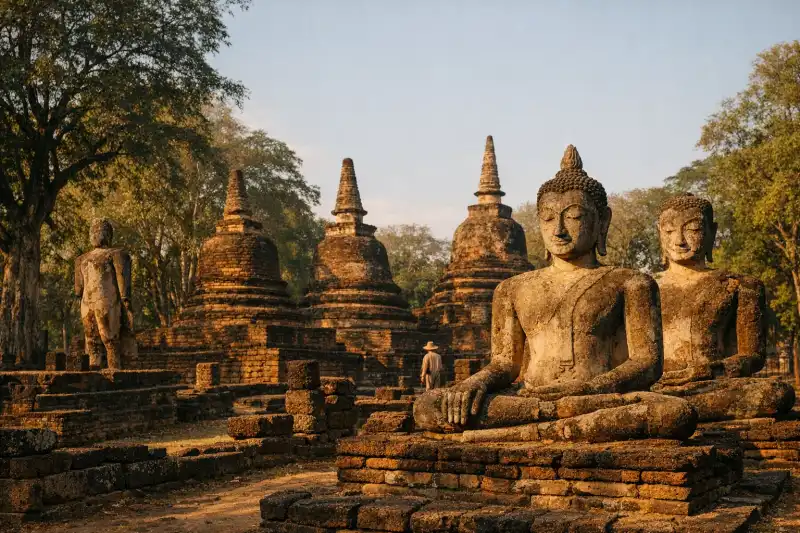
Kamphaeng Phet
Sukhothai KingdomExplore Kamphaeng Phet in Thailand, a walled historic city of temples, laterite ruins, and forested ...
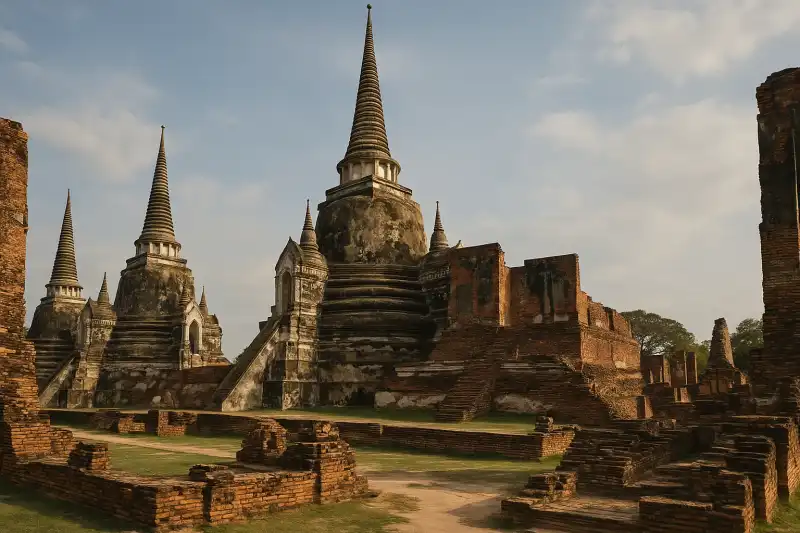
Ayutthaya Travel Guide 2026: Temple Ruins, Day Trip Planning, and What to Prioritize
Ayutthaya KingdomPlan a focused Ayutthaya visit with practical temple routing, timing, and transport guidance from Ba...
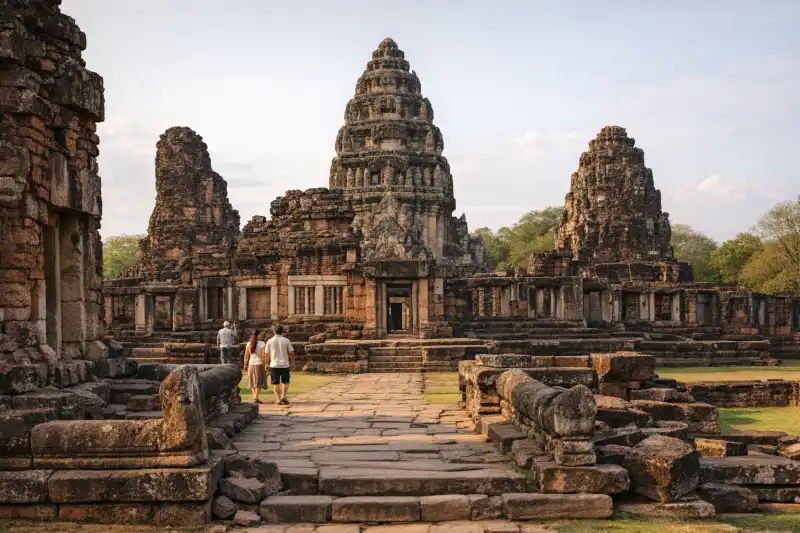
Phimai Historical Park
Khmer EmpireExplore Phimai Historical Park, a remarkable Khmer temple complex in northeastern Thailand famed for...