Quick Info
At a glance
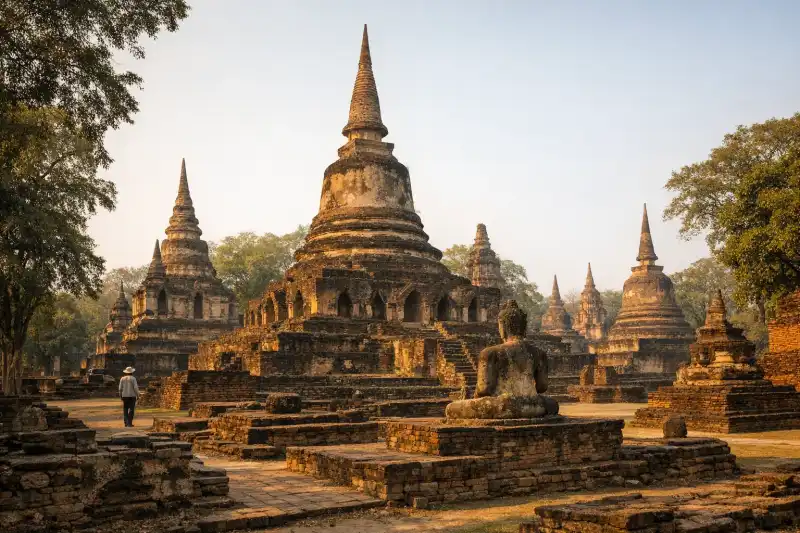
Wat Chedi Chet Thaeo in Thailand sits quietly among the old monuments of Si Satchanalai, where brick, laterite, stucco, and weathered stone still hold the memory of one of the great early Thai kingdoms. The temple does not overwhelm by size alone. Instead, it draws visitors in with rhythm and variety: rows of chedis in different forms, traces of once-bright decorative stucco, and a layout that suggests both royal patronage and deep devotional use. Walking through the grounds, you quickly feel that this is not simply a single ruin but a carefully arranged sacred landscape.
The name is often translated as the “Temple of Seven Rows of Chedis,” and that description hints at what makes the site so memorable. Rather than one dominant monument, the complex presents a collection of funerary and commemorative structures, each with its own profile and artistic language. Some are slender and lotus-bud shaped, unmistakably tied to the Sukhothai style. Others show influences that point beyond the kingdom, reflecting cultural exchange across mainland Southeast Asia. Trees cast shifting shadows over the old platforms, while birds and wind soften the silence of the archaeological park. For travelers interested in Thailand before Ayutthaya rose to greater prominence, Wat Chedi Chet Thaeo offers one of the most rewarding and atmospheric places to pause, observe, and imagine the sophistication of a medieval urban center now returned to calm.
History
Origins in the Sukhothai era
Wat Chedi Chet Thaeo emerged during the period when Si Satchanalai was one of the most important cities of the Sukhothai Kingdom. From the 13th century onward, Sukhothai and its associated towns developed into major political, religious, and artistic centers in what is now northern and central Thailand. Si Satchanalai, located north of Sukhothai proper, held a particularly important role. It functioned as a secondary royal city, a strategic urban center, and a place closely tied to elite patronage.
Scholars generally place the principal development of Wat Chedi Chet Thaeo in the 14th century, when Si Satchanalai was flourishing. The temple’s plan and the number of chedis suggest that it may have served a commemorative function linked to royalty or high-ranking nobility. Many researchers believe the site acted in part as a dynastic funerary complex, where the ashes or memorials of important figures were housed in separate stupas. This would help explain the unusual concentration of distinct chedi forms within one enclosure.
The temple’s architecture also reveals that the Sukhothai world was not isolated. The kingdom had artistic contact with Sri Lankan Buddhist traditions, Khmer architectural conventions, and regional Mon influences. At Wat Chedi Chet Thaeo, these strands seem to converge. The result is a site that preserves not just local craftsmanship, but a visual record of broader religious and political networks.
Growth, adaptation, and religious importance
As the temple developed, new chedis were likely added over time rather than built all at once. This gradual expansion would have made the complex a layered monument, one reflecting changing tastes, commemorative needs, and shifting expressions of Buddhist devotion. The range of forms visible today supports the idea that the temple evolved over generations.
Like many major temples in the Sukhothai orbit, Wat Chedi Chet Thaeo would have been more than a static burial ground. It likely included monastic activity, ritual observance, and merit-making ceremonies. The main viharn, now largely ruined, once served as an assembly and worship hall. Buddha images, now lost or fragmentary, would have formed a central part of the ritual environment. Stucco ornament and sculptural details that survive in traces hint at how visually rich the temple must once have been.
Its importance also derives from its place within Si Satchanalai itself. The historic city was enclosed and ordered, with temples, defensive works, and civic spaces tied together into an urban whole. Wat Chedi Chet Thaeo was one component of that sacred and political landscape, helping express both royal legitimacy and Buddhist piety.
Decline after political change
The fortunes of the temple changed as the balance of power in the region shifted. By the late 14th and 15th centuries, the Sukhothai Kingdom came increasingly under the influence of Ayutthaya. Over time, political centrality moved southward, and older urban centers such as Si Satchanalai lost some of their prominence. Temples remained meaningful as religious places, but long-term maintenance of large ceremonial complexes became harder to sustain.
As patronage weakened, buildings deteriorated. Wooden superstructures would have vanished first, while brick cores and laterite bases endured longer. Forest growth, weather, and the gradual abandonment of sections of the city changed the appearance of the temple. By the early modern period, much of what visitors see today had already entered the long phase of ruin familiar across many Southeast Asian archaeological sites.
Rediscovery, archaeology, and heritage status
In the modern era, Si Satchanalai’s ruins attracted increasing scholarly and governmental attention. Archaeological study, clearance work, and conservation helped define the outlines of Wat Chedi Chet Thaeo and protect its surviving structures. These efforts sought not to rebuild the temple completely, but to stabilize it and make its historical significance legible.
The wider recognition of Sukhothai, Si Satchanalai, and Kamphaeng Phet as a connected cultural landscape culminated in UNESCO World Heritage inscription. That status affirmed the importance of the Sukhothai Kingdom in the history of Thai art, urban planning, and Theravada Buddhist architecture. Within that larger network, Wat Chedi Chet Thaeo stands out as one of the most distinctive temple compounds, especially for those interested in funerary architecture and the diversity of early Thai stupa design.
Key Features
The defining feature of Wat Chedi Chet Thaeo is the remarkable concentration of chedis arranged across the temple enclosure. Even visitors with only a general interest in archaeology tend to notice immediately that this is not a site of repetition. Each major stupa seems to present a different interpretation of sacred architecture. Some rise in the graceful lotus-bud form strongly associated with Sukhothai aesthetics, while others are more bell-shaped or display tiered bases and decorative niches. This variety gives the temple a visual tempo that changes as you walk, making the experience less about a single focal point and more about observing relationships between monuments.
The main chedi, often treated as the centerpiece of the complex, stands on a substantial base and reflects the elegance of mature Sukhothai design. Though time has stripped away some of its detail, the monument still conveys refinement through proportion. The upward movement of the structure, narrowing into a balanced spire, expresses the symbolic ascent central to Buddhist stupa architecture. Around it, smaller chedis help create an architectural dialogue, showing how a temple could become a family of monuments rather than a solitary shrine.
Another notable aspect is the evidence of external artistic influences. Some of the chedis suggest Sri Lankan inspiration, especially in rounded forms tied to Theravada Buddhist transmission. Others show decorative or structural ideas that recall Khmer and regional mainland traditions. For travelers trying to understand medieval Thailand as a crossroads rather than an isolated kingdom, this architectural mixing is one of the site’s most valuable lessons. The temple demonstrates that sacred forms moved along with monks, artisans, courtly connections, and trade routes.
The remains of the viharn add a different dimension to the visit. While less visually complete than the chedis, the hall helps explain how the temple functioned in practice. Rows of columns, low bases, and the traces of a central sanctuary zone suggest where worshippers gathered and where important Buddha images once stood. It is often in these quieter, less intact spaces that visitors can imagine the human life of the monument most vividly: monks walking between structures, offerings being made, and ceremonies unfolding before the chedis.
Stucco fragments and decorative details, where preserved, are also worth close attention. Many first-time visitors focus on the larger shapes of the buildings, but the surviving ornament reveals how textured and expressive the temple once was. Floral motifs, moldings, and niches would have caught light and shadow beautifully when fresh. In their original state, these structures were not bare archaeological forms; they were finished monuments with color, symbolism, and carefully crafted surfaces.
The setting itself is one of the site’s greatest features. Wat Chedi Chet Thaeo sits within the peaceful landscape of Si Satchanalai Historical Park, where mature trees, open lawns, and relatively low visitor numbers create a more contemplative atmosphere than at some of Thailand’s busier heritage destinations. The site feels spacious, and that space allows the architecture to breathe. You can stand back to understand the overall layout, then move in close to study individual bases, corners, and surviving plaster.
Photographers often appreciate the temple for the way light changes the ruins through the day. Morning illumination tends to emphasize the vertical lines of the chedis, while late afternoon brings warmer tones that flatter brick and stucco. Yet even for those not taking pictures, the changing light deepens the experience. It reveals why the placement of monuments mattered: shadows, alignments, and the progression through the compound were all part of the temple’s original impact.
Getting There
Wat Chedi Chet Thaeo is located inside Si Satchanalai Historical Park in Sukhothai Province, roughly 55 kilometers north of Sukhothai and a shorter distance from the modern town of Si Satchanalai. The easiest base for most travelers is Sukhothai, where hotels, guesthouses, and transport options are more plentiful.
From Sukhothai, the most convenient option is a private car or taxi. A one-way ride typically costs around 800 to 1,500 THB depending on negotiation, vehicle type, and whether the driver waits while you explore. Hiring a car for a half-day or full-day loop that includes other ruins in the area can be better value, often ranging from 1,800 to 3,000 THB. This is the best choice if you want flexibility and plan to combine Wat Chedi Chet Thaeo with other monuments in the park.
Budget travelers can use local buses or songthaews heading toward Si Satchanalai district. Fares from Sukhothai are commonly around 40 to 80 THB, though schedules can be limited and may require extra transport from the drop-off point to the historical park. A motorcycle rental from Sukhothai, usually around 250 to 400 THB per day, is another practical option for confident riders, especially in the dry season.
If you are already staying near Si Satchanalai town, local tuk-tuks or songthaews can usually take you to the park for modest fares, often in the 100 to 300 THB range depending on distance and waiting time. Entrance fees for the historical park may apply separately, so carry small cash. Because services can be less frequent than in major tourist hubs, it is wise to arrange return transport in advance.
When to Visit
The best time to visit Wat Chedi Chet Thaeo is generally during Thailand’s cool and dry season, from November to February. At this time, temperatures are more comfortable for walking around open archaeological grounds, and the light is often excellent for photography. Mornings can be especially pleasant, with softer sun, fewer visitors, and a calmer atmosphere that suits the reflective mood of the site.
March to May is the hottest period. The ruins remain accessible, but midday heat can be intense, especially because much of the temple complex is exposed. If you travel at this time, arrive early, bring plenty of water, and wear a hat and breathable clothing. Short visits are more enjoyable than long ones in the peak afternoon heat.
The rainy season, roughly June to October, transforms the landscape into a greener and often more photogenic environment. Grass brightens, trees look lush, and the old brick structures can appear especially atmospheric under dramatic skies. The trade-off is that showers may interrupt plans, pathways can become muddy, and humidity rises. Still, many travelers enjoy this season because the park feels quiet and deeply evocative.
For the best experience in any season, aim to visit either soon after opening or in the late afternoon. Early visits are cooler and quieter, while later in the day the warm light gives the chedis greater depth and character. If your itinerary allows, avoid rushing the site as part of a packed circuit. Wat Chedi Chet Thaeo rewards slower observation, especially when shadows begin to stretch across the rows of monuments and the whole temple feels more clearly connected to the landscape around it.
| Quick Facts | Details |
|---|---|
| Location | Si Satchanalai Historical Park, Sukhothai Province, Thailand |
| Historical Period | Primarily 14th century, Sukhothai Kingdom |
| Site Type | Buddhist temple and commemorative chedi complex |
| Famous For | Multiple chedis in varied architectural styles |
| UNESCO Status | Part of the Historic Town of Si Satchanalai and Associated Historic Towns |
| Best Visit Duration | 45 minutes to 1.5 hours |
| Best Time of Day | Early morning or late afternoon |
| Nearest Base | Si Satchanalai or Sukhothai |
| Dress Code | Modest clothing recommended |
| Atmosphere | Quiet, reflective, and less crowded than many major Thai ruins |
Wat Chedi Chet Thaeo is one of those rare places where historical importance and visual subtlety meet. It may not have the instant fame of Thailand’s most photographed temples, but that is part of its appeal. Here, the rewards come through attentive looking: the slight differences in stupa form, the suggestion of courtly memory embedded in architecture, and the calm setting of a once-powerful city now softened by time. For anyone interested in the Sukhothai world, the temple is more than a stop on an itinerary. It is a concentrated lesson in how art, devotion, royal identity, and regional exchange shaped early Thai civilization.
Guided tours: worth it?
Self-guided works here, but a guide can add real value if you want the ruins explained as a living place rather than just a sequence of monuments.
Best for
- First-time visitors who want context, not just photos
- Short visits where a planned route saves time
When to go self-guided
Go independently if you prefer setting your own pace, reading as you go, and checking official hours or ticket rules directly before you arrive.
What I’d avoid
Skip paid tours that bundle unrelated stops you do not actually want. The best option should either save meaningful planning time or add historical context you would miss on your own.
Sukhothai Historical Park Day Tours
Useful when: you want to compare guided formats before deciding
Si Satchanalai Historical Park Tours
Useful when: you want to compare guided formats before deciding
Private Tour from Sukhothai to Si Satchanalai
Useful when: you want flexible timing or a private guide
Some tour links are affiliate links, which may earn Ancient Travel a small commission at no extra cost to you. I try to surface options that make practical sense for the site—not just anything bookable.
Frequently Asked Questions
Where is Wat Chedi Chet Thaeo located?
Wat Chedi Chet Thaeo is in Si Satchanalai Historical Park in Sukhothai Province, northern Thailand.
What is Wat Chedi Chet Thaeo known for?
It is best known for its large group of differently designed chedis, which showcase a variety of Sukhothai-period architectural styles in one temple complex.
Is Wat Chedi Chet Thaeo part of a UNESCO site?
Yes. It lies within the Historic Town of Si Satchanalai and Associated Historic Towns, which form part of the UNESCO World Heritage listing linked to the Sukhothai kingdom.
How much time should I plan for visiting?
Most visitors spend 45 minutes to 1.5 hours exploring the temple, though history enthusiasts may want longer to study the monuments and layout.
Do I need to dress modestly?
Yes. Since it is a historic Buddhist temple site, visitors should wear respectful clothing that covers shoulders and knees.
Can I visit Wat Chedi Chet Thaeo on a day trip from Sukhothai?
Yes. Wat Chedi Chet Thaeo is commonly visited on a day trip from Sukhothai, often combined with other ruins in Si Satchanalai Historical Park.
Nearby Ancient Sites
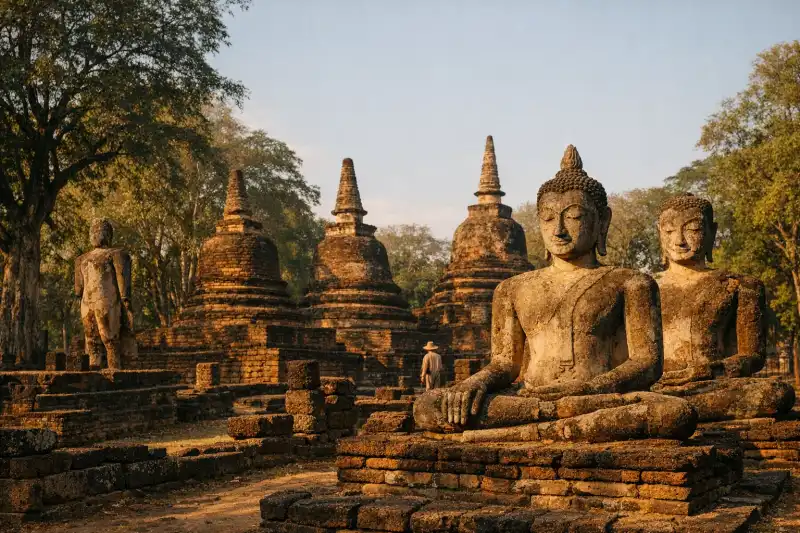
Kamphaeng Phet
Sukhothai KingdomExplore Kamphaeng Phet in Thailand, a walled historic city of temples, laterite ruins, and forested ...
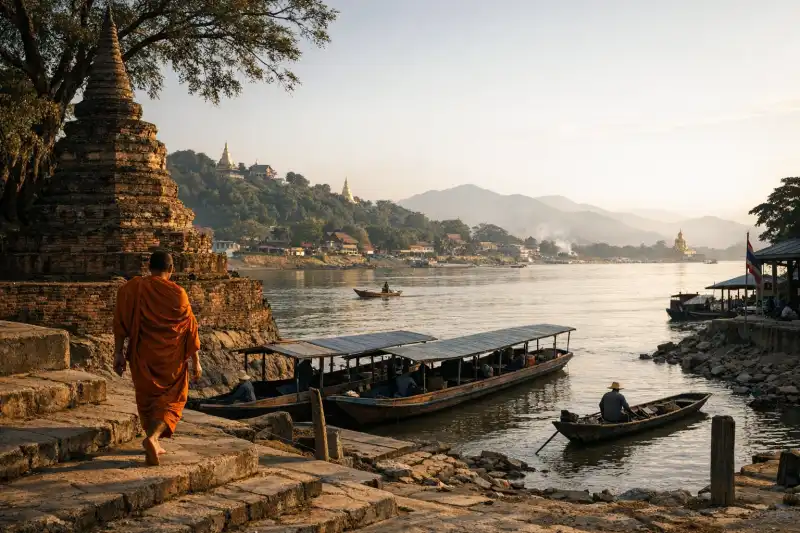
Chiang Saen
Lanna KingdomAncient riverside town in northern Thailand known for old city walls, Lanna heritage, and Mekong vie...
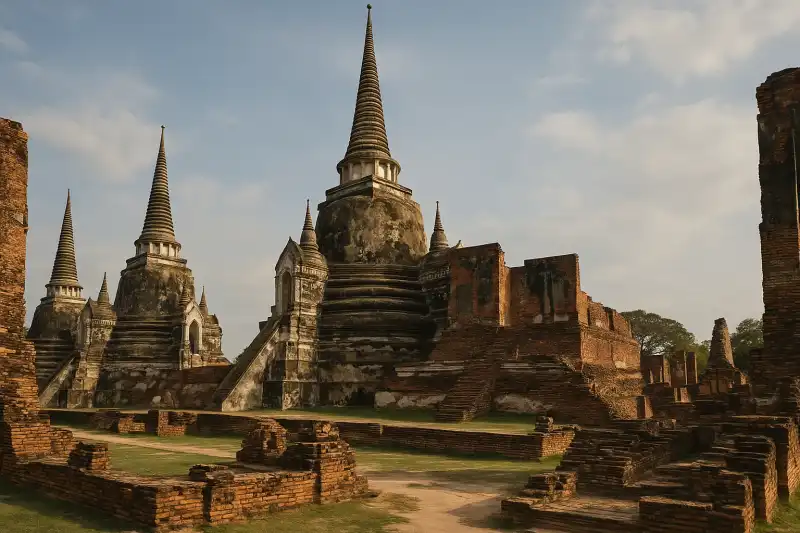
Ayutthaya Travel Guide 2026: Temple Ruins, Day Trip Planning, and What to Prioritize
Ayutthaya KingdomPlan a focused Ayutthaya visit with practical temple routing, timing, and transport guidance from Ba...