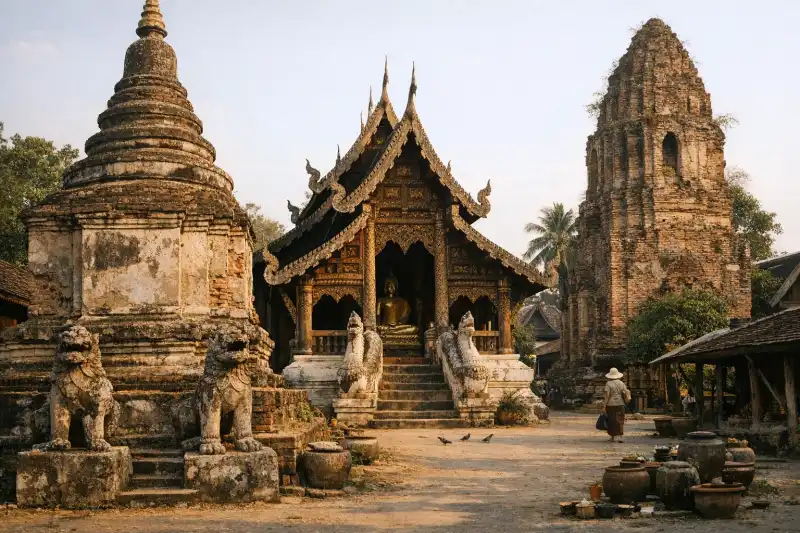
Quick Info
At a glance
Wat Ku Meng in Thailand is one of those places that rewards travelers who slow down. Away from the most crowded temple circuits of Chiang Mai, this historic site feels quieter, more local, and more reflective of the landscape from which it emerged. The remains do not overwhelm with monumental scale, but they offer something more subtle: the sense of a lived religious place that once formed part of the wider Lanna world of northern Thailand. Brick structures rise from the ground with a weathered dignity, and the surviving chedi, fragments of walls, and temple layout hint at centuries of devotion, repair, decline, and rediscovery.
For visitors used to polished temple compounds in city centers, Wat Ku Meng can feel almost intimate. Rural surroundings soften the experience, and the atmosphere changes through the day as sunlight strikes the old brickwork and vegetation frames the site. It is a destination for people who appreciate context as much as spectacle. Here, history is not delivered through grand restoration alone; it survives in texture, in traces, in the relationship between sacred architecture and the northern Thai countryside. Visiting Wat Ku Meng is therefore not just about seeing a ruin. It is about stepping into the older cultural geography of Chiang Mai Province, where Buddhism, regional kingship, and village life were deeply intertwined. With the right expectations, the site becomes a memorable stop for anyone interested in ancient Thailand, Lanna heritage, and the quieter edges of the region’s historical map.
History
Early Lanna Foundations
Wat Ku Meng is generally understood within the historical orbit of the Lanna kingdom, the northern Thai polity that emerged in the late 13th century and developed its own artistic, religious, and architectural traditions centered on Chiang Mai. As with many smaller temple sites in the region, precise dates can be difficult to establish with complete certainty, especially when inscriptions are absent, damaged, or not widely published. Even so, the temple’s surviving brick construction and sacred layout place it comfortably within the broader pattern of Lanna Buddhist monastic foundations.
During the rise of Chiang Mai as an important political and religious center, temples were established not only within the fortified city but also throughout surrounding settlements and agricultural zones. These monasteries served many purposes. They were places of worship and merit-making, but they also anchored local communities, linked villages to royal patronage, and contributed to the spread of Buddhist learning. Wat Ku Meng likely formed part of this landscape of everyday sacred institutions. It may not have ranked among the kingdom’s most famous monasteries, but such sites were vital to the lived practice of religion across the region.
Use, Patronage, and Religious Life
At its height, Wat Ku Meng would have functioned as a local monastic complex where monks resided, villagers made offerings, and ceremonies marked the annual calendar. The chedi or stupa would have been central to the sacred identity of the temple, likely enshrining relics or symbolizing the presence of the Buddha. Nearby structures probably included an ordination hall, an assembly space, and monastic living quarters, though not all of these have survived clearly above ground.
In the Lanna tradition, temples were often maintained through a mixture of elite support and communal labor. Even modest temples could be renovated repeatedly over generations, with new brick layers, stucco decoration, or wooden superstructures added when resources allowed. Wat Ku Meng may have undergone exactly this sort of incremental development. What visitors see today is almost certainly only one phase, or a compressed remnant of several phases, in the site’s longer history.
The spiritual life of the temple would also have reflected the distinctive blend of Theravada Buddhism and local northern customs found throughout the region. Rituals connected to merit, ancestors, agricultural cycles, and Buddhist festivals would have tied the monastery closely to nearby communities. In this way, Wat Ku Meng was not an isolated monument but part of a social and religious network.
Periods of Decline
Like many historical temples in northern Thailand, Wat Ku Meng likely experienced periods of decline connected to warfare, political change, demographic shifts, and the vulnerability of building materials. The history of Lanna includes episodes of conflict, changing overlordship, and transformations in trade and settlement patterns. When a local population moved, shrank, or redirected its resources, temple upkeep often suffered.
Brick monuments can endure for centuries, but wooden structures, roofs, decorative plaster, and inscriptions are much more fragile. Once regular maintenance stops, tropical weather rapidly accelerates decay. Trees and roots force apart masonry, rain weakens mortar, and repeated reuse of building materials by later communities can strip a site down to its core remains. This process explains why many once-complete temple complexes survive mainly as a chedi, low foundations, and scattered fragments.
Wat Ku Meng seems to have followed this familiar trajectory. The site never disappeared entirely from memory, but over time it became more of a ruin than an active monastic center. Its transformation from living temple to archaeological and heritage site reflects the broader story of many ancient religious places across Thailand.
Modern Recognition and Preservation
In the modern era, interest in local history, archaeology, and regional identity has encouraged renewed attention to sites like Wat Ku Meng. Scholars, heritage authorities, and local communities have increasingly recognized the value of preserving smaller Lanna monuments, not only the famous landmarks in central Chiang Mai. Preservation work at such sites often focuses on stabilizing brickwork, clearing overgrowth, and making the layout legible without over-restoring the ruins into something inauthentic.
Today, Wat Ku Meng stands as both a religious remnant and a cultural document. Its present condition reflects not only its original construction but also centuries of weathering and selective conservation. For visitors, this layered state is part of its appeal. Rather than presenting an entirely reconstructed version of the past, the site allows the passage of time to remain visible. That honesty gives Wat Ku Meng a special value in understanding the longer history of Lanna Buddhism and the rural temple landscape of northern Thailand.
Key Features
The most striking feature of Wat Ku Meng is its brick architecture, which immediately connects the site to the long building traditions of northern Thailand. The surviving chedi is often the visual and symbolic center of attention. Even in ruin, it preserves the vertical intention of Buddhist sacred architecture: the movement upward, the suggestion of relic veneration, and the centrality of merit in temple design. Visitors familiar with grander stupas elsewhere in Thailand may find this monument more restrained, but that restraint is part of its character. Its weathered surfaces, softened edges, and surviving mass evoke age in a way that polished restorations sometimes cannot.
Another important aspect of the site is the visible ground plan. At Wat Ku Meng, the relationship between structures can be as interesting as any single surviving element. Low walls, platforms, and brick foundations help visitors imagine where halls, ancillary buildings, and devotional spaces once stood. These traces are essential for reading the temple as a complex rather than a solitary ruin. They remind us that ancient monasteries were organized environments shaped by ritual movement, monastic routine, and community gathering.
The material itself deserves close attention. Lanna brickwork often rewards slow observation, especially where different phases of construction or repair are visible. Variations in brick size, mortar, alignment, and surviving stucco traces can suggest multiple periods of use. Although casual visitors may first notice only old red-brown masonry, a more careful look reveals an architecture built by hand, repaired over time, and altered by both human intervention and climate. This material history gives the site much of its depth.
The setting of Wat Ku Meng is also one of its defining features. Unlike urban temple compounds crowded by modern traffic and commercial activity, this site benefits from a calmer environment. The surrounding landscape helps explain why such temples mattered historically. They were embedded in local worlds of fields, villages, pathways, and water systems. That context often survives better in rural or semi-rural areas, making the visit feel less like entering a museum zone and more like encountering a place where sacred and ordinary life once met.
Light and atmosphere play a major role in the experience. Early morning and late afternoon are particularly rewarding, when the brick surfaces catch warm light and shadows emphasize the surviving architectural forms. In midday sun, the ruins can seem stark and archaeological; in softer light, they become more contemplative. This shifting mood is one reason photographers and historically minded travelers often enjoy sites like Wat Ku Meng more than expected.
There is also a subtle educational value in visiting a lesser-known temple ruin. Famous monuments tend to dominate historical narratives, but sites such as Wat Ku Meng help balance the picture. They reveal that the religious life of the Lanna kingdom was sustained not just by royal foundations but by a wider network of local monasteries. The site therefore contributes to a more complete understanding of Thai history. It demonstrates how Buddhist institutions spread across the landscape, how architecture adapted to local resources, and how regional identity was expressed outside the walls of major capitals.
For many visitors, one of Wat Ku Meng’s greatest features is precisely its lack of spectacle. There are no overwhelming crowds, no elaborate visitor theatrics, and usually no pressure to move quickly from one highlight to the next. Instead, the site invites observation. The ruin’s modest scale makes it accessible, and its stillness encourages interpretation. In practical terms, that means you can walk slowly, notice small details, and appreciate how heritage survives in fragments. In emotional terms, it means Wat Ku Meng offers something increasingly rare: a historical site that still feels quiet enough to think in.
Getting There
Wat Ku Meng is most easily reached from Chiang Mai, the main transport hub of northern Thailand. If you are already staying in Chiang Mai city, the most convenient option is to hire a taxi or use a ride-hailing app. Depending on traffic, the journey typically takes around 20 to 40 minutes, and one-way fares commonly range from THB 180 to THB 350. For travelers who want flexibility to combine several temple and heritage stops in one day, hiring a car with driver can be a practical choice, with half-day rates often starting around THB 1,000 to THB 1,800.
A rented scooter or car is another good option for independent travelers comfortable with Thai roads. Daily scooter rental in Chiang Mai usually costs about THB 200 to THB 350, while compact car rentals often start around THB 900 to THB 1,500 per day, excluding fuel. This is particularly useful if you plan to explore rural areas around the city rather than just one site. Be sure to use navigation carefully, as smaller historic temples may not always have prominent signage.
Public transportation can be less direct. Local songthaews, the shared red pickup taxis common in Chiang Mai, may get you part of the way depending on your route, but they are not always the most efficient option for a specific heritage site. Fares within and around Chiang Mai often range from THB 30 to THB 80 per person for shared rides, though a private negotiation can be higher.
If arriving from elsewhere in Thailand, first reach Chiang Mai by air, train, or long-distance bus. From Chiang Mai International Airport, onward travel by taxi is usually straightforward, with fares often around THB 150 to THB 300 depending on distance and traffic. Carry water, sun protection, and cash for smaller local expenses.
When to Visit
The best time to visit Wat Ku Meng is generally during the cool and dry season from November to February. At this time, northern Thailand is more comfortable for walking outdoors, with milder temperatures in the morning and late afternoon. The lower humidity also makes it easier to spend time examining the ruins without feeling rushed by the heat. Light during this season can be especially beautiful for photography, bringing out the texture and warm tones of the old brick.
The hot season, roughly March to May, is still manageable if you visit early in the day. Midday temperatures in Chiang Mai Province can become intense, often rising above 35°C, and exposed ruins offer little relief. If you travel during these months, plan to arrive soon after opening hours or in the late afternoon, and bring plenty of water, a hat, and sunscreen. April can also coincide with Songkran celebrations, which may make the broader region livelier and more crowded, though smaller historical sites often remain calmer than city-center attractions.
The rainy season, usually from June to October, transforms the landscape into a greener and often more atmospheric setting. Vegetation around temple ruins can look especially vivid, and the surrounding countryside becomes lush. The trade-off is that showers may interrupt your visit, paths can become slippery, and photography can be more challenging during storms. On the other hand, the softer skies and fewer visitors can create a peaceful mood that suits the site well.
For the most rewarding experience in any season, aim for early morning or late afternoon. These hours not only improve comfort but also emphasize the quiet character of Wat Ku Meng. If your main interest is historical appreciation rather than simply checking off sights, timing your visit around light and temperature will make a noticeable difference.
| Quick Facts | Details |
|---|---|
| Name | Wat Ku Meng |
| Location | Chiang Mai Province, Thailand |
| Cultural Context | Lanna Buddhist heritage |
| Site Type | Historic temple ruin |
| Main Materials | Brick, with probable former stucco and wooden elements |
| Best For | History lovers, photographers, temple enthusiasts |
| Typical Visit Length | 30 minutes to 1 hour |
| Nearest Major Hub | Chiang Mai |
| Best Time of Day | Early morning or late afternoon |
| Ideal Season | November to February |
Wat Ku Meng may not be among Thailand’s most famous ancient sites, but that is precisely why it deserves attention. It preserves a quieter chapter of northern Thai history, one rooted in the local temple networks that supported Buddhist life across the Lanna world. For travelers interested in more than headline monuments, it offers a chance to connect with the region on a different scale. The ruin’s brick forms, modest footprint, and rural calm encourage a slower style of travel and a more observant way of seeing. In a province known for celebrated temples, Wat Ku Meng stands apart by asking for patience rather than awe. Those who give it that patience are likely to leave with a deeper appreciation of how Thailand’s past survives not only in grand capitals and heavily restored landmarks, but also in the enduring stillness of places like this.
Guided tours: worth it?
Self-guided works here, but a guide can add real value if you want the ruins explained as a living place rather than just a sequence of monuments.
Best for
- First-time visitors who want context, not just photos
- Short visits where a planned route saves time
When to go self-guided
Go independently if you prefer setting your own pace, reading as you go, and checking official hours or ticket rules directly before you arrive.
What I’d avoid
Skip paid tours that bundle unrelated stops you do not actually want. The best option should either save meaningful planning time or add historical context you would miss on your own.
Chiang Mai temple tours
Useful when: you want to compare guided formats before deciding
Chiang Mai historical city tours
Useful when: you want to compare guided formats before deciding
Chiang Mai cultural tours
Useful when: you want to compare guided formats before deciding
Some tour links are affiliate links, which may earn Ancient Travel a small commission at no extra cost to you. I try to surface options that make practical sense for the site—not just anything bookable.
Frequently Asked Questions
What is Wat Ku Meng?
Wat Ku Meng is an old temple ruin in Chiang Mai Province, Thailand, associated with the Lanna cultural sphere and known for its brick remains and historic chedi.
Where is Wat Ku Meng located?
Wat Ku Meng is located in Chiang Mai Province in northern Thailand, within reach of Chiang Mai city and other historic Lanna-era sites.
Is Wat Ku Meng worth visiting?
Yes, Wat Ku Meng is worth visiting for travelers interested in quieter historical places, local temple architecture, and lesser-known heritage sites beyond Chiang Mai's busiest attractions.
How much time should I spend at Wat Ku Meng?
Most visitors spend 30 minutes to 1 hour at Wat Ku Meng, though history enthusiasts may stay longer to examine the brickwork, layout, and surrounding landscape.
Do I need a guide to visit Wat Ku Meng?
A guide is not essential, but having one can help explain the temple's Lanna-era context, religious significance, and architectural details that are easy to miss.
What should I wear when visiting Wat Ku Meng?
Wear lightweight clothing that covers shoulders and knees, along with comfortable walking shoes, as this is a religious and historical site in a warm climate.
Nearby Ancient Sites

Chiang Saen
Lanna KingdomAncient riverside town in northern Thailand known for old city walls, Lanna heritage, and Mekong vie...
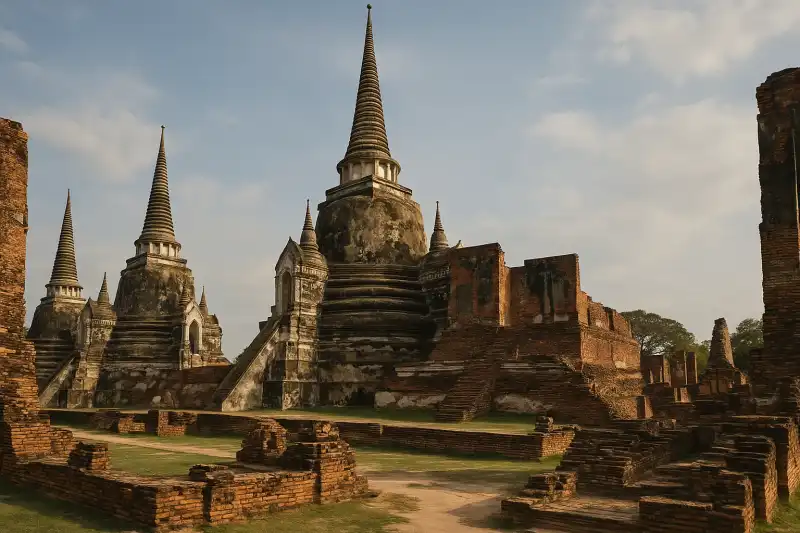
Ayutthaya Travel Guide 2026: Temple Ruins, Day Trip Planning, and What to Prioritize
Ayutthaya KingdomPlan a focused Ayutthaya visit with practical temple routing, timing, and transport guidance from Ba...
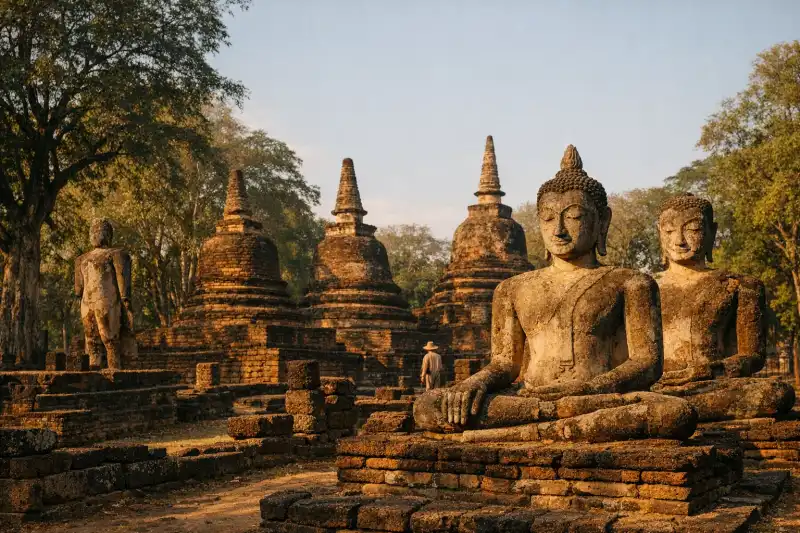
Kamphaeng Phet
Sukhothai KingdomExplore Kamphaeng Phet in Thailand, a walled historic city of temples, laterite ruins, and forested ...