Quick Info
At a glance
Wat Phu Kamphaeng Laeng in Thailand is one of those places that can surprise travelers who think they already know the country’s temple landscape. Set in the historic town of Phetchaburi, this compact but striking monument looks different from the gilded Thai wats many visitors expect. Its weathered laterite towers, Khmer plan, and layered religious identity immediately suggest an older and more complicated story, one that reaches back to the centuries when the Khmer cultural sphere extended far beyond Angkor. Today the site sits quietly within an urban setting, yet its atmosphere still carries the dignity of an ancient sanctuary.
For visitors interested in Southeast Asian history, Wat Phu Kamphaeng Laeng offers a valuable bridge between worlds. It belongs to Thailand, but its architectural language is unmistakably tied to the Khmer tradition. It is a Buddhist temple today, but many scholars understand its earliest phase as a Hindu sanctuary later reworked and reinterpreted over time. That blend makes it especially rewarding: this is not a monument frozen in one moment, but a place that has continued to live, adapt, and gather meaning across centuries. Even a short visit reveals details worth lingering over, from the dark red laterite masonry to the surviving tower forms that hint at ritual practices, royal patronage, and regional exchange in premodern mainland Southeast Asia.
History
Early Khmer foundations
The origins of Wat Phu Kamphaeng Laeng are usually placed in the period when Khmer political and cultural influence spread across parts of present-day Thailand. Most scholars date the sanctuary to around the 12th century, though some elements may reflect construction and modification over a broader span between the 11th and 13th centuries. At that time, Phetchaburi occupied a useful position along routes linking the central plains, the upper Malay Peninsula, and the coast. That location made it a natural place for artistic and religious forms associated with the Khmer world to take root.
The temple’s basic plan and surviving towers suggest that it was conceived in the style of a Khmer sanctuary complex. Such sanctuaries often served as ritual centers connected to elite patronage, and many were dedicated to Hindu deities, particularly Shiva or Vishnu, though Buddhist usage also occurred in different periods and regions. At Wat Phu Kamphaeng Laeng, the architectural evidence points strongly toward this broader Khmer sacred tradition. The use of laterite for the towers and enclosure is especially characteristic, as is the axial arrangement that organized movement toward the shrine.
Transition and local adaptation
As political patterns shifted in mainland Southeast Asia, temples like this often passed through phases of reuse rather than simple abandonment. The decline of direct Khmer power in outlying regions did not erase the monuments already established there. Instead, local communities and later Thai polities adapted them to new forms of worship. Wat Phu Kamphaeng Laeng appears to have followed that path.
Over time, the sanctuary was incorporated into the Buddhist religious life of Phetchaburi. This was not unusual in Thailand, where older Hindu and Khmer monuments were often reinterpreted through a Buddhist lens. Images, structures, and ritual emphases changed, but the sacred value of the place remained. In many cases, the very age of a site enhanced its prestige. Ancient shrines could be seen as powerful spaces worthy of continued devotion, regardless of their original dedication.
This process of adaptation helps explain why Wat Phu Kamphaeng Laeng feels layered rather than purely archaeological. It is not simply a ruin detached from living practice. Instead, it represents centuries of continuity through change, where a monument from one cultural framework became meaningful within another. The result is a site that speaks both to regional history and to the flexibility of sacred landscapes in Thailand.
Ayutthaya and later Thai periods
During the rise of Thai kingdoms, especially Ayutthaya, Phetchaburi grew in importance as a strategic and religious center. Monuments in and around the city were repaired, embellished, or folded into local temple networks. While Wat Phu Kamphaeng Laeng retained its older Khmer core, later generations interacted with it as part of a Buddhist environment. Some original sculptures and decorative features were likely lost, removed, or replaced during these long centuries of reuse.
The Ayutthaya period also contributed to the broader historical memory of Phetchaburi as an old and significant town. By then, the ancient sanctuary would already have been recognized as a relic of an earlier age. That sense of antiquity probably shaped how local people valued it. Rather than demolishing the old structure to build entirely anew, they preserved enough of it for the Khmer identity of the monument to remain visible today.
Modern recognition and preservation
In the modern era, Wat Phu Kamphaeng Laeng has gained recognition as one of Thailand’s important Khmer-related monuments outside the better-known northeastern zone. For many travelers, Khmer architecture in Thailand is associated with sites such as Phimai or Phanom Rung, but Phetchaburi demonstrates that these cultural networks extended much farther. Archaeological study and heritage preservation have helped clarify the temple’s significance and protect its remaining structures.
Although the complex is smaller and less elaborate than major imperial centers, its value lies in context and survival. It preserves evidence of long-distance influence, local religious change, and the endurance of sacred architecture in an urban Thai setting. Visiting today, you see not a complete reconstruction of the past, but a carefully maintained remnant whose worn surfaces carry the marks of many centuries. That is precisely what makes the site compelling: it reveals history not as a single episode, but as accumulation.
Key Features
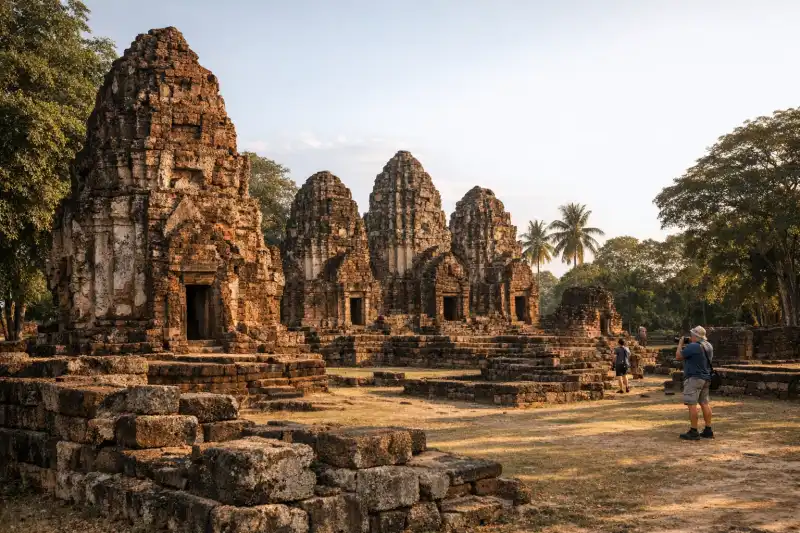
The most memorable elements of Wat Phu Kamphaeng Laeng are its Khmer-style prang towers. Built primarily of laterite, they stand with a dense, earthy texture unlike the gleaming stucco and tilework found in many later Thai temples. Laterite gives the structures a subdued reddish-brown tone that changes with the light. In the morning sun, the masonry can appear warm and almost coppery; on overcast days, it becomes darker and heavier, emphasizing the age of the monument. This material alone immediately signals that visitors have entered a different architectural tradition.
The central sanctuary tower is the visual anchor of the complex. Although time has stripped away some ornamental details, the vertical massing and shape still convey the Khmer idea of a sacred mountain-form shrine. Smaller accompanying towers contribute to the sense of an organized ritual plan rather than an isolated building. Even where restoration or weathering has softened the original profile, the arrangement remains legible enough to imagine the complex in its earlier state.
Another notable feature is the site’s enclosure and overall layout. Khmer sanctuaries were often carefully ordered, guiding movement through defined sacred space. At Wat Phu Kamphaeng Laeng, this planning survives in reduced but meaningful form. Visitors can observe how the towers relate to one another and to the surrounding temple grounds. The contrast between the ancient core and later Buddhist additions is especially interesting. Instead of appearing jarring, the combination often feels like a visual record of historical succession, with each generation leaving its mark without completely erasing what came before.
The site also rewards attention to small details. Door frames, wall surfaces, and surviving architectural joints reveal the construction logic of Khmer builders working far from the Angkor heartland. The craftsmanship is less about flamboyant decoration than about disciplined masonry and sacred geometry. This restraint can actually sharpen appreciation of the monument. Rather than overwhelming the visitor with ornament, Wat Phu Kamphaeng Laeng invites close looking.
Its urban context is another of its strengths. Some ancient sites impress through remoteness, but this one gains character from existing within living Phetchaburi. The temple is not marooned in an isolated archaeological park; it remains woven into the daily fabric of the town. That makes the experience feel intimate. You encounter old walls and towers amid a setting where religious practice, neighborhood life, and heritage tourism still meet.
There is also value in comparing Wat Phu Kamphaeng Laeng with other Khmer sites in Thailand. It is more modest than Phimai Historical Park and less dramatically sited than Phanom Rung, yet it offers a rare western example of Khmer architectural influence. For travelers tracing the spread of Khmer art and statecraft, that geographic position matters. It helps expand the map of premodern Southeast Asia beyond modern national boundaries.
Because the monument later became part of a Buddhist wat, visitors may also notice contemporary devotional elements or signs of active religious use. These should not be seen as distractions from the ancient architecture. On the contrary, they reveal one of the site’s defining qualities: continuity. Wat Phu Kamphaeng Laeng is not only a relic to be observed but also a sacred space that has remained meaningful across different eras. That living dimension gives it an atmosphere many purely archaeological ruins lack.
Getting There
Wat Phu Kamphaeng Laeng is located in Phetchaburi city, making it relatively straightforward to reach from Bangkok or other destinations in central Thailand. From Bangkok, the most budget-friendly option is usually train service from Krung Thep Aphiwat Central Terminal or older connecting lines, with ordinary and rapid fares typically ranging from about 30 to 150 THB depending on class and train type. Travel time is generally around 2.5 to 3.5 hours. From Phetchaburi railway station, a tuk-tuk or motorcycle taxi to the temple area often costs around 60 to 120 THB, depending on distance and negotiation.
Minivans and buses are another common choice. Vans from Bangkok’s southern transport hubs or other city pickup points usually cost about 120 to 200 THB and can be slightly faster than trains, depending on traffic. Once in Phetchaburi, local songthaews, tuk-tuks, or ride-hailing services can take you the final distance. If you are already exploring nearby attractions such as Khao Wang or local cave temples, hiring a driver for a half-day circuit can be convenient and may cost roughly 600 to 1,200 THB.
Travelers with a rental car will find the journey easiest of all. Phetchaburi sits along well-used roads south of Bangkok, and the drive normally takes around two to three hours. Parking is usually simpler than at major tourist centers. Because the temple is within town, many visitors combine it with other historic sites in a single day. If you prefer a guided experience, private day tours from Bangkok sometimes include Phetchaburi highlights, though prices vary widely based on vehicle, inclusions, and group size.
When to Visit
The most comfortable time to visit Wat Phu Kamphaeng Laeng is during Thailand’s cooler, drier season, generally from November to February. Daytime temperatures are more manageable, humidity is lower, and walking around the exposed stone structures is far more pleasant. Morning and late afternoon are especially good, both for comfort and for photography. The angled light brings out the color and texture of the laterite, making the ancient towers look more dramatic.
March through May can be intensely hot in central Thailand. If you visit in these months, try to arrive early, carry water, and plan indoor breaks elsewhere in Phetchaburi during the hottest hours. The temple is not vast, but the heat can still drain energy quickly, especially if you are combining multiple heritage stops in one day.
The rainy season, usually from about June to October, has both advantages and drawbacks. Sudden showers are common, and paths can be damp, but the surrounding vegetation often looks greener and the town may feel quieter. Cloud cover can also soften the light and reduce heat. If you do not mind occasional rain and flexible scheduling, this can still be a rewarding time to visit.
Weekdays are often calmer than weekends, especially if local visitors or school groups are present. As with many active temple spaces in Thailand, respectful clothing is recommended year-round: shoulders and knees should be covered, and behavior should remain considerate. If your main interest is atmosphere, choose an early weekday morning. If your main interest is photography, aim for the golden-hour light before sunset.
| Quick Facts | Details |
|---|---|
| Site name | Wat Phu Kamphaeng Laeng |
| Location | Phetchaburi city, Phetchaburi Province, Thailand |
| Cultural tradition | Khmer-influenced sanctuary later adapted as a Buddhist temple |
| Likely date | Mainly 12th century CE, with later modifications |
| Main building material | Laterite |
| Best visit length | 30-60 minutes |
| Best season | November to February |
| Good combined stops | Khao Wang, Phetchaburi old town, local temples and markets |
| Access from Bangkok | Train, minivan, bus, private car, or guided day trip |
| Why it matters | A rare western Thai example of Khmer sacred architecture and religious continuity |
Wat Phu Kamphaeng Laeng may not be the largest or most famous ancient monument in Thailand, but that is part of its appeal. It invites a slower kind of attention, one grounded in texture, form, and historical layering rather than spectacle. In a single compact complex, visitors can trace the reach of Khmer architecture, the transformation of sacred space, and the enduring importance of Phetchaburi as a crossroads in Thai history. For anyone interested in the deeper map of mainland Southeast Asia, it is a site well worth seeking out.
Guided tours: worth it?
Self-guided works here, but a guide can add real value if you want the ruins explained as a living place rather than just a sequence of monuments.
Best for
- First-time visitors who want context, not just photos
- Short visits where a planned route saves time
When to go self-guided
Go independently if you prefer setting your own pace, reading as you go, and checking official hours or ticket rules directly before you arrive.
What I’d avoid
Skip paid tours that bundle unrelated stops you do not actually want. The best option should either save meaningful planning time or add historical context you would miss on your own.
Phetchaburi temples and heritage tours
Useful when: you want to compare guided formats before deciding
Bangkok to Phetchaburi day trips
Useful when: transport or pickup logistics matter
Thailand Khmer temple tours
Useful when: you want to compare guided formats before deciding
Some tour links are affiliate links, which may earn Ancient Travel a small commission at no extra cost to you. I try to surface options that make practical sense for the site—not just anything bookable.
Frequently Asked Questions
What is Wat Phu Kamphaeng Laeng?
Wat Phu Kamphaeng Laeng is an ancient Khmer-influenced sanctuary in Phetchaburi, Thailand, later adapted into a Buddhist temple complex.
Where is Wat Phu Kamphaeng Laeng located?
The site stands in Phetchaburi city in Phetchaburi Province, southwest of Bangkok and not far from the Gulf of Thailand.
How much time should I allow for a visit?
Most visitors spend 30 to 60 minutes exploring the towers, courtyard, and interpretive features, though history enthusiasts may stay longer.
Is Wat Phu Kamphaeng Laeng still an active religious site?
Yes, it functions within a Buddhist setting today, so visitors should dress respectfully and behave appropriately around worship areas.
When is the best time to visit Wat Phu Kamphaeng Laeng?
The cool and dry season from roughly November to February is the most comfortable, especially in the morning or late afternoon.
Can I visit Wat Phu Kamphaeng Laeng on a day trip from Bangkok?
Yes, Phetchaburi is reachable from Bangkok by train, bus, van, or private car, making the site feasible as a day trip.
Nearby Ancient Sites
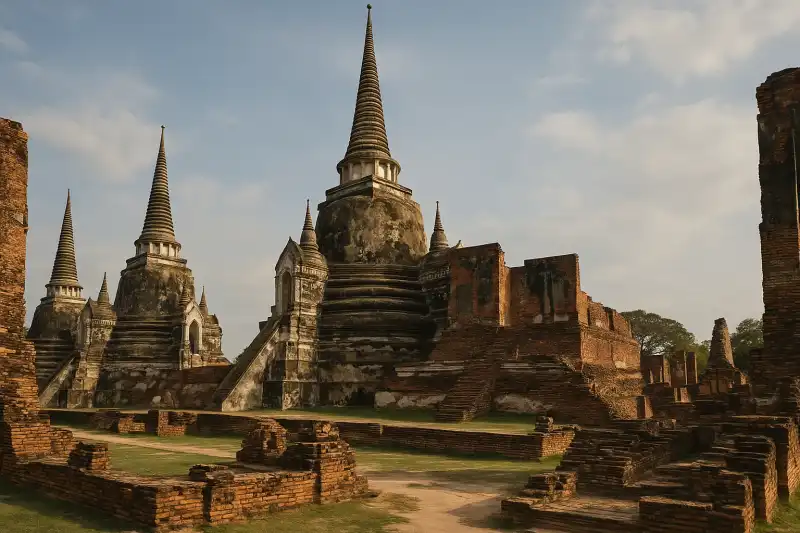
Ayutthaya Travel Guide 2026: Temple Ruins, Day Trip Planning, and What to Prioritize
Ayutthaya KingdomPlan a focused Ayutthaya visit with practical temple routing, timing, and transport guidance from Ba...
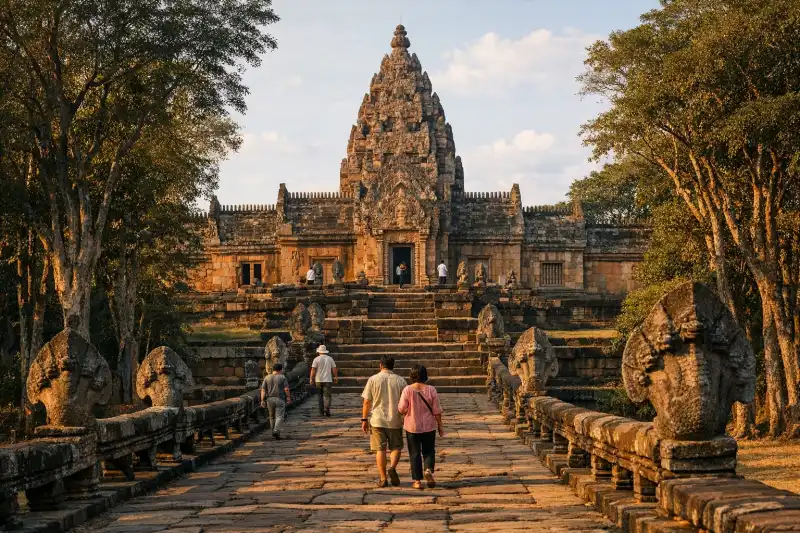
Phanom Rung
Khmer EmpireA dramatic Khmer hilltop temple in Thailand, Phanom Rung is famed for its sandstone carvings and sun...
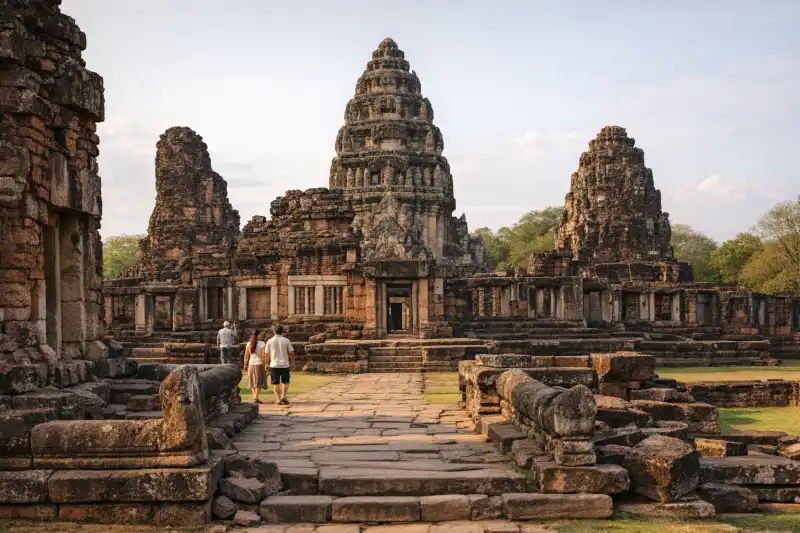
Phimai Historical Park
Khmer EmpireExplore Phimai Historical Park, a remarkable Khmer temple complex in northeastern Thailand famed for...