Quick Info
At a glance
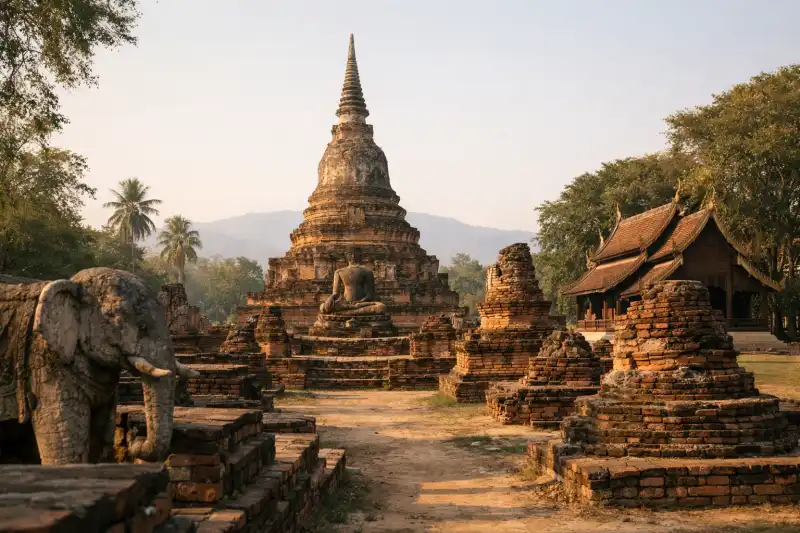
Wiang Kum Kam in Thailand feels less like a single monument and more like a half-remembered city gently returning to view. South of central Chiang Mai, beyond modern roads, neighborhoods, and riverside developments, the remains of this early Lanna settlement lie scattered across a broad plain where brick sanctuaries, old foundations, and weathered Buddha images emerge from the landscape with quiet persistence. It is a place of archaeology rather than spectacle, rewarding visitors who enjoy connecting fragments of the past into a larger story. Here, instead of one dominant ruin, you encounter an entire urban memory: moats, temple compounds, inscriptions, and traces of a capital once shaped by royal ambition and then humbled by nature.
Unlike the mountain temples and crowded markets that define many travelers’ first impressions of Chiang Mai, Wiang Kum Kam offers a calmer experience. The roads are flatter, the atmosphere more local, and the discoveries more intimate. You may arrive expecting a short stop among old bricks, but the site often surprises people with its scale and significance. Founded by King Mangrai before the establishment of Chiang Mai, Wiang Kum Kam preserves evidence of a formative period in northern Thai history. Flooding from the Ping River eventually weakened the city’s role, and over centuries many of its structures were buried under silt and farmland. That sense of disappearance and rediscovery gives the area much of its power today. Visiting Wiang Kum Kam is not only about seeing ruins; it is about stepping into the beginnings of the Lanna world.
History
Founding under King Mangrai
Wiang Kum Kam is closely tied to the rise of the Lanna Kingdom, one of mainland Southeast Asia’s most important regional powers. In the late 13th century, King Mangrai, the ruler credited with consolidating Lanna authority, established Wiang Kum Kam as a royal center around 1286 CE. The location was strategically chosen on the fertile plain near the Ping River, which supported agriculture, trade, and communication across northern Thailand. At the time, river access was a major advantage, linking settlements and helping rulers control both resources and movement.
The city appears to have been planned with defensive and ceremonial concerns in mind. Like many early mainland Southeast Asian urban centers, it combined religious monuments with a moated settlement layout. Temples were not simply places of worship; they anchored political legitimacy, reflected royal patronage, and expressed the cultural identity of an emerging kingdom. Brick architecture, stucco decoration, and Buddhist imagery at Wiang Kum Kam show the blending of local traditions with wider influences circulating through the region, including Mon and Haripunchai artistic forms.
A Short-Lived Capital
Although Wiang Kum Kam was important, it did not remain the principal royal center for long. The site’s greatest weakness was environmental rather than political. The Ping River, while useful for transport and agriculture, was unpredictable. Seasonal flooding repeatedly affected the settlement, damaging infrastructure and making long-term development difficult. These conditions likely convinced King Mangrai to seek a more suitable location nearby.
In 1296 CE, Chiang Mai was founded to the north and gradually eclipsed Wiang Kum Kam as the primary capital of Lanna. This shift did not mean the older city was instantly abandoned. Rather, Wiang Kum Kam continued to function as a significant religious and residential area, with temples maintained and expanded over time. Inscriptions and archaeological remains suggest ongoing activity across several centuries. It became part of the wider urban and sacred landscape surrounding Chiang Mai rather than disappearing immediately from use.
Religious Life and Urban Continuity
Even after losing political primacy, Wiang Kum Kam remained meaningful in Buddhist and local civic life. A number of temple foundations in the area indicate patronage from elites and communities that continued to inhabit or support the settlement. The surviving ruins include ordination halls, chedis, viharns, and Buddha images in styles associated with different periods of northern Thai history. This layered architectural record reveals that the city evolved over time rather than freezing in the moment of its founding.
The site also helps historians understand the development of Lanna urbanism. Instead of one fixed ceremonial core, the region seems to have supported a network of religious and administrative centers linked by waterways, roads, and agricultural lands. Wiang Kum Kam may have served as a satellite religious zone even as Chiang Mai became dominant. Its monuments show continuity in ritual practice and artistic production, highlighting how old capitals could remain spiritually active long after political power shifted elsewhere.
Decline, Burial, and Rediscovery
Over centuries, repeated flooding deposited layers of sediment across the area. Structures collapsed, were abandoned, or became partially buried. Agricultural use and later settlement further obscured the ancient city. By the modern period, much of Wiang Kum Kam survived only in local memory, scattered remains, and isolated standing structures. The idea of a buried former capital lingered, but the full extent of the site was not clearly understood.
Systematic archaeological work in the 20th century, especially from the 1980s onward, dramatically changed that picture. Excavations uncovered temple compounds, inscriptions, ceramics, and urban features over a wide area south of Chiang Mai. These discoveries confirmed Wiang Kum Kam as a major archaeological zone of exceptional importance to Lanna history. Conservation efforts then sought to stabilize exposed ruins while making them accessible to the public.
Today, Wiang Kum Kam stands as both a research site and a place of heritage tourism. Its significance lies not only in what can be seen above ground, but also in what its rediscovery tells us about the vulnerability of cities built in dynamic river landscapes. The story of Wiang Kum Kam is one of ambition, adaptation, environmental challenge, and historical recovery—an unusually vivid example of how a capital can vanish from prominence yet remain embedded in the land.
Key Features
What makes Wiang Kum Kam memorable is the way its ruins are distributed across a lived-in landscape. Rather than entering a single enclosed archaeological park, visitors move through a broad zone where old temple compounds appear among houses, lanes, trees, and open ground. This creates a layered experience: the ancient city is not isolated from the present but woven into it. That sense of continuity can be especially striking for travelers used to seeing ruins fenced off from everyday life.
Among the site’s most noted remains is Wat Chedi Liam, one of the best-preserved monuments associated with Wiang Kum Kam. Its tiered chedi, with multiple niches and images, is often linked stylistically to older Haripunchai models, showing how northern Thai builders adapted earlier forms. The structure gives a strong impression of verticality and order, and because it remains an active religious place as well as a historic one, it bridges the gap between archaeology and living devotion. For many visitors, it provides the clearest visual anchor for understanding the city’s spiritual importance.
Other temple sites reveal a more fragmentary but equally compelling side of Wiang Kum Kam. Brick foundations outline former assembly halls and sanctuaries; headless Buddha images and damaged stucco fragments hint at artistic richness now partly lost. At sites such as Wat Chang Kham, Wat E-Kang, Wat Nanchang, and Wat Ku Padom, what survives is often enough to suggest the scale of the original complexes. Elephant sculptures, lotus motifs, laterite bases, and traces of wall alignments reward slow observation. Because many structures are incomplete, the imagination plays an active role in reconstructing the city from its remains.
The archaeological layout also helps visitors appreciate Wiang Kum Kam as an urban settlement rather than a lone temple field. Remnants of moats, embankments, and spatial organization suggest a planned environment shaped by hydrology and royal authority. Even where modern development overlaps with the ancient city, the geography still communicates why the site mattered: it sits on fertile lowland close to river routes, within easy reach of Chiang Mai but distinct enough to have served as a separate center.
Another key feature is the atmosphere. Wiang Kum Kam is usually quieter than Thailand’s most famous historical parks. There may be school groups, local worshippers, cyclists, or a small tram carrying visitors between compounds, but the site rarely feels overwhelming. This makes it especially suitable for travelers who enjoy photography, reflective walks, or learning through pacing rather than spectacle. Early morning and late afternoon light can be particularly beautiful, warming the old brickwork and softening the surrounding greenery.
Interpretive signs and local museums or visitor points can add useful context, though the quality of information may vary by area and season. Hiring a local guide or driver often improves the visit, since the historical importance of the scattered ruins is not always immediately obvious. The stories behind the monuments—founding legends, flood history, artistic influences, excavation discoveries—give shape to what might otherwise seem like disconnected remains.
Ultimately, the value of Wiang Kum Kam lies in its cumulative effect. No single ruin here competes in scale with the grandest ancient capitals of Asia, but together the surviving monuments offer a rare window into the birth of Chiang Mai’s cultural world. The site preserves a prelude: the first royal experiment, the riverine city that came before the famous walled capital. That makes its broken walls and half-buried shrines especially evocative. They are not merely remnants of decline, but evidence of a city that helped define northern Thailand’s historical identity.
Getting There
Wiang Kum Kam is very easy to reach from Chiang Mai, which makes it one of the most convenient ancient sites in northern Thailand. From Chiang Mai Old City or the Night Bazaar area, the archaeological zone lies roughly 5 to 7 kilometers to the south. The simplest option is a taxi or ride-hailing app such as Grab. Expect a one-way fare of about THB 120 to THB 250 depending on traffic, pickup point, and time of day. A return trip with waiting time may cost more, but it is still reasonable by local standards.
Songthaews, the shared red pickup taxis common in Chiang Mai, can also be used if you are comfortable negotiating routes and price. Private hire is often around THB 150 to THB 300 from central Chiang Mai. Some hotel desks can arrange a driver familiar with the different temple clusters, which is helpful because the ruins are spread out.
Cycling is another practical and enjoyable option in the cooler months. Renting a bicycle in Chiang Mai usually costs around THB 50 to THB 150 per day, and the roads to Wiang Kum Kam are mostly flat. The distance is manageable, though traffic on some connecting roads can be busy. Motorbike rental, typically THB 200 to THB 350 per day excluding fuel, gives more flexibility if you plan to combine the site with other attractions.
Some visitors join half-day cultural tours that include transport and commentary. Prices vary widely, but shared tours often start around THB 800 to THB 1,800 per person, while private tours can be significantly higher. Once at Wiang Kum Kam, local tram or carriage-style circuits may be available near the visitor area for a small additional fee, often around THB 20 to THB 300 depending on service and format.
When to Visit
The best time to visit Wiang Kum Kam is generally from November to February, when northern Thailand is cooler and drier. During these months, daytime temperatures are more comfortable for walking or cycling between the ruins, and the softer light also helps with photography. Mornings can be especially pleasant, with less heat and a quieter atmosphere around the temple compounds.
March to May is the hottest period. Temperatures can become intense by late morning, making exposed brick sites and open paths less enjoyable. This season may also coincide with smoky air in northern Thailand due to regional agricultural burning, which can affect visibility and overall comfort. If you visit during these months, start as early as possible, carry water, and plan a shorter itinerary.
The rainy season, typically from June to October, brings greener scenery and fewer visitors, but also occasional downpours and muddy conditions. Because Wiang Kum Kam’s history is so closely tied to flooding, seeing the low-lying landscape in wet weather can actually deepen your understanding of the site. Still, heavy rain can interrupt plans, and some paths may be less convenient. Light rain gear and flexible timing are useful.
For the best experience in any season, aim for early morning or late afternoon rather than midday. The site’s mood changes with the light: sunrise hours feel calm and contemplative, while late afternoon casts warm tones across the brick ruins. If you want a deeper cultural context, visiting during a Chiang Mai stay that includes museums and old city temples helps place Wiang Kum Kam within the larger story of Lanna history.
| Quick Facts | Details |
|---|---|
| Location | South of Chiang Mai city, Chiang Mai Province, Thailand |
| Historical Importance | Early Lanna royal center associated with King Mangrai |
| Founded | c. 1286 CE |
| Later Development | Superseded by Chiang Mai after 1296 but remained a religious settlement |
| Main Appeal | Scattered temple ruins, moated city remains, and early Lanna history |
| Best Base | Chiang Mai |
| Time Needed | 1.5 to 3 hours |
| Best Season | November to February |
| Typical Transport Cost from Chiang Mai | THB 120 to THB 250 by taxi one way |
| Best For | History enthusiasts, photographers, cyclists, and travelers interested in lesser-known ruins |
Guided tours: worth it?
Self-guided works here, but a guide can add real value if you want the ruins explained as a living place rather than just a sequence of monuments.
Best for
- First-time visitors who want context, not just photos
- Short visits where a planned route saves time
When to go self-guided
Go independently if you prefer setting your own pace, reading as you go, and checking official hours or ticket rules directly before you arrive.
What I’d avoid
Skip paid tours that bundle unrelated stops you do not actually want. The best option should either save meaningful planning time or add historical context you would miss on your own.
Chiang Mai Historical Temples and Wiang Kum Kam Tours
Useful when: you want to compare guided formats before deciding
Private Chiang Mai City Highlights with Wiang Kum Kam
Useful when: you want flexible timing or a private guide
Half-Day Chiang Mai Ancient City and Wiang Kum Kam
Useful when: you want to compare guided formats before deciding
Some tour links are affiliate links, which may earn Ancient Travel a small commission at no extra cost to you. I try to surface options that make practical sense for the site—not just anything bookable.
Frequently Asked Questions
What is Wiang Kum Kam?
Wiang Kum Kam is an ancient fortified settlement just south of Chiang Mai in northern Thailand, often described as an early Lanna capital founded in the late 13th century.
How far is Wiang Kum Kam from Chiang Mai Old City?
Wiang Kum Kam is about 5 to 7 kilometers south of Chiang Mai Old City, depending on your starting point, and is usually reached in 15 to 25 minutes by car or taxi.
Is there an entrance fee at Wiang Kum Kam?
The wider archaeological area is generally free to explore, though some visitor facilities, tram rides, or museum services may have small fees.
How much time do I need to visit Wiang Kum Kam?
Most visitors spend 1.5 to 3 hours exploring the main temple ruins, longer if they visit by bicycle or combine it with other Chiang Mai historical sites.
What is the best way to explore Wiang Kum Kam?
The easiest ways are by bicycle, hired car, songthaew, or local tram service, since the ruins are spread across a broad archaeological zone rather than concentrated in one enclosure.
When is the best time of year to visit Wiang Kum Kam?
The coolest and most comfortable months are generally November to February, when northern Thailand has drier weather and lower daytime temperatures.
Nearby Ancient Sites
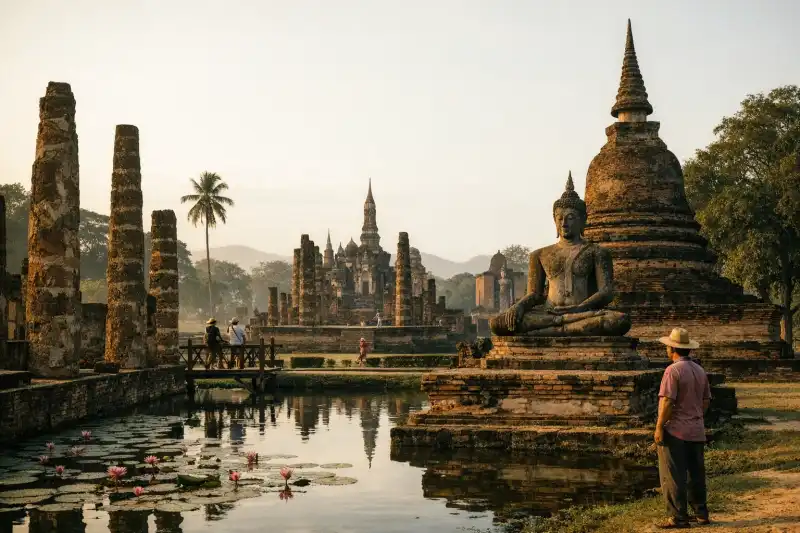
Sukhothai
Sukhothai, in northern Thailand's Sukhothai Province, is famed as the cradle of Thai civilization an...
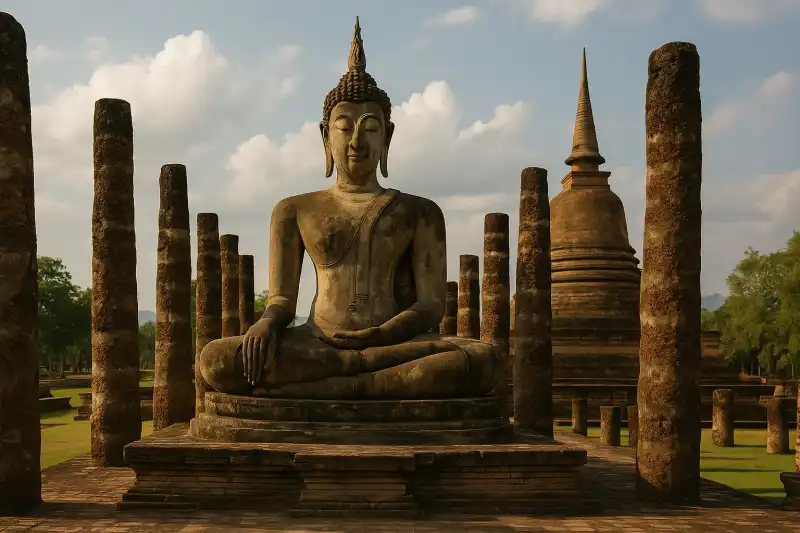
Sukhothai Historical Park Travel Guide 2026: Thailand’s First Capital Without the Crowds
Sukhothai KingdomPlan a smarter Sukhothai Historical Park visit with route tips, key ruins, and practical timing for ...
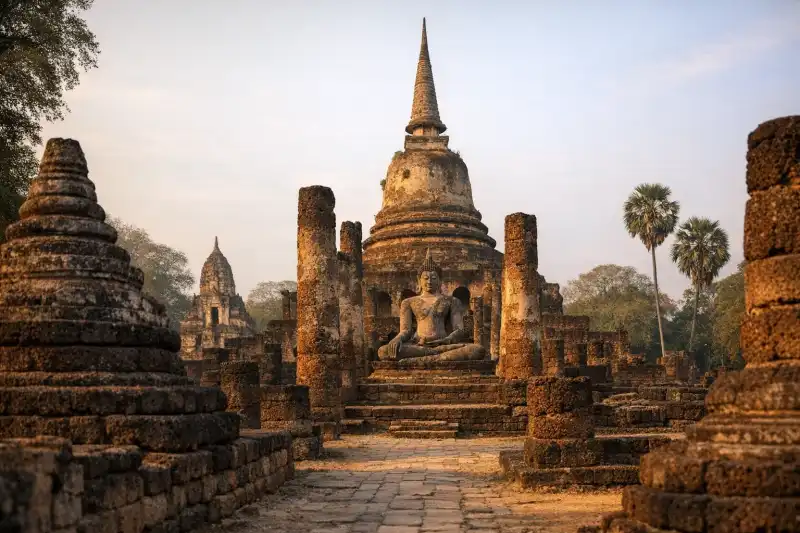
Si Satchanalai
Sukhothai KingdomExplore Si Satchanalai, a serene UNESCO-listed ancient city in Thailand known for elegant temples, k...
Phimai Historical Park
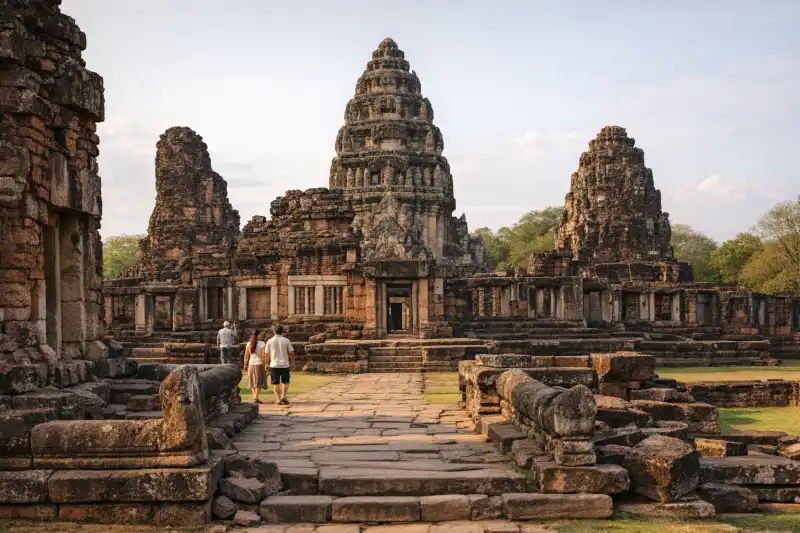
Khmer EmpireExplore Phimai Historical Park, a remarkable Khmer temple complex in northeastern Thailand famed for...