Quick Info
Curated Experiences
Xi'an City Wall Bicycle Rental & Guided Tour
Xi'an Full-Day Cultural Highlights Tour
Xi'an Terracotta Army & City Wall Combo Tour
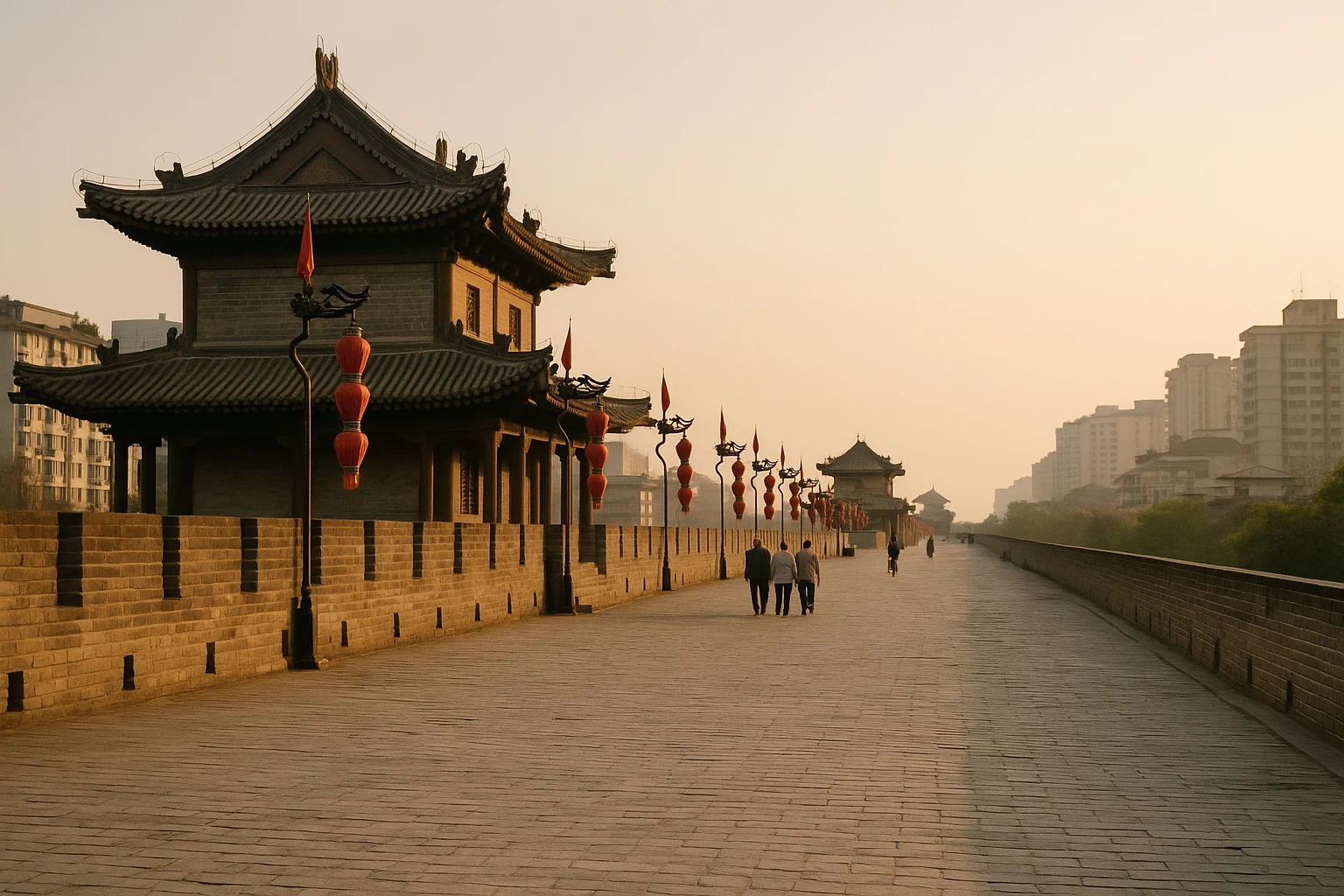
Xi’an’s ancient city wall is one of the most complete and best-preserved examples of Chinese imperial fortification architecture surviving anywhere in the world. Rising twelve meters above street level and stretching nearly fourteen kilometers around the historic city center, this massive Ming Dynasty barrier has stood for more than six centuries as a physical boundary between ancient capital and modern metropolis. Today it functions as one of China’s most accessible and rewarding heritage experiences — a place where visitors can walk, cycle, and linger above a city that once served as the eastern terminus of the Silk Road and the imperial seat of thirteen Chinese dynasties.
Unlike many ancient walls reduced to fragments or speculative reconstructions, Xi’an’s fortification has been continuously maintained and remains structurally intact around its full perimeter. The sheer scale of the structure — wide enough at the top for two horse-drawn carriages to pass side by side — communicates something of the ambition that drove its construction and the strategic importance Xi’an held across a thousand years of dynastic history.
A Capital Built in Layers
Xi’an’s position as a walled city predates the current structure by well over a thousand years. The site known today as Xi’an was called Chang’an during the Tang Dynasty (618–907 AD), when it served as the most populous city on earth and the cosmopolitan hub of the Silk Road network linking China to Central Asia, Persia, and the eastern Mediterranean. The Tang capital was enormous — far larger than the walls that survive today — and its grid of broad boulevards, official markets, and imperial compounds attracted merchants, Buddhist pilgrims, Zoroastrian priests, Nestorian Christians, and diplomats from dozens of nations.
When the Tang Dynasty collapsed in the early tenth century and successive shorter-lived dynasties cycled through power, Chang’an’s grandeur faded but its geographic advantages endured. The city sat at the confluence of the Wei River valley and a naturally defensible plateau, commanding the entrance to the Guanzhong Plain and the overland routes into central China. Any dynasty serious about projecting westward power needed to hold it.
The Ming Dynasty founder Zhu Yuanzhang consolidated control of China through the 1360s after driving out the Mongol Yuan rulers, and one of his primary projects of national reconstruction was refortifying strategic cities. Xi’an — then called Fengyuan — received particular attention given its position guarding the northwest frontier. Beginning in 1370 and largely completed by 1378, Ming builders expanded and systematically rebuilt the existing Tang-era earthen foundations into the massive rectangular enclosure that stands today.
The construction method was deliberate and sophisticated. Workers packed the core with rammed earth, then faced it with gray fired brick fired locally in kilns that produced material of remarkable durability. A broad moat was dug on the exterior, its earthwork spoil used to raise the interior elevation of the city center. The plan specified 98 watchtowers distributed at regular intervals, four main gate complexes aligned with the cardinal directions, and crenellated parapets designed so that defenders could fire downward on approaching forces while remaining protected behind the merlons.
Later dynasties contributed their own modifications. The Qing carried out substantial renovations in the seventeenth and eighteenth centuries, reinforcing sections that had been weakened by earthquake or weathering. Through periods of conflict, population collapse, and the sweeping urban changes of the twentieth century, the wall survived largely intact — a testament both to the quality of Ming engineering and to the civic value successive generations placed on maintaining it.
Walking the Ramparts: What to See
The Four Great Gates
Each of the four cardinal gates is a miniature fortress in its own right. The gate complexes consist of a sequence of defensive layers: an outer gate, a walled barbican courtyard known as a wengcheng, and an inner gate. Any attacking force that breached the outer gate would find itself trapped in the courtyard under fire from defenders on three sides before reaching the city proper. The watchtower buildings that rise above each gate are among the finest surviving examples of Ming military architecture in China.
South Gate (Yongning Gate) is the ceremonial face of the wall and the most visited entry point. Its three-tiered watchtower is one of Xi’an’s defining landmarks, visible across the southern districts of the modern city. The barbican courtyard below frequently hosts cultural performances and rotating exhibitions on Tang and Ming history. A drawbridge mechanism — largely ceremonial in function today — spans the outer moat, and the area holds the largest bicycle rental station on the wall.
North Gate (Anyuan Gate) faces the historically significant northern quarter of the old city. Its watchtower was more heavily damaged in the twentieth century and involved more reconstruction, but the complex remains architecturally commanding and is typically far less crowded than the South Gate — worth visiting for a quieter experience of the fortification’s defensive logic.
East Gate (Changle Gate) and West Gate (Anan Gate) complete the circuit. Each has its own barbican complex and multi-story tower. The West Gate carries particular resonance: caravans and ambassadors departing Chang’an for the Silk Road routes across Central Asia would have passed through its outer gates, beginning journeys of months or years toward Samarkand, Persia, and beyond.
The Wall Walk
The top surface of the wall ranges from twelve to fourteen meters in width — broad enough that the city has laid a dedicated cycling path along the full interior edge, with substantial walking space remaining on the exterior side. The surface underfoot is a combination of original and replaced brick, and the parapet walls rising chest-high on both sides give a sense of elevated security while leaving the views entirely open.
Looking inward from the wall, visitors see the dense urban fabric of modern Xi’an compressed within the old boundary, with the minarets of the Great Mosque, the tower of the Bell Tower, and the pagoda of Xingshan Temple punctuating a skyline otherwise dominated by contemporary construction. Looking outward, the restored moat and its tree-lined promenade form a green buffer between the walled city and the streets beyond. On clear days, the view extends to the Qinling mountain ridge to the south — the same horizon that Tang Dynasty poets wrote about in verse still read today.
The 98 watchtowers, spaced approximately 120 meters apart along both the inner and outer faces of the wall, were positioned so that archers in adjacent towers could cover the full length of wall between them with overlapping fields of fire. Each tower is accessible from the wall surface and several have been fitted with small exhibition spaces detailing construction techniques, defensive strategies, and the human stories of the soldiers who once garrisoned them.
At night the wall is dramatically illuminated, with warm light picking out the texture of the gray brick and the upturned eaves of the gate towers. The reflection of the lit wall in the moat below creates one of Xi’an’s most photographed scenes, and evening cycling — especially in spring and autumn — draws a steady crowd of locals and visitors alike.
Getting There
Xi’an’s city wall sits at the geographic center of the modern city, making it straightforward to reach from most points of arrival.
From Xi’an Xianyang International Airport (XIY): Airport buses run regularly to the city center, with stops near the South Gate and Bell Tower. Taxis and ride-hailing services via the Didi app take 45–60 minutes depending on traffic. High-speed rail from the airport terminal connects to Xi’an North Station, from which Metro Line 4 reaches the walled city area.
By Metro: Xi’an Metro Line 2 stops at Nanguanzheng Station, a short walk from the South Gate. Line 1 runs along the southern edge of the walled city. The metro system is clean, reliable, and inexpensive — the most practical option during peak travel hours.
On Foot from the City Center: The Bell Tower, Drum Tower, and Muslim Quarter all lie within the walled city and are walkable to any of the four main gates, making it easy to incorporate the wall into a broader circuit of central Xi’an sights on the same day.
Admission: The wall charges an entry fee (currently ¥54 for adults). Bicycle rentals are purchased separately at the gate stations; tandems and electric bikes cost more than single-speed models. The wall is open daily from 8:00am to 10:00pm.
When to Visit
Xi’an follows a continental climate pattern with cold, dry winters and hot, humid summers. Spring (April–May) and autumn (September–November) offer the most comfortable conditions for extended time on the wall, with mild temperatures and lower humidity that make walking or cycling the full circuit genuinely pleasant.
Autumn is the preferred season for most visitors: summer heat has dissipated, the trees along the moat promenade turn gold and amber, and the afternoon light falls at a warm angle ideal for photography. September and October offer the best overall balance of weather and atmosphere, though early October’s Golden Week national holiday brings significant crowds.
Summer visits (June–August) are manageable but demanding — temperatures above 35°C are common in July, and the brick surface absorbs heat throughout the day. Early morning starts before 9am make summer visits more bearable. The extended evening hours in summer allow cooler late-day rides that are popular with local residents.
Winter visits (December–February) bring cold temperatures and occasional fog, but the wall in frost or dusted with snow is atmospheric in ways the busier seasons cannot match. Crowds are thin, admission is straightforward, and the sight of the lit gate towers emerging from morning mist is genuinely memorable. Layering is essential.
Combining with Other Xi’an Sites
The city wall pairs naturally with the dense concentration of historic sites within and just beyond the walled perimeter.
The Bell Tower and Drum Tower stand at the geographic center of the walled city, easily walkable from any gate. Together they anchored the Ming city’s official timekeeping functions, with the Bell Tower sounding dawn and the Drum Tower marking dusk. The Bell Tower in particular frames a direct visual axis south toward the Yongning Gate tower, making clear how the Ming planners conceived the walled city as a coherent spatial composition.
The Muslim Quarter (Huimin Jie) extends northwest from the Drum Tower through lanes that have served Xi’an’s Hui Muslim community for over a thousand years. The Great Mosque of Xi’an — built in Tang architectural style within a sequence of courtyard gardens — is one of the oldest mosques in China and one of the most architecturally distinctive. The surrounding food streets offer Xi’an’s most concentrated and authentic street food: lamb skewers, roujiamo, persimmon cakes, and the wide flat noodles called biang biang mian that are particular to Shaanxi cuisine.
The Terracotta Army, located approximately 40 km east of the walled city, is Xi’an’s signature UNESCO World Heritage Site. The underground vaults containing thousands of individually modeled life-size warriors, horses, and chariots demand at least a half-day. Day trips are straightforward by tour bus, taxi, or metro combined with local transit, and most organized tours pair the site with the Huaqing Palace hot-spring complex on the same excursion.
The Big Wild Goose Pagoda, roughly 4 km south of the South Gate, was built in 652 AD to house Buddhist sutras brought back from India by the monk Xuanzang after a seventeen-year overland journey. The pagoda’s simple Tang elegance — seven square tiers of pale brick rising 64 meters — contrasts strikingly with the ornate Ming gate towers, and the two sites together bracket the span of Xi’an’s imperial glory.
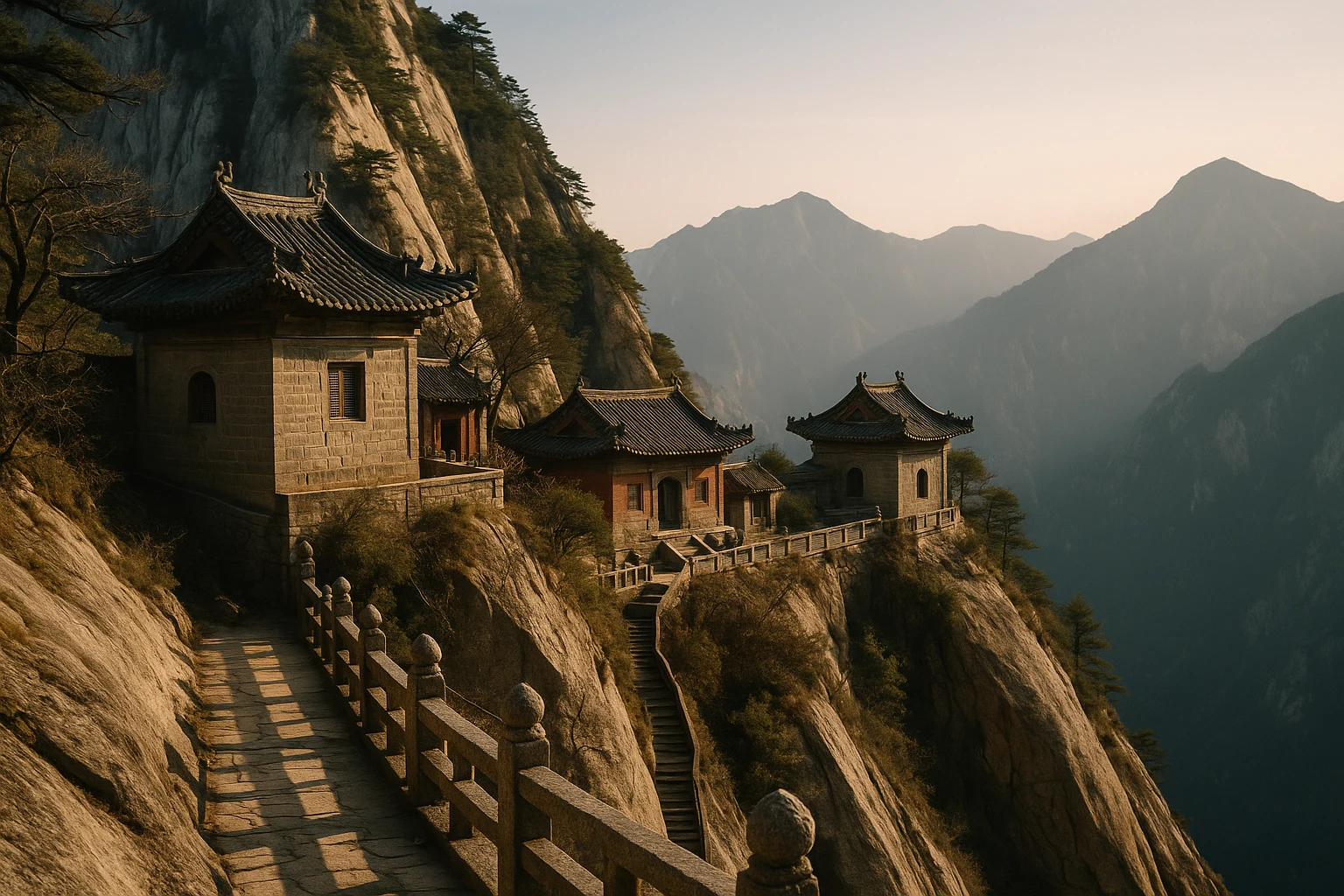
For visitors with additional days, Mount Huashan — one of China’s Five Sacred Mountains and one of the most dramatic pilgrimage landscapes in Asia — is reachable by high-speed train and cable car as a full-day excursion from Xi’an.
Why the Xi’an City Wall Matters
In a country where most historic city walls were demolished during the twentieth century to make way for ring roads and urban development, Xi’an’s decision to preserve and continuously invest in its Ming wall represents a significant cultural choice. Beijing’s walls came down in the 1950s and 1960s to become subway lines and boulevards. Nanjing’s great wall survives only in sections. Most other ancient capitals retain little more than isolated gate towers. Xi’an stands as the principal surviving exception — the one city where you can still trace the full imperial boundary on foot or by bicycle.
The wall is also a piece of living urban infrastructure in a way that many comparable monuments are not. Residents cycle it for early morning exercise. Couples walk its illuminated length on summer evenings. Local retirees practice tai chi on the broad top surface at dawn. The moat promenade is a daily recreational space for families with children. This integration of a six-hundred-year-old fortification into the rhythms of a contemporary city — rather than its complete museumification and separation from daily life — gives the Xi’an City Wall a vitality that is rare among sites of its age and scale.
For any visitor serious about Chinese history, the wall is not optional. It frames and contains a city that has been continuously inhabited for more than three thousand years, and standing on its ramparts above the evening rush below, it is genuinely possible to understand something of what it meant to live in, defend, and belong to one of the ancient world’s greatest capitals.
Quick Facts
| Detail | Information |
|---|---|
| Built | 1370–1378 AD (Ming Dynasty), on Tang Dynasty foundations |
| Perimeter Length | 13.74 km (8.5 miles) |
| Wall Height | 12 meters (39 feet) |
| Top Width | 12–14 meters |
| Watchtowers | 98 evenly spaced along the perimeter |
| Main Gates | South (Yongning), North (Anyuan), East (Changle), West (Anan) |
| Location | Xi’an, Shaanxi Province, China |
| Nearest Airport | Xi’an Xianyang International (XIY), ~45–60 min by car |
| Metro Access | Line 2, Nanguanzheng Station (South Gate) |
| Admission | ¥54 adults; bicycle rental charged separately |
| Opening Hours | 8:00am–10:00pm daily |
| Best Season | April–May and September–November |
Explore More
The Xi’an City Wall is the natural anchor for exploring the Shaanxi heartland, one of the most historically dense regions in Asia. From the Neolithic villages of the Wei River valley to the First Qin Emperor’s subterranean army, from the cosmopolitan Tang capital to the ring of Ming brick still encircling it all, this city rewards time, return visits, and attention in equal measure. Whether you cycle the full perimeter at dusk, stand in the barbican courtyard of the South Gate imagining the caravans that once passed through, or simply pause on the ramparts to watch a modern city pulse inside ancient walls, the experience is one that few places on earth can match.
Frequently Asked Questions
How long does it take to walk or cycle the Xi'an City Wall?
Cycling the full 13.74 km perimeter takes approximately 1.5–2 hours at a leisurely pace. Walking the entire circuit takes 3–4 hours. Many visitors explore a single section — such as from the South Gate to the West Gate — rather than completing the full loop.
Can you rent bicycles on the Xi'an City Wall?
Yes, bicycle rentals are available at all four main gates: South, North, East, and West. Single-speed bikes, tandems, and electric bikes are offered for an additional fee beyond the entry ticket. Availability is best on weekday mornings.
What is the best gate to enter the Xi'an City Wall?
The South Gate (Yongning Gate) is the most impressive entry point, featuring a three-tiered watchtower, a walled barbican courtyard, and a ceremonial drawbridge. It has the largest bicycle rental station and is the easiest to reach by metro, making it the most practical starting point.
Is the Xi'an City Wall a UNESCO World Heritage Site?
The Xi'an City Wall is not individually inscribed as a UNESCO World Heritage Site, though it is protected as a national key cultural relic of China. Xi'an's Terracotta Army, located approximately 40 km east of the walled city, holds UNESCO World Heritage status.
When is the Xi'an City Wall least crowded?
Weekday mornings between 8am and 10am see the fewest visitors. The wall is busiest on weekends and during Chinese national holidays, particularly Golden Week in early October. Visiting at dusk draws larger crowds but offers the most atmospheric lighting for photography.
What dynasty built the Xi'an City Wall?
The current wall was built during the early Ming Dynasty between 1370 and 1378 AD under Emperor Hongwu, though it rests on Tang Dynasty foundations. The Qing Dynasty carried out substantial renovations and reinforcements, and modern restoration work has maintained the structure's full perimeter.
Is the Xi'an City Wall accessible for visitors with mobility issues?
Ramps and escalators are available at the South and North Gates, making the wall surface accessible for wheelchairs and strollers. The top is flat and wide — between 12 and 14 meters across — allowing comfortable movement, though some passages between towers involve short flights of steps.