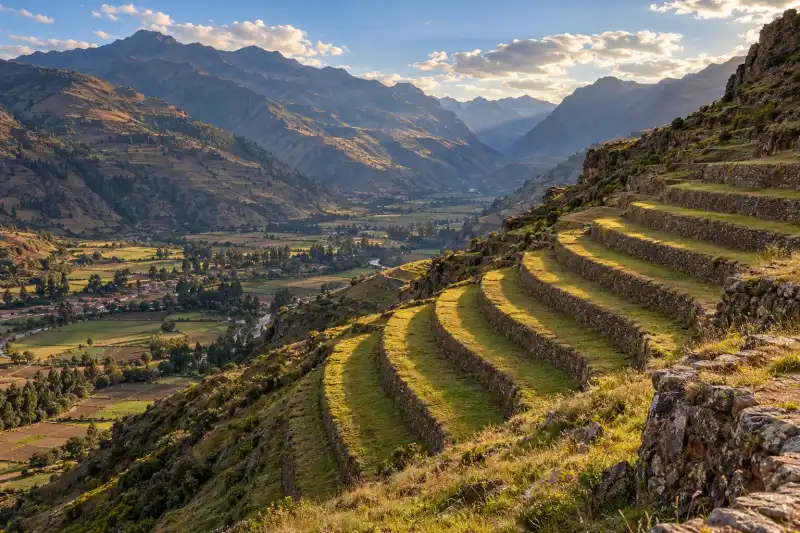
A southern Peru itinerary falls apart when it treats geography as decoration. Cusco, the Sacred Valley, Machu Picchu, Puno and Arequipa can form a coherent route, but they are not interchangeable stops. Altitude, rail access, road days and a limited number of sensible overnight bases do the actual work.
This is a route-first guide. It does not prescribe a fixed number of days or claim that one order fits every flight. Use it to build a sequence that stays useful when an arrival shifts or you decide a site deserves another morning.
Start with a soft landing in the Cusco area
Cusco is often the entry point for a highland itinerary. Treat the first day as an arrival day. The UK government’s Peru advice identifies altitude illness as a serious risk in parts of Peru, including Cusco. A light walk, a hotel check-in and a flexible meal are better planning than a tightly timed ruin circuit.
Keep Sacsayhuaman and central Cusco for a day when you can move at your own pace. If you are continuing to the Sacred Valley, decide whether the next base will be Pisac, Urubamba or Ollantaytambo based on the following morning, not on the idea that one town is universally best.
Give the Sacred Valley its own middle chapter
The Sacred Valley can connect Pisac and Ollantaytambo while reducing backtracking, but it is not a conveyor belt. Choose one or two archaeological priorities and leave room for the road, a market town, lunch and a hotel move. A route that tries to see every ruin before a train check-in creates a bad day and a fragile next day.
If Machu Picchu is on the plan, its dated entry and rail approach should shape the previous night. Peru’s official tourism information names the Ollantaytambo-Machupicchu rail route and the operators serving it. Use the operators’ current information for station, baggage and service requirements. Our Peru transport planning guide explains how to book that chain from the fixed commitment outward.
Treat Machu Picchu as a two-day planning problem
A practical pattern is to arrive in the rail-access town with time to settle, visit Machu Picchu on the following day under the entry conditions you have actually confirmed, then return to the Sacred Valley or Cusco afterward. Some travelers can do it in a compressed day. That does not mean the compressed version is a good default when it rests on flight timing, rail inventory and a strict entry slot.
Read the official booking rules before deciding your sequence. Do not rely on a reseller’s screenshot or an old social post for routes, availability or circuit access.
Continue south only after the Cusco section is complete
Puno and Arequipa work better as the next stage of the trip than as pieces crammed between Sacred Valley nights. Peru Travel’s route information identifies links in this southern corridor, but the current timetable belongs to each carrier. Plan a clean transfer day, then choose whether Puno’s lakeside setting or Arequipa’s urban and regional archaeology is the next priority.
If the route includes Colca, keep it as an overnight excursion with its own elevation and road-day logic. Do not use it as a decorative half day around an Arequipa arrival. Our Peru overland transport guide covers the transfer-side decisions.
A sequence that leaves room for reality
| Stage | Planning purpose | Overnight idea |
|---|---|---|
| Arrival in Cusco area | Recover from travel and altitude | Cusco |
| Cusco archaeology | Explore local sites without a departure clock | Cusco |
| Sacred Valley | Cluster valley sites and line up the rail start | Valley base |
| Machu Picchu | Use the confirmed entry and rail sequence | Rail-access town or Valley base |
| Southern connection | Travel to the next region without a headline site attached | Puno or Arequipa |
| Regional extension | Add Lake Titicaca, Colca or a second city only if it has a full day | Puno or Arequipa |
Before confirming anything
Check each current official operator page for transport terms and each official site page for entry conditions. Keep recovery time before your final flight. This guide does not provide live fares, schedules, permits or availability. It is a framework for making the route less brittle, which is more useful than pretending a 12-day country is a 7-day errand.
For official context, start with Peru Travel’s transport guidance and its Puno destination information.