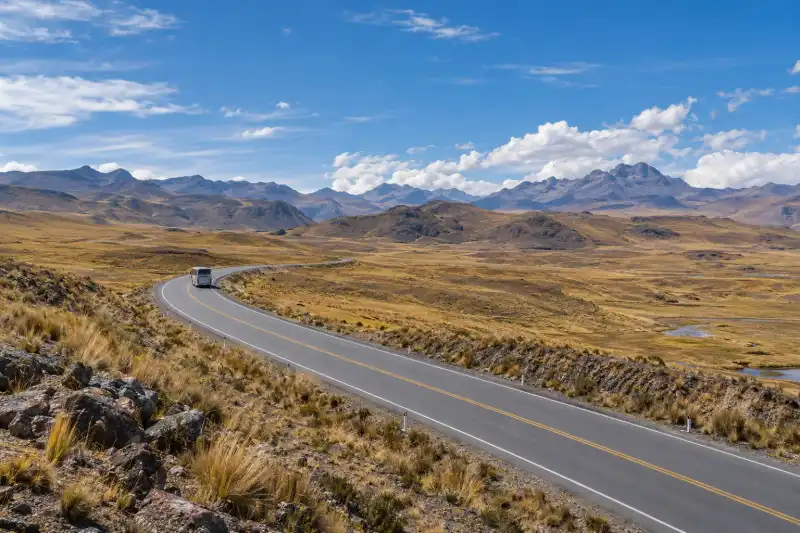
Southern Peru rewards a route that moves at road speed. Lines on a map look tidy. The actual journey includes terminal transfers, mountain weather, rest stops, changing elevation and the practical question of where you will sleep if a departure moves. This guide is about that overland logic, not a comparison of every mode or a shopping list of tickets.
Peru’s official tourism information identifies road, air and rail options across the country and names rail links used in the Cusco and Machu Picchu area. That does not make any one connection interchangeable. Start with your fixed dates, then decide which stretches deserve daylight, which can absorb delay, and where a flight or train is worth using because it changes the whole route.
Build the route around overnight bases
Cusco is often the first highland base, but it should not be treated as a transit lounge. If you arrive by air, leave room before a demanding road journey or a long site day. Our Peru altitude acclimatization guide covers health planning; the transport lesson is simpler: do not lock yourself into a same-day high-altitude departure because the spreadsheet says the times technically touch.
The Sacred Valley has its own road and rail geography. Pisac, Sacsayhuaman and Ollantaytambo are not three stops to be collected between airport and train. Choose a base that matches the next morning’s departure point. If Machu Picchu is part of the trip, read Peru transport planning for the booking sequence around dated entry and rail.
Puno, Arequipa and the Colca region make more sense when treated as stages rather than optional detours. Peru Travel identifies links between Puno, Cusco and Arequipa, but current operation, class of service and pickup location belong on the operator’s own page. Confirm them shortly before travel.
Separate route shape from vehicle choice
A route can be reasonable by bus, private vehicle, shared transfer or a mixture. Decide the shape first:
| Route question | What to settle before choosing a provider |
|---|---|
| Cusco to Sacred Valley | Your overnight base and any train or site commitment the next day |
| Cusco to Puno | Whether the travel day needs daylight stops, an arrival buffer, or an extra night |
| Puno to Arequipa | Where you will sleep if the transfer runs late and how the elevation change fits the wider trip |
| Arequipa to Colca | Whether the canyon is a dedicated overnight segment rather than a day appended to an arrival |
This is why a generic “fastest route” answer is usually useless. A later departure can be safer if it prevents a missed ticket. A slower road day can be better if it creates a clean overnight before an early site entry. The machine does not get a medal for shaving forty minutes off the plan.
Plan for disruption without turning the trip into a bunker
Official travel advice notes that southern rail services can be disrupted at times, including routes serving Machu Picchu. Road travel can also change with weather, works or local events. Keep each major connection’s confirmation, exact terminal, baggage rule and provider contact in an offline note. Build one recovery night into a sequence that has a non-refundable international departure at the far end.
That is not a reason to reserve every hour twice. It is a reason to avoid dependencies you cannot repair. Do not schedule a highland arrival, a long bus ride, a train check-in and a timed archaeological admission in one chain.
What this guide does not claim
This page does not publish live driving times, bus fares, departures, road conditions or rail inventory. Those facts move. Use Peru Travel’s transport guidance for official route context, then verify the current details with the named carrier. For mode comparison, see Peru transportation. For a route-led visit sequence, see our southern Peru itinerary guide.