Quick route summary
This 3-day route uses Ayutthaya as the main base and keeps Bangkok as the practical entry and exit point. You travel north from Bangkok, settle into Ayutthaya, and spend the route around the old royal island, Wat Mahathat Ayutthaya, Wat Phra Ram, Wat Phra Si Sanphet, and Wat Chaiwatthanaram.
The pace is full but sensible. Ayutthaya can be done as a Bangkok day trip, but this version is better for travelers who want the temples to make sense as a former capital, not just as a string of brick ruins and photo stops.
Who this itinerary is for
This itinerary is for travelers who want a compact ancient-sites route in Central Thailand without flying or changing regions. It works well for a first Thailand trip if you can spare two nights outside Bangkok and care more about history than nightlife for this part of the journey.
It is not ideal if you want one quick temple photo before returning to Bangkok, or if you dislike hot, exposed archaeological parks. Ayutthaya rewards early starts, shaded breaks, and a willingness to slow down when the afternoon heat makes ambition feel silly.
Route at a glance
- Day 1: Overnight in Ayutthaya. Travel from Bangkok, get oriented on the old island, then visit Wat Mahathat and Wat Phra Ram by bicycle, tuk-tuk, taxi, or private driver.
- Day 2: Overnight in Ayutthaya. Focus on the royal heart of the city, especially Wat Phra Si Sanphet, with short local transfers and a slower afternoon.
- Day 3: Overnight in Bangkok. Visit Wat Chaiwatthanaram across the river, then return to Bangkok by train, van, taxi, or private transfer.
Practical logistics before you go
Ayutthaya sits close enough to Bangkok for a day trip, but the old city is easier to understand with at least one overnight. Two nights lets you visit the major ruins in the cooler parts of the day, take a proper lunch break, and avoid turning every temple into a race against your train back.
The best base is Ayutthaya itself, either near the historical park or near the river if you want easier evening food and a quieter feel. Bangkok remains the practical start and finish because most travelers arrive there and because transport options are frequent.
Local movement is the real planning choice. Confident cyclists often enjoy Ayutthaya, but traffic, heat, and uneven routes can make cycling less charming than expected. Tuk-tuks, taxis, and private drivers are worth considering, especially if you want to cover both the island temples and Wat Chaiwatthanaram without getting fried.
A guided tour makes the most sense if you are visiting from Bangkok with limited time, or if you want the city’s royal history explained clearly. A well-matched Ayutthaya temple tour from Bangkok can solve transport and context in one go, but for this 3-day route, independent travel is very workable.
Day 1: Ayutthaya arrival, Wat Mahathat, and Wat Phra Ram
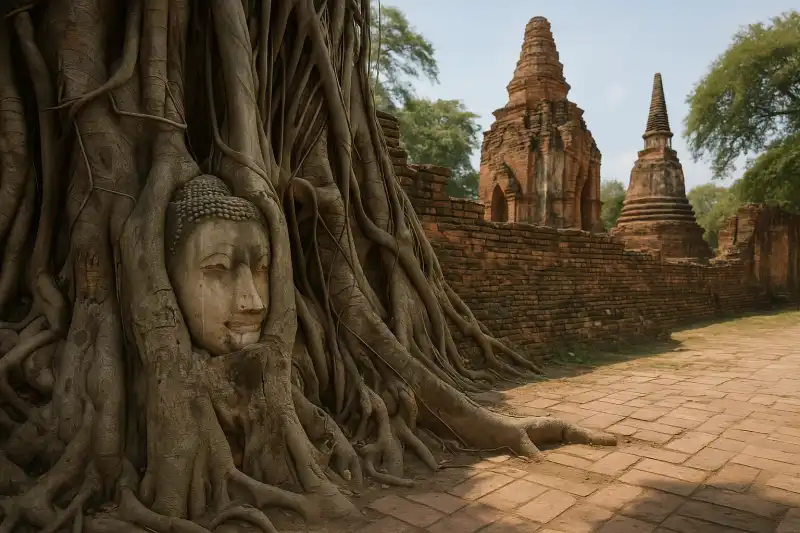
Travel from Bangkok to Ayutthaya in the morning and resist the urge to overfill the first day. The train is the classic budget option, vans can be faster depending on where you start in Bangkok, and a taxi or private transfer is easiest with luggage. Once you arrive, drop your bags before starting the temple circuit.
Begin with Wat Mahathat Ayutthaya. It is famous for the Buddha head held in tree roots, but the site deserves more than that one image. Wat Mahathat was one of the city’s major religious centers, and its ruined prang, brick foundations, and broken Buddha images show how central Buddhist institutions were to Ayutthaya’s royal city.
Be patient at the tree-root Buddha head. It is a sacred image, not just a photo prop, so crouch or sit lower when posing nearby and keep the mood respectful. The best part of Wat Mahathat is not only the famous face, but the way the ruins show damage, repair, devotion, and abandonment all at once.
After lunch or a shade break, continue to Wat Phra Ram. Its Khmer-style prang rises from a greener, calmer setting than Wat Mahathat, and that contrast is useful. Ayutthaya did not invent its sacred architecture from nothing. It borrowed, adapted, and localized forms from older Khmer and regional traditions while building a capital with its own political voice.
Keep the evening light. A short walk, river meal, or early night will serve you better than squeezing in another major ruin. Ayutthaya’s heat has a way of collecting in your body by late afternoon.
Day 2: Royal Ayutthaya at Wat Phra Si Sanphet
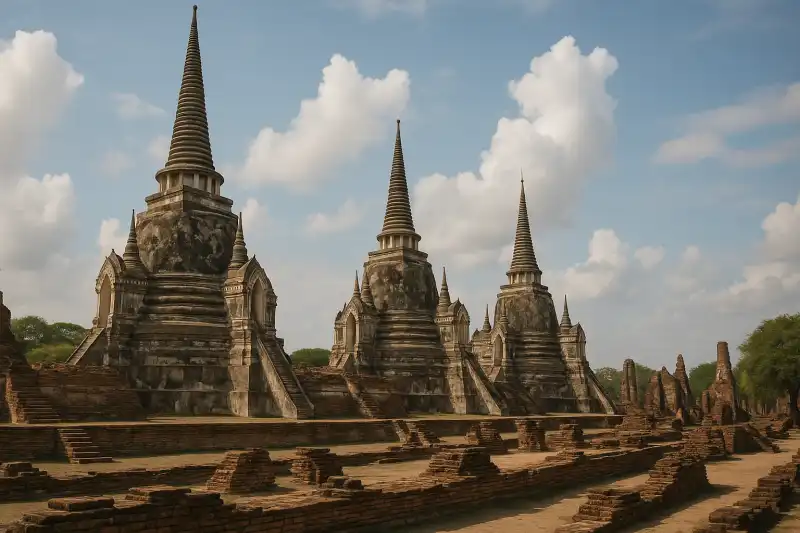
Give Day 2 to the royal heart of Ayutthaya. Start early at Wat Phra Si Sanphet, the former royal temple beside the palace area. Unlike many working Thai temples, this was not a monastery with resident monks in the usual sense. It served the court, which changes how you should read the space.
The three large chedis are the anchors of the visit. They held royal remains and still give the site its rhythm, even though much of the surrounding palace world has vanished. Ayutthaya was one of the great trading and diplomatic capitals of early modern Asia, dealing with Chinese, Persian, Japanese, Portuguese, Dutch, French, and other communities. The quiet brick forms here once sat inside a city with serious international reach.
Do not try to solve all of Ayutthaya in one morning. Pair Wat Phra Si Sanphet with nearby ruins, museum time if it fits your interests, and a long midday pause. The old island is compact on a map, but sun exposure and repeated temple walking make the day heavier than it looks.
This is also a good day to notice materials. Ayutthaya’s brick ruins feel different from the stone temples of Angkor or the laterite Khmer sanctuaries in northeastern Thailand. Brick, stucco, whitewashed surfaces, gilded images, and timber buildings once made the capital brighter and more finished than the surviving ruins suggest. The city you see now is the skeleton, not the full body.
If your energy dips, stop after the central royal zone. A better Ayutthaya day leaves room to look closely at fewer places.
Day 3: Wat Chaiwatthanaram and a slower return to Bangkok
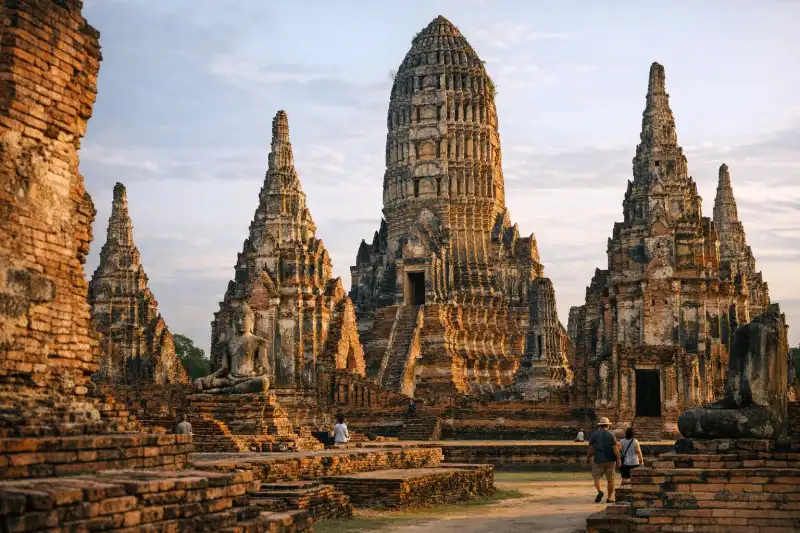
Save Wat Chaiwatthanaram for the final day. It sits west of the old island beside the Chao Phraya River, so it works well as a focused last stop before returning to Bangkok. Go in the morning if you want lower heat, or late afternoon if your schedule allows and you want the warm river light.
Built in the 17th century under King Prasat Thong, Wat Chaiwatthanaram is one of Ayutthaya’s most visually coherent temple complexes. Its central prang and surrounding smaller towers draw on Khmer cosmological planning, with Mount Meru imagery translated into an Ayutthaya royal-Buddhist setting. The stones are quiet now, but the political ambition here was not shy.
Give the site more time than the map suggests. Walk the perimeter, look back toward the central tower, and notice how the river setting changes the mood. Ayutthaya was a water city, tied to trade, movement, defense, and ceremony. Seeing one of its major temples from the river side helps the old capital feel less like an isolated park and more like a city built around movement.
After Wat Chaiwatthanaram, return to Bangkok. The train is fine if you are traveling light and have patience. Vans and taxis can be more convenient, while a private transfer is the least romantic but often the easiest. Do not plan a tight international flight connection the same evening unless you have built in a generous buffer.
The historical thread: royal power, river trade, and sacred brick
Ayutthaya makes sense when you treat it as a royal capital built at the meeting point of rivers, trade routes, Buddhist kingship, and regional architectural memory. Its temples were not only devotional places. They helped stage royal legitimacy, preserve dynastic memory, and make the city’s power visible.
The route moves from Wat Mahathat’s religious center, to Wat Phra Si Sanphet’s courtly landscape, to Wat Chaiwatthanaram’s riverside royal statement. Along the way, you see Khmer forms reused in a Thai kingdom, brick ruins that once carried stucco and gold, and a capital whose surviving calm can hide how busy, wealthy, and contested it once was.
Ayutthaya fell to Burmese forces in 1767, and that final destruction often dominates the way visitors imagine the ruins. It matters, but do not let the ending flatten the story. For centuries before that, Ayutthaya was a working capital with diplomacy, trade, temples, palaces, canals, markets, foreign quarters, and court ritual all pressed into one riverine city.
Transportation notes
Use Ayutthaya as your base for the first two nights and Bangkok for the final night. Staying in Ayutthaya saves you from repeating the Bangkok transfer and gives you better morning and evening temple windows.
From Bangkok, choose train, van, taxi, or private transfer. The train is inexpensive and has character, but it is not always the fastest door-to-door option. Vans can be efficient, though terminals and drop-off points vary. Taxis and private transfers cost more but remove most of the friction.
Inside Ayutthaya, do not underestimate the heat. Bicycles are enjoyable for some travelers, especially in the cooler season, but tuk-tuks, taxis, and hired drivers are more forgiving. Wat Chaiwatthanaram sits off the main island, so plan that transfer instead of assuming every site is a short stroll away.
Do not self-drive unless you are comfortable with Thai traffic patterns, parking, and local navigation. For most visitors, a driver or local transport is simpler.
Optional add-ons and swaps
If you want a longer Thailand route, continue north to Sukhothai Historical Park. Remove the final Bangkok overnight and add at least two more days. Sukhothai shifts the story from Ayutthaya’s river capital to an earlier Thai kingdom with a very different temple landscape.
For a deeper Central Thailand route, consider Si Thep Historical Park. It is not a casual half-day add-on from Ayutthaya, so use it only if you can add a separate travel day or reshape the route around a driver. The payoff is a broader view of Dvaravati and Khmer-linked history before Ayutthaya.
If you want a smaller swap closer to Bangkok and the Gulf side, Wat Phu Kamphaeng Laeng adds a Khmer-influenced temple layer in Phetchaburi Province. It belongs in a different Central Thailand circuit rather than squeezed into these three days.
If you need to cut this itinerary down, keep Wat Mahathat, Wat Phra Si Sanphet, and Wat Chaiwatthanaram. Wat Phra Ram is the easiest cut, though it is a good one if you like quieter ruins.
Shorter and longer itinerary options
For a shorter visit, make Ayutthaya a long day trip from Bangkok: start early, focus on Wat Mahathat, Wat Phra Si Sanphet, and Wat Chaiwatthanaram, and accept that you are sampling the city rather than really settling into it.
For a longer route, the natural next step is a 5-day Bangkok to Ayutthaya and Sukhothai ancient-sites itinerary. That version would keep this Ayutthaya core, then continue north toward Sukhothai and Si Satchanalai.
A 7-day ancient Thailand route can add Khmer temple sites such as Phimai, Phanom Rung, and Prasat Muang Tam. That is a stronger historical arc, but it needs more transport planning and should not be forced into a 3-day Central Thailand trip.
Related ancient sites
- Ayutthaya
- Wat Mahathat Ayutthaya
- Wat Phra Ram
- Wat Phra Si Sanphet
- Wat Chaiwatthanaram
- Sukhothai Historical Park
- Si Thep Historical Park
- Wat Phu Kamphaeng Laeng
FAQ
The most common planning questions for this Ayutthaya route are answered below.