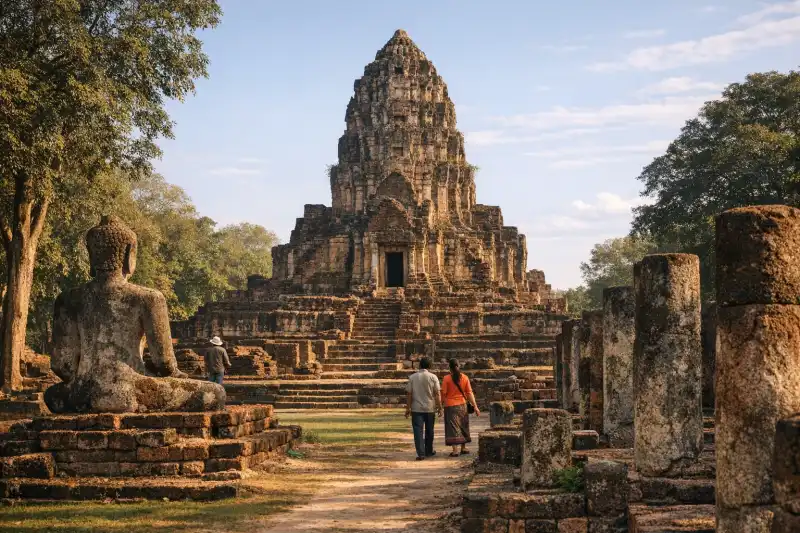
Quick Info
At a glance
Si Thep Historical Park in Thailand is one of those places that quietly reshapes your sense of the country’s past. Far from the crowded circuits of Bangkok, Ayutthaya, or Sukhothai, this broad archaeological landscape in Phetchabun Province preserves the remains of an ancient city that once linked central Thailand with the wider cultural worlds of Mon-Dvaravati and the Khmer empire. Moats still trace the old urban plan, low brick sanctuaries rise from grassy fields, and a solitary prang hints at shifting religious styles and political connections across centuries. What makes Si Thep especially compelling is that it does not feel like a single monument, but like the surviving outline of a forgotten urban civilization.
The scale of the site reveals itself gradually. You move from the museum and excavated structures in the inner city to earthworks, reservoirs, and outlying monuments that speak to organized settlement and ritual life on a much larger level. The atmosphere is quieter than at Thailand’s better-known heritage parks, which gives the ruins a contemplative quality. Instead of monumental grandeur alone, Si Thep offers patterns: city walls, sacred spaces, artistic fragments, and evidence of changing beliefs over time. For travelers interested in early Southeast Asian history, this UNESCO-listed ancient town is one of Thailand’s most rewarding destinations, combining archaeology, landscape, and the rare chance to experience a major historic site before mass tourism fully arrives.
History
Early settlement and the rise of an ancient city
The story of Si Thep begins long before the visible monuments took shape. Archaeological evidence suggests that communities occupied this fertile area for centuries, attracted by water sources, arable land, and routes connecting the central plains to the Khorat Plateau and beyond. By the first millennium CE, the settlement had grown into a significant urban center. Its location was strategic: it sat within networks of exchange that moved goods, ideas, and religious traditions across mainland Southeast Asia.
Si Thep’s city plan still shows this early development. The site includes an inner city and a larger outer city, both enclosed by earthworks and moats. Such planning indicates organized authority, labor mobilization, and an understanding of water management. The moats were not merely defensive features; they were also part of a broader system that structured the urban environment. The scale of these works makes clear that Si Thep was no rural shrine complex but a true city with political and ritual importance.
The Dvaravati period
Si Thep flourished particularly during the Dvaravati era, generally dated from about the 6th to 11th centuries CE. Dvaravati was not a centralized empire in the way later states might be imagined, but rather a network of Mon-influenced urban centers across what is now central Thailand. These communities shared artistic styles, Buddhist practices, inscriptions, and forms of city planning. Si Thep stands out as one of the most substantial examples of this cultural world.
During this period, the city developed important religious monuments and likely served as a center of both administration and worship. Archaeologists have found sculptures, architectural remains, and decorative fragments pointing to Buddhist influence, alongside evidence of Hindu worship. This coexistence was common in early Southeast Asia, where religious traditions overlapped and adapted locally. Si Thep’s surviving monuments, especially large brick and laterite structures, reflect a mature urban culture that was connected to broader regional traditions while retaining distinctive local features.
The monument known as Khao Khlang Nok, outside the city proper, belongs to this broad phase of development and demonstrates the scale of ritual construction associated with Si Thep. Massive in form and unlike a conventional temple tower, it suggests ceremonial functions that are still debated. What is not in doubt is the city’s importance as a religious and cultural center in the Dvaravati landscape.
Khmer influence and transformation
From around the 11th century onward, Si Thep entered a new phase shaped by Khmer influence. This did not necessarily mean abrupt replacement of the earlier culture; rather, it reflects changing political and artistic currents spreading westward from the Angkorian sphere. Architectural forms became more recognizably Khmer in certain monuments, especially in the use of prang-style temple towers and sandstone decorative elements.
The best-known example of this phase is Prang Si Thep, a striking sanctuary that differs visibly from the earlier Dvaravati-style remains. Its plan, materials, and symbolism place it within the orbit of Khmer sacred architecture, though it remains adapted to local conditions. The presence of such monuments suggests that Si Thep remained significant enough to be integrated into wider regional systems of power, exchange, and religion.
At the same time, continuity mattered. The city’s long life means that layers of occupation and belief were not simply erased as new influences arrived. Instead, Si Thep appears to have evolved through interaction, with old sacred landscapes reused and reinterpreted.
Decline, abandonment, and rediscovery
Like many ancient cities in Southeast Asia, Si Thep eventually declined. The exact causes remain complex and likely include shifting trade routes, political reorganization, environmental change, and the rise of other centers. By the late first and early second millennium, its urban vitality had diminished, and the city was gradually abandoned. Earthen embankments softened into the landscape; brick monuments collapsed; vegetation reclaimed ceremonial spaces.
Modern scholarly attention grew in the 20th century as archaeologists and historians began to recognize the significance of the site. Excavations, surveys, and conservation work revealed the true extent of the ancient town and clarified its role in Thailand’s early history. Museums and interpretive facilities helped make the site more accessible to the public, though Si Thep remained less famous than other historical parks for many years.
That changed dramatically with its inscription as a UNESCO World Heritage Site in 2023. The designation acknowledged not just isolated ruins, but the broader cultural landscape of the Ancient Town of Si Thep and associated Dvaravati monuments. Today, Si Thep is increasingly recognized as one of the key places for understanding how early urban civilization developed in mainland Southeast Asia.
Key Features
What makes Si Thep Historical Park memorable is the way its features work together as parts of an ancient city rather than as disconnected ruins. The first thing many visitors notice is the urban layout itself. The moated enclosures of the inner and outer city remain visible in the terrain, giving a strong sense of planned space. Even before you focus on individual buildings, you can read the city through embankments, open fields, and the geometry of the old defenses. This is one of Si Thep’s greatest strengths: it preserves the scale of a settlement, not just the drama of a temple.
Within the site, Khao Khlang Nai is among the principal monuments of the inner city. Built on a raised laterite base and approached through an open archaeological zone, it has the commanding simplicity often associated with Dvaravati religious architecture. The structure’s surviving form may seem austere compared with the ornate temples of later eras, but that restraint is part of its appeal. It invites attention to mass, alignment, and construction technique. Around it, excavated remains and scattered fragments suggest a wider sacred complex now mostly lost above ground.
Prang Si Thep provides a very different visual experience. Taller and more vertical, it reflects Khmer artistic influence and marks a later chapter in the city’s life. The sanctuary’s surviving tower is one of the clearest signs that Si Thep participated in cultural currents extending from Angkor. Where the Dvaravati remains feel broad and grounded, the prang introduces a more concentrated sacred form, designed to symbolize a cosmic mountain and to house a central cult image. Seeing both styles in one park helps visitors understand how the city changed over time.
Outside the main enclosure, Khao Khlang Nok is arguably the most impressive monument in terms of scale. This enormous rectangular brick-and-laterite structure rises from the plain with a monumental solidity that can feel almost enigmatic. It is not a dramatic tower or a fully preserved temple in the conventional sense, yet its bulk and isolation make it unforgettable. Scholars have interpreted it as an important ritual monument associated with the Dvaravati period, and its construction reveals substantial organizational capacity. Walking around it, you appreciate how significant Si Thep once was in regional religious life.
The site museum and interpretive displays add depth to the visit. Sculptures, architectural fragments, ceramics, and inscriptions found in and around Si Thep help fill in what weathered ruins alone cannot show. Decorative pieces reveal sophisticated craftsmanship, while religious imagery illustrates the coexistence of Buddhist and Hindu traditions. For visitors unfamiliar with Dvaravati culture, the museum is especially valuable because it provides a framework for understanding why Si Thep matters beyond the visible remains.
Another notable feature is the landscape itself. Si Thep does not overwhelm through vertical monumentality; instead, it works through space, quiet, and context. Trees cast shade over archaeological zones, open lawns reveal the contour of old embankments, and the countryside beyond the ruins reminds you that ancient cities were tied to agricultural hinterlands. The atmosphere can feel almost pastoral, which heightens the contrast between present calm and former urban importance.
Because the park is relatively uncrowded, visitors often have the unusual luxury of time and silence. You can pause at a platform and imagine processions, listen to birds where ritual chanting once sounded, or trace city boundaries without the distraction of tour bus congestion. That understated experience is itself a key feature. Si Thep rewards those who like to observe patterns, compare building traditions, and think about how cities evolve across centuries. It is less a checklist destination than a place for historical imagination.
Getting There
Si Thep Historical Park is in Si Thep district of Phetchabun Province, and the easiest way to reach it is by road. From Bangkok, driving usually takes around 3.5 to 4.5 hours depending on traffic and your starting point. A rental car is the most practical option because it gives flexibility for reaching both the main archaeological zones and nearby towns. Fuel and toll costs from Bangkok commonly total around THB 700 to 1,200 each way, depending on vehicle type and route.
If you prefer public transport, buses and minivans from Bangkok’s Mo Chit area to Phetchabun or Wichian Buri are the usual first step. Fares generally range from about THB 180 to 350 one way. From Wichian Buri, you may need a local bus, songthaew, or taxi for the final stretch to the park. Local transfers can cost roughly THB 150 to 500 depending on distance, waiting time, and whether you negotiate a return pickup. Because local transport options are limited and schedules may not be tourist-friendly, confirm return arrangements in advance.
Another workable approach is to travel by bus to a nearby town and hire a private driver for the day. Depending on duration and vehicle, a driver from the region may charge around THB 1,500 to 3,000. This can be worthwhile if you want to combine Si Thep with other rural attractions in Phetchabun Province.
Once at the park, walking and short drives between monument zones are the norm. Bring water, cash for small local expenses, and sun protection, as facilities are more modest than at Thailand’s busiest heritage destinations.
When to Visit
The best time to visit Si Thep Historical Park is during Thailand’s cooler dry season, generally from November to February. Daytime temperatures are more comfortable, skies are often clearer, and walking around the exposed archaeological areas is much easier than in hotter months. This is the ideal period for visitors who want to explore the city boundaries, outlying monuments, and museum without feeling rushed by heat.
March to May is the hottest time of year, and central Thailand can become intensely warm by late morning. If you visit during these months, arrive as early as possible and plan indoor or shaded breaks around midday. The ruins themselves remain rewarding, but the heat can reduce how much ground you comfortably cover. Carry plenty of water, wear a hat, and expect strong sun.
The rainy season, roughly June to October, brings greener scenery and fewer visitors. The park can look particularly atmospheric then, with the moats and surrounding landscape appearing more vivid. However, heavy showers, muddy paths, and humidity can complicate longer walks, especially around larger open areas. If you do not mind variable weather, this season can still be a pleasant time to visit because the site feels even quieter.
For photography, early morning and late afternoon provide the softest light and best temperatures. Midday light is harsh and can flatten details on brick and laterite surfaces. If your schedule allows, aim for a weekday morning, when the park is typically at its calmest and most reflective.
| Quick Facts | Details |
|---|---|
| Location | Si Thep district, Phetchabun Province, Thailand |
| UNESCO Status | Inscribed in 2023 as the Ancient Town of Si Thep and associated Dvaravati monuments |
| Main Cultural Phases | Dvaravati and later Khmer influence |
| Approximate Date | c. 6th-13th centuries CE |
| Signature Monuments | Khao Khlang Nai, Prang Si Thep, Khao Khlang Nok |
| Site Layout | Inner and outer moated city with associated outlying monuments |
| Best Time to Visit | November to February |
| Typical Visit Length | 3 to 5 hours |
| Nearest Useful Town | Wichian Buri |
| Best Transport Option | Private car or hired driver |
Si Thep Historical Park is not the kind of place that depends on spectacle alone. Its power lies in accumulated evidence: moats that still map an ancient city, sanctuaries that reveal changing artistic worlds, and monuments that show how early Thailand was connected to religious and political networks across Southeast Asia. For travelers drawn to archaeological landscapes rather than only iconic temples, Si Thep offers one of the richest experiences in the country. It rewards patience, curiosity, and a willingness to look beyond the obvious.
What stays with many visitors is the sense of encountering a major chapter of history in relative quiet. You can stand by a Dvaravati monument, walk toward a Khmer-style prang, and understand that this was a city shaped not by a single moment but by centuries of adaptation. That long view makes Si Thep especially valuable. It widens the story of Thailand beyond later capitals and better-known kingdoms, showing that sophisticated urban life, religious creativity, and cross-regional exchange were already flourishing here long before the modern nation took shape.
If you are building an itinerary focused on ancient Southeast Asia, Si Thep deserves a place beside the country’s more famous historical parks. It may require more effort to reach, but that effort is part of the reward. The roads lead not just to ruins, but to one of Thailand’s most important and least overexposed ancient cities.
Guided tours: worth it?
Self-guided works here, but a guide can add real value if you want the ruins explained as a living place rather than just a sequence of monuments.
Best for
- First-time visitors who want context, not just photos
- Short visits where a planned route saves time
When to go self-guided
Go independently if you prefer setting your own pace, reading as you go, and checking official hours or ticket rules directly before you arrive.
What I’d avoid
Skip paid tours that bundle unrelated stops you do not actually want. The best option should either save meaningful planning time or add historical context you would miss on your own.
Thailand historical sites tours
Useful when: you want to compare guided formats before deciding
Phetchabun cultural day trips
Useful when: transport or pickup logistics matter
Ayutthaya and ancient Thailand tours
Useful when: you want to compare guided formats before deciding
Some tour links are affiliate links, which may earn Ancient Travel a small commission at no extra cost to you. I try to surface options that make practical sense for the site—not just anything bookable.
Frequently Asked Questions
Where is Si Thep Historical Park located?
Si Thep Historical Park is in Si Thep district, Phetchabun Province, central Thailand, roughly between Bangkok and the lower northeastern region.
Why is Si Thep Historical Park important?
The park preserves a major ancient urban center associated with Dvaravati culture and later Khmer influence, showing moated city planning, religious monuments, and long-distance trade links.
Is Si Thep Historical Park a UNESCO World Heritage Site?
Yes. The Ancient Town of Si Thep and its associated Dvaravati monuments were inscribed on the UNESCO World Heritage List in 2023.
How much time should I spend at Si Thep Historical Park?
Most visitors should allow at least half a day to see the museum area, the inner and outer city zones, and major monuments such as Khao Khlang Nok and Prang Si Thep.
Can I visit Si Thep Historical Park from Bangkok in one day?
Yes, but it makes for a long day. Driving from Bangkok usually takes around 3.5 to 4.5 hours each way, so an overnight stay nearby is more comfortable.
What should I wear when visiting Si Thep Historical Park?
Wear light, breathable clothing, comfortable walking shoes, sun protection, and modest attire suitable for visiting archaeological and religious heritage areas.
Nearby Ancient Sites
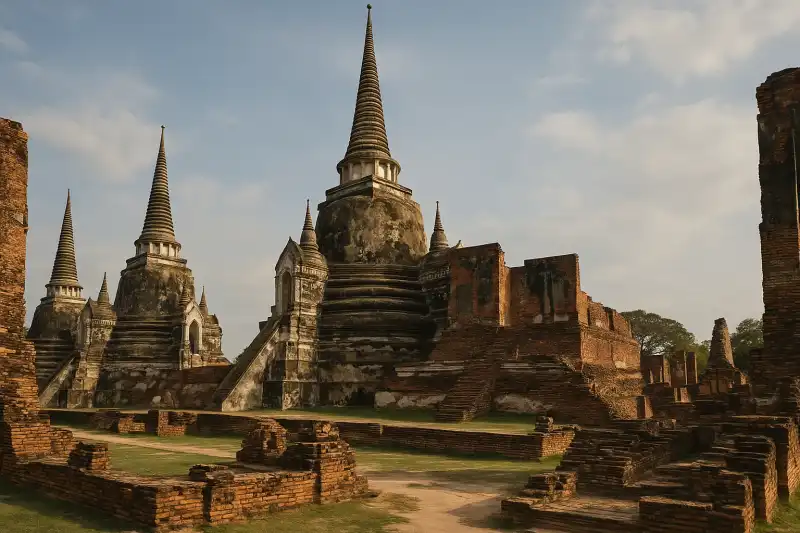
Ayutthaya Travel Guide 2026: Temple Ruins, Day Trip Planning, and What to Prioritize
Ayutthaya KingdomPlan a focused Ayutthaya visit with practical temple routing, timing, and transport guidance from Ba...
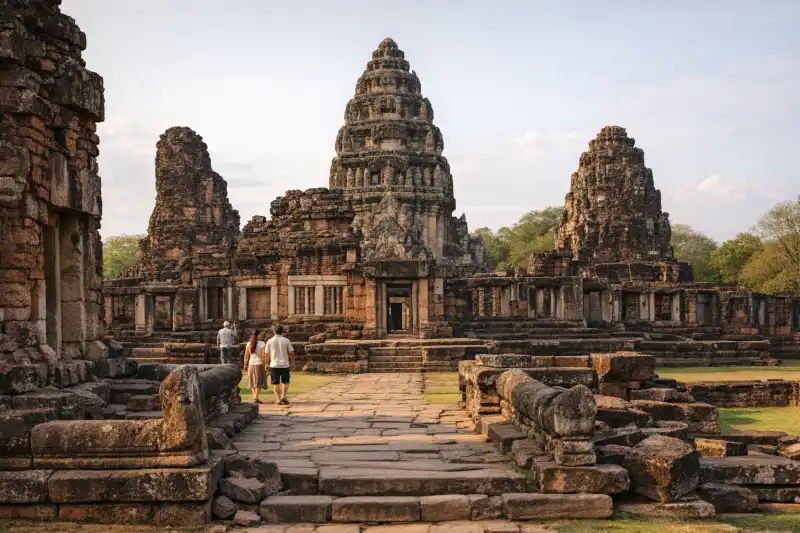
Phimai Historical Park
Khmer EmpireExplore Phimai Historical Park, a remarkable Khmer temple complex in northeastern Thailand famed for...
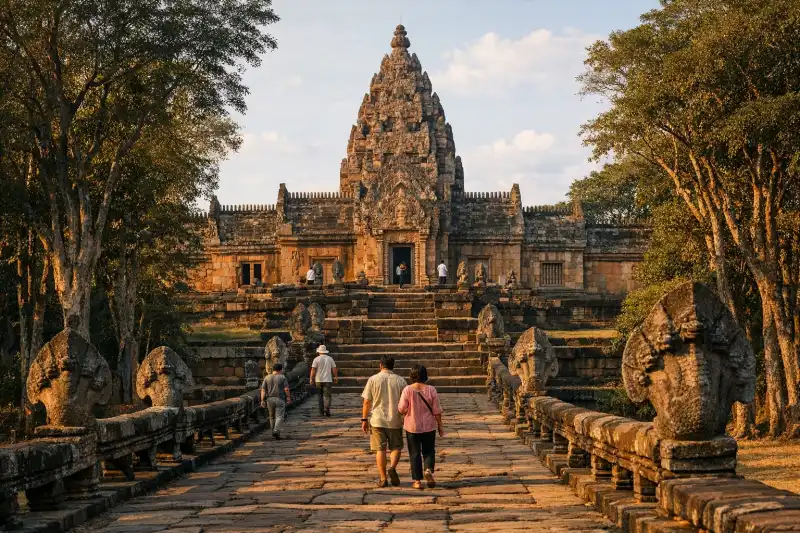
Phanom Rung
Khmer EmpireA dramatic Khmer hilltop temple in Thailand, Phanom Rung is famed for its sandstone carvings and sun...
Kamphaeng Phet
Sukhothai KingdomExplore Kamphaeng Phet in Thailand, a walled historic city of temples, laterite ruins, and forested ...