Quick Info
At a glance
Abila in Jordan is one of those ancient places that rewards travelers who enjoy ruins in a living landscape rather than a polished monumental park. Set among the greener hills of the country’s north, the site combines archaeological remains, fertile valleys, and the quiet atmosphere of a place that once sat within the orbit of major regional powers yet now feels far from the busiest tourist circuits. Unlike Jordan’s more famous desert or Nabataean settings, Abila offers a different mood: olive groves, cultivated land, soft slopes, and the sense that a city once grew naturally out of the countryside around it.
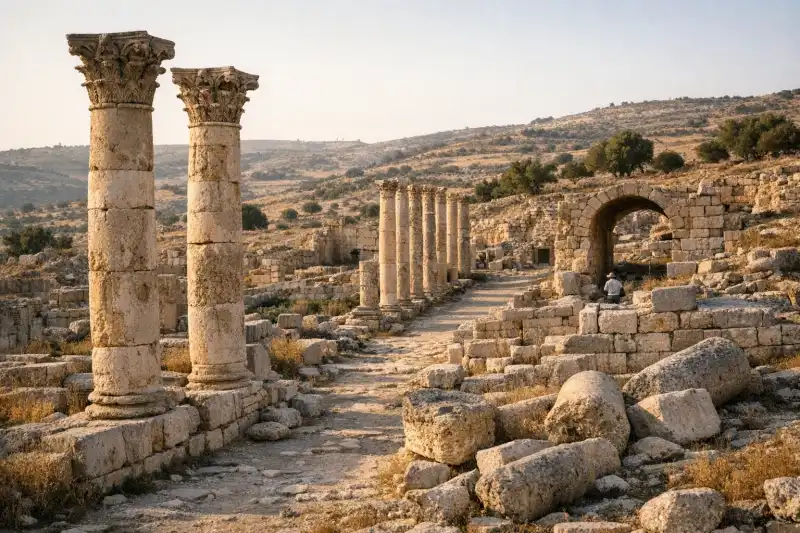
Known in antiquity as one of the cities of the Decapolis, Abila occupied an important position in a network of urban centers that linked the Levant’s inland routes with trade, administration, and Greco-Roman culture. Today, visitors come not for a single iconic monument but for layers of history. There are tells marking older settlement, Roman and Byzantine remains scattered across the terrain, church ruins with mosaic traces, rock-cut tombs, and the outlines of streets and buildings that hint at centuries of adaptation. Exploring Abila means reading a landscape as much as observing architecture. It is a destination for travelers who appreciate context, archaeology, and the way ancient cities evolved over time instead of appearing all at once in perfect stone.
History
Hellenistic beginnings and the Decapolis world
Abila’s importance became more clearly defined in the Hellenistic era, when the eastern Mediterranean was reshaped by the campaigns of Alexander the Great and the kingdoms that followed him. Northern Jordan entered a world where Greek urban planning, political organization, and cultural influence spread alongside older local traditions. Abila developed within this blended setting, not as an isolated colony but as part of a regional system in which cities acted as administrative and commercial hubs.
Its later identification as one of the Decapolis cities gives a clue to its stature. The Decapolis was not a formal empire in itself but a group of cities in the southern Levant associated by language, culture, trade, and varying degrees of autonomy under larger powers. For Abila, this meant participation in a world that valued civic identity, public architecture, and strategic connectivity. The city benefited from its placement in a fertile zone, where agriculture supported settlement and movement through the wider region linked it to neighboring centers in what are now Jordan, Syria, and Israel-Palestine.
Roman rule and urban development
Under Roman influence, especially from the 1st century BCE onward, Abila seems to have flourished as a provincial city within a stable imperial framework. Rome did not create every Decapolis settlement from nothing, but Roman administration helped sustain the conditions in which cities like Abila could invest in streets, public buildings, water systems, and burial architecture. Archaeological evidence from the site points to urban growth and the consolidation of civic life during this period.
As with other Roman cities in the Levant, Abila likely combined local elites, imperial structures, and regional trade. Coins, inscriptions, and architectural fragments from the wider area suggest a population integrated into commercial and political networks beyond the immediate valley. Roads connected it to nearby urban centers, and the city’s role would have been strengthened by its agricultural hinterland. This was a place where people lived, farmed, traded, worshipped, and buried their dead in a landscape closely tied to daily economic life.
Roman Abila was probably never among the grandest cities of the Near East, but that is part of its appeal today. It reflects the texture of provincial urbanism: substantial enough to leave significant remains, yet intimate enough to imagine as a functioning community rather than only an imperial showcase.
Byzantine prosperity and Christian transformation
During the Byzantine period, Abila continued to be occupied and in some ways was transformed rather than diminished. Christianity altered the religious and architectural map of many cities in the Levant, and Abila was no exception. Churches were built, some decorated with mosaics, and the urban fabric was adapted to new forms of communal and devotional life. Archaeologists have identified multiple ecclesiastical remains in the area, demonstrating that the settlement retained enough population and wealth to support religious construction over several centuries.
This phase is especially important for understanding Abila because many of the visible remains today are tied to late antique occupation. The Byzantine era often preserved older urban patterns while redirecting them. Streets continued in use, houses were modified, and sacred geography changed as churches became major landmarks. The site’s position in a productive, relatively well-watered zone likely helped sustain this continuity. Rather than collapsing after the Roman age, Abila appears to have remained a meaningful local center in late antiquity.
Early Islamic continuity and gradual decline
The transition to early Islamic rule in the 7th century did not mean immediate abandonment. Across Jordan and the broader Levant, many towns continued with modified administrative systems, mixed populations, and evolving building patterns. Abila seems to fit this broader regional pattern of continuity followed by gradual contraction. Some structures remained in use, others were repurposed, and settlement shifted over time.
Eventually, political change, economic reorientation, seismic activity, and the normal long-term movement of populations contributed to the site’s decline as a major urban center. Earthquakes affected many cities in the region, and while the exact sequence at Abila is still reconstructed through excavation and survey, such events likely played a role in damaging infrastructure and accelerating change.
Rediscovery through archaeology
Modern knowledge of Abila comes from archaeological work rather than continuous monumental memory. Survey, excavation, and analysis have revealed occupation layers spanning multiple eras. Researchers have documented tells, churches, tombs, domestic remains, and artifacts that help reconstruct how the settlement changed over time. Because the site is not heavily reconstructed, visitors often encounter Abila much as archaeologists do: as a landscape of clues rather than a single, fully legible urban plan. That makes it especially valuable for those interested in how ancient cities are studied and understood.
Key Features
Abila’s greatest feature is its layered setting. The site is spread across more than one mound and surrounding terrain, with ruins emerging from fields and slopes instead of being compressed into one formal archaeological enclosure. This spatial breadth helps visitors understand that ancient cities were not just clusters of freestanding monuments. They were ecosystems of habitation, worship, burial, cultivation, and movement. At Abila, the land itself is part of the interpretation.
One of the most compelling elements is the pair of settlement mounds associated with the ancient city. These tells preserve deep occupational history and mark where successive communities built over earlier remains. Standing near them, you get a sense of continuity that goes beyond any one empire. The visible stonework may belong to late phases, but the mounded form speaks to centuries of rebuilding. For travelers used to Roman columns and façades, the tells offer a reminder that urban history often accumulates vertically before it is understood horizontally.
The Byzantine church remains are among the site’s most evocative archaeological features. Although not always preserved to dramatic heights, these structures reveal Abila’s importance in late antiquity. Fragments of mosaic floors, column bases, apsidal forms, and ecclesiastical layouts give shape to the Christian phase of the city. What makes them memorable is the contrast between the refined religious architecture and the quiet rural landscape around them. You are not just looking at isolated ruins; you are seeing the spiritual infrastructure of a once-inhabited community.
Rock-cut tombs and funerary spaces add another dimension. These remains underscore that Abila was not only a center of civic and religious life but also a place where generations established relationships with death, memory, and ancestry. Tomb architecture in the Roman and Byzantine Levant can reveal social status, family identity, and changing ritual practices. At Abila, the funerary remains enrich the experience by extending the city beyond its streets and public spaces into the surrounding slopes.
Scattered architectural fragments across the site help attentive visitors imagine the former built environment. Blocks, carved stones, wall lines, and reused materials show how structures were erected, dismantled, and repurposed over centuries. Abila does not overwhelm with perfect preservation, but it rewards close observation. A threshold stone here, a column drum there, and the trace of a paved route elsewhere gradually assemble into a mental picture of urban life.
The landscape itself is one of Abila’s defining attractions. Northern Jordan is greener than many first-time visitors expect, especially outside the dry peak of summer. Valleys, agricultural fields, and seasonal vegetation create a setting very different from the red-rock or black-basalt imagery often associated with the region. This backdrop matters historically as well as aesthetically. Abila’s success was tied to arable land, water access, and the ability to sustain settlement over time. Looking out across the surrounding countryside, it becomes easier to understand why an ancient city emerged here.
Another important feature is the relative quiet. Abila is not usually crowded, and that gives the site a reflective quality. You can walk slowly, notice topography, and appreciate how excavation areas relate to one another. For photographers, the low-key atmosphere is a major advantage: soft hill contours, weathered stone, and changing light create images that feel contemplative rather than theatrical. Morning and late afternoon are especially effective, when shadows sharpen wall lines and textures.
For travelers interested in regional context, Abila also stands out because it broadens the story of Jordanian archaeology. Famous destinations such as Petra and Jerash dominate many itineraries, but Abila introduces the Decapolis world from another angle. It demonstrates that Roman and Byzantine urbanism in Jordan was not confined to one or two celebrated sites. Instead, it unfolded across a network of cities, each shaped by local geography, resources, and historical circumstances. Abila’s remains may be subtler than some, but that subtlety is exactly what makes the site intellectually satisfying.
Getting There
Abila is most easily reached by road from Irbid, which is the most practical nearby urban base, or from Amman on a longer day trip. Because public transport to the exact archaeological area can be limited and infrequent, most visitors arrive by rental car, private driver, or taxi. From Irbid, a taxi to the Abila area typically costs around 10 to 20 Jordanian dinars depending on starting point, wait time, and negotiation. From Amman, a private taxi or driver for a return day trip usually ranges from 50 to 90 dinars, especially if you combine Abila with other northern sites.
If you are driving yourself, roads in northern Jordan are generally manageable, though local navigation apps are helpful because signage to smaller archaeological areas may be inconsistent. The drive from Amman often takes roughly 1.5 to 2 hours depending on traffic, while Irbid is much closer. Parking conditions vary and may be informal rather than structured, so it helps to travel in daylight.
Buses and service taxis can get you part of the way via northern towns, but they are not the most efficient option for visitors on a schedule. If you do use public transport, expect to combine a larger bus to Irbid with a local taxi for the final stretch. Budget travelers can usually manage the full trip from Amman for under 15 dinars each way using shared transport plus taxi connections, but it takes more time and flexibility.
Bring water, sun protection, and cash. Facilities at or near the site may be minimal, and card payment should not be assumed.
When to Visit
Spring is the best time to visit Abila. From around March to early May, northern Jordan is often at its most attractive, with milder temperatures, greener hills, and clearer conditions for walking the site. Daytime temperatures are usually comfortable for exploration, and the landscape feels especially alive after seasonal rains. This is also the most photogenic period, as vegetation softens the archaeological remains without obscuring them.
Autumn, especially October and November, is another strong option. The heat has eased, skies are often clear, and the site is pleasant for travelers who prefer quieter conditions after the peak summer travel period. The countryside is less lush than in spring, but visibility is often excellent and the light can be very beautiful in late afternoon.
Summer is possible, but you should plan carefully. Northern Jordan is not as extreme as the desert south and east, yet midday heat can still make exposed archaeological walking tiring. If you come in June through August, aim for an early morning visit and carry more water than you think you need. Shade can be limited, and uneven terrain feels more demanding in hot weather.
Winter has advantages for those who enjoy solitude and cool-weather travel, but rain and mud can affect footing, and occasional cold snaps make the open landscape less comfortable. Still, on a clear winter day, the site can be wonderfully atmospheric.
Whenever you visit, the best light for both comfort and photography is usually early morning or the last two hours before sunset. Those times also bring out the contours of the mounds and the texture of the surviving stonework.
| Quick Facts | Details |
|---|---|
| Location | Northern Jordan, in the Irbid Governorate |
| Ancient Identity | One of the cities of the Decapolis |
| Main Periods | Hellenistic, Roman, Byzantine, Early Islamic |
| Best For | Archaeology lovers, history travelers, quiet offbeat sites |
| Nearest Major City | Irbid |
| Typical Visit Length | 1.5 to 3 hours |
| Best Season | Spring and autumn |
| Access | Best reached by car, taxi, or private driver |
| Terrain | Uneven ground, open archaeological landscape |
| What to Bring | Water, hat, sturdy shoes, sun protection, cash |
Abila is not a destination for travelers seeking instant spectacle. Its appeal is slower and deeper than that. You come here to see how an ancient city lived within its environment, how Roman and Byzantine worlds took shape in northern Jordan, and how archaeology reveals a place through fragments rather than grand reconstruction. That makes the experience unusually rewarding. Abila invites patience, observation, and imagination, and in return it offers a more textured understanding of Jordan’s ancient past than many better-known sites can provide on their own.
Guided tours: worth it?
A guide can be genuinely useful at Abila, especially if you want help with transport, timing, tickets, or understanding a large site without losing half the day to logistics.
Best for
- First-time visitors who want context, not just photos
- Travelers who want transport, timing, or entry logistics handled
- Short visits where a planned route saves time
When to go self-guided
Go independently if you already have transport and tickets sorted, enjoy moving at your own pace, and are comfortable checking the latest official rules before you arrive.
What I’d avoid
Skip paid tours that bundle unrelated stops you do not actually want. The best option should either save meaningful planning time or add historical context you would miss on your own.
Northern Jordan Archaeology Tours
Useful when: you want to compare guided formats before deciding
Umm Qais and North Jordan Day Tours
Useful when: you want to compare guided formats before deciding
Jordan Decapolis Historical Tours
Useful when: you want to compare guided formats before deciding
Some tour links are affiliate links, which may earn Ancient Travel a small commission at no extra cost to you. I try to surface options that make practical sense for the site—not just anything bookable.
Frequently Asked Questions
Where is Abila located?
Abila is in northern Jordan, generally identified with the archaeological area of Tell Abil and Qweilbeh in the Irbid Governorate near the Yarmouk region.
What is Abila known for?
Abila is best known as one of the cities of the Decapolis, with remains from Hellenistic, Roman, Byzantine, and early Islamic periods, including churches, tombs, streets, and settlement mounds.
Can you visit Abila independently?
Yes, many travelers visit independently by car or taxi from Irbid or Amman, though a guide can be helpful because the site is spread across multiple areas and interpretation on-site may be limited.
How much time should I spend at Abila?
Most visitors should allow 1.5 to 3 hours to explore the main ruins, hillside remains, and surrounding landscape at a comfortable pace.
Is Abila suitable for families?
Abila can suit families interested in archaeology and open-air exploration, but paths may be uneven and there is limited shade and visitor infrastructure.
What should I bring to Abila?
Bring water, sun protection, sturdy walking shoes, and cash for transport or local purchases, since facilities near the site may be minimal.
Nearby Ancient Sites
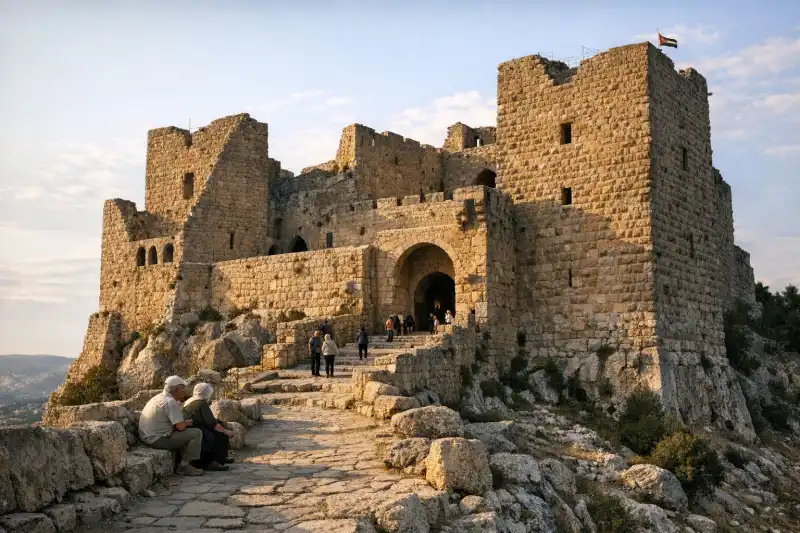
Ajloun Castle
Ajloun Castle in Jordan is a 12th-century Muslim fortress renowned for its strategic hilltop locatio...
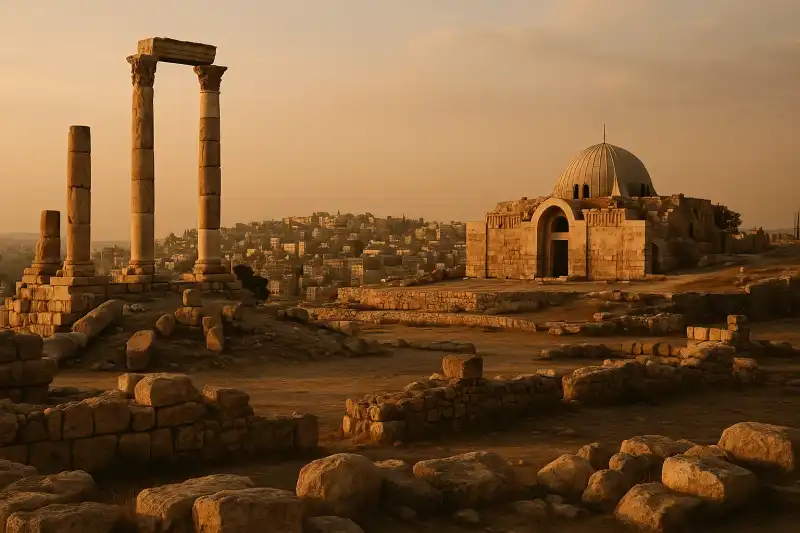
Amman Citadel Jordan Guide 2026: Temple of Hercules & Ancient Rabbah
Ammonite-Roman-UmayyadExplore Jordan's ancient citadel overlooking modern Amman. Discover the Temple of Hercules, Umayyad ...
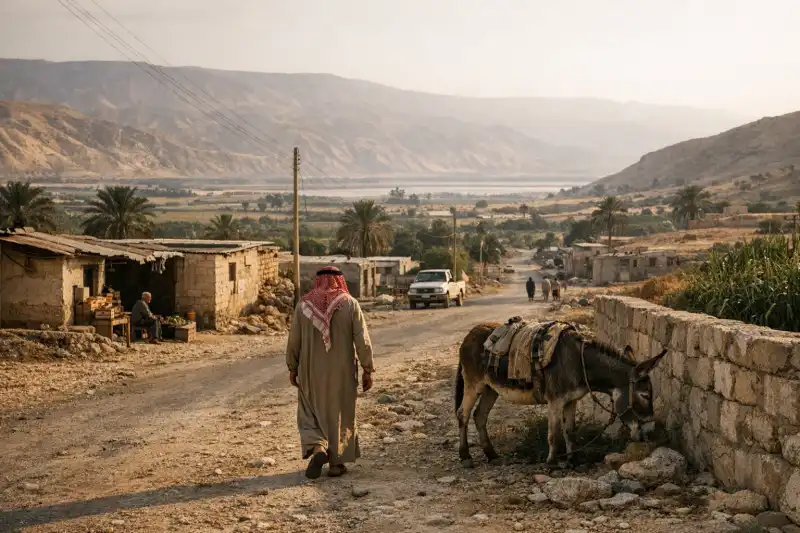
Deir Alla
Canaanite, Israelite-era, and regional Levantine culturesExplore Deir Alla in Jordan, an important Jordan Valley archaeological mound linked to Bronze and Ir...
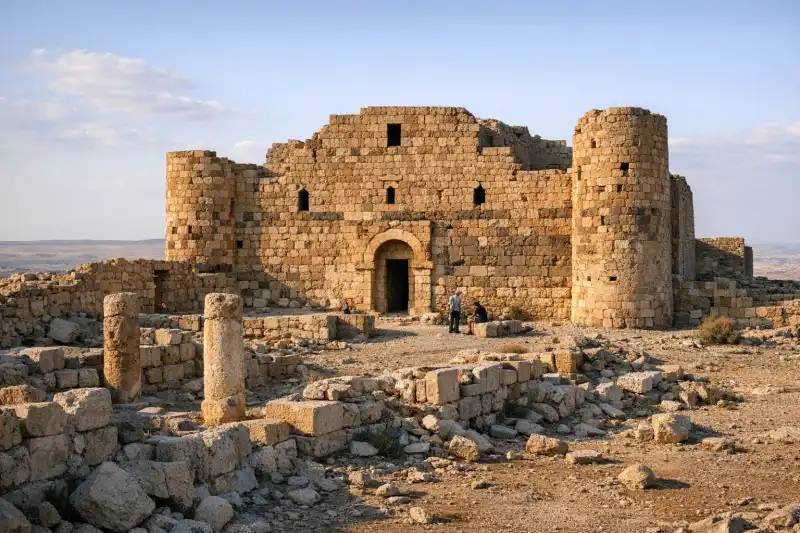
Desert Castles (Qasr al-Hallabat)
Roman and UmayyadExplore Qasr al-Hallabat, a striking Umayyad desert castle in Jordan with Roman roots, mosaics, and ...