Quick Info
At a glance
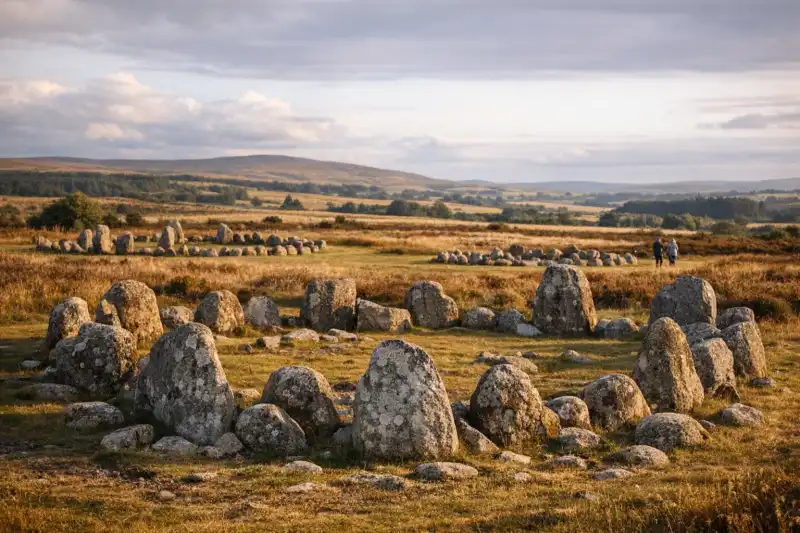
Beaghmore Stone Circles in Ireland occupy a lonely, wind-brushed upland where archaeology and atmosphere seem inseparable. Set in County Tyrone near the Sperrin Mountains, the site is less a single monument than an entire ritual landscape spread across open moorland. Visitors arriving here often expect one tidy stone circle and leave having encountered a far stranger composition: multiple circles, rows of standing stones, cairns, and alignments that suggest repeated use over centuries. The setting matters as much as the stones themselves. Even on a bright day, the land feels spacious and slightly remote, with peat, heather, and shifting weather giving the place an elemental character that modern roads have not entirely erased.
Unlike some of Ireland’s more heavily visited ancient attractions, Beaghmore does not overwhelm with size or towering masonry. Its power lies in pattern, repetition, and placement. The stones are generally modest in height, but their deliberate arrangements hint at ceremony, social memory, and perhaps astronomical observation. Excavation has revealed that the visible monuments belong to a landscape shaped by environmental change, particularly the spread of peat that gradually transformed the area. As a result, a visit here offers more than a look at prehistoric engineering. It opens a window onto how Bronze Age communities in Ireland adapted to changing terrain while continuing to mark sacred space. For travelers interested in megaliths, ancient astronomy, or quiet places with enduring mystery, Beaghmore stands out as one of the island’s most evocative prehistoric sites.
History
Early Bronze Age origins
The monuments at Beaghmore are generally dated to the Bronze Age, with the principal activity often placed between roughly 2000 and 1200 BCE. Archaeologists believe the site developed over time rather than being built all at once. This matters because what visitors see today is not the work of a single generation but the accumulated result of repeated ceremonial or commemorative acts. Communities living in this upland zone selected the area for burial, ritual, alignment, or seasonal gathering, and they returned to it often enough to create a complex ceremonial field rather than one isolated structure.
At the time the earliest monuments were established, the landscape was likely more hospitable than it appears today. Evidence suggests that the area had once been open woodland or usable ground before peat growth expanded. This environmental shift may explain why some monuments seem to represent both continuity and adaptation. People continued to mark the land even as its character changed. That persistence implies the location had significance beyond practical settlement use. It may have been tied to ancestral memory, local cosmology, or observation of the sky.
Construction, ritual use, and changing landscape
The stone circles, stone rows, and cairns indicate a site used for more than one purpose. Some scholars have proposed connections with funerary practice because small cairns are present nearby. Others emphasize ceremonial gatherings or alignments linked to the sun and moon. Beaghmore is often discussed in relation to possible astronomical observation, particularly because several rows and settings appear to orient in meaningful ways. While exact prehistoric intentions remain debated, there is broad agreement that this was a carefully organized ritual landscape rather than a casual assembly of stones.
The spread of blanket peat seems to have played a major role in the site’s development. As peat encroached on formerly workable land, communities may have had to alter how they used the area. One theory suggests some circles and alignments were erected after the environment had already begun changing, turning the place into a more overtly ceremonial zone. Another possibility is that the monuments themselves acted as markers of a landscape being lost to bog. In that reading, Beaghmore is partly an act of memory: a way of claiming and preserving meaning in terrain becoming less suited to ordinary habitation or farming.
Discovery and excavation in the modern era
Although local people would have known of stones in the area, the complex gained archaeological attention in the twentieth century after peat cutting exposed additional features. This is a recurring theme across northern and western Europe, where bog landscapes have both concealed and preserved ancient remains. At Beaghmore, excavations in the 1940s and later decades revealed a much more extensive complex than had been obvious on the surface. Archaeologists identified several stone circles, long alignments, cairns, and related features spread across the site.
These excavations also uncovered evidence that the area had once supported tree growth before climatic or environmental changes led to peat expansion. Such findings helped place the monuments in a broader story of prehistoric adaptation. They also underscored how incomplete any surface view of a bogland site can be. What appears simple at first glance may represent only the visible fraction of a more complicated prehistoric landscape.
Interpretation today
Modern interpretation of Beaghmore remains cautious, and that caution is appropriate. Ancient sites often attract dramatic claims, especially where alignments and circles are involved. At Beaghmore, the strongest conclusions are that the site belongs to the Bronze Age, that it developed over time, and that it functioned as a significant ceremonial or ritual landscape. The presence of multiple circles and rows points to repeated planning and shared cultural meaning. The location in a changing upland environment adds another layer, suggesting that ritual life and environmental change were deeply intertwined.
For visitors today, this uncertainty is not a weakness but part of the site’s appeal. Beaghmore preserves enough structure to show intention clearly, yet leaves enough unanswered to invite reflection. It is a place where archaeology establishes a framework, and imagination must do the rest carefully, guided by the stones, the bog, and the open sky.
Key Features
The defining quality of Beaghmore Stone Circles is multiplicity. Rather than presenting one monumental centerpiece, the site unfolds as a network of related structures spread across the landscape. There are several stone circles, each with its own proportions and internal details, and their proximity to one another creates a sense of dialogue across the ground. Some circles include low central features or are associated with cairns, reinforcing the possibility of ritual or funerary significance. Because the stones are not enormous, the eye is drawn less to vertical drama than to arrangement. Geometry is the real monument here.
One of the most memorable features is the set of stone alignments or rows extending from parts of the complex. These lines guide attention outward and create a visual relationship between the monuments and the wider horizon. Even if a visitor knows little about archaeoastronomy, it is easy to see why the site has inspired theories about celestial observation. The alignments seem to encourage watching, measuring, or at least noticing the movement of light and seasons. At sunrise or sunset, the low angle of light can sharpen these impressions, casting slender shadows that reveal the planning behind the stones.
The cairns add another dimension. Though not as immediately striking as the circles, they are crucial to understanding Beaghmore as a lived ritual landscape rather than an abstract astronomical device. Cairns in prehistoric contexts often suggest burial, remembrance, or acts of deposition. Their presence here implies that ceremony may have involved the dead as well as the living, linking the site to ancestry and continuity. In such a setting, circles and rows may not have served one exclusive function. They could have formed part of a wider ritual vocabulary in which burial, commemoration, procession, and sky observation were all interconnected.
The landscape setting is itself one of the site’s key features. Beaghmore sits in open country that remains relatively uncluttered by modern development. The stones do not stand against an urban backdrop or within manicured grounds. Instead, they emerge from a moorland environment where weather remains an active presence. Wind, mist, and rain can change the mood rapidly, and this atmospheric instability helps visitors imagine why prehistoric communities may have experienced such places as thresholds between the ordinary and the sacred. On clear days, the openness of the site encourages long views and awareness of the horizon. On overcast days, the same openness can feel introspective and enclosed by sky.
Another notable feature is the modest scale of the individual stones. Travelers accustomed to famous megalithic monuments may initially find Beaghmore understated. Yet this understatement is deceptive. Because the stones are lower, visitors can better appreciate how the full composition operates across the ground. The eye sweeps from circle to circle, from row to cairn, noticing spacing and orientation. The experience becomes almost architectural, despite the lack of walls or roof. This is built space in its most elemental form: stone, earth, line, and emptiness.
The site’s archaeological importance also counts as a feature in its own right. Beaghmore illustrates how peatland can preserve traces of ancient life and conceal ceremonial landscapes for centuries. It invites visitors to think not just about what is visible now, but about what lay hidden until excavation. That sense of partial revelation gives the monument intellectual depth. You are not simply looking at old stones; you are seeing the exposed remains of a larger prehistoric story shaped by climate, land use, and rediscovery.
Finally, Beaghmore rewards quiet observation. It is not a place of dramatic interiors or museum-style interpretation on every step. Instead, its features reveal themselves gradually. Stand still for a few minutes and patterns begin to emerge. Walk from one edge to another and the geometry changes. Return in different weather and the site feels subtly transformed. This ability to sustain attention is one of Beaghmore’s greatest strengths. It offers not spectacle, but presence.
Getting There
Beaghmore Stone Circles are most easily reached by car. The site lies in County Tyrone near Carrickmore and within driving distance of Cookstown, Omagh, and Dungannon. From Belfast, the journey typically takes around 1 hour 30 minutes to 2 hours depending on traffic and route, while from Derry/Londonderry it is often about 1 hour 15 minutes to 1 hour 45 minutes. Car hire from Belfast generally starts around £30-£60 per day, with fuel extra. For most travelers, self-driving is the simplest option because rural public transport in this part of Northern Ireland is limited and schedules may not align well with sightseeing.
If you are relying on public transport, begin by taking a bus from Belfast or another major town to Cookstown or Omagh. Single fares commonly range from about £8 to £18 depending on distance and operator. From there, you may need a taxi for the final leg to the site. A taxi from Cookstown or Carrickmore can cost roughly £20-£40 each way, so it is wise to arrange return transport in advance, especially outside peak hours. Travelers without a car often find that combining a regional bus with a pre-booked taxi is the most practical solution.
Guided day tours can also be worthwhile if you want transport taken care of. While Beaghmore is not always included on standard itineraries, private or custom tours from Belfast can sometimes be arranged. Expect prices to vary widely, often from £80 per person on small-group excursions to significantly more for private drivers. Whatever method you choose, wear sturdy footwear: the final approach and the site itself can be damp, uneven, and muddy after rain.
When to Visit
Late spring through early autumn is generally the best time to visit Beaghmore Stone Circles. From May to September, days are longer, temperatures are milder, and the extra daylight gives you more flexibility for exploring the site and surrounding countryside. Summer often offers the easiest conditions underfoot, though this is never a landscape to approach unprepared. Even in June or July, weather can shift quickly in the uplands, so a waterproof jacket remains essential.
Spring is especially rewarding for travelers who enjoy a quieter atmosphere and fresh color in the landscape. The light can be crisp, visibility is often good, and the site feels open and expansive after winter. Autumn is another strong choice, bringing dramatic skies and a mood that suits the monument’s solemn character. Heather, changing vegetation, and lower sun angles can make the stones particularly photogenic.
Winter visits are possible, but they require more planning. The site can be cold, wet, windy, and occasionally misty, with shorter daylight hours reducing flexibility. That said, winter can also be deeply atmospheric, especially if you appreciate solitude and stark landscapes. Just avoid arriving late in the day without checking conditions, and make sure you have appropriate footwear.
Time of day matters almost as much as season. Early morning and late afternoon usually provide the most evocative light, with long shadows helping the alignments and circles stand out. Midday can flatten the shapes visually, especially under bright sun. If photography is part of your plan, aim for a clear or partly cloudy evening. If contemplation is your goal, an early visit often gives you the site at its quietest.
| Quick Facts | Details |
|---|---|
| Location | County Tyrone, Northern Ireland, Ireland |
| Nearest town | Carrickmore |
| Nearby base | Cookstown |
| Period | Bronze Age |
| Date | c. 2000–1200 BCE |
| Site type | Stone circles, alignments, cairns |
| Best for | Prehistoric archaeology, landscape photography, quiet exploration |
| Typical visit length | 45 minutes to 1.5 hours |
| Entry fee | Usually free |
| Access note | Rural setting with uneven, sometimes wet ground |
Beaghmore Stone Circles reward travelers willing to slow down. This is not a place that reveals itself instantly, nor is it one that depends on dramatic restoration or heavy interpretation. Its strength lies in the way ancient order survives within a living landscape of peat, weather, and open space. The circles, rows, and cairns are enough to prove that Bronze Age communities invested this upland with deep meaning, yet not enough to explain every intention fully. That balance between evidence and mystery is precisely what makes a visit memorable.
For anyone tracing Ireland’s prehistoric heritage, Beaghmore offers a compelling counterpoint to the better-known passage tombs and larger ceremonial centers elsewhere on the island. It feels more intimate, more exposed, and in some ways more enigmatic. The stones sit low to the earth, but the questions they raise are large: why this place, why these patterns, why return here over generations? Standing among them, with the Sperrin landscape stretching outward and the sky shifting overhead, you sense that the site was designed not just to be seen but to be experienced in motion, in light, and in time.
If you value ancient places that still retain silence, texture, and a strong connection to their surroundings, Beaghmore is worth the journey. Come prepared for weather, allow time to walk slowly, and resist the urge to rush. The monument’s meaning does not announce itself loudly. It accumulates, like the landscape that once concealed it, until the circles begin to feel less like ruins and more like a conversation still unfolding across the centuries.
Guided tours: worth it?
A guide can be genuinely useful at Beaghmore Stone Circles, especially if you want help with transport, timing, tickets, or understanding a large site without losing half the day to logistics.
Best for
- Travelers who want transport, timing, or entry logistics handled
- Short visits where a planned route saves time
When to go self-guided
Go independently if you already have transport and tickets sorted, enjoy moving at your own pace, and are comfortable checking the latest official rules before you arrive.
What I’d avoid
Skip paid tours that bundle unrelated stops you do not actually want. The best option should either save meaningful planning time or add historical context you would miss on your own.
Northern Ireland Ancient Sites Tours
Useful when: you want to compare guided formats before deciding
Sperrin Mountains Day Tours
Useful when: you want to compare guided formats before deciding
Belfast to Beaghmore Stone Circles Tours
Useful when: you want to compare guided formats before deciding
Some tour links are affiliate links, which may earn Ancient Travel a small commission at no extra cost to you. I try to surface options that make practical sense for the site—not just anything bookable.
Frequently Asked Questions
Where are Beaghmore Stone Circles located?
Beaghmore Stone Circles are in County Tyrone in Northern Ireland, near Cookstown and the village of Carrickmore, on the southeastern edge of the Sperrin Mountains.
Do you need a ticket to visit Beaghmore Stone Circles?
The site is generally free to visit, with open access managed as a heritage monument. Parking arrangements can vary, so check local information before traveling.
How much time should I allow for a visit?
Most visitors spend 45 minutes to 1.5 hours exploring the circles, alignments, and cairns, though landscape photographers and archaeology enthusiasts may stay longer.
What is the best time of day to visit?
Early morning and late afternoon are especially atmospheric, with lower light emphasizing the stones and the open moorland setting. Clear days also provide the best views.
Are Beaghmore Stone Circles suitable for children?
Yes, older children interested in history and outdoor spaces often enjoy the site, but families should note that the ground can be uneven, wet, and exposed in poor weather.
Can you visit Beaghmore Stone Circles in bad weather?
You can, but conditions in the Sperrin foothills change quickly. Waterproof footwear and warm layers are strongly recommended, especially outside summer.
Nearby Ancient Sites
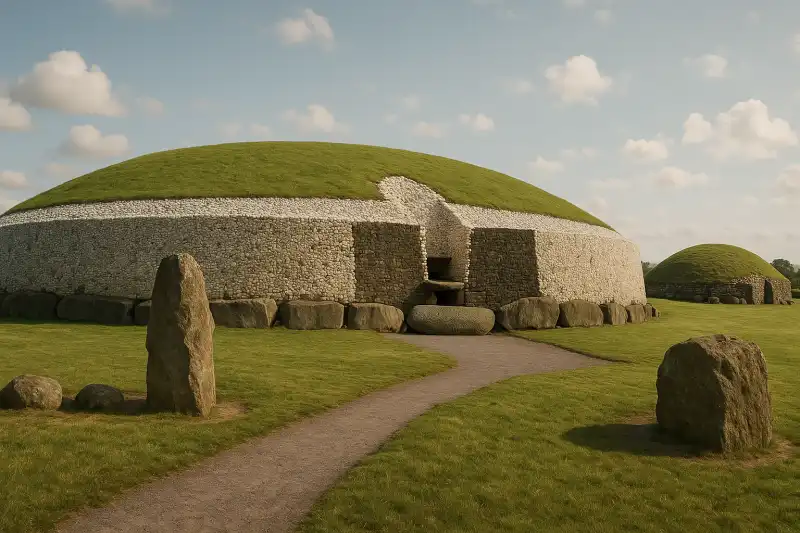
Boyne Valley Passage Tombs Travel Guide 2026: Newgrange, Knowth, and Dowth Visit Strategy
Neolithic IrelandPlan your first Boyne Valley passage tombs visit with practical timing, Brú na Bóinne access flow, a...
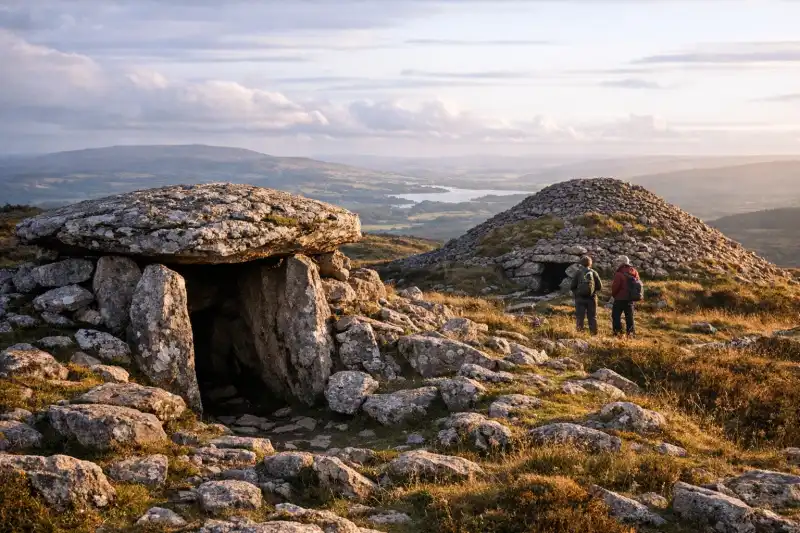
Carrowkeel Megalithic Cemetery
Neolithic IrelandA dramatic Neolithic hilltop cemetery in Ireland with passage tombs, mountain views, and ancient rit...
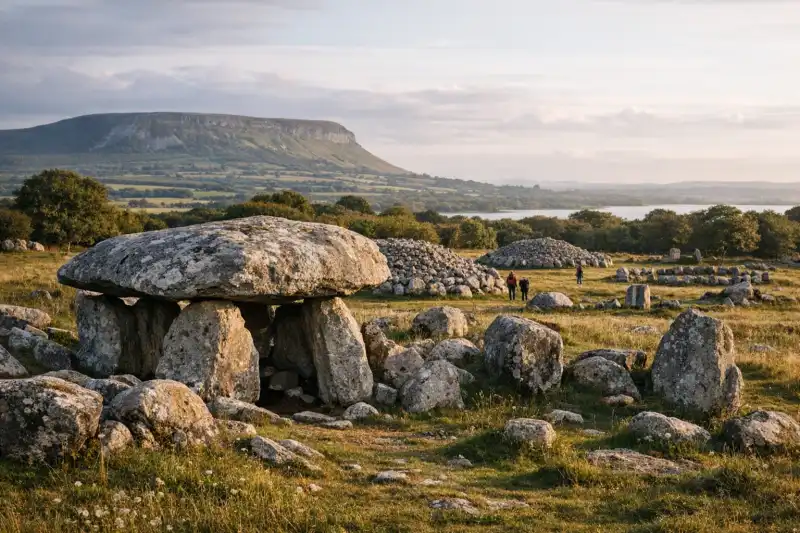
Carrowmore Megalithic Cemetery
Neolithic communities of prehistoric IrelandExplore Carrowmore Megalithic Cemetery, Ireland’s vast Neolithic burial landscape near Sligo, with t...
Céide Fields
Neolithic farming communities of Atlantic EuropeExplore Céide Fields in Ireland, a vast Neolithic landscape of stone-walled fields, tombs, and trace...