Quick Info
At a glance
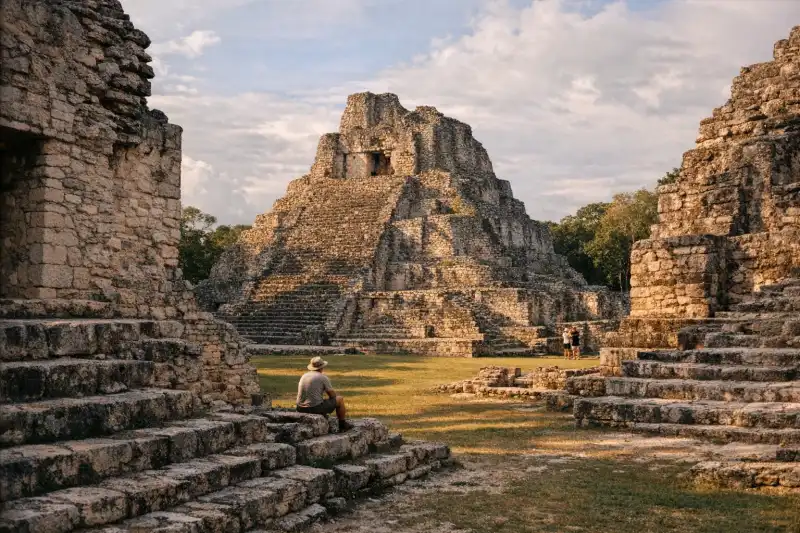
Becán, in Mexico’s state of Campeche, is one of those ancient places that feels both monumental and hidden. Rising from the low tropical forest of the Yucatán Peninsula, the site surprises visitors not with overwhelming crowds or polished spectacle, but with atmosphere: stone towers lifting above green canopy, plazas crossed by shifting light, and a strange ring-like ditch that immediately sets the city apart from many other Maya ruins. Even before you understand its chronology or political history, Becán leaves an impression of a place built to command, protect, and endure.
For travelers exploring southeastern Mexico, Becán offers a different experience from the most famous northern Yucatán destinations. It sits in the broader Río Bec region, an area known for distinctive Maya architecture and a landscape dotted with major and minor centers. Near modern Xpujil and within reach of Calakmul, Becán is often visited as part of a wider archaeological journey through Campeche’s forested interior. Yet it is worth treating as a destination in its own right. Its scale is manageable, its layout intelligible, and its monuments rewarding whether you are a first-time visitor or already familiar with Maya urbanism.
The site’s appeal lies in this combination of accessibility and depth. You can arrive, walk its core in a few hours, and leave with vivid memories of temples, causeways, and carved stone. But if you pause to look closer, Becán also tells a long story of growth, rivalry, adaptation, and resilience across more than a millennium of Maya history.
History
Early foundations and rise
Becán was established during the Middle Preclassic period, likely around 600 BCE, when communities across the Maya lowlands were beginning to form larger and more complex political centers. Its location was advantageous: the surrounding region linked trade and communication routes running through the southern Yucatán Peninsula, connecting inland centers with broader networks of exchange. Over time, Becán developed from a settlement into a major regional capital.
What distinguishes its early growth is the apparent investment in large-scale planning. The city’s best-known feature, the ditch and embankment surrounding much of the monumental core, appears to have been constructed in the late Preclassic or early Classic era. Archaeologists have long debated whether this system was primarily defensive, symbolic, hydrological, or some combination of all three. Whatever its exact function, it required labor, coordination, and authority. That alone suggests Becán was no ordinary town. It was a center with the resources and ambition to reshape its landscape.
By the Late Preclassic, the city had already begun to monumentalize its ceremonial core with pyramidal platforms, elite compounds, and formal plazas. Like many Maya centers, Becán expressed power through elevation and visibility. Buildings rose above the surrounding terrain, while processional spaces organized movement and ritual.
Classic period power and regional influence
Becán reached its greatest prominence during the Early and Late Classic periods, roughly from 250 to 800 CE. During these centuries it served as one of the principal powers in the Río Bec zone and likely interacted competitively and diplomatically with neighboring polities. Its strategic significance may have derived from both military strength and control over local trade and agricultural resources.
Architecturally, this was the era in which many of the site’s most impressive surviving structures were expanded or rebuilt. Tall pyramids, vaulted rooms, temple platforms, and elite residences transformed the city into a ceremonial and political capital. Some buildings exhibit features associated with the broader Río Bec tradition, including dramatic tower-like facades and ornamental architectural flourishes designed to project prestige. This style is notable for its theatricality: structures seem made not merely for use, but for display, status, and visual command.
Becán’s relationship with larger Maya powers remains a subject of scholarly interpretation. It may have been influenced by wider trends emanating from major lowland centers, and the city almost certainly participated in extensive networks of exchange involving obsidian, jade, ceramics, shell, and other goods. At the same time, it retained a regional identity visible in architecture and settlement organization.
Evidence from excavations suggests an active and stratified urban community, with elite compounds, common residential zones, and ceremonial spaces all integrated into a functioning cityscape. Causeways and planned access points indicate that movement into and through the monumental precinct was controlled. This again reinforces the impression of a city deeply concerned with order, hierarchy, and visibility.
Transformation, decline, and rediscovery
Like many Maya centers of the southern lowlands, Becán experienced significant change during the Terminal Classic period, roughly 800 to 1000 CE. Political systems across the region were shifting, populations were moving, and established dynasties in many places were weakening or disappearing. Becán was not abandoned overnight, but its role as a dominant center diminished. Construction slowed, and the urban vitality that had once defined the city gave way to contraction.
Occupation may have continued into the Postclassic in reduced form, but the site never regained its earlier regional power. Over centuries, the forest gradually reclaimed plazas and stairways, preserving some elements while obscuring others. This process of concealment was part destruction, part protection: roots and weather damaged masonry, yet remoteness also spared the site from the complete dismantling that affected some ancient centers.
Modern archaeological attention increased in the twentieth century, when surveys and excavations began to document Becán’s layout, architecture, and chronology in greater detail. Researchers recognized the site as one of the most important Maya cities in the area, especially for understanding the Río Bec region’s political organization and architectural traditions. Conservation and visitor infrastructure have since made the core accessible, allowing travelers today to enter a place that was once one of Campeche’s most significant ancient capitals.
Key Features
The first feature most visitors hear about is the moat, though “moat” is only a partial description. Becán’s encircling ditch and accompanying embankment form one of the most unusual large-scale landscape modifications in the Maya world. Whether conceived mainly as a defensive work or as a multi-purpose boundary with ceremonial and symbolic functions, it creates a striking threshold. Crossing into the core of the city feels deliberate. You are not just arriving at ruins scattered through the forest; you are entering a defined and protected center of power.
Inside that boundary lies the monumental nucleus, where plazas and elevated structures reveal the city’s ceremonial heart. The main plaza is framed by pyramidal buildings and elongated platforms that once supported temples, shrines, and elite activities. The arrangement of space reflects the classic Maya concern with processional movement, ritual observation, and political theater. Standing in the plaza, you can imagine gatherings of rulers, nobles, priests, traders, and residents assembled under the towering facades.
One of Becán’s great strengths as a destination is the variety of architecture visible within a relatively compact area. Some structures are massive and austere, emphasizing bulk and height, while others show the decorative tendencies associated with the Río Bec style. This regional tradition is famous for elegant but sometimes nonfunctional temple towers, intricate masonry, and facades designed to impress. At Becán, these stylistic currents contribute to an urban landscape that feels more textured and experimental than some more standardized Maya sites.
Structure IX is often singled out as one of the highlights. This large pyramid dominates part of the site and offers a strong sense of verticality and ceremonial authority. Even when climbing permissions are restricted, simply viewing the building from below conveys its scale. The steep stairways, layered platforms, and commanding placement tell you immediately that this was architecture meant to elevate both bodies and meanings. Other structures in the central group include palace-like buildings with multiple chambers, vaulted interiors, and terraces that suggest elite residential or administrative uses.
Vaulted rooms are another memorable element of Becán. The Maya corbel vault, created by gradually overlapping stone courses until they nearly met at the top, appears throughout the site in chambers that once formed part of residences, shrines, and ceremonial complexes. These enclosed spaces add intimacy to a visit. Outside, the architecture is expansive and public; inside, it becomes shadowed, acoustic, and close, inviting you to imagine the daily and ceremonial life that unfolded within.
The site’s causeways and controlled entrances are equally important. They indicate that Becán’s designers thought carefully about how people approached the city and moved through it. In ancient times, these routes would have structured access to the ceremonial core, perhaps separating elite and common spaces or channeling visitors toward key plazas. For modern travelers, they make the site easier to understand spatially. You can trace paths, transitions, and alignments in a way that reveals the city as a planned environment rather than a random cluster of monuments.
Then there is the setting itself. Unlike ruins embedded in large modern tourism zones, Becán remains surrounded by a landscape that helps preserve a sense of isolation. Bird calls, rustling leaves, humidity, and filtered light all contribute to the experience. The forest is not just backdrop; it is part of how the site is perceived. Ancient Maya cities were never separate from their ecological context, and at Becán the relationship between architecture and environment still feels vivid. Massive stone constructions emerge from a living green world, emphasizing both the ingenuity of the builders and the long arc of time since the city’s decline.
Finally, Becán rewards slow observation. Look closely at masonry joints, stair profiles, room plans, and platform levels, and the site begins to reveal social distinctions, building sequences, and architectural ambition. It is not only a place of dramatic silhouettes; it is also a place of details. For travelers interested in how Maya cities actually functioned, this combination of monumentality and legibility makes Becán especially satisfying.
Getting There
Becán is most commonly reached via Xpujil, the nearest practical base for visitors. Xpujil lies along Federal Highway 186 in Campeche and has small hotels, guesthouses, restaurants, and tour operators. From Xpujil, the site is only about 8 kilometers away, making it an easy taxi ride or short drive. A taxi typically costs around MXN 100 to 200 each way depending on negotiation, timing, and whether the driver waits for your return. Some hotels can also arrange transport.
If you are driving, Becán is straightforward to access by road and is often included in self-drive itineraries through southern Campeche. Rental cars can be picked up in larger hubs such as Campeche city, Chetumal, Mérida, or Cancún, though distances can be significant. Fuel up before heading into rural stretches, and start early if you plan to combine Becán with more distant sites like Calakmul. Parking at the archaeological zone is usually simple and close to the entrance.
Public transport options are more limited but possible. Buses connect Xpujil with cities such as Campeche, Escárcega, Chetumal, and sometimes Bacalar. Fares vary by route and class, but intercity buses to Xpujil commonly range from about MXN 200 to 600. Once in Xpujil, you can take a taxi to the site. Shared vans or colectivos may operate on some routes in the region, though schedules can be irregular and are best confirmed locally.
Entrance fees and opening hours can change, so check official information before visiting. Bring cash in small denominations for tickets, snacks, or local transport, as card facilities may be unreliable in the area.
When to Visit
The best time to visit Becán is generally during the dry season, from November to April. During these months, daytime conditions are usually more comfortable for walking among exposed stone structures, trails are less muddy, and road travel is easier. Morning visits are especially pleasant, with cooler temperatures, softer light for photography, and fewer insects. If you want the site to feel quiet and atmospheric, arriving near opening time is ideal.
From May to October, the rainy season brings heavier humidity, afternoon downpours, and lusher vegetation. This can make the site visually beautiful, with the forest appearing especially vibrant, but it also means greater heat, slippery surfaces, and more mosquitoes. If you travel in this season, wear breathable clothing, carry water, and aim for an early start before storms build. A light rain jacket can be useful even on apparently clear mornings.
The hottest weeks often fall between late spring and summer, when midday temperatures can become tiring. Becán is manageable in a few hours, but shade is not constant across all open areas, so sun protection matters. A hat, sunscreen, and at least one liter of water per person are sensible basics.
For travelers combining Becán with Calakmul or other nearby ruins, the cooler months are especially attractive because long days of site visits and driving become much easier. If your priorities include comfort, clearer skies, and straightforward logistics, December through February is an excellent window. If you prefer greener scenery and don’t mind humidity, the wet season can still be rewarding, provided you plan around the weather.
| Quick Facts | Details |
|---|---|
| Location | Near Xpujil, Campeche, Mexico |
| Civilization | Maya |
| Main period | Preclassic to Postclassic, with peak importance in the Classic period |
| Known for | Moat-like ditch, monumental core, and Río Bec architectural influences |
| Nearest town | Xpujil |
| Suggested visit length | 1.5 to 3 hours |
| Best season | November to April |
| Access | By car or taxi from Xpujil |
| Combine with | Calakmul, Chicanná, Xpuhil, and other Campeche Maya sites |
Becán may not be the most internationally famous Maya city in Mexico, but that is part of its strength. It offers enough grandeur to satisfy travelers seeking impressive monuments, enough complexity to reward those interested in archaeology, and enough calm to let the landscape speak. Its ditch, plazas, towers, and vaulted rooms together present a city that once projected confidence and control in a competitive regional world. Today, what remains is not a ruin stripped of meaning, but a place where urban design, political ambition, and environmental setting still feel intertwined.
For many visitors, Becán becomes memorable precisely because it balances clarity with mystery. You can understand its main features in a single visit, yet still leave with questions about who crossed its causeways, who ruled from its elevated compounds, and why its people invested so much in shaping both stone and earth. In that sense, it captures one of the essential pleasures of ancient travel: the ability of a silent place to suggest a vast, unfinished human story.
Guided tours: worth it?
Self-guided works here, but a guide can add real value if you want the ruins explained as a living place rather than just a sequence of monuments.
Best for
- First-time visitors who want context, not just photos
- Short visits where a planned route saves time
When to go self-guided
Go independently if you prefer setting your own pace, reading as you go, and checking official hours or ticket rules directly before you arrive.
What I’d avoid
Skip paid tours that bundle unrelated stops you do not actually want. The best option should either save meaningful planning time or add historical context you would miss on your own.
Becán and Calakmul tours
Useful when: you want to compare guided formats before deciding
Campeche Maya ruins tours
Useful when: you want to compare guided formats before deciding
Xpujil archaeological tours
Useful when: you want to compare guided formats before deciding
Some tour links are affiliate links, which may earn Ancient Travel a small commission at no extra cost to you. I try to surface options that make practical sense for the site—not just anything bookable.
Frequently Asked Questions
Where is Becán located?
Becán is in the state of Campeche in southern Mexico, near the town of Xpujil and not far from the Calakmul Biosphere Reserve.
What is Becán best known for?
Becán is famous for its unusual moat-and-rampart defensive system, its central acropolis, and its impressive examples of Río Bec-style Maya architecture.
How much time do you need to visit Becán?
Most visitors spend 1.5 to 3 hours at the site, though history enthusiasts may want longer to explore the main plaza, elevated structures, and surrounding features.
Can you climb the structures at Becán?
Access rules can change, so some structures may be climbable while others may be restricted for safety and conservation. Check current regulations when you arrive.
Is Becán suitable to combine with other ruins?
Yes. Becán is often combined with nearby sites such as Calakmul, Chicanná, and Xpuhil, especially if you are staying in or near Xpujil.
When is the best time to visit Becán?
The dry season from roughly November to April is usually the most comfortable, with lower humidity, less rain, and easier road conditions.
Nearby Ancient Sites
Calakmul
MayaExplore Calakmul, a vast Maya city deep in the forests of Campeche, Mexico, known for towering pyram...
Chacchoben
MayaExplore Chacchoben, a serene Maya archaeological site in Mexico surrounded by jungle, lagoons, and i...
Comalcalco
MayaExplore Comalcalco, Mexico's distinctive Maya city built with brick, carved stucco, and rich Gulf Co...