Quick Info
At a glance
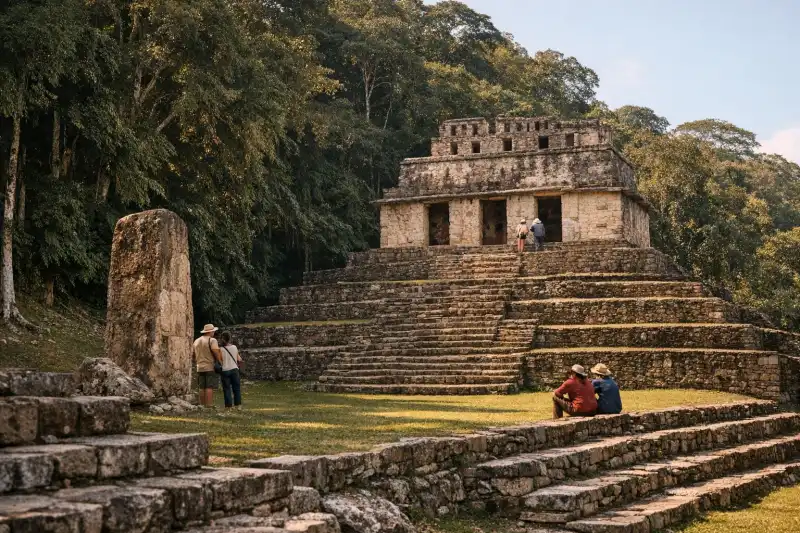
Bonampak, Mexico, lies deep in the humid green world of Chiapas, where the Lacandon rainforest presses close to ancient stone and birdsong fills the air around old Maya terraces. Unlike the largest Maya cities, Bonampak does not overwhelm by sheer scale. Its impact comes in a different way: through atmosphere, setting, and above all the remarkable wall paintings that have made it one of the most important archaeological sites in Mesoamerica. The approach itself feels part of the experience. The forest narrows the modern road, light filters through dense foliage, and the ruins emerge as if still half-claimed by the jungle.
For many travelers, Bonampak is memorable precisely because it feels intimate. You can stand close to the main buildings, imagine the movement of courtiers through the plazas, and sense how this hilltop ceremonial center once served as a stage for royal display. Then you enter the structure that changed the site’s reputation forever: the Temple of the Murals. There, scenes of nobles, warriors, dancers, musicians, and captives survive in color and complexity rare in the ancient Americas. Bonampak offers more than beautiful ruins. It gives visitors a vivid narrative window into Maya political life, ritual performance, and elite self-presentation during the Late Classic period. In a region filled with impressive archaeological destinations, Bonampak stands apart as a place where painted history still speaks.
History
Early development and regional setting
Bonampak was a Maya city of the Late Classic period, flourishing roughly between the 6th and 9th centuries CE. Its name is modern, derived from words often translated as “painted walls,” a fitting title given what the site is known for today. In antiquity, Bonampak occupied a strategic and ceremonial position within the wider network of Maya polities in what is now Chiapas and the neighboring Usumacinta river region. This was not an isolated settlement hidden from history. It participated in the dynamic, frequently competitive world of Classic Maya politics, where kingship, alliance, warfare, and ritual display shaped urban development.
The site rose in a landscape dominated by stronger regional powers, especially Yaxchilan, one of the great Maya capitals along the Usumacinta River. Bonampak’s rulers appear to have operated under the influence, and at times the direct political shadow, of that more powerful neighbor. The relationship mattered enormously. Like many smaller Maya courts, Bonampak used architecture, carved monuments, and ceremonial events to assert legitimacy while navigating alliances with larger kingdoms.
Bonampak under Yajaw Chan Muwaan
The best-documented phase of Bonampak’s history centers on the reign of Yajaw Chan Muwaan II in the late 8th century CE. He is the ruler most closely associated with the site’s artistic and ceremonial peak. Inscriptions and iconography suggest that his court invested heavily in royal image-making, and this culminated in the creation of the famous mural cycle. Bonampak during this period was not merely a provincial outpost; it was a court with ambitious visual propaganda.
The murals, generally dated to around 790 CE, document a sequence of elite events linked to rulership and dynastic authority. They show ceremonies involving richly dressed nobles, tribute and presentation rituals, battle scenes with captives, and elaborate celebrations with dancers and musicians. While the paintings are artistic masterpieces, they are also political texts. They reveal how Bonampak’s ruling elite wanted to be seen: victorious in war, connected to noble lineages, and supported by sacred ceremony.
There is also evidence that Bonampak’s royal family was connected by marriage to Yaxchilan’s dynasty, reinforcing the view that the site’s power and prestige were tied to regional political networks. Such alliances were common in Maya diplomacy, helping smaller courts secure status while binding them to stronger kingdoms.
Art, inscription, and the final centuries
Bonampak’s monuments and painted rooms offer a rare convergence of written and visual evidence. Stelae at the site record rulers and ceremonial acts, but it is the murals that transform abstract dynastic history into something immediate and human. We see faces in profile, layered textiles, feathered headdresses, instruments, body postures, and the tension of conflict. Few other Maya sites preserve this kind of painted storytelling at comparable scale.
Like many Maya centers of the southern lowlands, Bonampak eventually declined during the broader upheavals of the Terminal Classic period. The reasons were likely complex: shifting alliances, weakening dynasties, environmental pressures, trade disruption, and the gradual fragmentation of political authority across the region. By the 9th century, the site had lost much of its former vitality. Buildings were abandoned, plazas emptied, and the rainforest slowly advanced over ceremonial spaces once filled with ritual performance.
Rediscovery and modern significance
Although local Indigenous communities knew the region well, Bonampak entered wider international awareness in the 20th century. Its murals were brought dramatically to scholarly and public attention in the 1940s, when explorers and researchers documented their existence. The discovery caused excitement because it challenged older assumptions about Maya art. Earlier popular images of the Maya often emphasized astronomy, architecture, and hieroglyphic writing, while the murals at Bonampak revealed vivid court life, conflict, and pageantry in color.
Since then, Bonampak has become one of the key sites for understanding Classic Maya civilization. Conservation has been essential, since murals are extremely vulnerable to humidity, temperature shifts, light, and human presence. Modern visitor access is therefore shaped by the need to preserve what remains. Today Bonampak is valued not only as an archaeological site, but as an irreplaceable archive of ancient painting, politics, and ceremonial life in the Maya world.
Key Features
Bonampak’s most celebrated feature is unquestionably the Temple of the Murals, a modest-looking structure whose interior contains one of the greatest surviving painted programs from the ancient Americas. The temple has three rooms, and each presents a different chapter in a broader narrative of royal power. In the first chamber, visitors encounter scenes often interpreted as court ceremony and dynastic presentation. Nobles stand in elegant garments, children and attendants appear in carefully ordered composition, and the entire room projects hierarchy and formality. The colors, though faded from their original brilliance, remain astonishing. Reds, ochres, blacks, and blues still animate the walls, giving a sense of movement rather than static decoration.
The second chamber shifts in mood and intensity. Here, battle dominates. Warriors engage in combat, captives are displayed, and victorious force is shown as a central component of rulership. This room is one of the reasons Bonampak matters so much historically. It offers unusually direct visual evidence that warfare was not peripheral to Classic Maya society. The murals show conflict not as an abstract symbol, but as a lived event with winners, losers, and public consequences. The portrayal of captives underscores the political theater of victory.
In the third chamber, the narrative turns again toward ceremony and celebration. Dancers in elaborate costume, musicians with instruments, and nobles participating in ritual scenes evoke the performative side of kingship. This sequence across the rooms is one of Bonampak’s great achievements: the site unites court ritual, war, and ceremonial celebration into a coherent statement of dynastic legitimacy. Rather than a single isolated image, the temple offers a visual argument about power.
Outside the painted temple, Bonampak’s architecture rewards slower attention. The site is not enormous, but its arrangement over terraces and slopes gives it a distinctive profile. The Main Plaza opens onto elevated structures that would once have framed processions and gatherings. Acropolis buildings rise above the lower spaces, creating viewpoints across the forested landscape. Stairways and platforms emphasize vertical movement, a common Maya technique for dramatizing status and access. Climbing through these levels helps visitors understand that ancient architecture directed experience; rulers and priests occupied elevated, visible positions while audiences assembled below.
Stelae and sculptural remains also contribute to the site’s importance. Though less famous than the murals, these carved monuments anchor Bonampak within the broader tradition of Maya royal inscription. They linked named rulers to dates, ceremonies, and dynastic events, placing Bonampak’s local story into the calendar-rich historical framework characteristic of Classic Maya civilization.
The rainforest setting is another essential feature, not just a backdrop. Bonampak feels inseparable from its environment. Moist air, dense vegetation, and the sounds of insects and birds shape the visit in ways that are hard to separate from the ruins themselves. The site’s relatively compact size means the surrounding jungle remains visually present at almost every turn. That intimacy creates a powerful contrast with larger, more open archaeological zones. At Bonampak, the ancient and natural worlds meet at close range.
Finally, Bonampak’s emotional power lies in how personal it feels. Many ruins communicate through mass and stone. Bonampak communicates through human presence. Faces look out from walls. Musicians appear mid-performance. Dancers seem poised to move. Captives display pain and defeat. Nobles hold posture and rank in painted form. This makes Bonampak a rare destination where ancient history is not only monumental, but vividly inhabited.
Getting There
Most visitors reach Bonampak from Palenque, the main tourism hub for northern Chiapas and the easiest base for arranging transport. By road, the journey usually takes around 3 to 4 hours depending on conditions, checkpoints, and whether you continue onward to other sites in the region. Shared transport options can be limited and schedules are not always predictable, so many travelers book a guided day trip or hire a driver. Organized tours from Palenque often combine Bonampak with Yaxchilan and generally cost around MXN 1,200 to 2,500 per person depending on group size, inclusions, and whether boat transport is involved for the second site.
If you are traveling independently, renting a car in Palenque offers the most flexibility. Daily rental rates often begin around MXN 900 to 1,500 before insurance, and fuel costs should be added. Roads to the Bonampak area are generally manageable, but early departure is wise. Some jungle lodges and communities near the site can also arrange transfers. Private taxi or driver services from Palenque may cost roughly MXN 2,500 to 4,500 round trip, depending on waiting time and negotiation.
Travelers coming from San Cristóbal de las Casas usually break the journey rather than attempt a direct day trip, since distances are substantial. If your itinerary includes multiple sites in Chiapas, it often makes sense to overnight in Palenque or near the Lacandon region.
Entrance fees and local transport arrangements can change, so bring cash in Mexican pesos. Mobile coverage may be unreliable in the rainforest zone, and it is sensible to carry water, snacks, and sun and rain protection before leaving town.
When to Visit
The best time to visit Bonampak is usually during the drier months, broadly from November through April, when road conditions are often easier and walking around the site is more comfortable. Even then, this is rainforest country, so humidity remains high and brief showers are always possible. Morning visits are especially rewarding. Temperatures are lower, wildlife is more active, and the site feels quieter before larger tour groups arrive. Early light filtering through the trees also enhances the atmosphere.
The rainy season, typically from May through October, can make the landscape even more dramatic. The forest turns intensely green, rivers swell, and the region feels lush in every direction. For photographers and travelers who enjoy tropical scenery, this can be a beautiful time to come. The trade-off is practical: roads may be muddier, downpours can interrupt plans, and humidity can feel exhausting by midday. If visiting in these months, lightweight rain gear and quick-drying clothing are highly recommended.
Because Bonampak’s main draw includes the interior mural chambers, weather does not eliminate the value of a visit, but heavy rain can affect comfort getting to and around the site. If you are combining Bonampak with Yaxchilan, seasonal river conditions may also influence logistics.
Weekdays usually feel calmer than weekends or holiday periods. Major Mexican holiday seasons can bring more domestic tourism, and transport may book up earlier. Whatever the month, aim to avoid the hottest part of the afternoon. A visit of 1.5 to 3 hours is usually enough, but the overall day may be much longer because of travel time. Plan accordingly and give the site the unhurried attention it deserves.
| Quick Facts | Details |
|---|---|
| Location | Chiapas, Mexico |
| Civilization | Maya |
| Main period | Late Classic |
| Best known for | Exceptionally preserved murals |
| Signature building | Temple of the Murals |
| Approximate florescence | 6th to 9th centuries CE |
| Best base for visitors | Palenque |
| Typical visit length | 1.5 to 3 hours |
| Terrain | Forested archaeological site with stairs and uneven paths |
| Best season | November to April |
Bonampak is one of those rare archaeological places where scale matters less than survival. Its plazas and terraces are impressive, but it is the painted life of the site that makes it unforgettable. Here, ancient Maya history is not only carved into stone or inferred from ruins. It is rendered in faces, textiles, instruments, ceremonies, and acts of war. Visitors leave with a clearer sense that the Classic Maya world was not abstract or silent, but vividly political, performative, and human.
That combination of art and setting is what gives Bonampak its enduring power. Deep in the rainforest of Chiapas, far from the largest tourist circuits, it preserves a kind of ancient immediacy that few sites can match. If you are interested in Maya civilization beyond pyramids alone, Bonampak is not just worth the journey; it is essential.
Guided tours: worth it?
Most travelers can visit Bonampak independently. Compare a tour only if you want a tighter history-focused visit, easier logistics, or a guide who can answer questions on the spot.
Best for
- Short visits where a planned route saves time
When to go self-guided
Go independently if you prefer setting your own pace, reading as you go, and checking official hours or ticket rules directly before you arrive.
What I’d avoid
Skip paid tours that bundle unrelated stops you do not actually want. The best option should either save meaningful planning time or add historical context you would miss on your own.
Bonampak tours
Useful when: you want to compare guided formats before deciding
Bonampak and Yaxchilan tours
Useful when: you want to compare guided formats before deciding
Chiapas archaeological tours
Useful when: you want to compare guided formats before deciding
Some tour links are affiliate links, which may earn Ancient Travel a small commission at no extra cost to you. I try to surface options that make practical sense for the site—not just anything bookable.
Frequently Asked Questions
What is Bonampak best known for?
Bonampak is best known for its extraordinarily preserved Late Classic Maya murals, which depict ceremonies, warfare, captives, musicians, nobles, and courtly life in unusual detail.
Where is Bonampak located?
Bonampak is in the state of Chiapas in southern Mexico, within the Lacandon rainforest near the Usumacinta region and not far from the better-known Maya site of Yaxchilan.
Can you visit Bonampak independently?
Yes, many travelers visit independently by road from Palenque or nearby jungle lodges, though transport is limited and some visitors prefer organized tours that combine Bonampak with Yaxchilan.
How much time do you need at Bonampak?
Most visitors spend 1.5 to 3 hours at Bonampak, enough time to see the main acropolis area, visit the Temple of the Murals, and walk through the forested setting.
Is Bonampak worth visiting if I have already seen other Maya ruins?
Yes. Bonampak offers something rare among Maya sites: vivid narrative wall paintings that provide a unique look at dress, ritual, music, and conflict rather than architecture alone.
Nearby Ancient Sites
Chiapa de Corzo
Zoque and earlier Mesoamerican culturesExplore Chiapa de Corzo, Mexico, a major early Mesoamerican site beside the Grijalva River in Chiapa...
Comalcalco
MayaExplore Comalcalco, Mexico's distinctive Maya city built with brick, carved stucco, and rich Gulf Co...
Calakmul
MayaExplore Calakmul, a vast Maya city deep in the forests of Campeche, Mexico, known for towering pyram...