Quick Info
At a glance
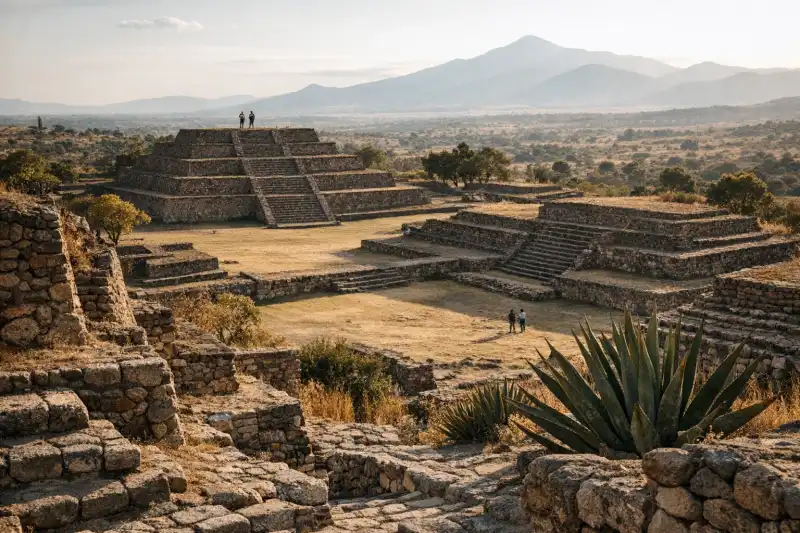
Cantona in Mexico rises from the high plains of Puebla with a striking sense of order, scale, and isolation. Long before Spanish colonial cities reshaped central Mexico, this was one of the region’s largest urban centers, a stone-built metropolis spread across volcanic terrain and defended by walls, terraces, and controlled entryways. Even today, the site feels different from many better-known Mesoamerican ruins. Instead of towering jungle temples or a compact ceremonial core, Cantona unfolds as a vast urban landscape of roads, patios, residential compounds, plazas, and ballcourts that stretch across dry hills under a broad sky.
For travelers, that first impression is often one of space. The air is cooler than in tropical lowland sites, the horizon feels open, and the architecture seems to emerge directly from the natural lava fields. Cantona rewards visitors who enjoy walking and imagining how a city functioned day to day. Its design suggests planning, security, trade, and social organization on a very large scale. You do not simply arrive at one main monument and leave; you move through a system of neighborhoods and routes, gradually realizing how extensive this ancient settlement once was. That quality makes Cantona one of Mexico’s most compelling archaeological destinations for anyone interested in urbanism, ancient infrastructure, and the diversity of pre-Hispanic civilizations beyond the most famous names.
History
Early settlement and the rise of the city
Cantona was founded in the highland zone of what is now Puebla, likely around 600 BCE, though the area may have seen earlier occupation. Its location was strategic. The surrounding Oriental Basin provided access to agricultural lands, routes linking the Gulf Coast and central highlands, and especially the movement of obsidian, the volcanic glass that was one of the most valuable materials in ancient Mesoamerica. Nearby obsidian sources helped fuel Cantona’s growth, and control over trade appears to have been central to its prosperity.
Unlike some cities built around a single monumental ceremonial axis, Cantona developed across uneven volcanic terrain. This geography shaped the city from the beginning. Builders incorporated natural rises and lava flows into terraces, walls, and causeways, creating a settlement that was both practical and defensible. Over time, what may have begun as a regional center expanded into a major urban complex with tightly organized compounds and a network of circulation routes.
Expansion during the Classic period
Cantona flourished especially between about 600 and 1000 CE, a period when many parts of Mesoamerica were undergoing major political realignments. During these centuries, the city may have reached a population of tens of thousands, making it one of the largest centers in central Mexico. Archaeologists have identified hundreds, and in some estimates more than two thousand, architectural units spread over a large area. These include residential patios, elite compounds, ceremonial spaces, storage areas, and an extraordinary number of ballcourts.
The city’s growth coincided with the decline or transformation of other major centers in central Mexico, particularly Teotihuacan. As regional networks shifted, Cantona appears to have benefited from trade and perhaps from its ability to control movement through this highland corridor. The city’s organization suggests careful management of neighborhoods and restricted access. Its many walled sectors imply a society concerned with defense, status, and internal regulation.
Cantona’s architecture also points to a distinct local identity. While it participated in broader Mesoamerican traditions such as ballgames, ritual spaces, and platform construction, it did not simply imitate larger imperial models. The city has its own character: low but extensive stone architecture, intricately planned circulation systems, and a form of urban design adapted to rugged topography.
Political power, trade, and social life
The power of Cantona likely rested on several foundations at once. Trade in obsidian and other goods was probably crucial, but so too were agriculture, regional alliances, and the ability to defend and administer a large population. The city’s roads and causeways reveal movement that was highly structured. Some sectors seem more open, while others are clearly restricted, hinting at social differentiation and controlled access to elite or ceremonial areas.
The large number of ballcourts is especially notable. Ballgames in Mesoamerica had ritual, political, and social importance, and at Cantona their abundance suggests that competition, ceremony, and community identity were woven deeply into civic life. The city may have used these spaces not only for sacred events but also for displays of authority and negotiation among groups within the wider settlement.
Domestic life would have been equally important. Cantona was not merely a ceremonial center; it was a living city. Families occupied compounds arranged around patios, and daily routines would have included food preparation, toolmaking, trade, ritual observance, and movement through a carefully structured urban grid. The site’s scale reminds visitors that ancient cities were full of ordinary activity as well as monumental spectacle.
Decline and abandonment
By around 900 to 1050 CE, Cantona entered a period of decline. The reasons remain debated and were likely multiple. Environmental stress, changing trade routes, political fragmentation, and shifting regional power centers may all have contributed. In ancient Mesoamerica, urban decline often did not happen in a single dramatic moment; populations could disperse gradually, institutions weaken, and neighborhoods be abandoned over generations.
As Cantona lost influence, the city was eventually left behind. Stone structures remained on the hillsides, but the urban life that had once animated them disappeared. The site avoided some of the dense overbuilding that later transformed other ancient centers, and in modern times archaeologists have been able to study substantial portions of its layout.
Today, Cantona stands as one of the most important archaeological sites in Mexico for understanding regional diversity in ancient urban development. Its ruins preserve evidence of a complex society that thrived through adaptation, trade, and strong internal organization in a demanding landscape.
Key Features
Cantona’s most memorable feature is its sheer extent. This is not a site where everything can be grasped from one central plaza. Instead, the city spreads over a broad area, and that scale changes the experience of visiting. As you move along stone roads and rising paths, the site gradually reveals itself as a network of linked spaces rather than a single ceremonial cluster. That urban complexity is part of what makes Cantona so rewarding.
One of the defining elements is the system of causeways and circulation routes. These elevated or carefully laid stone paths connected sectors of the city, allowing movement across rugged volcanic terrain. In practical terms, they made urban life possible in a difficult environment. In symbolic terms, they may also have reinforced hierarchy, directing people through controlled entrances and toward specific compounds or plazas. Walking them today gives a strong sense of how planned the city was.
The residential compounds are another highlight. Rather than isolated monuments, many structures are grouped around patios enclosed by stone walls. These spaces suggest neighborhoods and households, places where social life unfolded on a daily basis. Some compounds are modest, while others appear larger and more complex, hinting at differences in status. Their preservation helps visitors imagine Cantona not just as an archaeological abstraction but as a functioning city with domestic rhythms and community organization.
Cantona is also famous for its remarkable number of ballcourts. Few sites in Mesoamerica have so many. These courts vary in size and layout, and their distribution across the city suggests that the ballgame was deeply integrated into public life. For modern visitors, they add a strong visual rhythm to the ruins. You encounter them again and again, and each one reinforces the sense that ritualized competition had unusual prominence here. They also provide a useful reminder that Mesoamerican cities were culturally diverse; each adapted shared traditions in local ways.
The terracing and defensive character of the site are equally impressive. Cantona’s builders used the natural contours of the lava field to create walls, platforms, and stepped sectors. This produced a city that feels fortified without always relying on monumental height. Narrow access points, enclosed areas, and strategic elevations suggest concern with protection and control. As a result, Cantona has a more rugged, almost martial atmosphere than some open ceremonial centers elsewhere in Mexico.
Higher sectors of the site offer broad views across the surrounding basin. These panoramas are not simply scenic rewards for modern travelers; they also help explain why the location mattered. From above, the relationship between settlement, terrain, and movement becomes easier to understand. You can see how Cantona occupied a commanding position in its region, both physically and economically.
The on-site museum, though smaller than those at Mexico’s most famous destinations, adds valuable context. Artifacts, models, and interpretive material help connect the stone remains to the people who lived here. Pottery, tools, and architectural information show how the city fit into broader Mesoamerican networks while retaining its own identity. For many visitors, starting or ending at the museum makes the outdoor ruins much easier to interpret.
Perhaps the most distinctive feature of all is the mood of the site. Cantona is dry, open, and expansive. Its stone architecture blends into the volcanic landscape in a way that feels unusually integrated with nature. The result is an archaeological experience that is less about isolated monuments and more about understanding an entire urban environment.
Getting There
Cantona is located in the state of Puebla, and the easiest way to visit is usually by private car or hired driver. From Puebla City, the journey typically takes around 2.5 to 3 hours depending on traffic and your exact route. Fuel and tolls for a round trip can add up to roughly MXN 500-900, depending on vehicle type and route choices. Driving gives you the most flexibility, especially because public transport connections to the site itself can be limited and time-consuming.
If you are starting from Mexico City, expect a drive of roughly 3 to 4 hours. Renting a car can be practical for travelers who are comfortable driving in central Mexico; daily rental costs often begin around MXN 700-1,500 before fuel, insurance, and tolls. A private driver or taxi for the day from Puebla or nearby towns will be significantly more expensive, often in the range of MXN 2,500-5,000 depending on negotiation, vehicle size, and waiting time.
Public transportation is possible but less straightforward. Buses run from Puebla to towns in the region such as Tepeyahualco or nearby transport points, with fares often around MXN 100-250 each way. From there, you may need a local taxi to reach the archaeological zone, which can cost roughly MXN 100-300 depending on distance and availability. Because schedules may not be frequent, travelers relying on buses should leave early and confirm return options in advance.
Whichever method you choose, bring cash for tickets, snacks, taxis, and small purchases. It is also wise to carry water and sun protection before arrival, as the site is large and exposed.
When to Visit
The best time to visit Cantona is generally during the dry season, from about November to April. During these months, skies are often clearer, paths are easier to navigate, and daytime temperatures are more comfortable for long walks. Mornings are especially pleasant in the highland climate, making an early start ideal. Arriving soon after opening gives you cooler conditions and softer light for photographs.
From May through October, the rainy season can bring greener surroundings and dramatic skies, but afternoon showers are more likely. Rain does not usually make a visit impossible, yet stone paths can become slick, and cloud cover may reduce visibility across the basin. If you travel in these months, aim for a morning visit and carry a light rain layer.
Because Cantona sits in a highland environment, temperatures can vary more than visitors expect. Midday sun can feel intense, but mornings and late afternoons may be cool, especially in winter. Layers are useful year-round. The exposed setting also means wind can be a factor on ridges and upper sectors.
Weekdays are often calmer than weekends and holidays, when domestic tourism may increase. If you prefer a quieter experience, avoid major Mexican holiday periods when possible. In any season, allow enough time to explore slowly. Cantona is a site best appreciated without rushing, and weather is easier to manage when you can pace yourself with breaks, water, and shade stops where available.
| Quick Facts | Details |
|---|---|
| Location | Puebla, Mexico |
| Nearest city | Tepeyahualco |
| Best for | Archaeology enthusiasts, walkers, ancient urbanism |
| Main period | Late Formative to Epiclassic |
| Founded | c. 600 BCE |
| Peak occupation | c. 600-1000 CE |
| Known for | Stone causeways, fortified compounds, numerous ballcourts |
| Terrain | Highland volcanic landscape |
| Visit duration | 3-5 hours |
| Best season | November to April |
| Access | Best by car or arranged transport |
| Difficulty | Moderate, with uneven paths and sun exposure |
Cantona is one of those places that expands in the mind after a visit. At first, it may seem quieter and less theatrical than some of Mexico’s headline archaeological destinations. But the longer you walk its roads and compounds, the more impressive it becomes. This was a true city, shaped by trade, defense, and adaptation to a harsh landscape. Its planners created order across difficult terrain, and its residents built a community whose scale still surprises modern visitors.
For travelers interested in seeing a different side of ancient Mexico, Cantona offers depth, originality, and a powerful sense of place. It is a destination where the story lies not only in temples or treasure but in the fabric of urban life itself: streets, patios, courts, thresholds, and walls. That makes it especially memorable. Rather than presenting a single iconic monument, Cantona invites you to understand how a city worked, how people moved, and how power was organized in stone across the hills of Puebla.
Guided tours: worth it?
Self-guided works here, but a guide can add real value if you want the ruins explained as a living place rather than just a sequence of monuments.
Best for
- First-time visitors who want context, not just photos
- Short visits where a planned route saves time
When to go self-guided
Go independently if you prefer setting your own pace, reading as you go, and checking official hours or ticket rules directly before you arrive.
What I’d avoid
Skip paid tours that bundle unrelated stops you do not actually want. The best option should either save meaningful planning time or add historical context you would miss on your own.
Cantona Archaeological Site Tours
Useful when: you want to compare guided formats before deciding
Puebla Archaeology Day Trips
Useful when: transport or pickup logistics matter
Puebla City and Ancient Sites Tours
Useful when: you want to compare guided formats before deciding
Some tour links are affiliate links, which may earn Ancient Travel a small commission at no extra cost to you. I try to surface options that make practical sense for the site—not just anything bookable.
Frequently Asked Questions
What is Cantona?
Cantona is a major pre-Hispanic archaeological site in Puebla, Mexico, famous for its extensive stone causeways, walled compounds, and many ballcourts.
Where is Cantona located?
Cantona is located in the state of Puebla in central Mexico, northeast of Puebla City and within reach of the Oriental Basin highlands.
How much time should I spend at Cantona?
Most visitors should allow at least three to four hours to explore the site, and history enthusiasts may want half a day because Cantona covers a large area.
Is Cantona difficult to walk?
Cantona involves substantial walking on uneven stone paths, slopes, and exposed terrain, so sturdy shoes, water, and sun protection are strongly recommended.
When is the best time to visit Cantona?
The dry season from roughly November to April is generally the most comfortable, with clearer skies and easier walking conditions than the rainy months.
Can I visit Cantona as a day trip from Puebla?
Yes, Cantona can be visited as a day trip from Puebla City by car or arranged transport, though an early start is best to allow enough time on site.
Nearby Ancient Sites
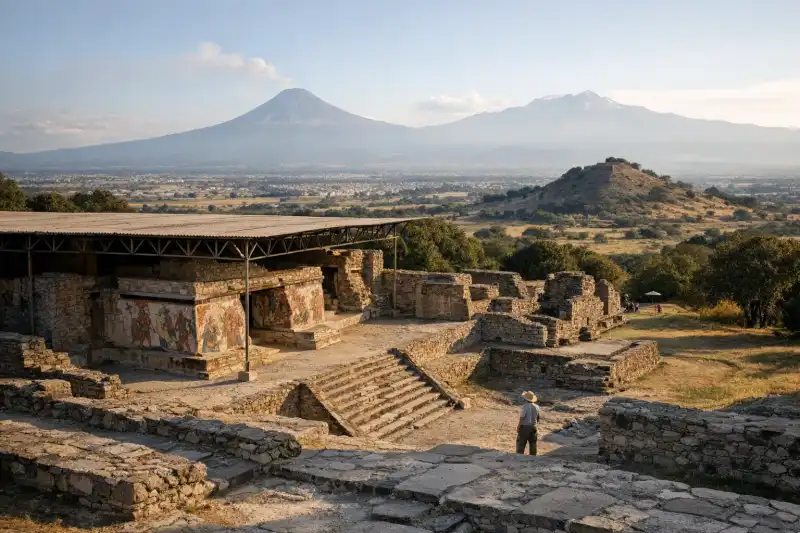
Cacaxtla
Olmeca-Xicalanca and broader Epiclassic Mesoamerican traditionsExplore Cacaxtla in Mexico, a hilltop archaeological site famed for vivid murals and Epiclassic hist...
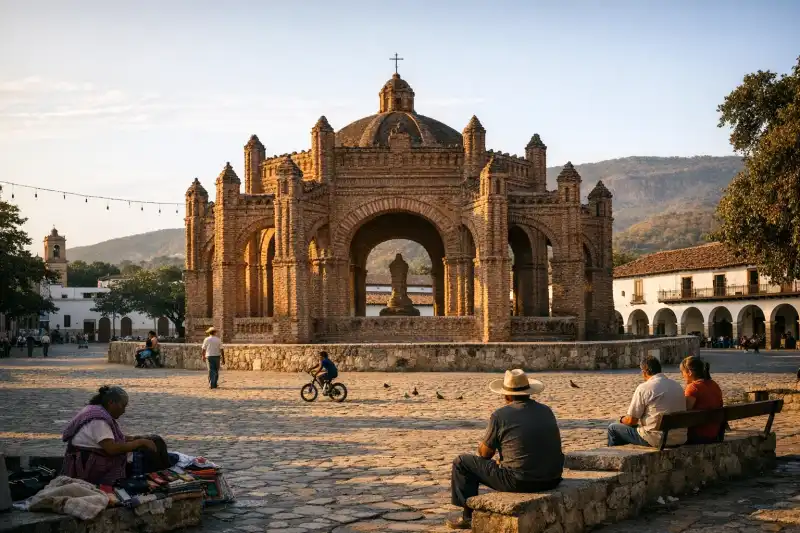
Chiapa de Corzo
Zoque and earlier Mesoamerican culturesExplore Chiapa de Corzo, Mexico, a major early Mesoamerican site beside the Grijalva River in Chiapa...
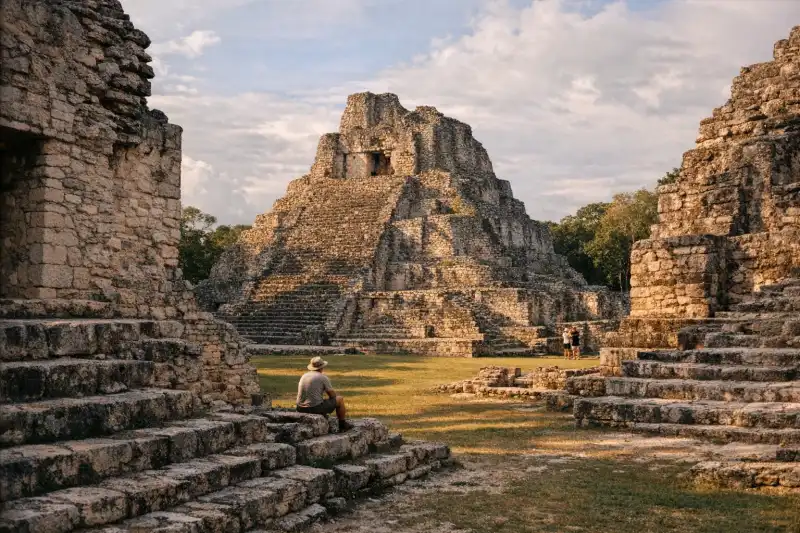
Becán
MayaExplore Becán, a moated Maya city in Campeche, Mexico, known for its causeways, temples, and forest ...