Quick Info
Curated Experiences
Caral and Ancient Coast Day Trip from Lima
Nazca and Ancient Desert Cultures Experience
Private Northern Peru Archaeology Circuit
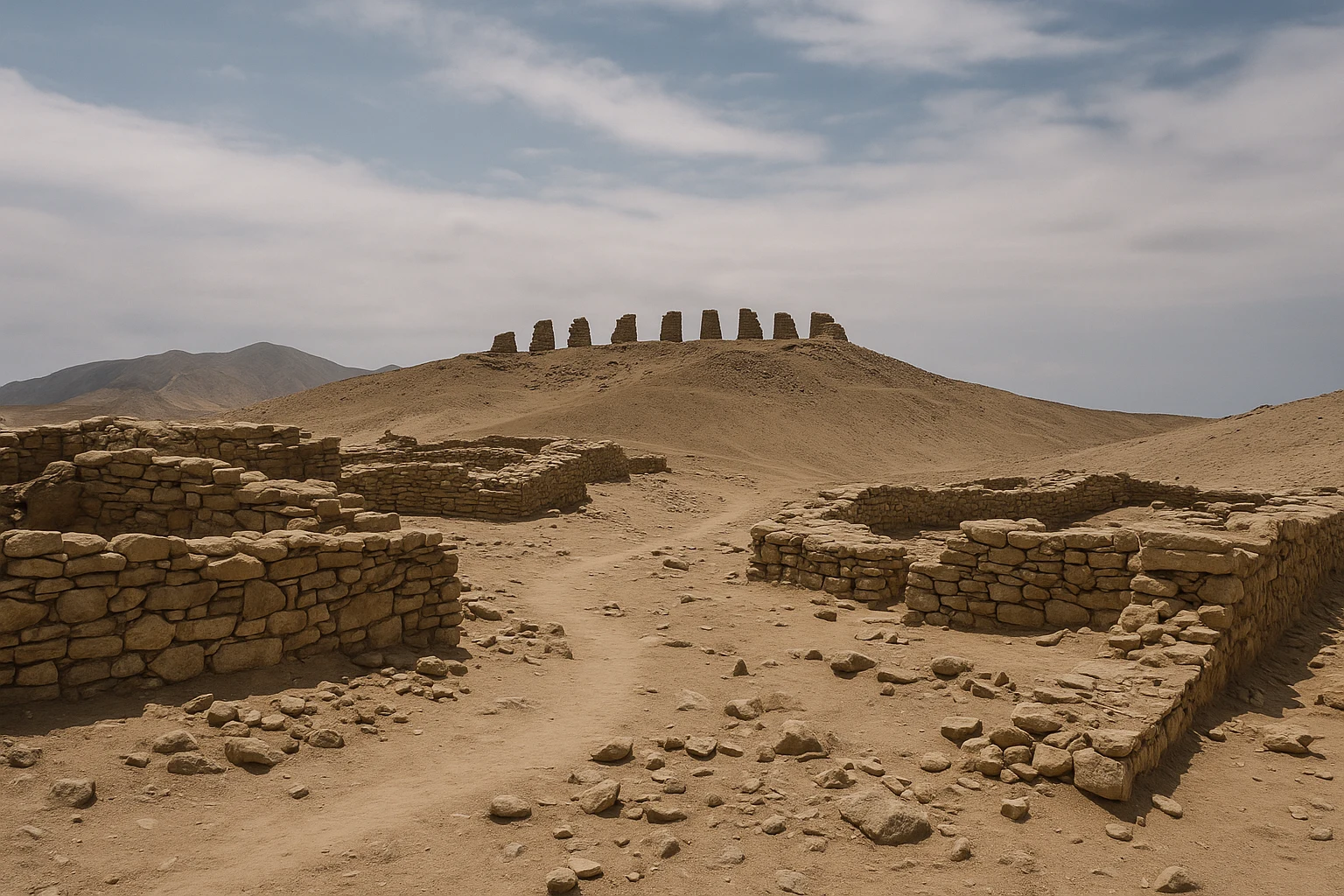
You feel Chankillo before you fully see it. The desert around Casma is quiet, the wind thin, and then a long ridge appears with thirteen stone towers stepping across the horizon like a ruled line drawn by an ancient surveyor. In Chankillo, Peru, architecture is not only defensive or ceremonial; it is observational, calibrated, and tied to the sky itself. If you are searching for a place that changes how you think about ancient science in the Andes, this is it. This Chankillo Peru travel guide explains why the complex matters historically, what to prioritize once you arrive, and how to handle logistics in a region where heat, distance, and sparse infrastructure still shape the day.
What makes Chankillo unforgettable is its layered purpose. You can walk a fortified hilltop, study ritual architecture in open desert, and stand at viewpoints where the annual path of sunrise and sunset was tracked with stunning precision more than two thousand years ago. This guide covers the site’s chronology, the 13 Towers and related structures, transport from Casma and Lima routes, practical entry and timing advice, seasonal conditions, and a realistic way to combine Chankillo with other Ancash and north-coast archaeological destinations.
History: A Desert Observatory Before Empire
Early Casma Valley foundations (c. 1500-500 BCE)
Long before Chankillo’s towers were built, the Casma Valley was already a landscape of ceremonial experimentation. Communities in this part of coastal Peru developed complex traditions of mound architecture, ritual plazas, and planned sacred spaces linked to agricultural cycles in an arid environment. The valley’s river corridors made cultivation possible, while surrounding desert created dramatic visual boundaries for monuments. Over centuries, regional groups invested in architecture that organized labor and ceremony, setting the stage for later innovations at Chankillo. Rather than appearing in isolation, the site emerged from a local history of increasingly formalized public ritual and territorial signaling.
Construction of Chankillo’s monumental core (c. 4th-3rd century BCE)
During the Late Formative period, Chankillo was developed as a coordinated complex that included a hilltop fortified structure, ceremonial areas, and the now-famous line of thirteen towers. The design indicates intentional planning at multiple scales: movement through gates and walls, sightlines across ridges, and specific observer points for tracking the sun’s shifting position over the year. This was not an accidental arrangement of towers. The architecture suggests an elite group capable of mobilizing labor, standardizing construction, and embedding cosmological meaning into the built landscape. Chankillo’s creators fused politics, ritual authority, and astronomical observation in one coherent project.
Ritual power, seasonal knowledge, and social control (c. 300-100 BCE)
At its height, Chankillo likely served as both symbolic center and practical calendar system. From designated observation points east and west of the tower line, the sun appears at different tower intervals as seasons progress, allowing horizon-based measurement of annual solar extremes and intermediate dates. In an agricultural society balancing river-fed production with fragile desert conditions, this kind of knowledge had power. Leaders who controlled ceremonial interpretation of the sky could also structure planting, festival timing, and collective labor rhythms. Chankillo therefore represents more than technical astronomy; it reflects how Andean ritual authority could be reinforced through precise environmental knowledge.
Conflict, transformation, and abandonment (c. 1st century BCE-1st century CE)
Archaeological evidence from parts of the complex suggests episodes of conflict and eventual decline in organized use. Defensive elements around the hilltop sector have prompted debate about warfare, internal competition, and changing regional power structures during this period. As political landscapes shifted along the coast, Chankillo appears to have lost its central role, and its monumental components were gradually abandoned. Even so, abandonment did not erase the site’s intellectual achievement. The architectural record preserved a rare model of pre-Hispanic solar observation, waiting for modern archaeology to recognize how sophisticated the system was.
Modern rediscovery and UNESCO-era recognition (19th-21st centuries)
Although local people always knew the ruins, systematic archaeological interpretation intensified in the twentieth and twenty-first centuries, when researchers documented the alignment logic of the towers and observer platforms. Landmark studies demonstrated that Chankillo offered one of the clearest known ancient solar horizon calendars in the Americas. That finding reshaped global conversations about early astronomy outside Eurasian traditions. Conservation initiatives, expanded documentation, and international attention eventually culminated in World Heritage recognition, underscoring Chankillo’s significance as both scientific heritage and cultural landscape. Today’s visitor encounters a site still under active study, where each season of research sharpens the story of ancient Andean skywatching.
The Key Monuments: What to See at Chankillo
The 13 Towers ridge
The 13 Towers are Chankillo’s defining feature and the reason the site is internationally celebrated. Set along a low ridge in a near-linear sequence, the towers create a serrated horizon marker that works with the annual movement of the sun. At solstices, sunrise and sunset align near opposite ends of the line when viewed from the correct observing points; through the rest of the year, the sun appears between different towers in predictable progression. The brilliance here is architectural simplicity paired with observational precision. You are looking at a durable, landscape-scale calendar built in stone.
Walking the ridge area, you will notice that the towers are not identical. Their spacing, size variations, and position relative to terrain create a visual rhythm likely designed for repeated public use, not one-time spectacle. While erosion and time have softened edges, the arrangement remains legible enough that even first-time visitors can grasp its function. For photography, early morning gives the cleanest profiles of tower silhouettes against pale desert light, while late-day side light emphasizes texture in the masonry.
The western and eastern observation points
Chankillo’s tower line only makes full sense when you connect it to its observation points. From these locations, ancient observers could watch the sun rise or set against different tower intervals, reading seasonal change without mechanical instruments. This is where theory becomes experience: stand still, imagine repeated observations over months, and the site shifts from ruin to working system. The architecture demonstrates a deliberate relationship between fixed viewing stations and horizon markers, reflecting long-term planning and accumulated empirical knowledge.
These points also reveal how movement was controlled. Pathways and approach lines suggest that observation may have been formal, possibly reserved for ritual specialists or staged events witnessed by broader groups. In practical terms for modern travelers, reaching both observer areas gives you the clearest understanding of why Chankillo is often described as an ancient solar observatory rather than simply a fortified hill.
The fortified temple complex
Above the surrounding plain stands Chankillo’s fortified hilltop complex, enclosed by thick walls, controlled entrances, and elevated internal spaces. At first glance, it reads as a defensive installation, yet its location and architectural composition also suggest ceremonial and status functions. The hill commands broad visibility over the valley approaches, allowing both practical surveillance and symbolic dominance. Inside, surviving walls and circulation corridors hint at restricted zones where authority may have been enacted through staged access.
Whether you interpret the complex primarily as fortress, temple, or hybrid political center, it anchors the social context of the towers. The observatory system did not exist in a vacuum; it was tied to institutions capable of organizing labor and ritual participation. Mid-morning is usually best for this sector before heat intensifies on exposed slopes.
Ceremonial plazas and processional spaces
Beyond the headline structures, Chankillo includes open ceremonial areas that likely hosted gatherings, offerings, and controlled processions. These spaces are less dramatic in silhouette than the towers, but they are essential for understanding the site’s public life. Broad platforms, directional pathways, and transitional zones between open and enclosed architecture suggest choreography rather than random movement. Visitors today can still trace these flows, especially with a guide who points out how sightlines connect plaza edges to ridge features.
These areas remind you that Chankillo was a social stage as much as an observational instrument. Calendar knowledge gained meaning through ritual performance, and ritual performance gained authority through architecture. Late afternoon often creates softer light for reading low-relief features in these open sectors.
The desert panorama and Casma Valley setting
The final monument at Chankillo is arguably the landscape itself. From elevated points, you can see how desert ridges, valley agriculture, and horizon lines integrate into one cultural system. The site was positioned where sky visibility is expansive and seasonal change is visually measurable. This setting explains why Chankillo feels different from enclosed urban ruins: it is about orientation, long-distance sight, and cyclical time expressed at territorial scale.
Take a few unhurried minutes at the end of your circuit simply to watch light move across stone and dust. That pause often becomes the moment when Chankillo’s intellectual ambition truly lands.
Getting There: Transportation and Access
Chankillo is reachable, but it remains a semi-remote archaeological visit where advance planning is the difference between a smooth day and a stressful one.
From Casma
Casma is the most practical base, with the shortest transfer time and the best chance of arranging same-day return transport.
- Taxi or private driver: S/90-160 round trip ($24-43 USD), typically 35-50 minutes each way depending on road conditions and waiting time negotiated on site.
- Local colectivo + short transfer: Around S/10-20 ($3-5 USD) to the nearest turnoff plus a hired moto-taxi or local ride for the final segment; cheapest option but less reliable for return timing.
- Rental car: Daily rental often S/170-300 ($46-81 USD) in larger hubs; road approach is manageable in dry conditions, but signage can be limited, so offline maps help.
From Lima
Most travelers from Lima either break the trip overnight in Casma/Chimbote or join a long private archaeology circuit.
- Intercity bus to Casma + taxi: Bus fares often S/55-110 ($15-30 USD), about 5.5-7 hours each way, then local taxi to Chankillo.
- Private transfer or guided route: Usually $220-420 USD depending on vehicle size and inclusions; expensive but efficient if your schedule is tight.
- Self-drive from Lima: Roughly 360 km and 6-7.5 hours each way in favorable traffic; feasible only if you are comfortable with long-distance highway driving in Peru.
When to Visit: Seasonal Considerations
Spring (September-November)
Spring is one of the most balanced windows for Chankillo, with daytime temperatures often around 20-28°C (68-82°F). Skies are frequently clear, visibility across the ridge is strong, and heat remains manageable if you arrive early. Crowd levels are generally moderate, with occasional school or domestic travel spikes on weekends. A start before 9:00 AM gives the best combination of comfort and photographic contrast.
Summer (December-March)
Summer can be hot and fatiguing in exposed sectors, often reaching 26-33°C (79-91°F) or higher on particularly dry days. Midday walking becomes strenuous because shade is limited and reflected heat from stone and dust is intense. Crowds are still lighter than at Peru’s marquee destinations, but the weather itself is the limiting factor. If visiting in summer, bring extra water, wear a brimmed hat, and plan your core circuit between 7:30 AM and 10:30 AM.
Autumn (April-June)
Autumn is often the ideal season for most travelers, with typical temperatures around 19-27°C (66-81°F), good horizon clarity, and less thermal stress than peak summer. Light is frequently crisp in morning and late afternoon, which helps tower profiles stand out in photos. Visitor density is usually low to moderate, making for a quiet interpretive experience. If you can choose one season, this is the strongest all-around option.
Winter (July-August)
Winter brings milder daytime conditions, often around 17-24°C (63-75°F), and can feel comfortable for long site walks. Some mornings may be hazier depending on coastal atmospheric patterns, but heat pressure is minimal and pacing is easier for families or older travelers. Crowds are generally light outside holiday clusters. Bring a light layer for early starts and aim for mid-morning if dawn conditions are overcast.
Combining Chankillo with Casma and the North Coast
Chankillo works best as the anchor of a half-day archaeological sequence from Casma. The most effective rhythm is to leave town early and arrive near opening, ideally by 8:00 AM, when the desert is still cool and tower silhouettes are sharply defined. Spend the first ninety minutes walking the observer points and 13 Towers alignment before heat and glare flatten the view. By 9:45 AM, continue toward the fortified sector and ceremonial areas, where slower interpretive walking helps connect architecture to ritual and political control. Most travelers finish the core circuit by 11:00 AM.
From there, you can return to Casma for lunch around 12:00 PM in the central market zone or along the Panamericana corridor, where simple ceviche and rice plates are easy to find. If you still have energy, a same-day extension toward Cerro Sechín adds another major layer of Casma Valley archaeology and creates a stronger regional narrative from early iconographic traditions to Chankillo’s horizon science. With private transport, this combined experience usually runs 6 to 8 hours door-to-door from Casma.
If you are traveling north-south along the coast, Chankillo can also be a strategic stop between Chimbote and Trujillo corridor movements. In that case, plan a single overnight in Casma to avoid long backtracking. For time-pressed visitors, Chankillo alone remains rewarding in about 2.5 to 3 hours, but the broader valley context makes the story substantially richer.
Practical Information
Admission and hours
Entry fees are typically in the budget range for Peruvian archaeological parks, often around S/11-15 ($3-4 USD) for international visitors, with reduced domestic or student categories depending on current policy. Hours can vary by season and staffing, but a common operating window is roughly 9:00 AM to 4:00 PM. Always verify locally the day before your visit, especially during holidays. Cash in soles is the safest payment method, as card infrastructure may be inconsistent. The best visiting window is early morning, when temperatures are lower, wind is milder, and tower geometry is easier to read in angled light.
What to bring
- Sun protection: Broad-brim hat, sunscreen, and lightweight long sleeves; shade is minimal across most of the circuit.
- Water: At least 1.5 liters per person for a standard visit, more in summer.
- Footwear: Closed, grippy shoes for dusty paths, uneven stones, and mild slope changes.
- Camera or phone battery pack: Wide views and horizon lines reward multiple shooting positions.
- Cash: Small bills in soles for entry, transport balancing, and local stops.
Dress code and etiquette
There is no formal religious dress requirement, but respectful site behavior matters. Avoid climbing unstable masonry, do not move stones, and keep to marked paths where indicated. Chankillo’s value lies in subtle alignments and fragile remains, so low-impact movement protects both the archaeology and future research.
Accessibility
Chankillo is partially accessible for visitors with limited mobility, but terrain is uneven and includes exposed paths, loose surfaces, and some uphill segments. There are no fully barrier-free circuits across all key points at present. Travelers needing assistance should arrange private transport and ask locally about the flattest available route before entering.
Why Chankillo Matters
Chankillo matters because it preserves a rare moment when architecture, astronomy, and authority were fused into one public language. You are not just looking at old walls in a beautiful desert. You are standing inside a system designed to make time visible, to align communal life with celestial cycles, and to translate observation into social power. Long before imperial roads crossed the Andes, people here were already building with horizon logic and seasonal precision.
That achievement expands the map of ancient scientific history. It reminds you that sophisticated sky knowledge was not confined to a few famous civilizations repeated in school textbooks. In Casma’s dry light, the towers still cut a measured line against the sky, and the idea behind them still feels modern: watch carefully, record patterns, and organize society around what the world reliably reveals. If your journey through Peru is about understanding depth rather than collecting landmarks, Chankillo is one of the places where that depth becomes unmistakable.
Quick Facts
| Attribute | Details |
|---|---|
| Location | Casma Valley, Ancash, Peru |
| Ancient Name | Chankillo (modern Quechua/Spanish usage) |
| UNESCO Status | UNESCO World Heritage Site (2021) |
| Established | c. 350 BCE ceremonial-astronomical center |
| Distance from nearest hub | ~23 km from Casma (35-50 min by road) |
| Entry Fee | About S/11-15 ($3-4 USD) |
| Hours | Typically around 9:00 AM-4:00 PM |
| Best Time | Autumn and spring mornings |
| Suggested Stay | 2-3 hours on site |
Explore More Peru
- Cerro Sechín: Monumental stone reliefs and deep early iconography in the same Casma cultural sphere.
- Chavín de Huántar: Highland ceremonial center with intricate carved stone and ritual architecture.
- Caral-Supe: One of the earliest urban traditions in the Americas, with major pyramid complexes.
Plan your broader route with our Peru Ancient Sites Guide and coordinate long overland connections using our Peru transportation guide.
Frequently Asked Questions
How much time should I plan for Chankillo?
Plan 2 to 3 hours on site if you want to walk between the observation points, the 13 Towers ridge, and the fortress sector at a steady pace. Add extra time in the hot season because slower walking and photo stops are common in exposed desert terrain.
What makes Chankillo different from other Peruvian ruins?
Chankillo is best known for the 13 Towers, an architectural line aligned with solar movement across the year. It is one of the clearest known pre-Columbian examples of a built solar observing system, not just a temple or settlement mound.
How do I get to Chankillo from Casma?
Most travelers arrange a taxi or private driver from Casma, usually taking around 35 to 50 minutes each way depending on road conditions. Public transport to the immediate site area is limited, so independent visitors should confirm return transport before entering.
How much does entry cost at Chankillo?
Ticket prices are generally modest, often around S/11-15 ($3-4 USD) for foreign visitors, though rates and categories can shift. Bring cash in soles, because card payments are not always reliable at smaller archaeological checkpoints.
When is the best season to visit Chankillo?
Late autumn through early spring is usually the most comfortable period, with clearer skies and lower heat stress than peak summer afternoons. Early morning visits are best year-round for walking, photography, and stronger visibility of the ridge geometry.
Is Chankillo suitable for families and older travelers?
Yes, if you prepare for sun exposure and uneven ground. There is no technical climbing, but surfaces are dusty and rocky, so supportive shoes, water, hats, and a moderate pace make a big difference.
Nearby Ancient Sites
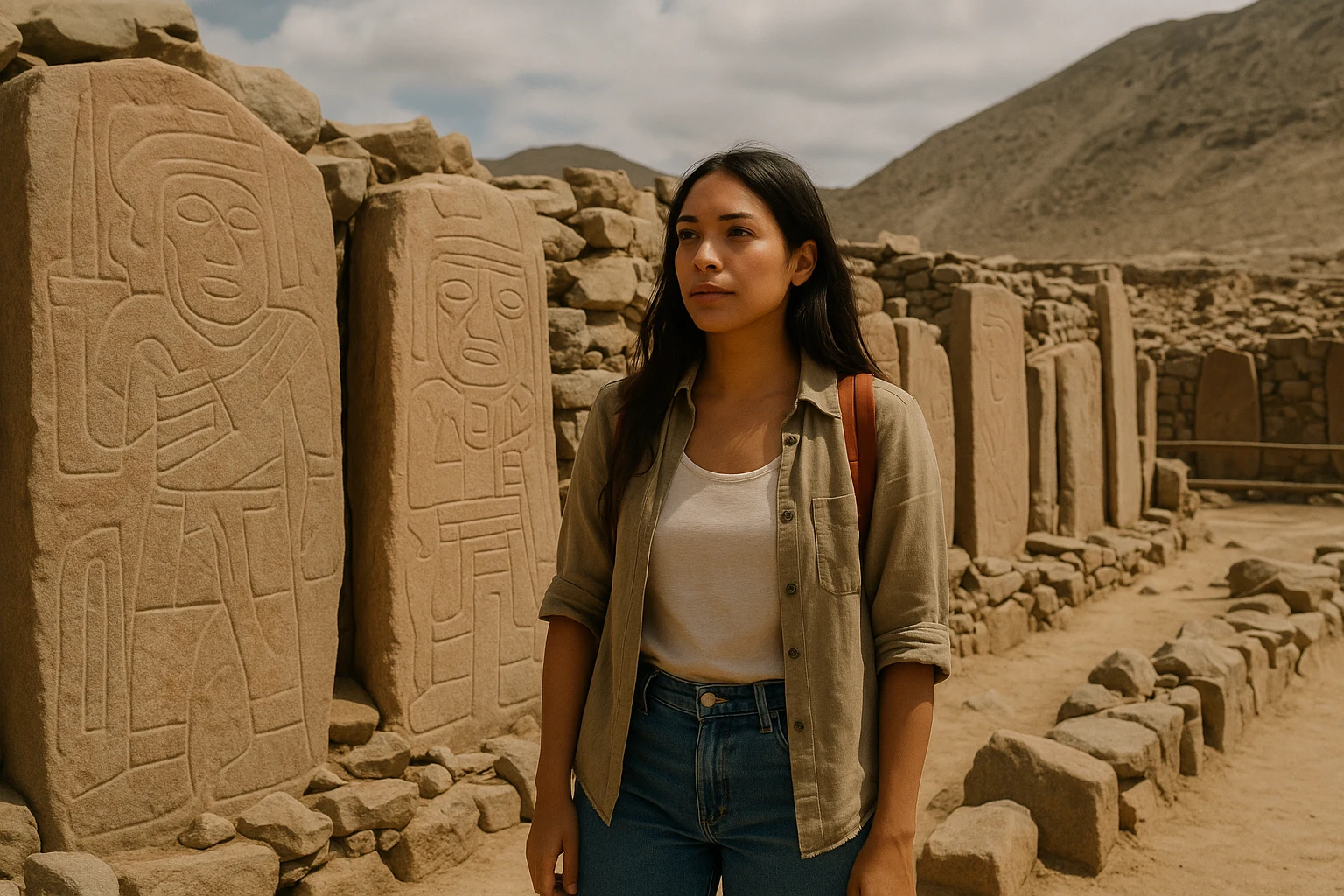
Cerro Sechín Peru Guide 2026: Relief Monoliths & Casma Valley
Sechin-Casma-initial-AndeanPlan your visit to Cerro Sechín in Peru with history, carved monolith highlights, transport from Cas...
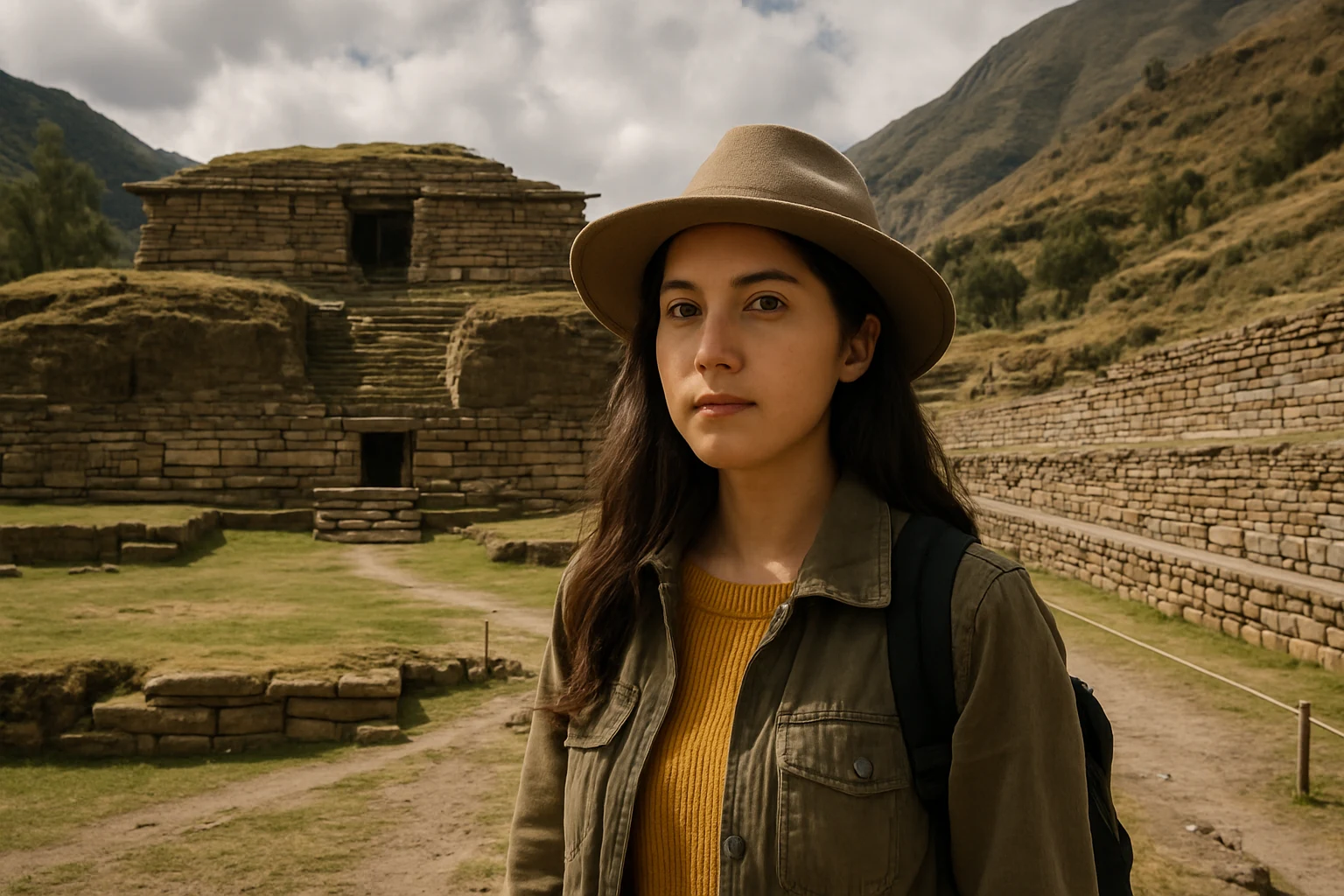
Chavin de Huantar Peru Guide 2026: Lanzon & Temple Galleries
Chavin-Highland Andean-Inca-Modern PeruvianPlan Chavin de Huantar, Peru: see the Lanzon and sunken plaza, reach the site from Huaraz, and time ...
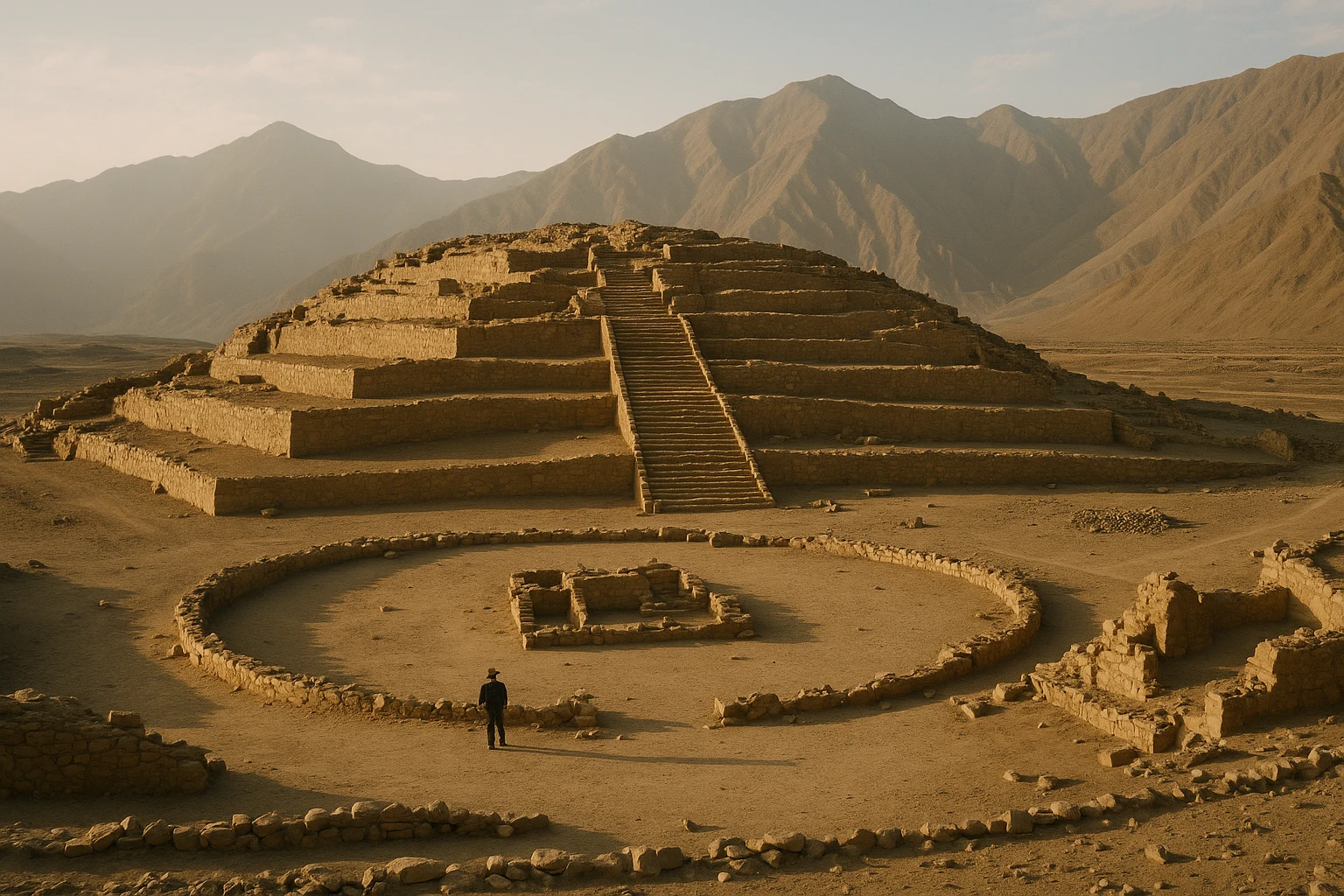
Caral-Supe Peru Guide 2026: Sacred Pyramids & the First Andean City
Norte-Chico-CaralVisit Caral-Supe in Peru, the oldest known city in the Americas, with practical transport from Lima,...