Quick Info
Curated Experiences
Sacred Valley Full Day: Pisac, Ollantaytambo & Chinchero from Cusco
Chinchero Weaving Workshop & Ruins Private Morning Tour from Cusco
Maras Salt Mines and Moray Circular Terraces Half-Day from Cusco
At 3,762 meters above sea level, Chinchero occupies a plateau so vast and high that the surrounding Andes appear as equals rather than guardians. This was not the Sacred Valley proper — it was the upland domain chosen by Tupac Inca Yupanqui, the tenth Sapa Inca, as his personal royal estate around 1470 CE. While Pachacuti built at Ollantaytambo and Machu Picchu, his son and successor chose this windswept tableland above the valley fog for a complex that blended ceremonial terracing, palatial residences, and astronomical observation in one of the empire’s highest permanent settlements.
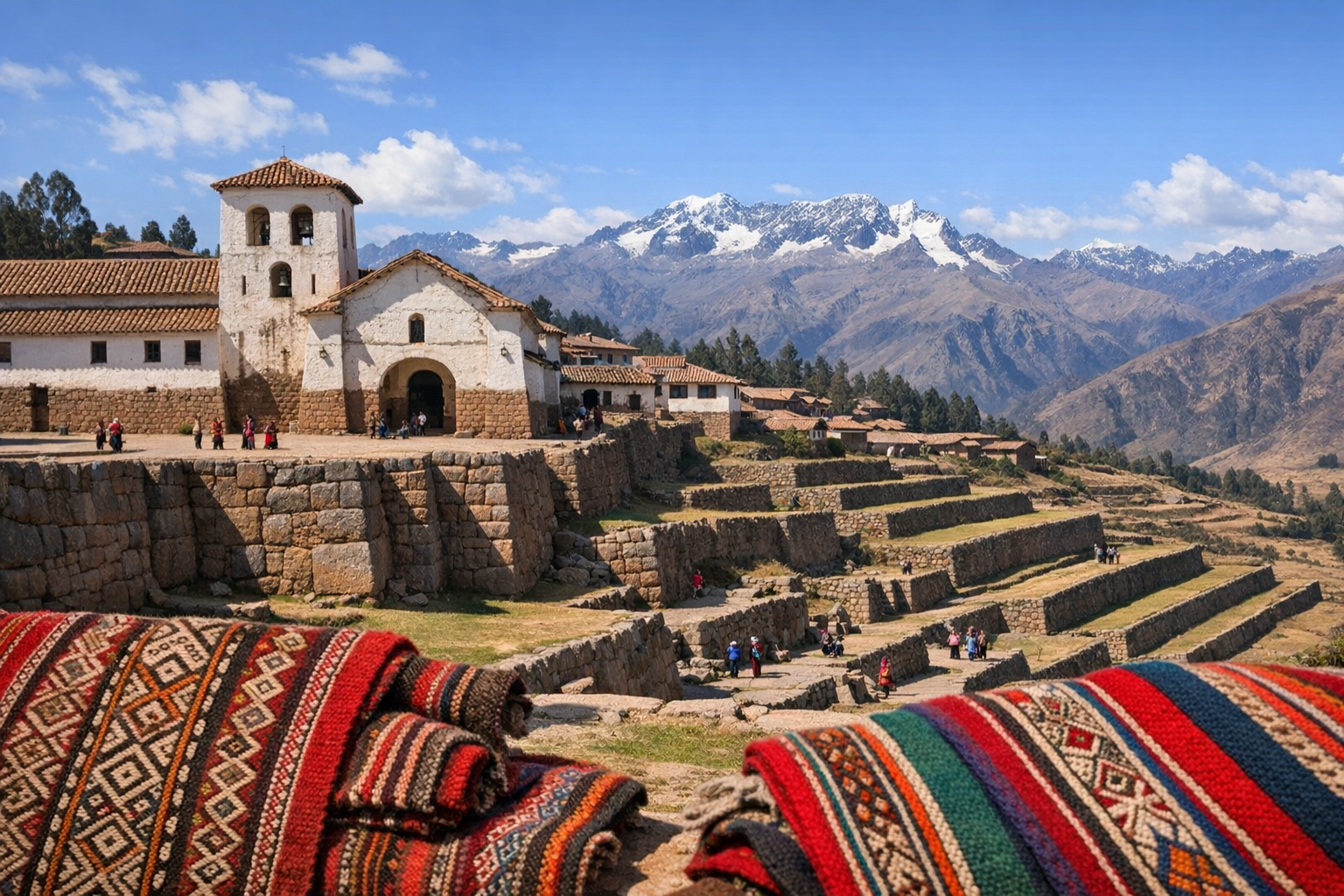
What makes Chinchero extraordinary today is the completeness of its historical layering. The Spanish colonial church of Nuestra Señora de Monserrat, constructed in 1607, rises directly from Tupac Inca’s palace walls — the Inca stonework serving as the church’s foundation so perfectly that the boundary between civilizations becomes visible at eye level. Below the church, massive stone-faced agricultural terraces cascade toward the valley rim, their scale communicating the Inca capacity to reshape entire landscapes. And in the village below, indigenous weaving cooperatives continue dyeing alpaca and wool with natural pigments and weaving on back-strap looms using techniques passed down from Inca times. Chinchero appears on most Sacred Valley day-trip itineraries as a final stop, but this undersells it. The site deserves its own focused morning, and this guide covers the terraces and palace ruins, the colonial church on Inca foundations, the weaving traditions, practical access from Cusco, and how to incorporate Chinchero into a Sacred Valley or Machu Picchu journey.
History: The Inca’s Plateau Kingdom
Pre-Inca Occupation (Before 1470 CE)
The high plateau between Cusco and the Sacred Valley had been inhabited by Quechua-speaking communities for centuries before the Inca expansion. Local Andean settlements at this elevation cultivated cold-tolerant crops — potatoes, quinoa, and bitter varieties of maize — and maintained llama herds on the high grasslands (puna). The plateau’s commanding position over multiple valley approaches made it both agriculturally productive and strategically significant. When the Inca Empire began organizing the Cusco basin in the early 15th century, this upland zone was among the first regions incorporated into state agricultural production networks, its terraced hillsides already demonstrating the productivity that would attract imperial attention.
Tupac Inca Yupanqui and the Royal Estate (c. 1470–1493 CE)
Tupac Inca Yupanqui (r. c. 1471–1493), son and successor of the great emperor Pachacuti, chose Chinchero for his personal royal estate — a llaqta (royal town) where the Sapa Inca would retreat from the formalities of Cusco. Construction followed the same engineering principles as Pachacuti’s projects elsewhere: massive stone-faced terraces, precisely fitted ashlar masonry for palace buildings, Inca fountains, and carved rock outcroppings integrated into the ceremonial landscape. The complex served as a private retreat, an agricultural station cultivating specialized crops at high altitude, and a ceremonial space aligned with astronomical events. The site’s name in Quechua — Chinchero, meaning “rainbow” — reflects its position above the cloud layer where rainbows frequently arch over the valley below.
Spanish Conquest and Colonial Transformation (1532–1607)
The Spanish occupation of the Cusco region brought systematic dismantling of Inca religious and ceremonial spaces. At Chinchero, colonial authorities built the church of Nuestra Señora de Monserrat in 1607, following the standard colonial practice of erecting Christian structures atop Inca sacred sites to symbolize conquest and accelerate religious conversion. Rather than demolish the palace entirely, the builders incorporated Tupac Inca’s finely cut stonework into the church’s own walls and foundation — a pragmatic reuse that inadvertently preserved some of the finest Inca masonry at the site. The colonial church’s white bell tower, visible from the plateau road approaching from Cusco, became Chinchero’s most immediately recognizable landmark.
Modern Rediscovery and Research
Systematic archaeological investigation of Chinchero began in the mid-20th century, with the site’s Inca components mapped and partially restored. The archaeological zone was incorporated into the Boleto Turístico del Cusco network as the Sacred Valley day-trip circuit expanded. Ongoing research has identified additional carved rock features and architectural elements beneath colonial and modern overlay. The planned international airport for the Cusco region was long proposed for the Chinchero plateau — a project that stirred considerable controversy before being modified. Today the site functions simultaneously as an active archaeological zone, a living village, and a cultural demonstration center drawing visitors from the Sacred Valley circuit.
The Key Monuments: What to See at Chinchero
The Agricultural Terraces (Andenes)
Chinchero’s most immediately impressive feature is the sequence of massive agricultural terraces that step down the hillside from the plateau’s edge toward the valley below. Like the terraces at Ollantaytambo and Pisac, these are not modest garden plots but engineering statements — each wall face standing 3–5 meters tall, built of fitted limestone blocks and backfilled with layered soil and drainage materials to create microclimate zones capable of producing crops across a wide elevation range. The Chinchero terraces are particularly distinguished by their uninterrupted scale: viewed from below, the stepped facades create an effect resembling a great amphitheater of stone pressing toward the valley floor. The terraces were working agricultural infrastructure, producing maize, potatoes, and quinoa at controlled altitude, while their aesthetic presence communicated the Inca command over nature. The best photographs of the terraces come from the road approaching Chinchero from Cusco, where the full extent of the terrace staircase is visible against the plateau edge in morning light.
The Colonial Church on Inca Foundations
The site’s most architecturally layered element is the church of Nuestra Señora de Monserrat (1607), which stands atop and incorporates the walls of Tupac Inca Yupanqui’s royal palace. Entering the church courtyard, the transition from Inca to colonial construction is unmissable: the lower courses of the enclosure walls are clearly Inca fitted stonework — polygonal blocks set without mortar in the characteristic Inca style — while the upper courses shift abruptly to colonial-era coursed rubble and plaster. Inside, the church retains its original 17th-century painted interior, with naïve Andean-Christian murals covering the walls and ceiling in combinations of European religious iconography and Andean flora and fauna. The contrast between the precision of the Inca stone below and the colonial paintings above summarizes the cultural collision of the conquest period in a single room. The church is still active; check locally for service times, as it may be closed to tourists during mass.
The Carved Rock Outcroppings
Integrated into the platform at the top of the terraces are several carved granite outcroppings that formed sacred elements of the Inca ceremonial landscape. These include carved steps, channels, seats, and flat platforms cut directly into the natural bedrock — features associated with Inca huaca worship and the ceremonial use of natural rock formations as connections to the earth deity Pachamama. The most accessible outcropping is the large carved rock platform in front of the church courtyard, whose smooth surface and precise channels once directed ritual libations (chicha corn beer) during state ceremonies. Photography of these carvings in raking early-morning or late-afternoon light reveals their surface texture most clearly.
The Weaving Village and Sunday Market
The living cultural tradition that distinguishes Chinchero from a purely archaeological site is the textile weaving practiced by local cooperatives, several of which offer demonstrations and sell directly to visitors in the village below the church. Weavers here use the back-strap loom — an ancient Andean technology in which the loom is anchored to the weaver’s waist — and dye yarns using natural materials: cochineal insects for red and pink, indigo for blue, mountain plants for yellow and green, and mineral compounds for brown and black. The full process from raw fleece to finished textile is often demonstrated, and the quality of handcrafted pieces sold at Chinchero is generally higher and more authentic than in Cusco markets. The Sunday market gathers vendors from Andean communities across the plateau; Tuesday and Thursday also see smaller markets. Arrive before 09:00 on Sunday for the best selection and atmosphere before organized tours arrive.
Getting There: Transportation and Access
Chinchero sits 28 kilometers from Cusco on the high plateau road linking the city to the Sacred Valley — easily reached by road in under an hour.
From Cusco
- Colectivo: Shared vans depart from Calle Pavitos (Cusco) marked “Urubamba” and stop at Chinchero (3–5 PEN / ~$0.80–1.40 USD, approximately 30–45 minutes). Vans fill quickly in the morning; arrive at the stand by 08:00 for reliable service.
- Taxi: 30–50 PEN ($8–14 USD) one-way; hotel-arranged taxis charge more but offer door-to-door pickup. The plateau drive is scenic and worth a window seat.
- Organized tour: Sacred Valley day tours typically end at Chinchero after visiting Pisac and Ollantaytambo in the valley (included in standard 90–180 PEN / $25–49 USD tours).
From Urubamba or the Wider Sacred Valley
Colectivos traveling the plateau road from Urubamba toward Cusco stop at Chinchero. The journey from Urubamba takes approximately 30 minutes and costs 3–5 PEN ($0.80–1.40 USD).
Admission and Hours
The Chinchero archaeological zone is covered by the Boleto Turístico del Cusco (BTC) partial circuit. The partial BTC (70 PEN / ~$19 USD) covers Chinchero and other Sacred Valley sites and is valid for 2 days from first use. Tickets must be purchased at the BTC office in Cusco (Avenida del Sol 103) or at the Pisac or Chinchero ticket windows — not at the site entrance. The site is open 07:00–17:30 daily. Note that the colonial church may be closed during religious services. The plateau elevation means intense UV exposure despite cool temperatures; bring sun protection and a warm layer for mornings.
When to Visit: Seasonal Considerations
Spring (September–November)
September and October are outstanding months for Chinchero. The post-rainy-season landscape is brilliantly green, plateau views are clear, and visitor numbers thin compared to peak season. Temperatures run 8–18°C (46–64°F) with cold mornings and mild afternoons. The light quality on the carved stone and church façade is exceptional in October — clear Andean air and warm afternoon sun produce ideal photography conditions.
Summer (June–August)
The dry season peak brings the clearest skies and most dramatic mountain views from the plateau. Cold mornings (5–12°C / 41–54°F) demand a warm layer even in July and August. Tour groups arrive from Cusco mid-morning; reach the site by 08:30 to have the terraces to yourself. The Sunday market is at its largest in July and August — arrive by 09:00 for the best textile selection before the tour buses appear.
Autumn (March–May)
April and May offer a good balance of drying conditions and green landscapes. March can bring significant afternoon rain on the plateau; a light waterproof layer is advisable. The market has more local participation relative to tourists during this period, and the weavers’ cooperative demonstrations are typically less crowded.
Winter (December–February)
The wet season brings frequent afternoon showers and cold mornings on the plateau. Stone surfaces become slippery, and views are often obscured by cloud. Visitor numbers are lowest, and the Sunday market continues year-round. January through February sees the coldest temperatures (sometimes near freezing at night), so dress warmly even for daytime visits. Clear mornings do occur — arrive early if conditions look promising.
Combining Chinchero with the Sacred Valley Circuit
Chinchero occupies an ideal geographic position at the end of the Sacred Valley circuit, sitting on the high plateau road that carries travelers from the valley floor back to Cusco.
The classic sequence begins in the valley with Pisac at 07:30–08:00, climbing the Inca citadel terraces before market crowds arrive. By 11:00, drive the 33 kilometers west along the valley floor to Urubamba for a brief lunch stop. Continue to Ollantaytambo by 13:00 and spend 2 hours at the fortress and living town before the afternoon light turns the stonework golden. At 15:00, begin the 35-kilometer drive up the plateau road toward Cusco, arriving at Chinchero by 15:30. Spend 1.5 hours exploring the terraces, the colonial church on its Inca foundation, and the carved rock outcroppings before the site closes at 17:30. Return to Cusco by 17:30–18:00, arriving for dinner in the historic center.
Chinchero can also be visited independently from Cusco as a focused half-morning excursion — the journey is only 30–45 minutes, making it the most accessible of the major Sacred Valley sites. Combining Chinchero with the Moray circular terraces (25 km northwest) and Maras salt ponds creates an excellent off-valley alternative itinerary: depart Cusco at 09:00, visit Chinchero by 10:00, drive to Moray by 11:30, add Maras salt ponds by 13:00, and return to Cusco by 15:00 for a compact 6-hour circuit covering three distinct archaeological and cultural experiences.
Why Chinchero Matters
Chinchero is a site of layered insistence: the Inca insisted on this exact plateau for Tupac Yupanqui’s royal estate; the Spanish insisted on replacing its sacred spaces with a colonial church; and the descendants of the original inhabitants have insisted, for five centuries, on maintaining their weaving techniques, their agricultural traditions, and their cultural identity on the same ground. The result is one of the Sacred Valley’s most honest encounters with Peruvian history — not a museum reconstruction but a living overlay where each civilization’s claim on the landscape remains visible and quietly contested.
The terraces still grow potatoes. The church still celebrates mass. The weavers still sit at their back-strap looms as their great-grandparents did, and as the weavers of the Inca empire did before them. Standing at the edge of the terraces where the plateau drops away toward the Sacred Valley — Nevado Chicón gleaming to the east, the valley haze below, the rainbow color for which this place is named sometimes arcing overhead — Chinchero offers a moment of continuity across a full millennium of Andean civilization.
Quick Facts
| Attribute | Details |
|---|---|
| Location | Chinchero, Cusco Region, Peru |
| UNESCO Status | Part of Cusco Historic Area (1983) |
| Established | c. 1470 CE (Inca royal estate) |
| Civilization | Inca Empire |
| Distance from Cusco | 28 km / ~30–45 min by road |
| Entry Fee | BTC Parcial: 70 PEN (~$19 USD) |
| Hours | 07:00–17:30 daily |
| Best Time | May–October; Sunday market most lively |
| Altitude | 3,762 m (12,342 ft) |
| Suggested Stay | 1.5–2 hours |
Explore More Peru
- Ollantaytambo: Living Inca town and fortress at the Sacred Valley’s western entrance
- Pisac: Inca citadel, cemetery, and artisan market at the valley’s eastern end
- Moray: Mysterious circular Inca agricultural terraces 25 km northwest of Chinchero
- Machu Picchu: The Lost City of the Incas — the Sacred Valley’s ultimate destination
Plan your complete Sacred Valley journey with our Peru Ancient Sites Guide.
Frequently Asked Questions
How much time should I allow for Chinchero?
Allow 1.5–2 hours for the archaeological terraces and colonial church, plus 30–45 minutes if attending a weaving demonstration in the village. Chinchero works well as a half-day visit from Cusco or as the final stop on a Sacred Valley day circuit before returning via the high plateau road.
What is the best time to visit Chinchero?
May through October (dry season) offers clear views across the plateau and reliable conditions for the terraces. The Sunday market is the most traditional, drawing vendors from highland communities. Arrive early — by 09:00 — before tour groups arrive from Cusco mid-morning.
Is Chinchero included in the Boleto Turístico?
Yes. Chinchero is included in the Boleto Turístico del Cusco (BTC) partial circuit covering Sacred Valley sites. The partial BTC costs 70 PEN (~$19 USD) and covers Chinchero plus other valley sites. Tickets must be purchased at BTC offices in Cusco — not at the site entrance.
How do I get from Cusco to Chinchero?
Shared colectivos depart from Calle Pavitos in Cusco toward Urubamba, stopping at Chinchero (3–5 PEN / ~$0.80–1.40 USD, approximately 30–45 minutes). Taxis cost 30–50 PEN ($8–14 USD). Chinchero sits on the high road between Cusco and the Sacred Valley, making it a natural first or last stop on the valley circuit.
What are the main things to see at Chinchero?
Key highlights include the massive Inca agricultural terraces on the hillside, the colonial church of Nuestra Señora de Monserrat built directly on the walls of Tupac Inca Yupanqui's royal palace, pre-Columbian carved rock outcroppings, and the weekly Sunday market with traditional weavers selling hand-dyed alpaca textiles.
Is Chinchero worth visiting as part of a Sacred Valley day trip?
Yes — Chinchero offers a high-altitude (3,762 m) Inca site on the plateau rather than in the canyon, and the church-on-palace juxtaposition is architecturally unique. For textile enthusiasts, the weaving demonstrations here are among the most authentic in the region. It pairs particularly well with the Moray circular terraces and Maras salt ponds as an off-valley half-day circuit.
Nearby Ancient Sites
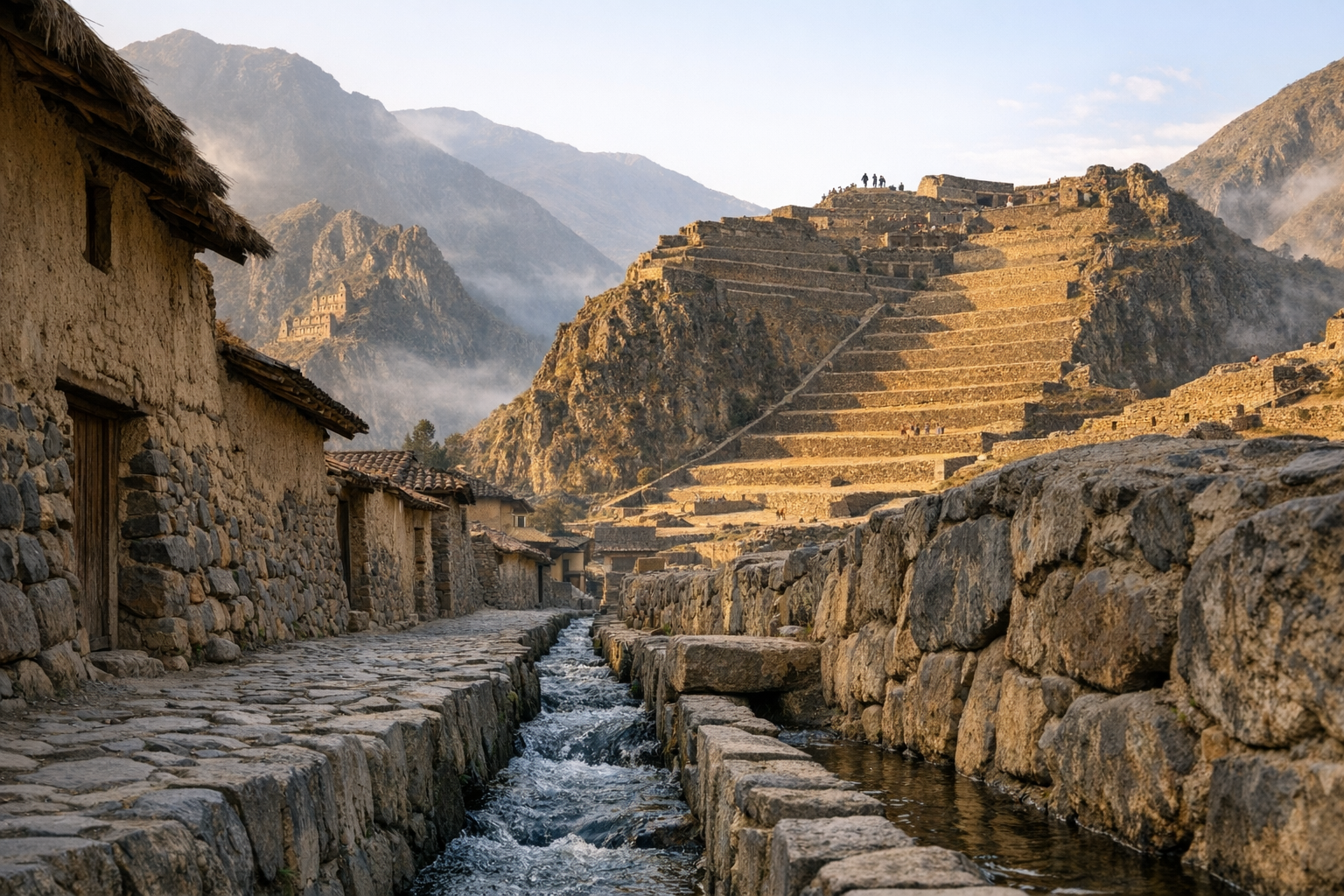
Ollantaytambo Peru Guide 2026: Inca Fortress & Sacred Valley Town
IncaVisit Ollantaytambo in Peru's Sacred Valley: explore the Inca fortress terraces, the Sun Temple, and...
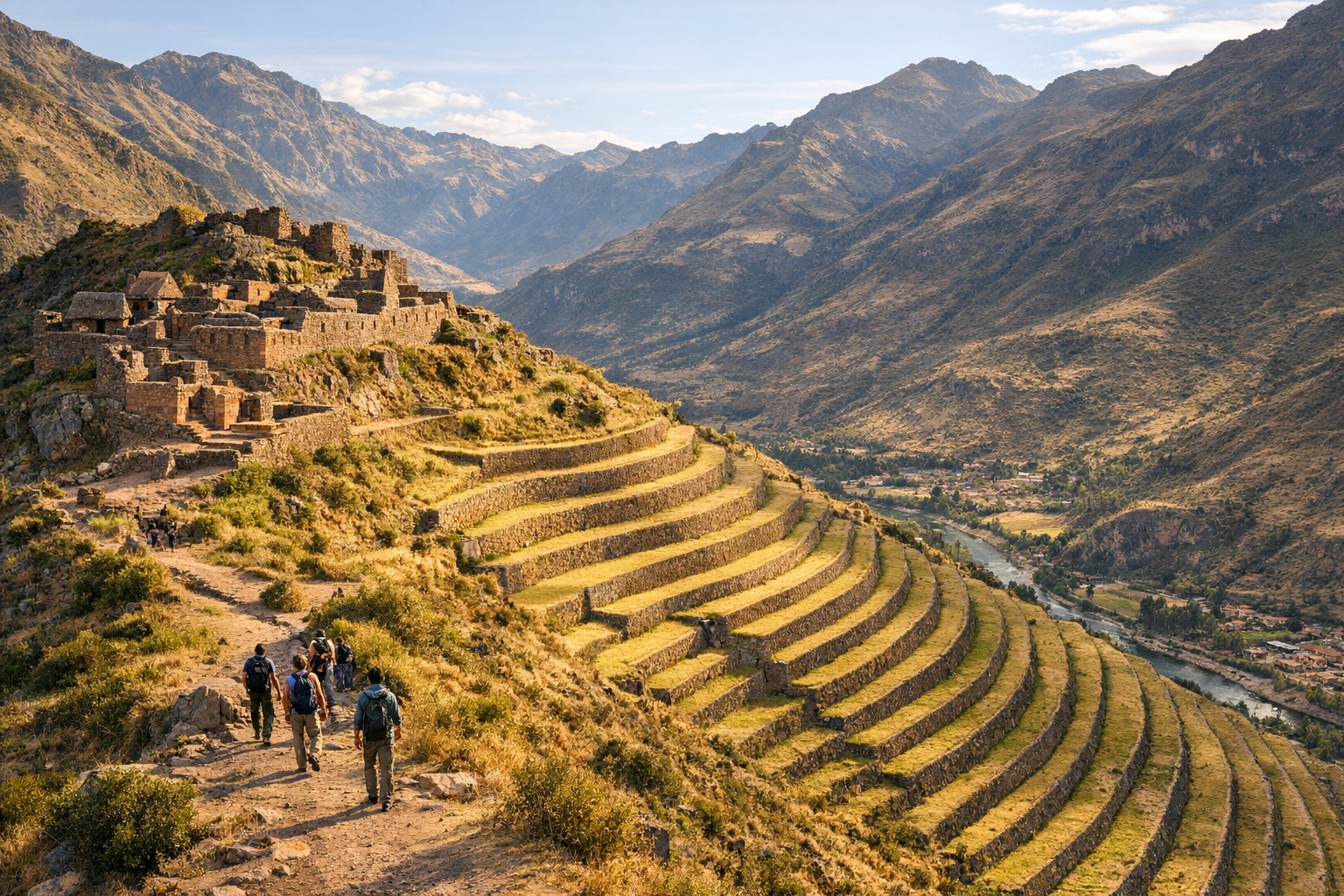
Pisac Peru Guide 2026: Inca Citadel, Market & Sacred Valley
IncaExplore Pisac in Peru's Sacred Valley: hike the Inca citadel terraces above town, visit the famous a...
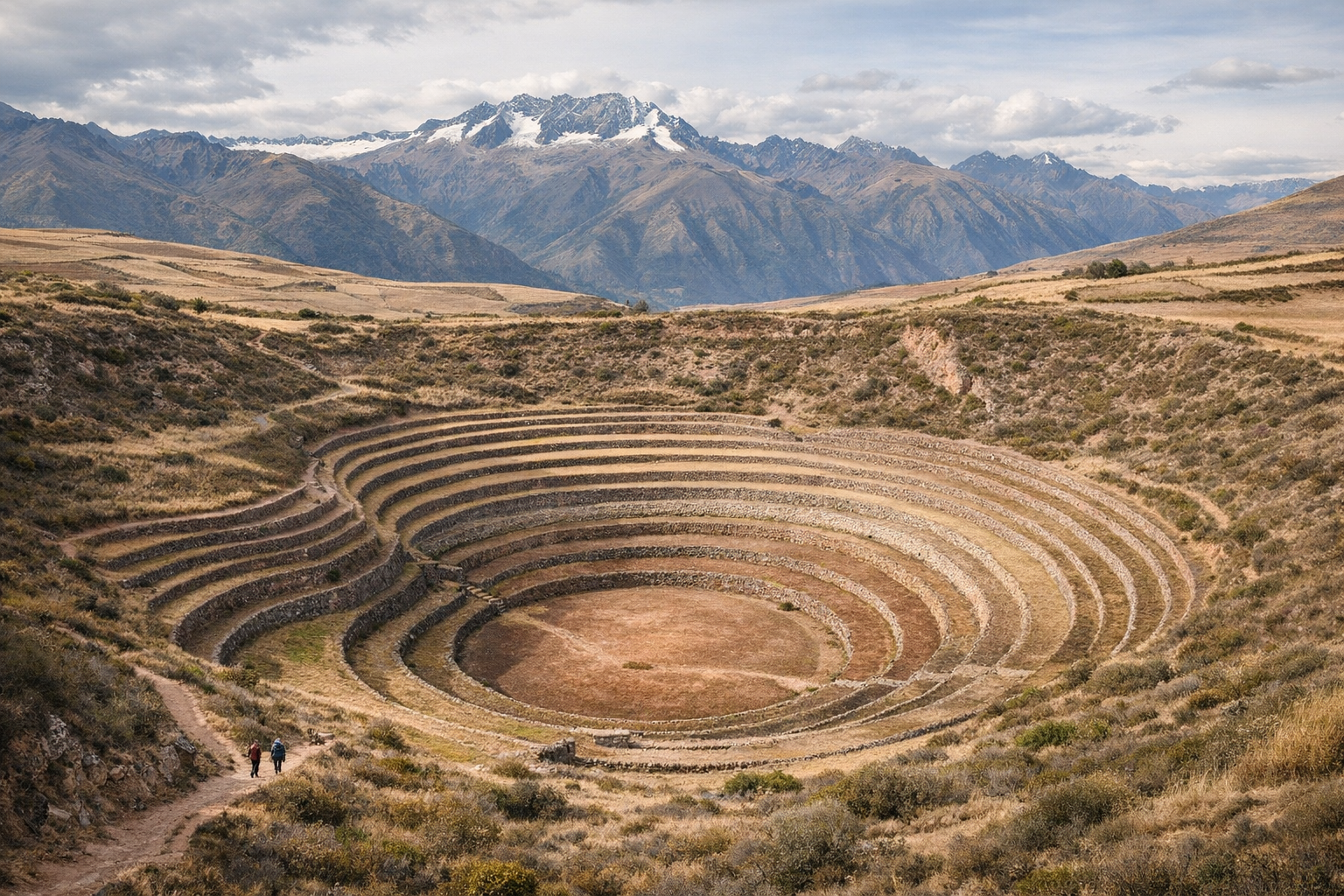
Moray Peru Guide 2026: Inca Circular Terraces & Maras Salt Mines
IncaVisit Moray's mysterious concentric circular terraces near Maras — an Inca agricultural laboratory i...
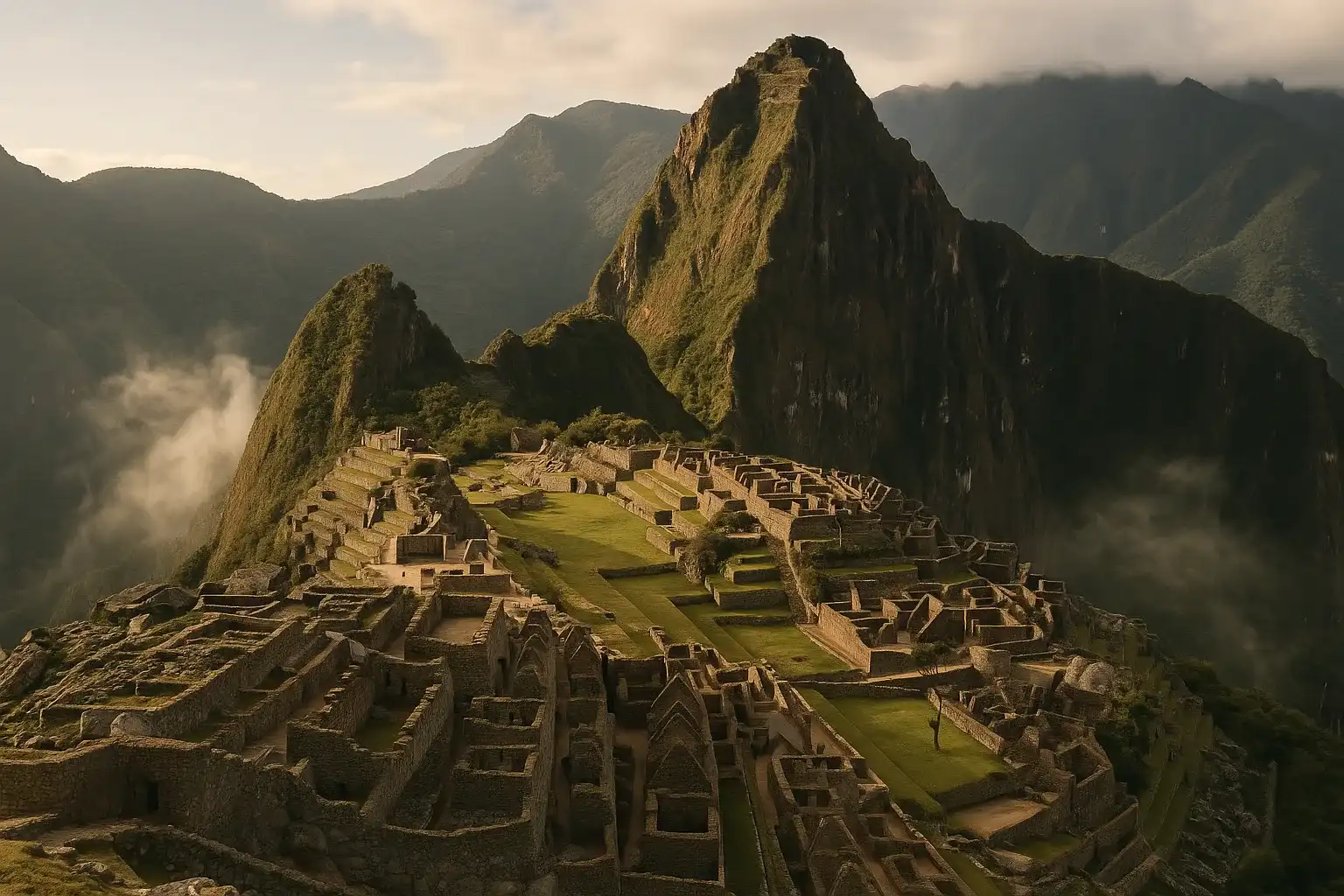
Machu Picchu Peru Travel Guide 2026: Circuits, Tickets & Entry Tips
Inca EmpireNavigate Machu Picchu's 2026 circuit system with our definitive guide. Learn how to choose your rout...