Quick Info
At a glance
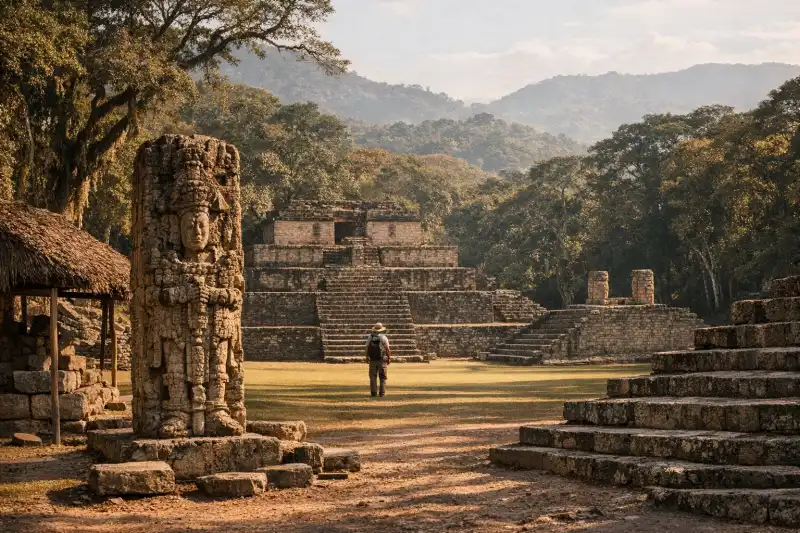
Copán in Honduras feels at once intimate and monumental: a green valley town opens onto one of the most artistically sophisticated cities of the ancient Maya world. Instead of overwhelming visitors with sheer scale alone, Copán impresses through detail—faces cut into stone with startling individuality, gods and kings emerging from monuments in deep relief, and plazas framed by temples that still hold the shape of royal ceremony. The site sits in western Honduras near the Guatemalan border, where forested hills and a river valley helped sustain a dynasty that rose to power during the Classic Maya period.
For modern travelers, Copán offers a rare combination of accessibility and depth. You can walk from the pleasant town of Copán Ruinas to the archaeological park, enter a landscape of macaws, ceiba trees, and stepped architecture, and within minutes stand before some of the finest sculptural works created anywhere in ancient Mesoamerica. The experience is not only visual. Copán is also a place of texts, memory, and political theater. Here, rulers recorded lineages, victories, rituals, and cosmic legitimacy in carved monuments and stairways. That makes a visit rewarding whether you come for photography, ancient history, architecture, or the broader story of the Maya civilization. Copán may be smaller than some of the giant cities of Mexico and Guatemala, but few sites communicate so clearly the intelligence, ambition, and artistry of the people who built them.
History
Early settlement and the rise of a Maya center
The Copán Valley had been inhabited long before the city became a major political power. Its fertile land, water resources, and position along routes linking the Maya lowlands with regions farther south made it a favorable place for settlement. Archaeological evidence suggests occupation well before the great florescence of royal Copán, but the city entered the historical spotlight in the early 5th century CE.
According to inscriptions, the dynastic history of Copán begins in 426 CE, when a founder known today as K’inich Yax K’uk’ Mo’ arrived and established a new royal line. Scholars have long debated the exact political context of his rise, but there are strong indications that his accession was tied to wider developments in the Maya world, possibly including influence from powerful centers such as Tikal and even more distant Teotihuacan-linked networks. What is clear is that his arrival marked a turning point. A local settlement was transformed into the seat of a kingdom with dynastic ambitions.
Expansion under the dynasty
Over the next centuries, Copán grew into one of the leading cities of the southeastern Maya region. Its rulers invested heavily in monumental architecture, sculpted stelae, altars, and ceremonial spaces. The Acropolis became the ceremonial and political heart of the city, while plazas and temple complexes articulated the public face of royal power.
Copán’s kings used art and inscriptions to legitimize their rule with unusual sophistication. Rather than relying only on massive pyramids, they developed a sculptural language of exceptional refinement. Rulers were depicted in elaborate regalia, often blending human identity with divine symbolism. Monuments marked calendrical cycles and ritual performances, making political authority visible in sacred time as well as physical space.
One of the most important phases came under the 13th ruler, Waxaklajuun Ubaah K’awiil, often known as 18 Rabbit, who reigned in the early 8th century. During his rule Copán reached a peak of artistic production. Many of the site’s most celebrated stelae date to this period, and they remain masterpieces of Maya stone carving. His reign ended dramatically, however, when he was captured and executed by the ruler of Quiriguá in 738 CE, a major political blow that altered the balance of power in the region.
Recovery, scholarship, and the Hieroglyphic Stairway
Despite that setback, Copán did not vanish immediately. Later rulers continued to build, restore legitimacy, and shape the city’s memory. One of the most remarkable creations from this period is the Hieroglyphic Stairway, associated especially with the reign of K’ak’ Yipyaj Chan K’awiil. This vast inscription, set on a temple stairway, is among the longest known Maya texts. It records dynastic history and political identity in a form both monumental and intellectually ambitious.
The late 8th century saw sustained efforts to reaffirm continuity with the founding ancestors. Royal construction became an act of historical argument, linking current rulers to the prestige of earlier generations. Yet the wider Maya world was entering a period of strain. Environmental pressure, political fragmentation, and social upheaval affected many cities across the region.
Decline and abandonment
By the 9th century, Copán experienced demographic and political decline. Like many Classic Maya centers, it suffered from a combination of pressures rather than a single catastrophic end. Archaeologists have pointed to evidence for deforestation, soil stress, overuse of resources, and weakening royal authority. Population density in the valley may have outpaced the environmental carrying capacity that had once supported urban growth.
As elite power waned, monumental building slowed and eventually ceased. The royal dynasty disappeared from the record, and Copán’s ceremonial core was gradually abandoned. Local people did not vanish from the region, but the city no longer functioned as a major capital. Over time, structures eroded, vegetation covered the plazas, and the surviving monuments entered a new existence as ruins in the landscape.
Rediscovery and conservation
Copán became known to the outside world through 19th-century explorers, including John Lloyd Stephens and Frederick Catherwood, whose publications brought extraordinary attention to Maya civilization. Their descriptions and illustrations helped establish Copán as one of the great archaeological discoveries of the Americas. Since then, excavations, epigraphic research, and conservation projects have transformed understanding of the site.
Today Copán is a UNESCO World Heritage Site and one of the most important places for studying Maya history, writing, and art. Ongoing research continues to reveal buried construction phases beneath visible temples, reminding visitors that what they see is only the outer layer of a deeply stratified royal city.
Key Features
Copán stands out first for its sculpture. The site’s carved stelae are not simply commemorative stones but highly sophisticated portraits of sacred kingship. Many are positioned in plazas where they once structured ritual movement and public ceremonies. Their surfaces are dense with costume details, glyphs, and symbolic imagery. Even for visitors without prior knowledge of Maya iconography, the workmanship is striking: jewelry hangs with convincing weight, feathers seem to flare from stone, and faces carry a vivid sense of personality. In Copán, sculpture was a language of power, one that made rulers appear at once human, ancestral, and divine.
The Great Plaza is the best place to feel this sculptural achievement in context. Open, grassy, and framed by monuments, it allows you to walk among stelae much as ancient spectators would have encountered them in public ritual space. Scarlet macaws are often seen or heard nearby, adding bright color and sound to the experience. Unlike some sites where monuments have been removed to museums, Copán still preserves a strong sense of original placement, making it easier to imagine the choreography of royal display.
The Acropolis offers a different atmosphere: more enclosed, layered, and politically charged. This elevated complex contains temples, courtyards, and elite spaces that reveal centuries of rebuilding. Maya architecture often involved constructing new buildings over older sacred structures, and Copán is an outstanding example of this practice. The result is a ceremonial core with remarkable depth. Archaeologists have uncovered earlier buried temples beneath later constructions, showing how each ruler reshaped the city while honoring—or appropriating—the sacred prestige of predecessors.
Among the Acropolis monuments, the Hieroglyphic Stairway is Copán’s most celebrated text-bearing structure. Though damaged and partially reconstructed, it remains one of the intellectual marvels of the Maya world. Its steps were carved with hundreds of glyph blocks that together formed a dynastic narrative. For visitors, it is a reminder that these ruins are not mute stone. Copán’s kings wrote history into architecture itself. The stairway also reflects the city’s concern with memory: political legitimacy depended not only on military power but on the ability to present a coherent lineage reaching back to the founder.
Temple 16 is another key feature because of what lies beneath it. Excavations revealed earlier structures, including the richly decorated Rosalila temple, one of the best-preserved examples of Maya sacred architecture known from the region. The original remains are protected, but the on-site sculpture museum contains a full-scale reconstruction that helps visitors understand the painted, vibrant quality ancient temples once had. This museum is essential rather than optional. It gathers original sculptures, architectural fragments, and replicas in a controlled environment where details are easier to appreciate than under open-air conditions. If the ruins show Copán in its landscape setting, the museum shows Copán as an artistic workshop of astonishing precision.
The ball court is another important stop. Ballcourts across Mesoamerica were places of sport, ritual, diplomacy, and cosmology, and Copán’s version is notable for its macaw-shaped markers. The use of avian imagery links the court to dynastic and sacred symbolism, reinforcing how deeply integrated ritual life was with political identity. Nearby, residential and elite sectors beyond the central core remind visitors that Copán was not only a ceremonial park but a living city sustained by artisans, scribes, nobles, farmers, and laborers spread across the valley.
What finally makes Copán distinctive is scale in human terms. It is grand enough to convey the power of a capital, yet compact enough to explore thoughtfully in a day. That intimacy helps visitors notice what defines the site: the precision of carving, the layering of architecture, and the extraordinary effort ancient rulers invested in shaping both public space and historical memory.
Getting There
Most travelers reach Copán through the town of Copán Ruinas, which serves as the practical base for visiting the archaeological park. From the town center, the ruins are about a 15- to 20-minute walk, and many hotels can point you along the pedestrian route. Tuk-tuks are also common for short transfers and usually charge around HNL 40-80 depending on distance and time of day.
If you are coming from San Pedro Sula, direct or semi-direct buses and shuttles are the standard option. Shared tourist shuttles often cost about USD 25-40 one way and take roughly 4.5 to 6 hours depending on stops and road conditions. Public buses are cheaper, sometimes in the range of HNL 250-450 in total with connections, but they can take longer and may require changing vehicles in La Entrada or Santa Rosa de Copán. From Tegucigalpa, overland travel is significantly longer—often 7 to 9 hours by bus or shuttle—with fares commonly ranging from USD 35-60 for tourist transport.
Many international visitors arrive via Guatemala. Shuttle services from Antigua or Guatemala City to Copán Ruinas are widely used and typically cost around USD 30-50, including border assistance in some cases. Travel times vary from 5 to 8 hours. Keep your passport ready for the border crossing and carry some cash for fees or snacks.
Once in Copán Ruinas, you can buy site tickets locally. Some travelers combine the main ruins with the sculpture museum and nearby archaeological zones, so budget for additional entrance fees if you want the fullest experience.
When to Visit
The best time to visit Copán is generally during the drier season from November to April. These months usually bring sunnier mornings, easier walking conditions, and clearer opportunities for photography. Because much of the site is open-air, even a modest amount of rain can make paths slick and visits less comfortable, especially if you plan to spend several hours moving between plazas, stairways, and the museum. Early mornings in the dry season are especially pleasant, with softer light and lower temperatures.
December through February tends to be the most comfortable period for many travelers. Daytime heat is manageable, humidity is lower than in the wetter months, and the surrounding valley is still green. March and April are also popular, but temperatures begin to rise, so carrying water, sunscreen, and a hat becomes more important. Arriving near opening time helps you avoid both midday heat and larger tour groups.
The rainy season, typically from May to October, has its own appeal. Vegetation is lush, the valley looks especially vibrant, and the site can feel atmospheric under shifting clouds. However, afternoon showers are common, and heavy rain may shorten visits or make some areas muddy. If you travel in these months, try to explore early in the day and keep a light rain jacket or umbrella with you.
Festival periods in Copán Ruinas can add energy to a trip, but they may also mean higher accommodation demand. For the calmest visit and best weather balance, aim for a weekday morning between late November and early March.
| Quick Facts | Details |
|---|---|
| Location | Copán Department, western Honduras |
| Nearest town | Copán Ruinas |
| Civilization | Maya |
| Main florescence | 5th-9th centuries CE |
| Dynasty founded | 426 CE |
| Best known feature | Hieroglyphic Stairway and carved stelae |
| UNESCO status | World Heritage Site |
| Recommended visit length | Half day to full day |
| Best season | November to April |
| Access | Walk or tuk-tuk from Copán Ruinas |
Guided tours: worth it?
Self-guided works here, but a guide can add real value if you want the ruins explained as a living place rather than just a sequence of monuments.
Best for
- First-time visitors who want context, not just photos
- Short visits where a planned route saves time
When to go self-guided
Go independently if you prefer setting your own pace, reading as you go, and checking official hours or ticket rules directly before you arrive.
What I’d avoid
Skip paid tours that bundle unrelated stops you do not actually want. The best option should either save meaningful planning time or add historical context you would miss on your own.
Copán Ruins tours
Useful when: you want to compare guided formats before deciding
Copán archaeological site day trips
Useful when: transport or pickup logistics matter
Honduras Maya ruins tours
Useful when: you want to compare guided formats before deciding
Some tour links are affiliate links, which may earn Ancient Travel a small commission at no extra cost to you. I try to surface options that make practical sense for the site—not just anything bookable.
Frequently Asked Questions
Where is Copán located?
Copán is in western Honduras, in the Copán Department near the border with Guatemala, close to the town of Copán Ruinas.
Why is Copán famous?
Copán is celebrated for its refined Maya sculpture, elaborately carved stelae, royal architecture, and one of the longest known hieroglyphic inscriptions in the Maya world.
How much time do you need to visit Copán?
Most travelers need at least half a day for the main ruins, but a full day is better if you also want to visit the sculpture museum and nearby archaeological areas.
Is Copán safe to visit?
Copán Ruinas is one of Honduras's most established tourist towns and is generally considered manageable for visitors who use normal precautions, arrange transport carefully, and avoid isolated areas at night.
What is the best time of year to visit Copán?
The driest and most comfortable months are usually from November to April, when trails are easier to walk and rain is less likely to interrupt your visit.
Can you visit Copán from Guatemala?
Yes. Many travelers reach Copán overland from Guatemala, especially from Antigua or Guatemala City via border crossings and shuttle services.
Nearby Ancient Sites
Calakmul
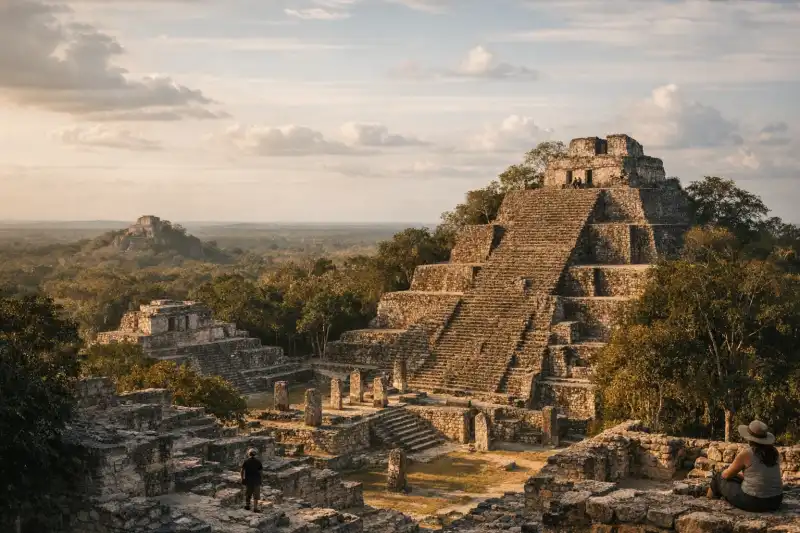
MayaExplore Calakmul, a vast Maya city deep in the forests of Campeche, Mexico, known for towering pyram...
Chacchoben
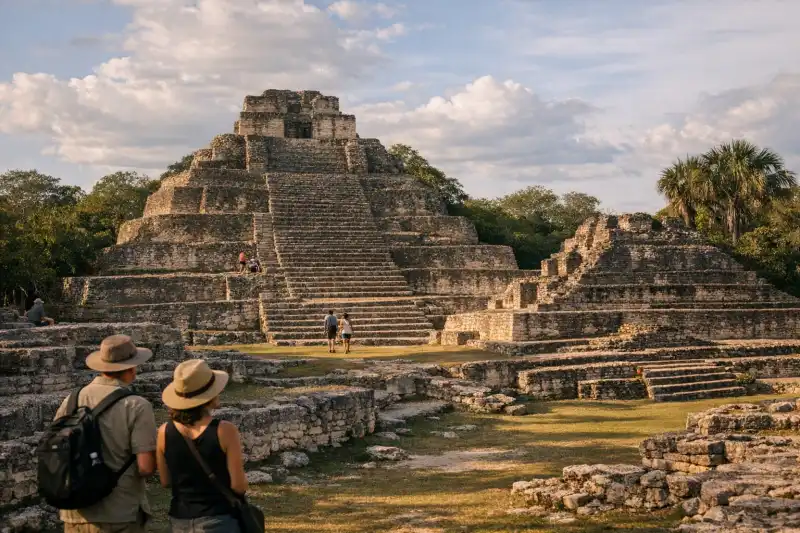
MayaExplore Chacchoben, a serene Maya archaeological site in Mexico surrounded by jungle, lagoons, and i...
Cacaxtla
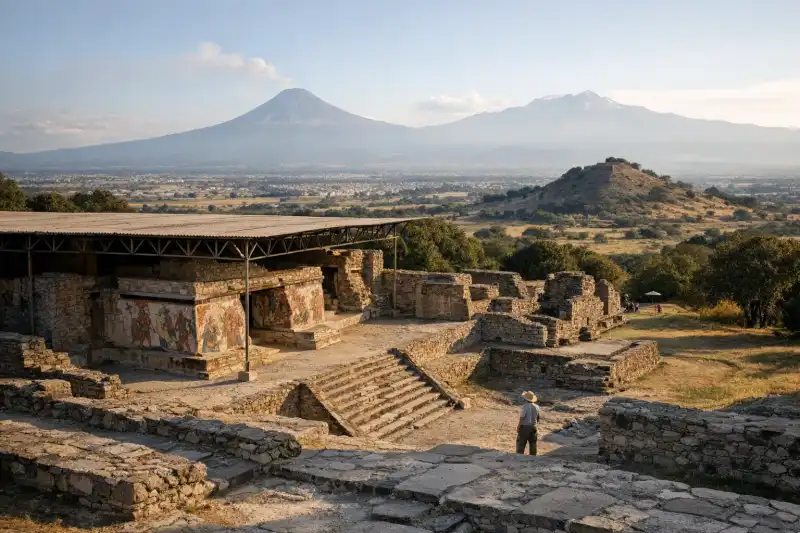
Olmeca-Xicalanca and broader Epiclassic Mesoamerican traditionsExplore Cacaxtla in Mexico, a hilltop archaeological site famed for vivid murals and Epiclassic hist...