Quick Info
At a glance
Cuajilote, Mexico, is one of those archaeological places that rewards curiosity more than checklist tourism. Rather than announcing itself with giant pyramids or crowds of tour buses, this site sits within the broader cultural landscape of Oaxaca as a quieter reminder of how many ancient settlements once thrived across southern Mexico. For travelers who enjoy the feeling of discovering somewhere underappreciated, Cuajilote offers a different kind of encounter with the past: one rooted in terrain, carved stone, local memory, and the long continuity of Indigenous history in the region.
The first impression is often the setting. Oaxaca is famous for dramatic mountains, deep valleys, Pacific coast routes, and communities whose traditions remain visibly alive. Cuajilote belongs to that wider world. Visiting it is not just about standing before ruins; it is about understanding how ancient people selected defensible, productive, and symbolically meaningful places in the landscape. The site is associated with carved monuments and traces of settlement that connect it to exchange networks and cultural developments extending beyond one single valley or town. That wider context matters, because Cuajilote makes the most sense when seen as part of Oaxaca’s patchwork of regional centers, ceremonial spaces, and communities linked by trade, ritual, and political negotiation.
For modern visitors, the appeal is precisely this combination of modest scale and historical depth. Cuajilote does not overwhelm. Instead, it invites slower observation: the shape of the ground, the placement of stones, the evidence of a former civic or ceremonial life, and the sense that many more stories remain partially hidden. It is a rewarding stop for anyone interested in ancient Mexico beyond the most famous headline sites.
History
Early settlement and the rise of regional communities
The history of Cuajilote belongs to the long arc of Mesoamerican development in what is now Oaxaca. Long before Spanish arrival, the region was home to complex societies that adapted to varied environments, from interior valleys to coastal corridors. Cuajilote likely emerged within this pattern of dispersed but interconnected settlements, where communities relied on agriculture, local craft production, and exchange with neighboring zones. Maize cultivation, seasonal water management, and access to routes linking coast and highland would have shaped the viability of any site in this area.
By the Preclassic period, many parts of Oaxaca already showed signs of increasing social differentiation and ceremonial activity. Even where sites never developed into huge urban capitals, they often participated in the same broad cultural tendencies: construction of formal spaces, the use of carved stones to mark authority or memory, and the establishment of local elites who mediated ties with other communities. Cuajilote appears to fit this regional pattern. It was likely not isolated, but part of a living network in which ideas, goods, and ritual practices circulated over considerable distances.
This is an important point for understanding the site. Ancient Oaxaca was never culturally simple. Numerous ethnic and linguistic groups lived across the state over many centuries, including Mixtec, Zapotec, Chatino, and others, with shifting boundaries and alliances. Cuajilote’s history therefore cannot be reduced to a single uninterrupted identity. Instead, it reflects a layered occupation history in which local traditions interacted with larger Mesoamerican currents.
Ceremonial expression and carved monuments
One of the reasons Cuajilote attracts archaeological interest is its association with carved stones and sculptural remains. In Mesoamerica, monuments were not merely decorative. They could serve as records of rulership, ritual markers, territorial statements, ancestor memorials, or symbols of cosmological order. At a site like Cuajilote, carved monuments suggest a community that invested labor and meaning in public expression, even if the architecture itself was more restrained than at larger capitals.
Such monuments often reveal connections that architecture alone cannot. Styles of carving, iconographic themes, and the placement of stones in plazas or ceremonial areas may indicate dialogue with neighboring cultural traditions. In Oaxaca, that can mean influences moving between the highlands and the coast, or between major centers and lesser regional nodes. Cuajilote’s importance may therefore lie less in monumental size than in what it tells scholars about communication across regions.
Over time, sites like this could rise in significance as local centers for ceremony, tribute, or administration. A settlement might anchor nearby agricultural populations while also hosting gatherings tied to ritual calendars, political negotiations, or market exchange. Even without a towering pyramid, the organization of space could still reflect hierarchy and planning. Raised platforms, open areas, and sculptural placements all hint at how people assembled, watched, performed, and remembered.
Change, continuity, and the Postclassic world
As Oaxaca’s political map shifted across the Classic and Postclassic periods, many settlements were reconfigured rather than simply abandoned. Some gained prominence through new trade routes. Others adapted to changing alliances, climatic stresses, or competition with larger centers. Cuajilote was likely affected by these broader transformations. Occupation may have continued in altered form, with ceremonial activity shrinking, expanding, or taking on new meanings as regional powers changed.
The Postclassic period in southern Mexico was dynamic, marked by strong interregional exchange and the strategic use of landscape. Communities often built on older foundations, inheriting sacred places even when political systems changed. This continuity matters at Cuajilote because carved stones and settlement remains may have remained significant long after their first installation. Ancient places were rarely forgotten quickly; they were reinterpreted, reused, and folded into new local traditions.
Colonial disruption and modern archaeological recognition
The Spanish conquest transformed Oaxaca’s social and political structures, but many ancient sites survived in fragmentary form within rural lands, known to local communities long before archaeologists documented them. Cuajilote likely followed this path. Its remains would have persisted in the landscape, subject to erosion, agricultural activity, and the slow loss of architectural definition. Yet local awareness often preserved place names and stories even when formal excavation came later.
Modern archaeological interest in sites like Cuajilote has been part of a broader effort to map Oaxaca’s regional complexity beyond headline destinations such as Monte Albán. Survey, recording, and limited conservation help situate Cuajilote within settlement networks and historical chronology. For visitors today, that means the site is best appreciated not as a polished open-air museum, but as an important piece of a much larger historical puzzle. Its significance lies in showing how many centers, communities, and ceremonial places sustained ancient life across southern Mexico.
Key Features
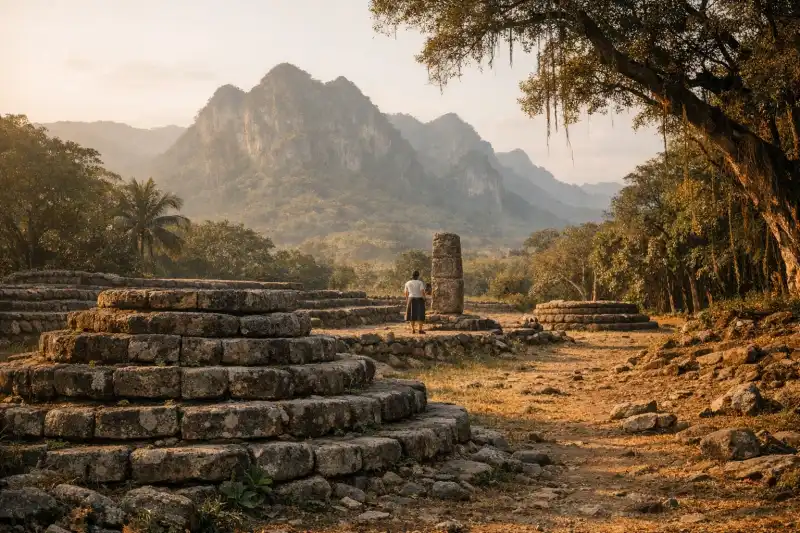
Cuajilote’s most compelling feature is its atmosphere of partial revelation. Unlike heavily restored archaeological parks, the site often feels closer to the raw material of history. You are not presented with an overly tidy narrative. Instead, you encounter traces: earthworks, sculpted elements, surface remains, and the arrangement of land that once supported a meaningful center of communal life. For many travelers, that subtlety becomes the site’s greatest strength.
The carved stones are central to this experience. Even when seen outside the context of a grand staircase or palace facade, carved monuments have a remarkable ability to command attention. Their very existence signals intention. Someone commissioned them, shaped them, placed them, and expected them to speak to an audience. At Cuajilote, these sculptural remains suggest status, ritual, and memory. They hint at the visual language ancient communities used to define sacred authority and public identity. For visitors interested in iconography or political symbolism, this alone makes the site worth attention.
Equally important is the setting of Cuajilote within the broader Oaxacan landscape. The contours of the terrain help explain why ancient people settled here. Mesoamerican sites were rarely random. They were positioned in relation to resources, routes, visibility, and ceremonial logic. At Cuajilote, the relationship between archaeological remains and the surrounding countryside can be as informative as any single structure. Looking outward from the site, you begin to understand how nearby fields, hills, and paths may once have structured everyday life. Ancient communities depended on these landscapes for food, movement, and spiritual orientation.
Another notable feature is the site’s scale. Cuajilote does not demand that you race from one monumental highlight to another. Instead, it encourages close looking. Smaller or less restored sites often train the eye better than famous ones do. You notice foundation lines, broken stone, elevation changes, and the way open spaces might have functioned as gathering places. That slower rhythm makes the visit especially appealing to travelers who enjoy archaeology as interpretation rather than spectacle.
Cuajilote also stands out as a place that helps broaden the story of ancient Mexico. Many visitors come to the country with a mental map dominated by Teotihuacan, Chichén Itzá, or Palenque. Those sites are extraordinary, but they can create the impression that ancient history was concentrated in a few giant cities. Cuajilote corrects that impression. It represents the countless regional centers that sustained local identity, managed territory, and participated in long-distance cultural exchange without necessarily becoming imperial capitals. In that sense, the site is educational in a very direct way: it expands your understanding of how civilization actually works on the ground.
The rural surroundings add another layer. A visit here is usually embedded in living Oaxaca rather than separated from it. Roads pass through contemporary communities, agricultural landscapes, and small settlements where Indigenous and mestizo traditions continue to shape daily life. This continuity between ancient and modern land use can be striking. You leave with a sense not of a vanished world detached from the present, but of a region where history has accumulated over centuries in visible and invisible forms.
Finally, Cuajilote’s lack of heavy commercialization can be refreshing. You are less likely to find large visitor infrastructure and more likely to feel the importance of preparation and attention. That is not always convenient, but it can produce a more intimate experience. For respectful visitors, the site offers something increasingly rare: room to think. The remains may be modest, yet they create a powerful impression of endurance, reminding you that history is often preserved not only in spectacular monuments, but in quieter places that survive because people continue to value them.
Getting There
Getting to Cuajilote usually requires some planning, as it is not among Oaxaca’s easiest archaeological sites to reach by public transport alone. The most practical approach for many travelers is to use a rental car or hire a driver from a larger hub such as Oaxaca City, Puerto Escondido, or Pinotepa Nacional, depending on your route through the region. Road conditions can vary, and local directions are worth confirming shortly before travel.
If you are driving, budget for fuel and tolls where applicable. From a regional city, a private car journey may cost roughly MXN 500 to 1,500 in fuel depending on distance and your broader itinerary. A hired driver for a day trip can range from about MXN 2,500 to 5,500, depending on departure point, waiting time, and whether multiple stops are included. This is often the most comfortable option if you want to combine archaeology with nearby cultural or scenic visits.
Public transport may be possible in stages using regional buses or colectivos to nearby towns, followed by a taxi. Bus fares in Oaxaca are generally affordable, often around MXN 100 to 400 for intercity segments, while short colectivo rides may be under MXN 100. The challenge is not the cost but the coordination. Schedules can be limited, and the final connection may require negotiating with a local taxi driver. Expect a taxi transfer in rural areas to cost roughly MXN 150 to 500 depending on distance.
Because signage and services may be limited, it is wise to download offline maps, carry cash, and ask locally for current access conditions. Start early in the day, especially if returning before dark. If you prefer not to manage logistics yourself, booking a cultural guide or custom regional tour is the easiest solution.
When to Visit
The best time to visit Cuajilote is generally during Oaxaca’s dry season, from about November to April. During these months, roads are typically easier to navigate, skies are clearer, and walking around the site is more comfortable. Morning visits are especially pleasant, as temperatures remain lower and the light can make the landscape and stone details easier to appreciate.
From late spring into early summer, heat can become more intense, particularly if your route passes through lower elevations or coastal corridors. A visit is still possible, but it is better done early, with plenty of water and sun protection. Lightweight long sleeves, a hat, and sturdy shoes are more useful here than travelers sometimes expect.
The rainy season, usually from around May or June into October, brings greener scenery but also more uncertainty. Rural roads may become muddy or slower, and sudden downpours can affect both comfort and travel time. If you do visit in this period, build flexibility into your day and avoid tight transport connections. On the positive side, the countryside can look especially lush, and there may be fewer visitors in the region overall.
Festival timing in Oaxaca can also shape your trip. If you are already traveling for cultural events in Oaxaca City or coastal towns, adding Cuajilote can deepen the historical side of your itinerary. Just remember that local holidays may affect transport availability. Whenever you go, aim for a weekday or a quiet morning if you want the most contemplative experience.
| Quick Facts | Details |
|---|---|
| Location | Oaxaca, Mexico |
| Type | Archaeological site |
| Cultural context | Regional Mesoamerican traditions of Oaxaca |
| Best for | History travelers, archaeology enthusiasts, independent explorers |
| Ideal visit length | 1 to 2 hours |
| Best season | November to April |
| Access | Best by car, driver, or arranged regional transport |
| What to bring | Water, sun protection, sturdy shoes, cash, offline maps |
| Nearby hub | Pinotepa Nacional |
| Travel style | Best combined with a broader Oaxaca cultural itinerary |
Cuajilote is not the kind of place that tries to impress through scale alone. Its value lies in something more durable: the sense that ancient Mexico was built not only by famous capitals, but by regional communities whose ceremonial, political, and artistic lives mattered deeply within their own landscapes. In Oaxaca, where the past remains woven into present-day identity, that lesson feels especially important.
For travelers willing to venture beyond the best-known circuit, Cuajilote offers a richer and more grounded understanding of southern Mexico. You come for archaeology, but you leave thinking as much about geography, continuity, and the many local worlds that made Mesoamerica possible. That combination of modest remains and large historical meaning is precisely what makes the site memorable.
Guided tours: worth it?
Most travelers can visit Cuajilote independently. Compare a tour only if you want a tighter history-focused visit, easier logistics, or a guide who can answer questions on the spot.
Best for
- Short visits where a planned route saves time
When to go self-guided
Go independently if you prefer setting your own pace, reading as you go, and checking official hours or ticket rules directly before you arrive.
What I’d avoid
Skip paid tours that bundle unrelated stops you do not actually want. The best option should either save meaningful planning time or add historical context you would miss on your own.
Oaxaca archaeology tours
Useful when: you want to compare guided formats before deciding
Oaxaca day trips from Oaxaca City
Useful when: transport or pickup logistics matter
Puerto Escondido cultural tours
Useful when: you want to compare guided formats before deciding
Some tour links are affiliate links, which may earn Ancient Travel a small commission at no extra cost to you. I try to surface options that make practical sense for the site—not just anything bookable.
Frequently Asked Questions
What is Cuajilote?
Cuajilote is an archaeological site in Oaxaca, Mexico, associated with ancient occupation in the coastal and Mixteca-linked cultural sphere. It is best known for its carved stones and regional significance rather than monumental pyramids.
Where is Cuajilote located?
Cuajilote is located in the state of Oaxaca in southern Mexico, in a rural setting that is usually reached by road from larger towns on the Oaxaca coast or inland transport hubs.
Is Cuajilote easy to visit independently?
It can be visited independently if you have a car and current local directions, but many travelers find it easier to go with a driver or a regional guide because signage and visitor services may be limited.
How much time do you need at Cuajilote?
Most visitors need around 1 to 2 hours on site, though history enthusiasts may stay longer if combining the visit with other cultural stops in Oaxaca.
What should I bring to Cuajilote?
Bring water, sun protection, sturdy shoes, cash for transport or local purchases, and downloaded maps, since facilities and mobile coverage can be limited.
When is the best time to visit Cuajilote?
The dry season, generally from November to April, is the most comfortable for visiting because roads are usually easier and the heat is more manageable earlier in the day.
Nearby Ancient Sites
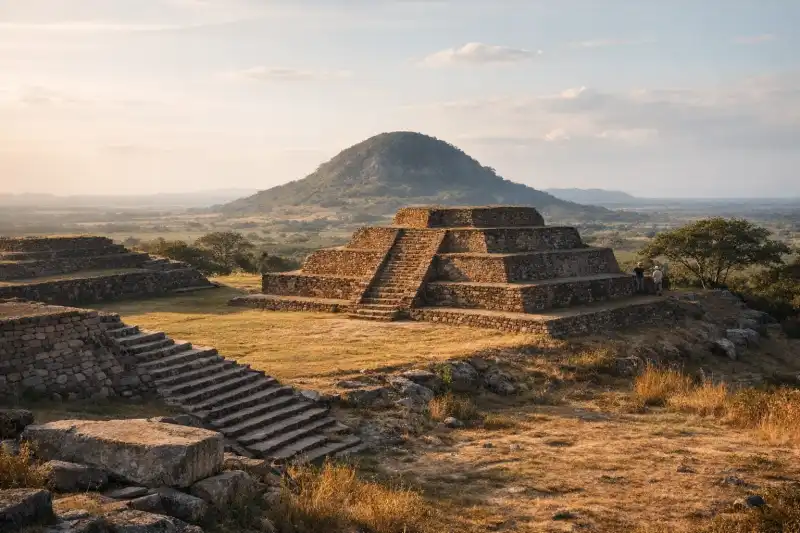
Cerro de las Mesas
Epi-Olmec and Classic VeracruzExplore Cerro de las Mesas, a major Classic-era archaeological site in Veracruz, Mexico, known for s...
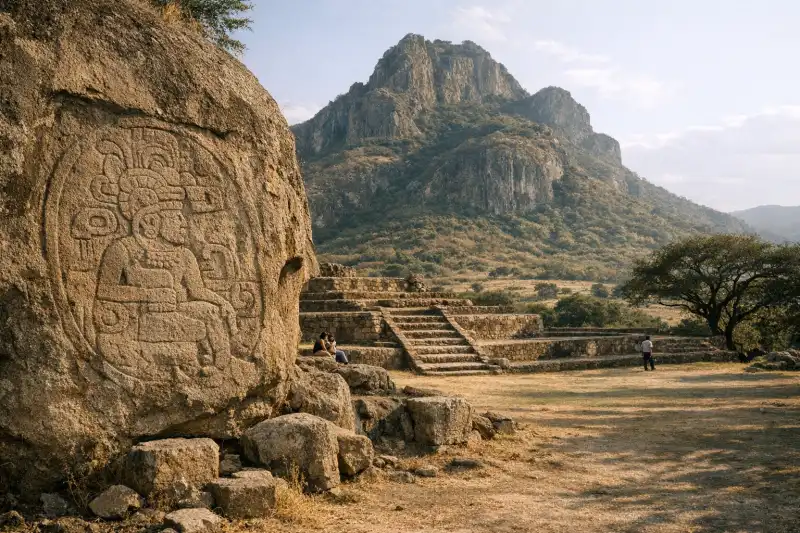
Chalcatzingo
Preclassic Mesoamerican / Olmec-influencedChalcatzingo is a striking Olmec-era ceremonial site in Mexico known for carved reliefs, mountain sc...
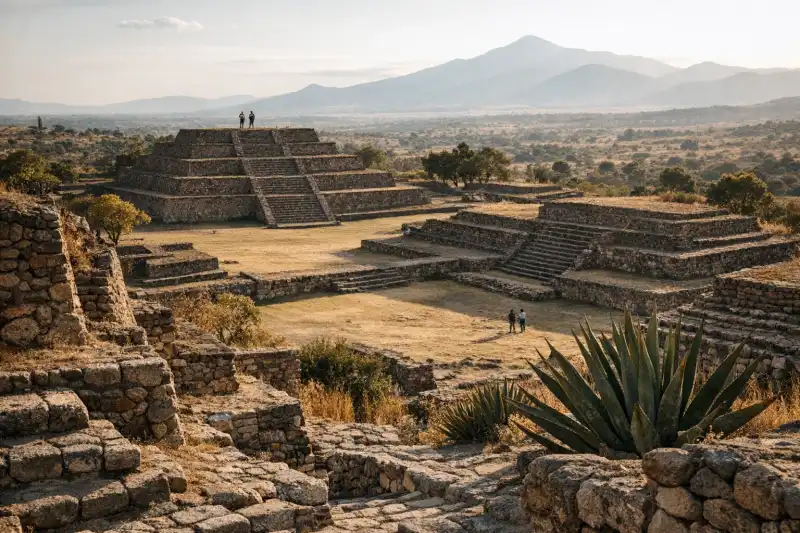
Cantona
MesoamericanExplore Cantona, a vast fortified archaeological city in Puebla, Mexico, known for its stone roads, ...