Quick Info
At a glance
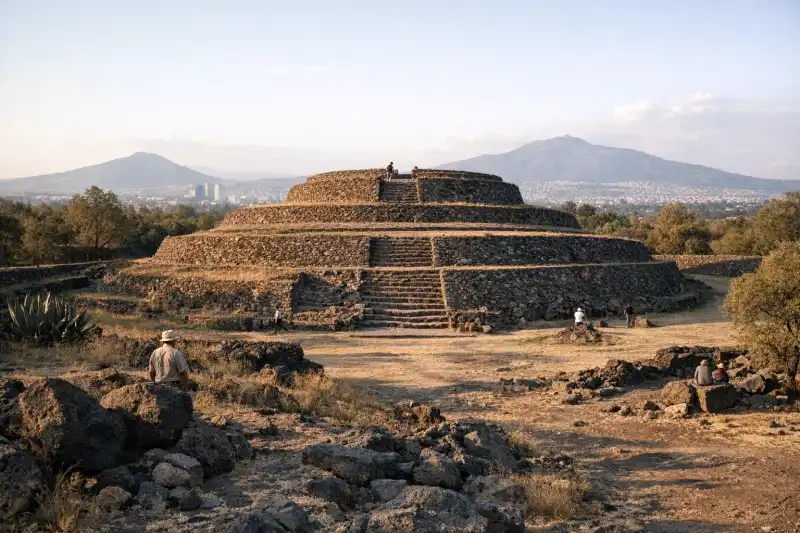
Cuicuilco, in Mexico, feels at first like a surprise hidden in plain sight. On the southern edge of Mexico City, amid major roads, modern neighborhoods, universities, and the dark volcanic landscape of the Pedregal, this ancient site preserves the memory of one of the earliest major ceremonial and population centers in the Valley of Mexico. Many travelers arrive expecting a brief stop and leave with a deeper sense of how old urban life in central Mexico truly is. The site’s most striking landmark, a broad circular pyramid rising in low terraces, looks unlike the more familiar stepped pyramids of later Mesoamerican civilizations, and that difference alone makes Cuicuilco memorable.
Yet the appeal of Cuicuilco is not only architectural. It is also a place where geology and history meet dramatically. The city flourished during the Preclassic period, drawing communities into an organized center of ritual, residence, and exchange. Then volcanic eruptions from nearby Xitle transformed the region, burying parts of the settlement in lava and ash and helping shift power toward other emerging centers. Standing at Cuicuilco today, you are looking at a site shaped by both human ambition and natural force. Green lawns soften the setting, but the black basalt around the area reminds visitors that this was once a landscape of sudden destruction. For anyone interested in the earliest layers of Mexico City’s past, Cuicuilco offers a rare chance to see where one chapter ended and another began.
History
Early settlement and the rise of Cuicuilco
Cuicuilco began as a settlement during the Formative, or Preclassic, period, likely around 800 BCE, when communities in the Basin of Mexico were becoming more permanent and socially complex. Its location was advantageous. The southern valley offered access to fertile land, water resources, and routes connecting different ecological zones. Over time, what may have started as a modest community grew into a major regional center.
By the middle and late Preclassic period, Cuicuilco had become one of the most important settlements in central Mexico. Archaeological evidence suggests that it was not merely a ceremonial precinct but a substantial urbanized center with residential areas, public architecture, and evidence of social organization on a larger scale than earlier villages. Its people participated in broader Mesoamerican networks of exchange, ideas, and ritual practices. Ceramics and construction patterns indicate a society that was deeply rooted locally while also engaged with developments elsewhere in ancient Mexico.
The site’s best-known structure, the great circular pyramid, belongs to this era of growth. Its construction reflects planning, communal labor, and a distinctive architectural identity. Cuicuilco’s emergence is especially significant because it predates the later dominance of Teotihuacan and shows that the Basin of Mexico already had large ceremonial centers centuries before the Classic period.
A powerful center in the late Preclassic
At its height, probably between roughly 400 BCE and 150 CE, Cuicuilco may have covered a large area and supported a substantial population. Scholars have long argued that it was one of the principal political and religious centers of the southern Basin of Mexico. The city likely included not just elite or ritual architecture but neighborhoods, agricultural zones, and spaces for craft production.
This flourishing period coincided with a time of increasing complexity in Mesoamerica. Monumental architecture, specialized labor, and regional interaction were becoming more visible across several cultural spheres. Cuicuilco’s circular pyramid is often interpreted as part of a ceremonial core that anchored the city’s public life. Burials, offerings, and architectural remains suggest a community with formal ritual traditions and social differentiation.
Its importance may also be understood in relation to nearby regions. Cuicuilco occupied a strategic position between the lakes of the basin and routes leading southward. That location would have aided trade, migration, and communication. While later cities tend to overshadow it in popular imagination, Cuicuilco was part of the early story of urbanism in central Mexico and stands as evidence that large-scale planning and ceremonial construction were already well established before the Classic age.
Eruption, decline, and transformation
The most famous turning point in Cuicuilco’s history came with the eruptions of Xitle, a volcano in the Ajusco region to the southwest. These eruptions, dated broadly to the late Preclassic or early Classic period, spread lava flows across parts of the southern Basin of Mexico. The Pedregal landscape that still defines this area of modern Mexico City is the result.
The exact sequence of Cuicuilco’s decline remains debated, but volcanic activity clearly transformed the environment and likely made large parts of the settlement difficult or impossible to inhabit. Some sectors were buried under lava, while others may have been abandoned gradually as conditions changed. Population displacement probably followed, and some scholars have suggested that movements of people from the south of the basin contributed to the growth of Teotihuacan farther north, though the details remain uncertain.
Rather than imagining a single catastrophic moment, it is more accurate to think of Cuicuilco’s end as a process shaped by environmental disruption, political change, and shifting settlement patterns. What is clear is that the city lost its earlier prominence, and the historical spotlight in central Mexico moved elsewhere.
Rediscovery and archaeology
In modern times, Cuicuilco became increasingly important to archaeologists because it offered insight into a formative chapter of Mesoamerican history. Excavations in the 20th century revealed architecture, ceramics, tombs, and stratified volcanic deposits that helped researchers understand both the site’s chronology and the impact of Xitle’s eruption. Cuicuilco’s remains also became crucial to debates about the development of urbanism in central Mexico.
Today the preserved site is only part of the ancient settlement’s original extent. Modern urban growth has encircled it, and much of the wider archaeological landscape lies beneath contemporary development. Even so, the surviving ceremonial core remains a valuable and evocative place. It reminds visitors that the history of Mexico City did not begin with the Mexica or with Spanish colonial foundations, but stretches much deeper into the Preclassic world.
Key Features
The feature that defines Cuicuilco immediately is its great circular pyramid. This structure is unlike the sharply angular temple platforms many travelers associate with Mesoamerican archaeology. Broad, low, and ringed in concentric terraces, it rises with a calm massiveness that seems almost to grow from the ground rather than dominate it. The circular form is rare enough to make the site architecturally distinctive, and it encourages visitors to think beyond standard images of ancient Mexico. Walking around the pyramid, you notice how its geometry changes from different angles. It does not produce a single postcard view so much as a sequence of impressions: earthwork, platform, ceremonial monument, and landmark.
The pyramid’s location also matters. It sits within an open archaeological zone where lawns, paths, and scattered remains create a spacious atmosphere. Because the monument is not hemmed in by a dense cluster of towering structures, it can be appreciated in relation to the surrounding terrain. This helps visitors imagine Cuicuilco as part of a broader inhabited and ceremonial landscape rather than as an isolated building. The lower profile of the architecture invites slower observation. Instead of craning upward, you move laterally, tracing the lines of terraces and trying to reconstruct how ancient processions or gatherings might have unfolded here.
Beyond the main pyramid, the site includes additional structural remnants and mounded features that hint at a once much larger settlement. Some of these remains can appear modest at first glance, but they are important because they reveal that Cuicuilco was not simply a ritual platform in an empty field. It was a lived urban center with multiple architectural zones. Archaeology here often works through fragments: foundations, altered surfaces, artifact scatters, and the shape of the land itself. For visitors willing to look carefully, these subtler traces are part of the reward.
Another of Cuicuilco’s defining features is its relationship to volcanic geology. The surrounding Pedregal lava fields, formed by Xitle’s eruption, make the site one of the clearest places in central Mexico to see how environmental catastrophe can alter human history. Even if you do not walk extensively beyond the main archaeological area, the broader district retains the visual memory of lava terrain in dark stone, rough textures, and uneven ground. This geological context gives Cuicuilco unusual interpretive power. You are not only seeing ancient ruins; you are also seeing the aftermath of the event that helped end the city’s central role.
The setting inside modern Mexico City adds another layer of interest. Cuicuilco is one of those places where deep antiquity and contemporary life stand side by side. Roads, institutions, and neighborhoods surround the site, yet the archaeological zone feels quieter than its urban location suggests. This contrast can be striking. In one direction lies the metropolis, one of the largest cities in the world. In another lies a ceremonial center whose origins reach back more than two thousand years. That juxtaposition makes Cuicuilco especially powerful for travelers who want to understand the long continuity of settlement in the Valley of Mexico.
Visitors also appreciate the site’s manageable scale. Unlike some larger archaeological zones that demand half a day just to orient yourself, Cuicuilco can be explored without fatigue. This makes it ideal for travelers with limited time or for those combining several museums and historic stops in southern Mexico City. The experience is contemplative rather than overwhelming. You can circle the main monument, pause to absorb the landscape, and leave feeling you have genuinely encountered something significant.
What ultimately makes Cuicuilco special is that it represents an earlier architectural and political world than the one most people know from central Mexico. Its forms, chronology, and fate all distinguish it. It is a place of transition, where pre-urban villages had already become a complex center, and where that center was then reshaped by volcanic force and by the rising importance of other cities. Few sites communicate so clearly that ancient history is never static. Cuicuilco’s surviving features are modest in number but rich in meaning, and that is exactly why the site stays with visitors.
Getting There
Cuicuilco is one of the easiest ancient sites in Mexico to reach because it lies within Mexico City rather than far out in the countryside. From the historic center or Reforma area, the simplest option is usually a taxi or rideshare. Depending on traffic, the journey often takes 30 to 60 minutes. Typical fares are around MXN 150 to 300 by app-based car service, though surge pricing and heavy congestion can raise the cost.
Public transport is cheaper but may require a little patience. One common approach is to take the Metro or Metrobús toward the south of the city and then connect by local bus, taxi, or a short rideshare ride. Combined public transport costs are usually under MXN 20 to 40, making this a budget-friendly option. If you are staying near Coyoacán, Tlalpan, or the UNAM area, Cuicuilco is especially easy to fit into a day of exploration.
Many visitors pair Cuicuilco with other southern Mexico City attractions, such as the UNAM campus, museums, or the ecological areas around the Pedregal. Organized archaeology or city tours occasionally include the site, though it is more often visited independently. If you prefer a guided experience, look for day tours focusing on ancient Mexico City, and expect prices from roughly USD 40 upward depending on duration and inclusions.
Driving yourself is possible, but Mexico City traffic can be intense, and parking availability may vary. For most travelers, rideshare or a taxi remains the least stressful option.
When to Visit
Cuicuilco can be visited year-round, but the most comfortable months are generally during the dry season, from November through April. During this period, skies are often clearer, temperatures are mild, and walking around the open site is more pleasant. Morning visits are especially enjoyable, as the air is cooler and the light can be excellent for photography. If you want a calmer experience, try arriving earlier in the day before the surrounding city reaches its busiest rhythm.
The rainy season, typically from May to October, brings greener vegetation and a softer atmosphere, but afternoon showers are common. Rain usually does not make a visit impossible, though paths may feel slick and weather can change quickly. If you visit in these months, aim for the morning and bring light rain protection. The lushness of the grounds after rain can make the archaeological zone quite attractive, even if clouds limit long-distance views.
Because Cuicuilco is in Mexico City’s high-altitude environment, sunlight can be strong even on cooler days. Sunscreen, water, and a hat are useful in every season. Weekends and public holidays may see more local visitors, particularly families and people exploring the south of the city. If you prefer a quieter atmosphere for reading signs and taking photos, weekdays are generally best.
There is no dramatic seasonal closure pattern that defines the site in the way extreme climates do elsewhere. Instead, the timing of your visit depends mostly on whether you value dry weather, thinner crowds, or easier combinations with other city sights. For most travelers, a dry-season weekday morning is the sweet spot.
| Quick Facts | Details |
|---|---|
| Site | Cuicuilco |
| Location | Southern Mexico City, Mexico |
| Region | Mexico City |
| Civilization | Preclassic Mesoamerican |
| Main monument | Circular pyramid |
| Earliest occupation | c. 800 BCE |
| Peak importance | Late Preclassic period |
| Famous for | Early urban center and unusual circular architecture |
| Historical turning point | Impact of Xitle volcanic eruptions |
| Typical visit length | 1–2 hours |
| Best access | Taxi, rideshare, or Metro plus local connection |
| Best time to visit | Dry season mornings, November to April |
Cuicuilco rewards travelers who enjoy places that are quieter than their historical importance would suggest. It does not overwhelm with towering temples or vast plazas, and that is part of its charm. Instead, it offers something subtler: a chance to stand at one of the earliest great centers of the Valley of Mexico, to see a pyramid unlike almost any other in the region, and to feel how ancient settlement, ritual, and environmental change shaped the landscape long before the rise of later empires. In a city famous for layers of history, Cuicuilco belongs to the deepest layer of all.
Guided tours: worth it?
Self-guided works here, but a guide can add real value if you want the ruins explained as a living place rather than just a sequence of monuments.
Best for
- First-time visitors who want context, not just photos
- Short visits where a planned route saves time
When to go self-guided
Go independently if you prefer setting your own pace, reading as you go, and checking official hours or ticket rules directly before you arrive.
What I’d avoid
Skip paid tours that bundle unrelated stops you do not actually want. The best option should either save meaningful planning time or add historical context you would miss on your own.
Mexico City archaeology tours
Useful when: you want to compare guided formats before deciding
Cuicuilco and south Mexico City tours
Useful when: you want to compare guided formats before deciding
Mexico City ancient sites tours
Useful when: you want to compare guided formats before deciding
Some tour links are affiliate links, which may earn Ancient Travel a small commission at no extra cost to you. I try to surface options that make practical sense for the site—not just anything bookable.
Frequently Asked Questions
What is Cuicuilco known for?
Cuicuilco is best known for its large circular pyramid and for being one of the earliest major urban centers in the Valley of Mexico.
Where is Cuicuilco located?
Cuicuilco is in southern Mexico City, Mexico, near Tlalpan and close to the UNAM campus and the Pedregal lava fields.
How much time do you need to visit Cuicuilco?
Most visitors spend 1 to 2 hours exploring the pyramid, open grounds, and small site museum area, though history enthusiasts may stay longer.
Is Cuicuilco worth visiting in Mexico City?
Yes, Cuicuilco is worth visiting for travelers interested in early Mesoamerican history, unusual architecture, and a quieter archaeological site within the city.
How do you get to Cuicuilco?
You can reach Cuicuilco by taxi, rideshare, bus, or Metro plus connecting transport from central Mexico City, making it an easy half-day trip.
Why is Cuicuilco circular?
The exact reason is still debated, but its circular pyramid likely reflects a local architectural tradition and ceremonial design distinct from later rectangular pyramids.
Nearby Ancient Sites
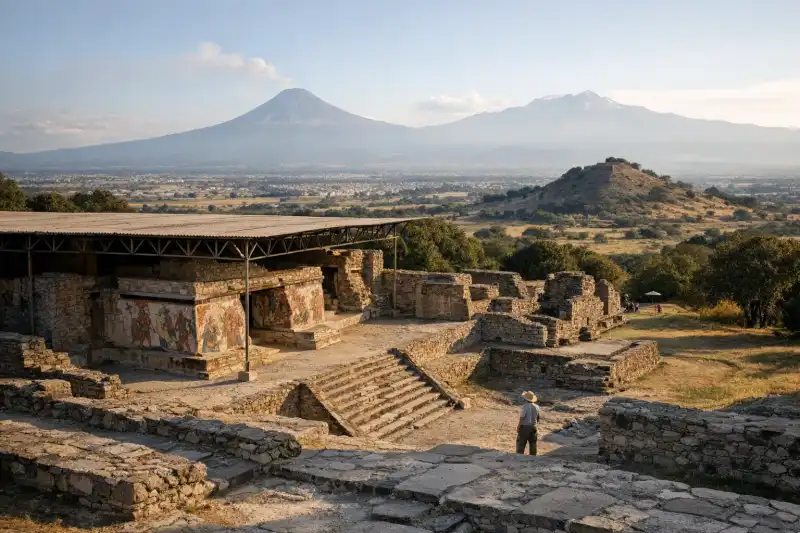
Cacaxtla
Olmeca-Xicalanca and broader Epiclassic Mesoamerican traditionsExplore Cacaxtla in Mexico, a hilltop archaeological site famed for vivid murals and Epiclassic hist...
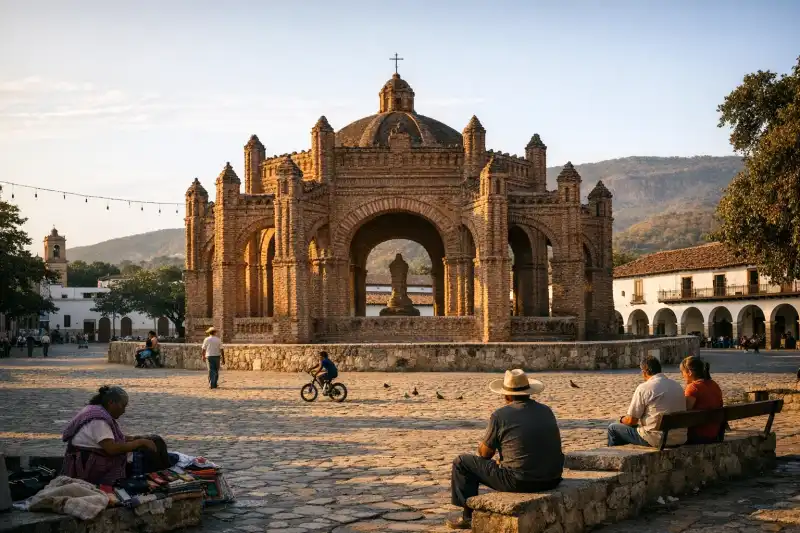
Chiapa de Corzo
Zoque and earlier Mesoamerican culturesExplore Chiapa de Corzo, Mexico, a major early Mesoamerican site beside the Grijalva River in Chiapa...
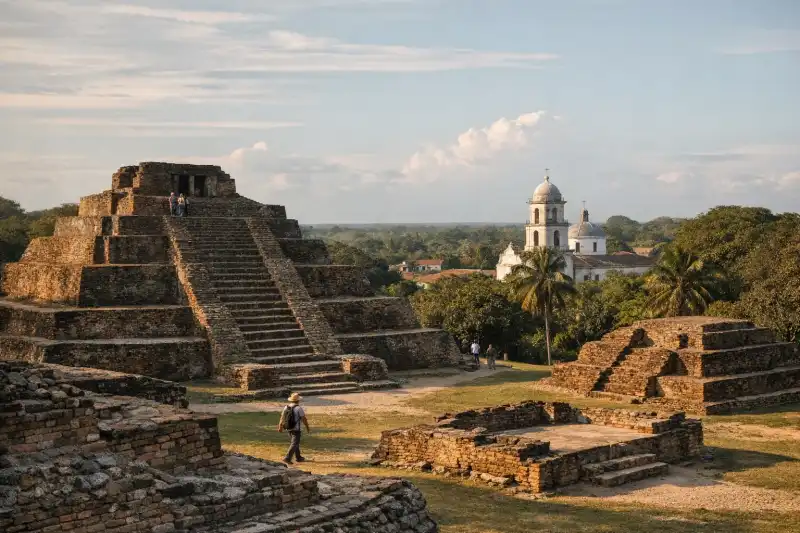
Comalcalco
MayaExplore Comalcalco, Mexico's distinctive Maya city built with brick, carved stucco, and rich Gulf Co...