Quick Info
At a glance
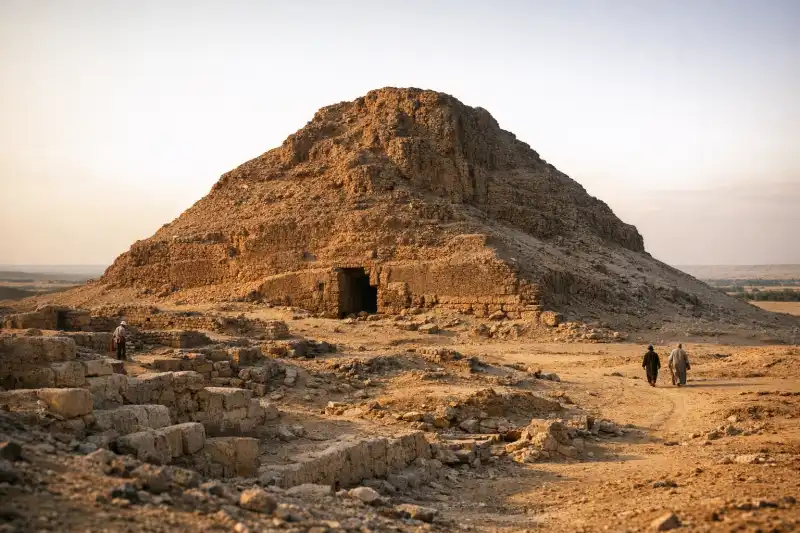
El-Lahun Pyramid in Egypt sits where cultivated land gives way to desert, at the threshold of the Faiyum depression and the Nile Valley beyond. It is not the tallest pyramid in the country, nor the most polished, nor the easiest to recognize from a distance. Yet that is part of its appeal. This is a monument that rewards curiosity more than spectacle. Built for Pharaoh Senusret II during the Middle Kingdom, El-Lahun belongs to a period when Egyptian kingship was still deeply invested in pyramid building, but was also experimenting with new architectural ideas, practical deception, and more complex relationships between royal tombs, worker settlements, and provincial landscapes.
For many travelers, the site feels quieter and more reflective than Egypt’s more famous pyramid fields. The desert around it holds traces of ancient planning, labor, and ritual rather than the dramatic crowds associated with Giza. Nearby stood Kahun, the carefully laid out town built for the workers, officials, and craftsmen involved in the royal project. Together, the pyramid and its surrounding remains offer a rare sense of how a pyramid complex functioned as a living center of administration and labor, not just as a monumental tomb. Visiting El-Lahun means stepping into a chapter of Egyptian history that is often overshadowed by the Old Kingdom giants, but no less fascinating for anyone interested in engineering, kingship, and the everyday machinery of ancient state power.
History
Senusret II and the Middle Kingdom Vision
El-Lahun Pyramid was constructed for Senusret II, a king of Egypt’s 12th Dynasty, generally dated to the late 19th century BCE. By this time, Egypt had moved beyond the political fragmentation that followed the Old Kingdom. The Middle Kingdom was marked by renewed central authority, administrative sophistication, and ambitious state projects. Senusret II is especially associated with the development of the Faiyum region, where irrigation and land management transformed the area into an economically important agricultural zone.
The placement of his pyramid at El-Lahun was not accidental. The site stood near the entrance to the Faiyum, symbolically linking the king to a region undergoing royal investment and practical development. Rather than simply recreating the formula of earlier pyramid fields, the builders adapted the monument to local topography and new architectural priorities. The core was laid around a natural limestone outcrop, which reduced building material needs and created a solid central mass. This approach shows a practical engineering mindset that differed from the massive all-masonry methods of earlier royal pyramids.
A Pyramid Designed to Mislead
One of the most intriguing features of El-Lahun is its unusual entrance arrangement. Earlier pyramids often announced their access points in more predictable positions, typically on the north side. At El-Lahun, the actual entrance was hidden and placed away from that expected pattern, likely to confuse tomb robbers. This choice reflects a long Egyptian struggle against looting, a problem that had already affected royal burials for centuries.
Inside, the pyramid’s passages and chambers reveal how Middle Kingdom architects balanced ritual logic with defensive thinking. The burial chamber itself was built of granite and designed with the precision expected of royal funerary architecture. Even so, the precautions were not enough to guarantee permanent security. Like many ancient Egyptian royal tombs, the pyramid was eventually entered and plundered in antiquity. What remains valuable today is not intact treasure, but the evidence of planning, design, and changing ideas about royal burial.
The superstructure, originally cased in fine limestone, has suffered heavily over time. Much of the outer stone was stripped in later periods, leaving the monument with its more rugged, eroded appearance. That weathered form can make the pyramid seem less impressive at first glance, but it also exposes something important: the skeleton of construction beneath the polished image that ancient kings intended to project.
Kahun and the Human World Around the Monument
The history of El-Lahun cannot be separated from Kahun, also known as the workers’ town associated with the pyramid complex. This settlement is among the most important archaeological discoveries related to Middle Kingdom Egypt. Built to house the labor force and administrative personnel serving the royal project, Kahun offers a remarkable glimpse into planned urban life.
Excavations revealed streets, houses, workshops, and written records that shed light on ordinary and official life alike. Archaeologists found papyri and objects connected to administration, medicine, domestic routines, and religious practice. These discoveries transformed El-Lahun from a single monument into part of a much broader historical landscape. Through Kahun, historians have been able to reconstruct how a pyramid project drew together scribes, priests, builders, and families into a state-managed community.
This wider context is one reason El-Lahun matters so much. It is not simply a ruin of royal ambition; it is a place where elite ideology and everyday labor intersected. In the shadow of Senusret II’s tomb, a functioning town once operated with all the complexity of food supply, housing, record-keeping, and social hierarchy.
Excavation, Study, and Modern Understanding
Modern archaeological attention to El-Lahun and Kahun increased significantly in the late 19th and early 20th centuries, when British archaeologist Flinders Petrie worked in the area. Petrie’s methods, though shaped by the standards of his time, were influential in showing the importance of careful excavation beyond spectacular finds. At El-Lahun and Kahun, the value lay as much in plans, pottery, tools, texts, and settlement remains as in monumental architecture.
Subsequent research has continued to refine understanding of the pyramid’s construction and the role of the surrounding complex. Scholars now view El-Lahun as one of the key monuments for understanding Middle Kingdom royal architecture. It demonstrates how Egyptian kings adapted pyramid building after the age of the great Old Kingdom pyramids, using different materials, new internal arrangements, and a landscape-based strategy tied to regional power.
Today, El-Lahun remains less visited than better-known Egyptian sites, but that relative quiet gives it a special atmosphere. It is a place where the history of kingship, labor, urban planning, and archaeological discovery all overlap in a compact but deeply significant setting.
Key Features
El-Lahun Pyramid’s most striking feature is its setting. Unlike the dramatic concentration of pyramids at Giza, this monument stands in a more transitional landscape, near the edge of the Faiyum basin. The position gives the site a sense of strategic purpose. It feels tied to movement and threshold, marking a point where royal architecture meets agricultural ambition. For Senusret II, the pyramid was not just a tomb in the desert; it was part of a statement about control over land and resources.
Architecturally, the pyramid is notable for the way it was built around a natural limestone knoll. This choice reduced the amount of stone needed and provided a stable core, but it also reminds visitors that Egyptian pyramid building was never as rigidly formulaic as it may seem in simplified histories. The monument originally had a mudbrick core strengthened with stone elements and finished with fine limestone casing. Much of that outer finish is gone now, which means modern visitors see a more skeletal structure than ancient Egyptians did. Even so, the surviving form reveals important evidence of Middle Kingdom construction methods, including the shift toward more economical materials compared with the vast stone masses of earlier pyramids.
Another key feature is the hidden entrance. This is one of the pyramid’s most discussed details because it demonstrates a practical response to tomb robbery. Rather than placing the entrance where intruders might instinctively search, the architects concealed it in a less expected location. That decision makes the building feel almost secretive, as though the designers understood that royal eternity required misdirection as much as monumentality. It also reflects a broader pattern in Middle Kingdom funerary architecture, where internal complexity and security grew increasingly important.
The burial chamber area, though not preserved in the pristine condition travelers may imagine, remains central to the site’s significance. It was built with royal-level precision and intended to protect the king’s remains and funerary equipment. The chamber’s granite construction speaks to the continued prestige of hard stone in elite funerary design. While looting in antiquity stripped the tomb of much of its original content, the structural remains still convey the seriousness with which burial space was conceived. Here, engineering served theology: the king’s tomb had to endure physically in order to support his eternal transformation.
Beyond the pyramid itself, the broader complex is one of El-Lahun’s greatest strengths. The nearby remains of Kahun make this destination different from many isolated funerary sites. The town allows visitors to imagine the social machinery that made a royal monument possible. Workers had to be housed, materials had to be tracked, rations distributed, ceremonies organized, and tools maintained. The surviving traces of this settlement give El-Lahun unusual interpretive depth. Instead of seeing only the final monumental product, you get evidence of the human systems behind it.
The landscape around the site also contributes to its character. Desert winds, muted colors, and wide horizons create an atmosphere that feels less theatrical than some of Egypt’s headline attractions but more contemplative. This can be especially rewarding for travelers interested in archaeology rather than spectacle. The site encourages close observation: the shape of the mound, the surviving masonry, the relation between settlement and tomb, and the way geography influenced royal choices.
What many visitors remember most is not one single photogenic angle, but the cumulative sense of standing at a place where ancient planning becomes visible. El-Lahun is a pyramid, but it is also a case study in adaptation. It shows how Egypt’s rulers preserved the prestige of pyramid burial while modifying design, materials, and placement to fit a changing political and practical world. For travelers who want to move beyond the standard list of famous monuments, that layered significance is exactly what makes El-Lahun memorable.
Getting There
El-Lahun Pyramid is most commonly reached from Cairo as part of a private day trip to the Faiyum region. By road, the journey usually takes around 2 to 3 hours depending on traffic and your exact starting point. A private car with driver is the simplest option for international visitors, especially because public transport connections to the immediate archaeological area can be indirect. A full-day car hire from Cairo often costs roughly EGP 2,500 to 5,000 depending on vehicle type, duration, and whether a guide is included.
Budget travelers can combine microbuses or shared transport to Faiyum with a local taxi onward to Lahun, but this requires flexibility and some Arabic or local assistance. Cairo to Faiyum shared transport may cost around EGP 80 to 150 per person, while a local taxi for the final leg can vary widely, often from EGP 200 to 500 depending on negotiation, waiting time, and return arrangements. Because site access conditions can change, many travelers prefer to arrange a driver who stays with them.
Guided tours can be particularly useful here. Unlike major museum-style attractions, El-Lahun benefits from context, and a knowledgeable guide can connect the pyramid to Senusret II, Kahun, and the wider Middle Kingdom landscape. Tour prices vary considerably, but a private archaeology-focused excursion from Cairo can start around USD 80 to 150 per person, with premium custom trips costing more.
Bring water, sun protection, cash for small local expenses, and sturdy shoes. Facilities at or near less-visited sites may be limited, so it is best to arrive prepared rather than expect the visitor infrastructure found at Egypt’s busiest landmarks.
When to Visit
The best time to visit El-Lahun Pyramid is from October to April, when temperatures in Egypt are generally milder and walking in open desert conditions is much more comfortable. During these months, daytime temperatures are usually suitable for exploring archaeological landscapes without the intense heat that can quickly drain energy. Winter, especially December through February, often offers the most pleasant conditions for photography and slow-paced visits.
Spring can be an excellent season as well, especially in March and early April, though occasional khamsin winds may bring dust and haze. If you are planning a broader Faiyum itinerary that includes outdoor stops, spring light can be beautiful, but it is wise to check forecasts. Summer visits from May through September are possible, yet the heat can be severe, especially around midday. If you come in summer, start as early as possible and keep the visit short and well supplied with water.
Time of day matters almost as much as season. Morning is usually the best window, both for cooler temperatures and for softer light across the desert terrain. Early arrivals also make the site feel even more remote and atmospheric. Late afternoon can be attractive for photography, but you will want to confirm travel timing so you are not navigating rural roads after dark unless transport is prearranged.
If your main interest is archaeology rather than crowd avoidance, the good news is that El-Lahun is generally quieter year-round than Egypt’s marquee attractions. That means the ideal visit is less about escaping crowds and more about choosing weather that lets you appreciate the site slowly and comfortably.
| Quick Facts | Details |
|---|---|
| Location | Near Lahun at the entrance to the Faiyum region, Egypt |
| Builder | Pharaoh Senusret II |
| Dynasty | 12th Dynasty |
| Period | Middle Kingdom |
| Date | c. 1897-1878 BCE |
| Type | Royal pyramid complex |
| Distinctive Feature | Hidden entrance designed to deter tomb robbers |
| Associated Settlement | Kahun, a planned workers’ town |
| Best Base | Cairo or Faiyum |
| Ideal Visit Length | 1-2 hours for the pyramid area, longer with nearby sites |
El-Lahun Pyramid may not compete with Egypt’s most famous monuments in scale or preservation, but it offers something many blockbuster sites cannot: a strong sense of historical process. Here you can see how pyramid building evolved, how royal authority shaped landscapes beyond the capital, and how a tomb was inseparable from the community that served it. The monument’s battered exterior, hidden access, and connection to Kahun make it especially rewarding for travelers who enjoy piecing together the logic of ancient places.
In practical terms, El-Lahun is best approached with preparation and patience. It works particularly well for repeat visitors to Egypt, archaeology enthusiasts, and anyone interested in the Middle Kingdom’s quieter achievements. Yet even first-time travelers can find it compelling if they arrive ready to look beyond polished surfaces. This is a site about ingenuity rather than grandeur alone.
Standing at El-Lahun, you are looking at a royal experiment in stone, mudbrick, landscape, and secrecy. It marks the ambitions of a king, the work of a community, and the endurance of a monument that still has much to say about ancient Egypt’s changing priorities. For those willing to seek it out, that makes El-Lahun one of the country’s most intellectually satisfying pyramid visits.
Guided tours: worth it?
Most travelers can visit El-Lahun Pyramid independently. Compare a tour only if you want a tighter history-focused visit, easier logistics, or a guide who can answer questions on the spot.
Best for
- Short visits where a planned route saves time
When to go self-guided
Go independently if you prefer setting your own pace, reading as you go, and checking official hours or ticket rules directly before you arrive.
What I’d avoid
Skip paid tours that bundle unrelated stops you do not actually want. The best option should either save meaningful planning time or add historical context you would miss on your own.
Cairo to Faiyum and El Lahun Pyramid Tours
Useful when: you want to compare guided formats before deciding
Egypt Middle Kingdom Sites and Faiyum Day Tours
Useful when: you want to compare guided formats before deciding
Cairo Desert Pyramids and Faiyum Archaeology Tours
Useful when: you want to compare guided formats before deciding
Some tour links are affiliate links, which may earn Ancient Travel a small commission at no extra cost to you. I try to surface options that make practical sense for the site—not just anything bookable.
Frequently Asked Questions
Where is El-Lahun Pyramid located?
El-Lahun Pyramid stands at the entrance to the Faiyum region in Egypt, near the modern village of Lahun and south of Cairo.
Who built El-Lahun Pyramid?
It was built for Pharaoh Senusret II of Egypt's 12th Dynasty during the Middle Kingdom, around the 19th century BCE.
Why is El-Lahun Pyramid important?
The pyramid is important for its unusual hidden entrance, its connection to Middle Kingdom royal burial traditions, and its proximity to the planned town of Kahun, one of Egypt's best-known ancient workers' settlements.
Can visitors go inside El-Lahun Pyramid?
Access policies can change depending on conservation work and site management, so travelers should confirm locally or with a guide before planning on entering internal passages.
How do you visit El-Lahun Pyramid from Cairo?
Most visitors come by private car, taxi, or guided day trip from Cairo to Faiyum, often combining El-Lahun with other regional sites.
How much time should I allow for a visit?
Allow around 1 to 2 hours for the pyramid area itself, and more if you plan to explore nearby archaeological locations in the Faiyum.
Nearby Ancient Sites
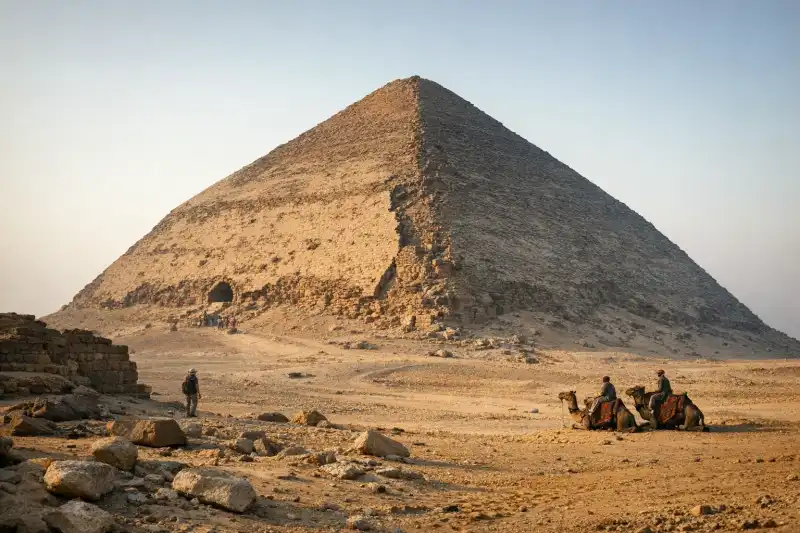
Bent Pyramid
Ancient EgyptianThe Bent Pyramid in Egypt is a rare Old Kingdom monument where a dramatic change in angle reveals th...
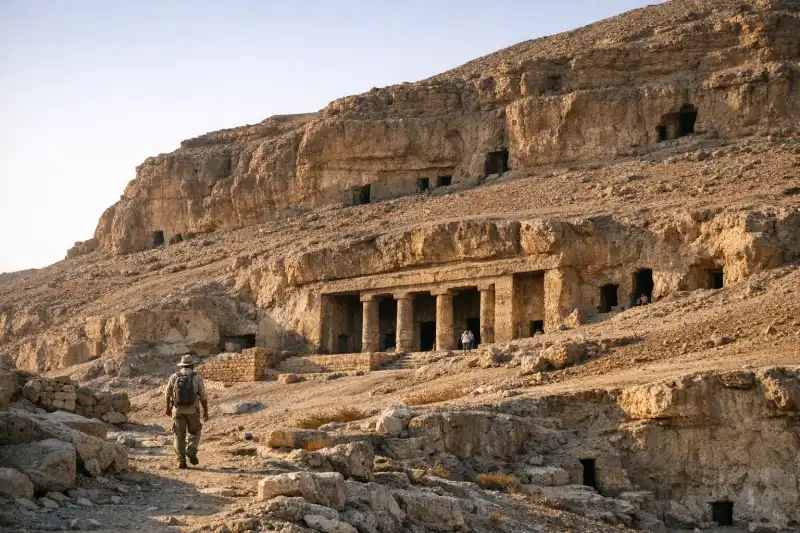
Beni Hassan Tombs
Ancient EgyptianRock-cut Middle Kingdom tombs in Egypt famed for vivid wall paintings, provincial elite burials, and...
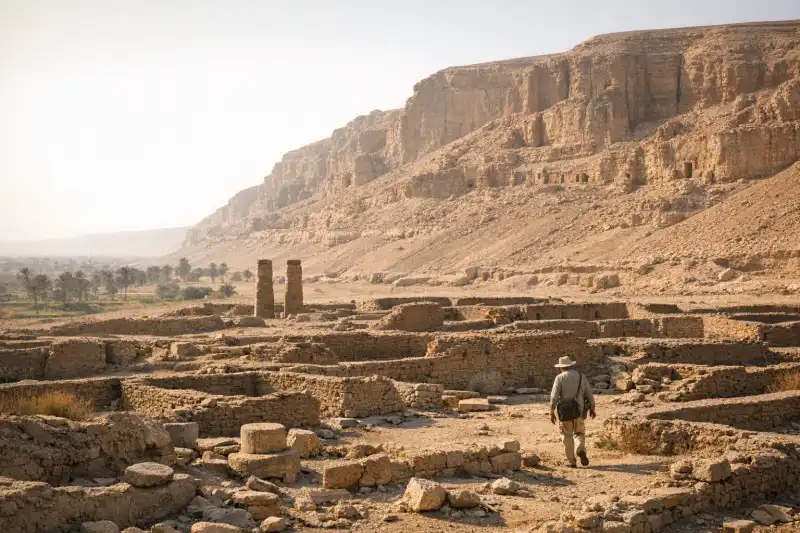
Amarna
Ancient EgyptianExplore Amarna in Egypt, Akhenaten’s short-lived royal capital, known for boundary stelae, desert to...