Quick Info
Curated Experiences
Fiesole Half-Day Archaeology Tour from Florence
Fiesole and Florence Hills Cultural Day Tour
The bus from Florence takes twenty minutes, and the change is total. One moment you are in Renaissance traffic, wedged between tour groups and scooters on the Arno’s north bank. The next you are climbing a narrow road through olive groves and cypress corridors, watching Florence shrink into a terracotta panorama below. At the top, the small piazza of Fiesole feels like a village that got away with something — it sat above one of Europe’s most visited cities for two thousand years and never got swallowed by it.
Walk through the archaeological area’s gate and the reason for that independence becomes clear. Fiesole was here first. Long before Florence existed as anything more than a marshy river crossing, the Etruscans built a fortified settlement on this hilltop because it commanded the Arno valley, the Mugnone stream corridors, and the major overland routes between northern and central Italy. When Rome absorbed the Etruscans, it built a theatre, a bath complex, and a temple directly over the older settlement. The result is a compact, layered archaeological site where you can read the transition from Etruscan hill-fortress to Roman municipal town in a single afternoon, standing in one place.
For travelers who are spending most of their time in Florence’s Renaissance museums, Fiesole offers something no Uffizi gallery can: physical evidence that this landscape was urban, strategic, and contested a thousand years before Brunelleschi raised his dome.
Historical Context
Fiesole — ancient Faesulae, and before that the Etruscan Vipsul or Visul — was established as a significant hilltop settlement by at least the 8th century BCE, making it one of the oldest continuously occupied sites in Tuscany. Its position at roughly 300 meters above the Arno plain gave it natural defensive advantages and control over the valley below. Archaeological evidence suggests Etruscan Fiesole was a center of regional importance, part of the network of independent Etruscan city-states that dominated central Italy before Roman expansion. The city’s territory likely extended across the surrounding hills and into the Arno basin, making it one of the larger Etruscan polities in the Florentine region.
The city’s walls — stretches of which survive today in massive Etruscan polygonal masonry on the slopes below the piazza — enclosed a substantial area and demonstrate the engineering sophistication of pre-Roman urbanization. These walls were not ceremonial. They were military infrastructure built by a culture that understood the hilltop’s vulnerability to siege from multiple approach routes. The largest surviving blocks weigh several tons and are fitted without mortar, relying on precision-cut faces for structural integrity. This technique, known as opera poligonale, is characteristic of Etruscan fortification work across central Italy and places Fiesole in the same engineering tradition as Volterra, Perugia, and Cortona.
Roman Fiesole emerged gradually. The city was allied with Rome by the 3rd century BCE and became a Roman colony in the 1st century BCE, when veterans from Sulla’s campaigns were settled there following the civil wars. This was not a peaceful transition. Fiesole had supported the wrong side in the conflict between Marius and Sulla, and its territory was confiscated and redistributed to Roman veteran settlers. The Romans retained the hilltop location but added their own civic infrastructure: the theatre you see today, carved into the hillside around the 1st century BCE or early 1st century CE, and a bath complex that demonstrates even a provincial municipium could provide public bathing facilities on the Roman model. A temple, likely dedicated to a Roman state deity, was built on the upper terrace, occupying ground that probably had sacred significance in the Etruscan period as well.
Fiesole appears again in history during the late Republic when it served as a base for the Catiline conspiracy in 63 BCE. Catiline’s rebel forces gathered in the hills around Fiesole before their final defeat, an episode that Cicero made famous in his orations. The connection underscores Fiesole’s position as a strategic rally point with deep local loyalties that survived Roman incorporation.
The site’s fortunes declined as Florence — originally a minor Roman colony in the plain below — grew in political and economic importance during the medieval period. By the time Florence became a Renaissance powerhouse, Fiesole had been eclipsed entirely, though it retained its bishopric and its hilltop identity. The irony is that Florence’s success preserved Fiesole’s archaeology. Because the hilltop never became a major medieval or Renaissance building site, the Roman and Etruscan layers survived largely intact beneath thin soil cover. Systematic excavation beginning in the 19th century revealed the theatre, baths, temple platform, and museum-quality artifacts that form the archaeological area visitors see today.
What to See
The Roman Theatre
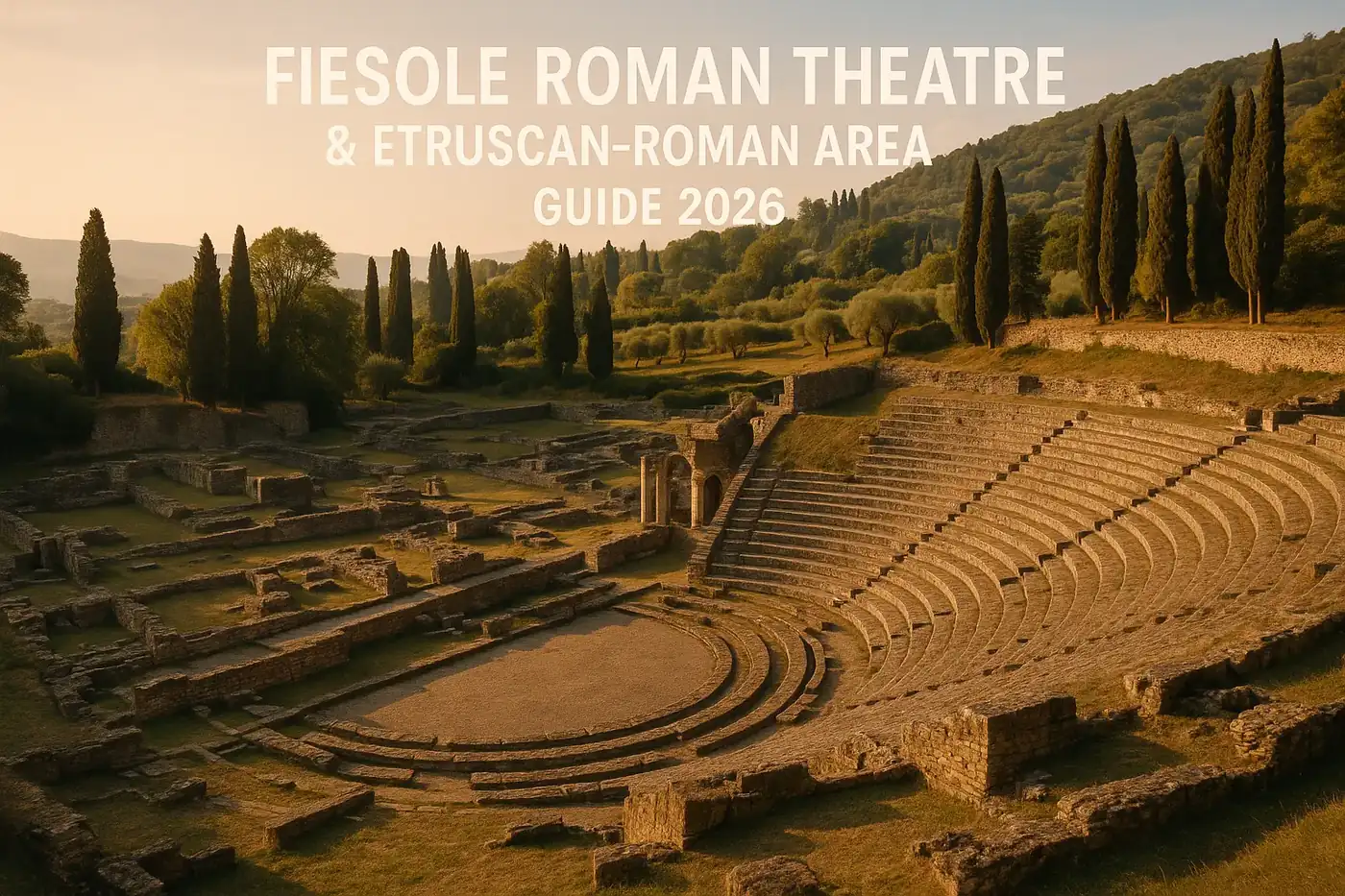
The theatre is the centerpiece of the archaeological area and the single most impressive structure on site. Built into the natural slope of the hill, it could seat approximately 3,000 spectators — a respectable size for a provincial Roman town and roughly comparable to the theatre at Volterra. The cavea (seating bowl) is well preserved, with enough tiers surviving to make the spatial experience of Roman theatrical architecture immediately legible. The orchestra floor and stage-building foundations are clearly traceable, and the theatre’s orientation takes advantage of the hillside acoustics and the valley views behind the stage.
Unlike Rome’s massive entertainment venues, this theatre operates at a human scale that makes the relationship between audience, performer, and landscape easy to understand. You can sit on the surviving stone seating and look across the stage area to the Tuscan hills beyond, experiencing the same sightlines that Roman audiences had. The stone is warm in the afternoon sun, and the acoustics remain surprisingly effective — a conversation at normal volume in the orchestra carries clearly to the upper tiers.
The theatre is still used for live performance. The Estate Fiesolana festival runs from June through September and stages music, dance, and theatre in the ancient venue. Catching a performance here is one of the most atmospheric live-arts experiences in Tuscany, and tickets are remarkably affordable for what you get: ancient architecture, hilltop setting, and the lights of Florence visible below after dark.
Practical tip: Descend to the orchestra floor and look up at the seating tiers to feel the scale. Then climb to the top row for panoramic views across the archaeological zone and the Florentine hills. Morning light is best for photography of the stone detail.
The Roman Baths
Adjacent to the theatre, the bath complex survives as a series of low walls and room foundations that reveal the standard Roman bathing sequence: frigidarium (cold room), tepidarium (warm room), caldarium (hot room), and furnace areas. The remains are less visually dramatic than the theatre but equally important for understanding what Roman municipal life actually looked like outside the capital. Even a small Tuscan hill town got heated public baths, which tells you something about how deeply the bathing habit was embedded in Roman civic identity.
Look for the surviving sections of the hypocaust system — the under-floor heating channels supported by small brick pillars (pilae). These fragments connect Fiesole to the same engineering tradition visible at the Baths of Caracalla in Rome, just executed at a fraction of the scale. The bath complex also shows evidence of multiple construction phases, suggesting it was maintained and expanded over several centuries of use.
The baths were supplied by an aqueduct system that brought water from higher elevations in the surrounding hills. Traces of the water-supply infrastructure have been found during excavation, though they are not prominently displayed.
Practical tip: The bath foundations are most legible when the sun is low and the shadows emphasize the wall lines. Visit this section early in the morning or in the last hour before closing.
The Temple Terrace
On the upper level of the archaeological area, a raised platform marks the site of a Roman temple, built over what may have been an earlier Etruscan sacred precinct. The surviving foundations show the temple’s orientation and approximate footprint, though the superstructure is entirely gone. What matters here is position: this was the highest point of the civic center, deliberately placed above both the theatre and the baths. The Romans understood vertical hierarchy, and the temple’s elevation over the entertainment and bathing facilities made its symbolic dominance clear to anyone moving through the town.
The temple terrace also provides the best overview of the archaeological area as a whole. From here you can see how the different components — theatre, baths, temple, surrounding walls — relate to each other spatially and how the Romans organized civic functions within the hilltop terrain.
Practical tip: The temple terrace offers some of the best views of the theatre from above. Use this vantage to photograph the full cavea and stage layout. The perspective also makes clear how the theatre was carved from the hillside rather than built freestanding.
The Civic Archaeological Museum
Housed in a building adjacent to the archaeological area (included in the combined ticket), the Museo Civico Archeologico contains artifacts spanning the Etruscan, Roman, and Lombard periods. The Etruscan funerary objects — urns, bronze mirrors, and ceramics — are the highlights, providing the cultural context that the outdoor ruins alone cannot deliver. A carved Etruscan funerary stele and several bucchero pottery pieces (the distinctive black-fired Etruscan ceramics) are particularly fine.
The Roman collection includes coins, glass, architectural fragments, and household objects that help you imagine daily life in the provincial town. The Lombard-period material fills in the gap between the Roman decline and the medieval period, a transition that is poorly documented at most Italian archaeological sites.
The museum is small enough to absorb in 30-45 minutes, and it significantly deepens the visit by connecting outdoor architecture to portable material culture. Without it, the site visit is primarily a spatial experience; with it, the spatial experience acquires human detail.
Practical tip: Visit the museum before or after the outdoor site, not during. It works best as either orientation (context first, then ruins) or consolidation (ruins first, then artifacts that anchor what you saw). The museum is cooler than the open-air site, making it a good midday refuge in summer.
The Etruscan Walls
Scattered along the slopes below the piazza and the archaeological area, segments of massive polygonal masonry survive from the original Etruscan fortification circuit. The blocks are enormous — some weighing several tons — and fitted without mortar in the characteristic Etruscan style. These wall fragments predate everything else you see in Fiesole and represent the oldest visible architecture on the hill.
Finding them requires a short walk outside the archaeological area proper, but they are worth the detour because they physically demonstrate the depth of Fiesole’s pre-Roman occupation. The wall construction technique is directly comparable to what you find at Volterra, Cortona, and other Etruscan hilltop cities, establishing Fiesole as part of a wider Etruscan engineering tradition.
Practical tip: The best-preserved wall section is along Via delle Mura Etrusche, a few minutes’ walk from the main piazza. Combine this with the walk back to the bus stop. The wall is partially overgrown, which adds atmosphere but makes photography slightly challenging — a wide-angle lens helps.
Timing and Seasons
Best months: April through June and September through October. Temperatures range from 60-80°F (15-27°C), the light is ideal for ruins photography, and the hilltop breezes keep conditions comfortable. May and June are particularly good because the surrounding olive groves and cypress trees are at their greenest, creating a vivid contrast with the grey Roman stone.
Summer (July-August): Hot (85-95°F / 30-35°C) with strong sun exposure in the open archaeological area. The Estate Fiesolana summer performance festival compensates for the heat — an evening show in the Roman theatre is one of the best things you can do in the Florence area during the summer months. If visiting midday, bring plenty of water and a hat.
Winter (November-March): Cool to cold (35-55°F / 2-13°C), occasionally foggy, and very quiet. The fog can obscure the valley views that give the site half its impact, so check the forecast before making the trip. On clear winter days, however, Fiesole is stunning and nearly empty, with crisp air and sharp shadows on the stone.
Best time of day: Arrive by 10:00 AM to beat both the heat and the day-trip crowds from Florence. The archaeological area sees its busiest period from 11:00 AM to 2:00 PM when tour groups overlap. Late afternoon (4:00-6:00 PM in summer) is excellent for golden-hour light on the theatre stone.
Tickets, Logistics and Getting There
Admission: A combined ticket for the archaeological area and museum costs approximately 10-12 EUR ($11-13 USD) for adults. Reduced rates are available for EU students and seniors. Children under 6 typically enter free. The ticket covers the theatre, baths, temple terrace, and museum in a single visit.
Hours: Generally 10:00 AM to 7:00 PM in summer (April through September), 10:00 AM to 5:00 PM in winter (October through March). Closed Tuesdays in the off-season. Confirm current hours before visiting, as schedules vary. Last entry is typically 30 minutes before closing.
Getting there from Florence by bus: ATAF bus 7 departs from Piazza San Marco in central Florence and reaches Fiesole’s main piazza in approximately 20-25 minutes. Buses run frequently throughout the day (every 15-20 minutes in peak hours). The fare is part of the standard Florence transit ticket system (approximately 1.50 EUR for a 90-minute ticket, purchased at tabacchi shops or machines before boarding). This is the recommended approach for most visitors — it is cheap, simple, and deposits you directly in front of the archaeological area entrance.
By taxi: A taxi from central Florence costs approximately 20-30 EUR ($22-33 USD) and takes 15-20 minutes depending on traffic. The return taxi can be called from any of the cafes in the piazza.
By car: Driving is straightforward but parking in Fiesole’s small hilltop center can be difficult, especially in summer. If you have a car, consider parking at one of the lower lots and walking up, or use the bus from Florence and save the car for wider Tuscany routing.
Estate Fiesolana tickets: If visiting during the summer festival (June-September), check the festival schedule at estatefiesolana.it and consider booking evening performance tickets in advance. Prices typically range from 15-35 EUR depending on the event.
Practical Tips
- Wear comfortable walking shoes with grip. The archaeological area includes uneven stone surfaces, loose gravel, and moderate slopes between the theatre, baths, and temple levels.
- Bring water, especially in warm months. There is no shade in the theatre bowl or on the temple terrace, and the exposed stone radiates heat in summer.
- The archaeological area is compact but not flat. Budget for gradual uphill walking between levels, and pace yourself if visiting in hot weather.
- Photography is unrestricted throughout the outdoor area. A wide-angle lens captures the theatre best from the upper tiers. From the orchestra floor, a normal lens gives better perspective on the seating scale.
- The Bandini Museum (Museo Bandini), next to the archaeological area, houses a small collection of medieval paintings and ceramics. If you have an extra 20 minutes and an interest in Tuscan art history, it is worth a quick visit.
- Fiesole’s main piazza has several cafes and restaurants with panoramic terrace seating overlooking the Florentine valley. Plan lunch here after your site visit — the view of Florence from above is the best in the metropolitan area, and the prices are lower than comparable restaurants in the city center.
- If you are combining Fiesole with a walk, the footpath from San Domenico (halfway between Florence and Fiesole on the bus route) passes through gardens and woodland with excellent views. You can take the bus up and walk down, or vice versa.
Suggested Itinerary
9:45 AM — Catch Bus 7 from Piazza San Marco in Florence.
10:10 AM — Arrive at Fiesole’s main piazza. Purchase a combined ticket and enter the archaeological area.
10:15 AM — Begin at the Roman theatre. Descend to the orchestra floor, sit on the stone seating, climb to the upper tiers, and spend 20-25 minutes studying the structure and photographing the valley views.
10:40 AM — Walk to the Roman baths. Examine the room foundations, hypocaust remains, and the bathing sequence layout. Allow 15-20 minutes.
11:00 AM — Climb to the temple terrace for an overview of the full archaeological zone. Photograph the theatre from above and study the spatial relationship between the civic buildings. Allow 10-15 minutes.
11:15 AM — Enter the Civic Archaeological Museum. Spend 30-40 minutes with the Etruscan funerary objects, Roman artifacts, and interpretive displays. Use the museum to anchor what you saw outdoors.
11:55 AM — Exit the museum and walk to Via delle Mura Etrusche to see the Etruscan wall segments. Allow 15-20 minutes for the walk and wall inspection.
12:15 PM — Return to the main piazza for lunch at one of the terrace restaurants. Enjoy the view of Florence below.
1:30 PM — Catch Bus 7 back to Florence, or walk down through the San Domenico footpath (approximately 30 minutes downhill, with good views) to Piazza San Marco.
Total Fiesole time: approximately 3.5 hours.
Nearby Sites
Volterra — The great Etruscan-Roman hilltop city in western Tuscany, about 90 minutes by car from Fiesole. If Fiesole gives you a compact taste of Etruscan-to-Roman continuity, Volterra gives you the full meal: monumental Etruscan gates, a larger Roman theatre, the finest Etruscan museum in Italy, and dramatic eroding cliffs that are actively consuming ancient burial grounds. The two sites together make a strong Tuscan archaeology weekend.
Roman Temples of Brescia — Northern Italy’s best-preserved Roman temple complex, about 2.5 hours from Florence by car or train. Brescia’s Capitolium and Santa Giulia museum complex (a UNESCO World Heritage Site) complement Fiesole by showing Roman civic religious architecture at a larger scale than Fiesole’s temple terrace, and with far more decorative material surviving in situ.
Colosseum and Roman Forum — Florence to Rome is 1.5 hours by high-speed train. Visitors who see Fiesole’s modest Roman theatre first will appreciate the Colosseum’s engineering ambition in sharper relief. The scale contrast between provincial and imperial Rome is one of the most instructive comparisons in Italian archaeology, and the fast train connection makes a day trip from Florence feasible.
Cortona — Another Etruscan hilltop town, about 1.5 hours southeast of Florence by car. Cortona’s MAEC museum (Museo dell’Accademia Etrusca) holds significant Etruscan artifacts and the town’s defensive walls show the same polygonal masonry technique visible in Fiesole’s surviving wall segments. A combined Fiesole-Cortona itinerary covers the northern and eastern edges of Etruscan Tuscany.
Final Take
Fiesole works because it does not try to compete with Rome or Pompeii. It offers something those places cannot: a compact, quiet, manageable site where you can stand in one spot and see two civilizations stacked on top of each other, with a Renaissance city spread out in the valley below to complete the timeline. The twenty-minute bus ride from Florence delivers you from one of the world’s great art cities to one of Tuscany’s oldest settlements, and the return trip puts everything in perspective. Florence was a Roman colony planted in the plain. Fiesole was the Etruscan stronghold on the hill above it. The older city lost the power struggle, but it kept its ruins, and those ruins are more honest about the deep past than anything hanging on a gallery wall.
Come in the morning, when the light is angled and the theatre stone glows warm against the green Tuscan hillside. Walk the site slowly, visit the museum, sit in the piazza with a coffee, and then ride the bus back down to Florence with a longer sense of time than you had when you left.
Discover More Ancient Wonders
- Volterra — Etruscan gates, Roman theatre, and one of Tuscany’s finest archaeological museums
- Roman Temples of Brescia — Northern Italy’s best-preserved Capitolium and the UNESCO-listed Santa Giulia complex
- Colosseum — Imperial Rome’s defining monument, 1.5 hours from Florence by fast train
- Pantheon — The most perfectly preserved Roman building, in the heart of modern Rome
- Explore our full Italy Ancient Sites Guide for complete planning resources
Quick Facts
| Attribute | Details |
|---|---|
| Location | Florence, Tuscany, Italy |
| Country | Italy |
| Region | Tuscany |
| Civilization | Etruscan / Roman |
| Historical Period | Etruscan era to Roman Imperial period |
| Established | Settlement roots from at least the 8th century BCE |
| Entry Fee | ~10-12 EUR ($11-13 USD) combined ticket |
| Hours | 10:00 AM to 5:00-7:00 PM (seasonal); closed Tuesdays off-season |
| Best Time | Weekday mornings, Apr-Jun or Sep-Oct |
| Coordinates | 43.8065, 11.2931 |
Frequently Asked Questions
Is Fiesole worth visiting if you already plan to see major Roman sites in Rome?
Yes. Fiesole offers a more compact, legible urban archaeology experience where Etruscan and Roman layers sit in one manageable hilltop context.
How long do you need at the Fiesole archaeological area?
Most travelers need 1.5 to 2.5 hours for the theatre, baths, temple area, and museum, with extra time if combining viewpoints and lunch in town.
Can you get to Fiesole from Florence without a car?
Yes. Public bus links are straightforward, making Fiesole one of the easiest archaeology-focused half-day trips from central Florence.
What is the key historical reason to visit Fiesole?
Fiesole helps explain continuity and change from Etruscan settlement to Roman municipium in a strategic hill location overlooking the Arno plain.
Is Fiesole family-friendly compared with larger archaeology parks?
Generally yes. The site is compact and easier to cover in a short window, though you should still expect uneven stone paths and sun exposure.
Nearby Ancient Sites
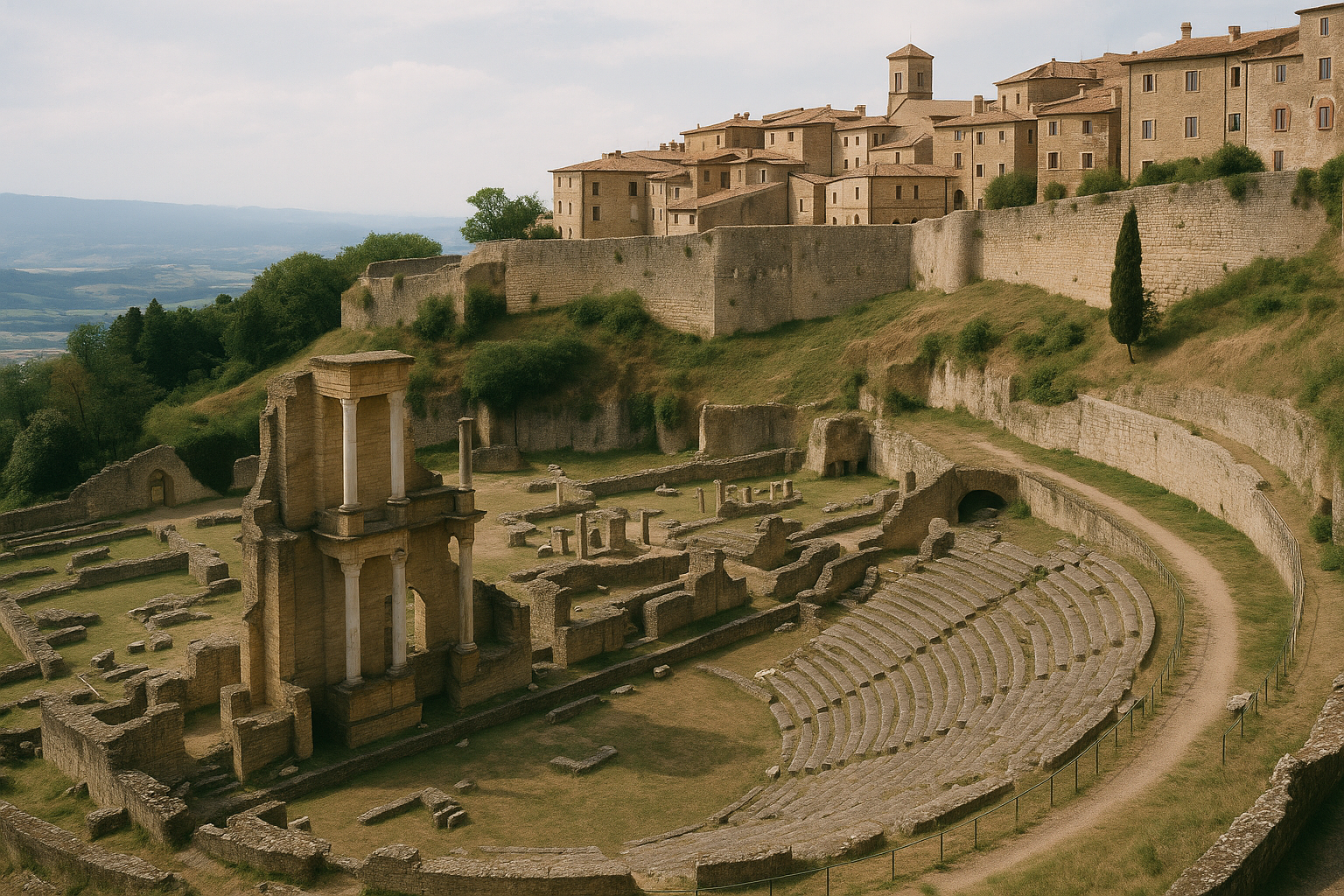
Volterra Guide 2026: Etruscan Walls, Roman Theatre, and Tuscany Hilltown Strategy
Etruscan and RomanPlan a focused visit to Volterra with practical route strategy, what to see first, and how to read t...
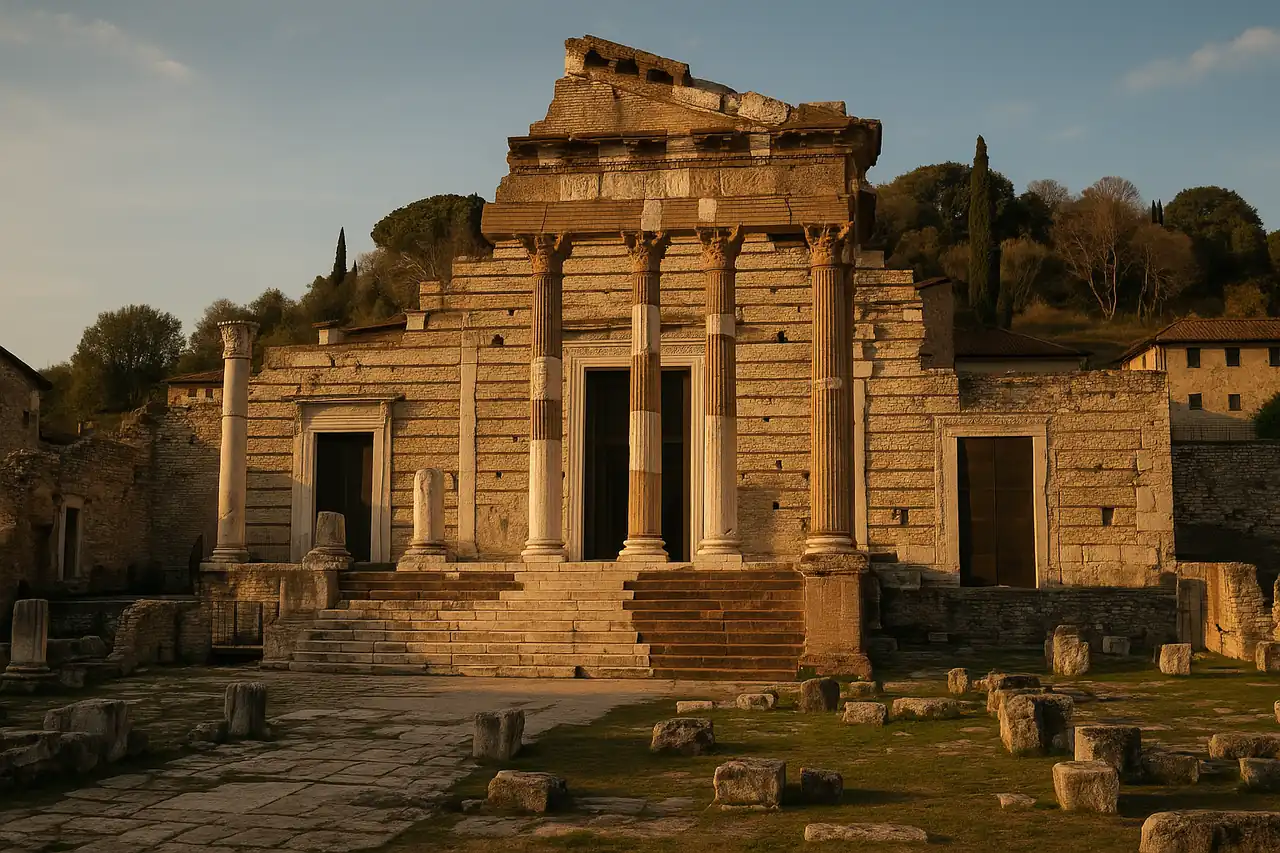
Roman Temples of Brescia Guide 2026: Capitolium Ruins, Museum Access, and Route Strategy
RomanPlan a smart visit to the Roman Temples of Brescia with practical timing, ticketing guidance, and co...
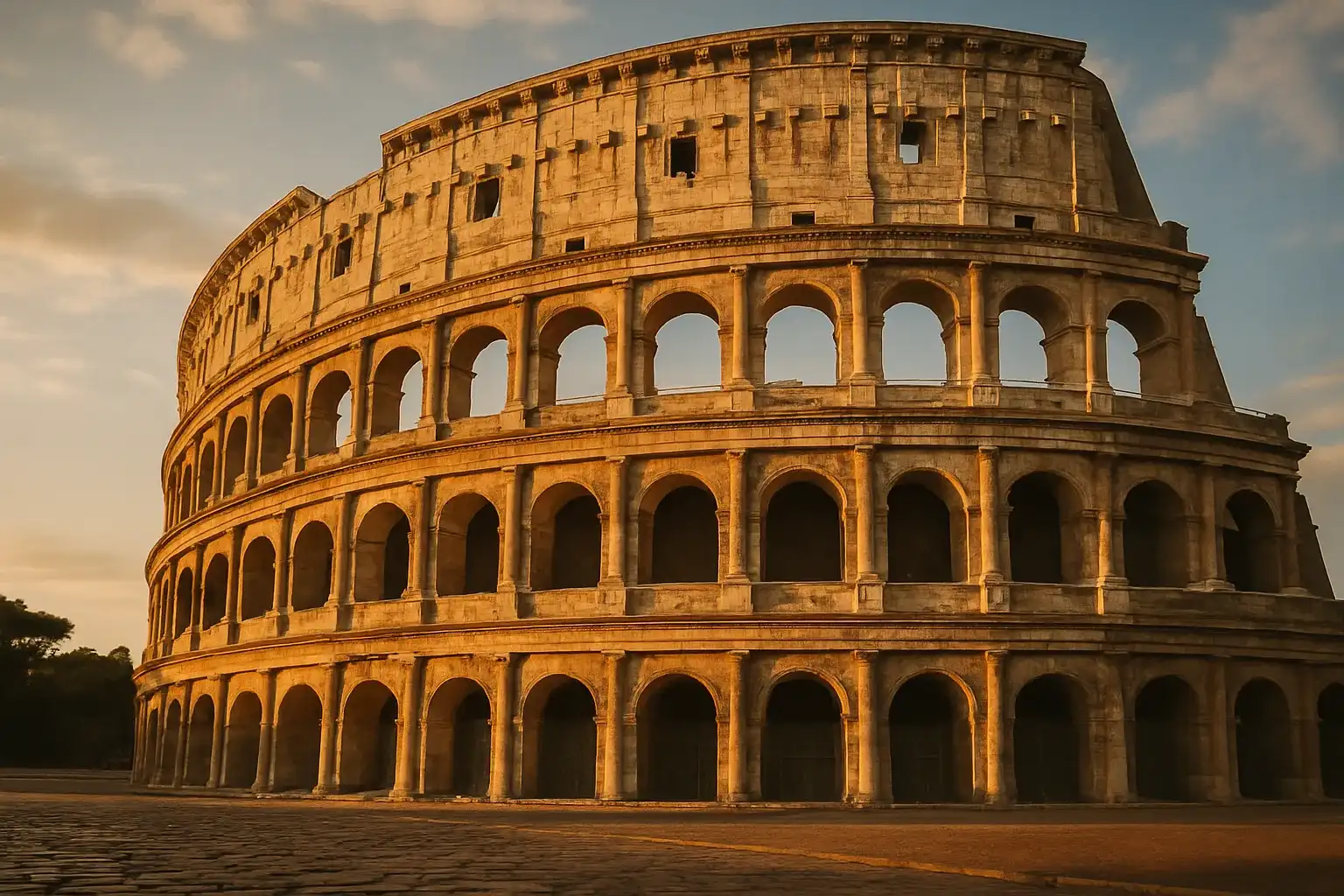
Colosseum Rome: Complete 2026 Guide to Arena Floor, Tickets, and Timing
Roman EmpirePlan the perfect Colosseum visit with timed-entry strategy, Arena Floor and underground access tips,...
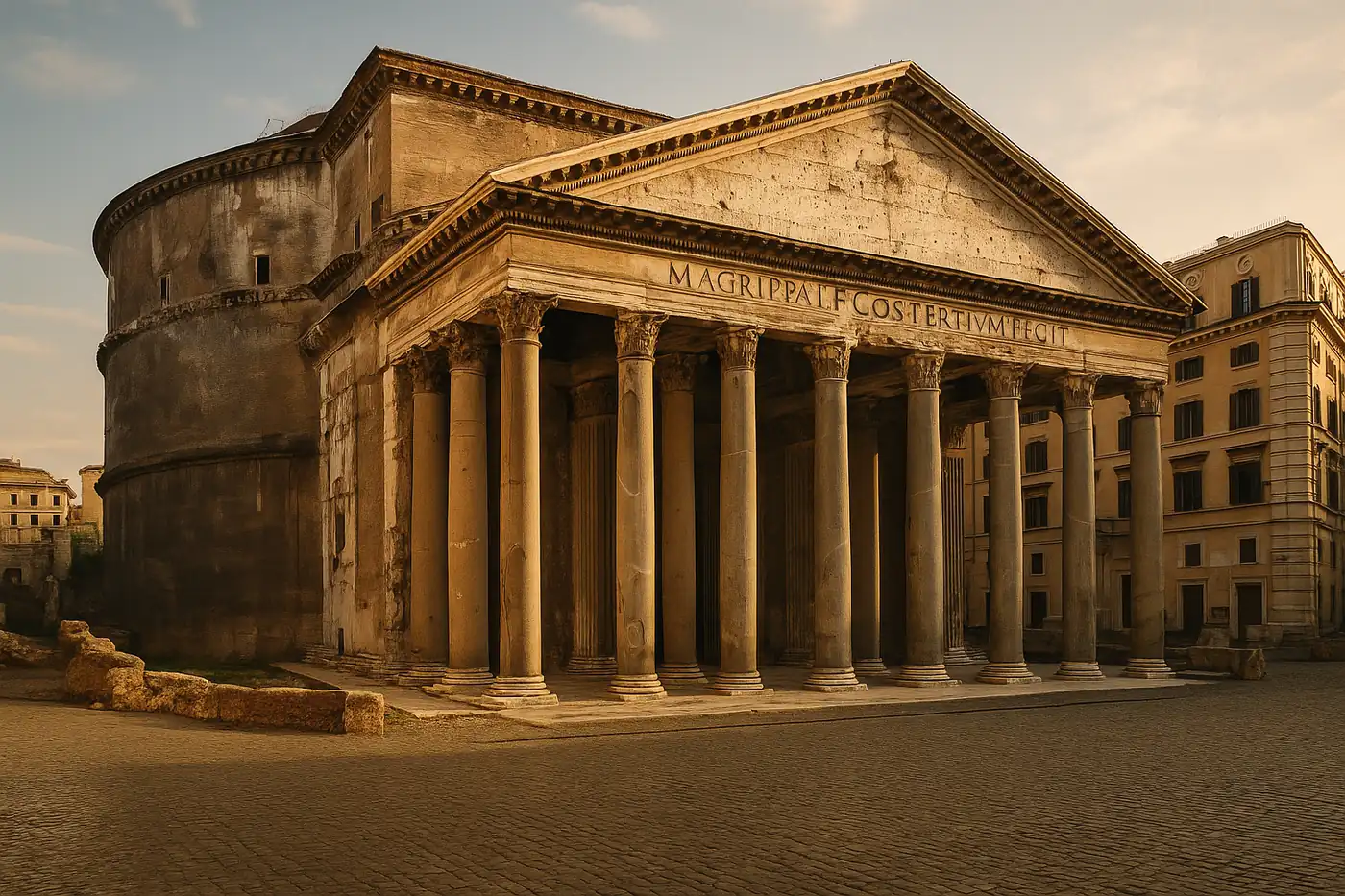
Pantheon Rome: Ultimate Guide to Rome's Best-Preserved Ancient Temple
Roman EmpireMaster your Pantheon visit with history, dome engineering secrets, visiting tips, skip-the-line opti...