Quick Info
At a glance
Hochob, in Mexico’s state of Campeche, is one of those Maya sites that rewards travelers who are willing to leave the major tourist circuits behind. Hidden among low hills, seasonal greenery, and quiet rural roads, it does not overwhelm with giant pyramids or sprawling plazas. Instead, it captivates with detail: sculpted masks, carefully arranged stonework, and architecture that seems to invite close looking. The atmosphere is intimate and contemplative, especially compared with larger destinations in the Maya world. A visit here feels less like arriving at a famous monument and more like discovering a guarded fragment of the ancient landscape.
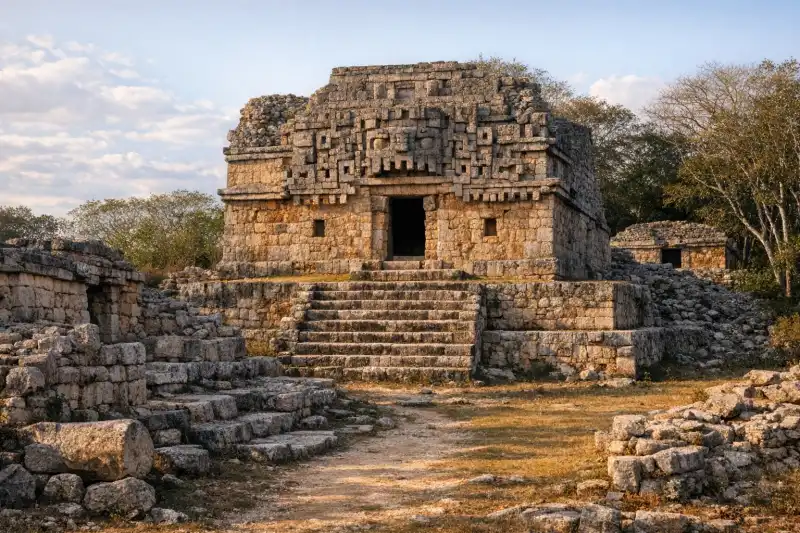
What makes Hochob memorable is its combination of artistry and solitude. Its best-known buildings display richly ornamented facades associated with the Chenes architectural tradition, where temples were designed not only as structures but as symbolic mountains and supernatural beings. The doorway of one principal building appears almost alive, transformed into the open mouth of a sacred creature. At the same time, the site’s forested setting helps visitors imagine how many Maya centers once looked before excavation and consolidation. Birds call from the trees, the air can feel heavy and warm, and sunlight shifts across carved limestone surfaces. For travelers interested in architecture, iconography, and the less crowded side of ancient Mexico, Hochob offers a deeply satisfying experience.
History
Early settlement and regional context
Hochob developed within the broader Maya cultural sphere of the Yucatán Peninsula, in a zone that linked several architectural and political traditions. Although the site is modest in size compared with major regional capitals, it occupied an important local position in what is now Campeche. Archaeological evidence suggests that settlement in the area began before the most visible monuments were built, but the site’s main florescence came during the Late Classic period, when many Maya centers expanded their ceremonial cores and invested heavily in architecture.
Its location placed it within a landscape of interconnected communities rather than in isolation. Trade, ritual practice, dynastic relationships, and artistic exchange all moved across this part of the peninsula. Hochob reflects that networked world. Its buildings show links to the Chenes style, characterized by highly decorated facades and zoomorphic temple entrances, while also sharing broader Maya conventions in masonry, stairways, and plaza planning. This suggests that local elites were participating in a regional language of power, one expressed through buildings as much as through inscriptions or portable goods.
The Late Classic building phase
Most of the surviving architecture at Hochob appears to date from roughly the seventh to ninth centuries CE, a time of ambitious construction across the Maya lowlands. During this period, local rulers and noble lineages often sponsored temple platforms, palatial residences, and ceremonial spaces to assert authority and reinforce sacred legitimacy. At Hochob, the emphasis seems to have been on elegant, symbolically dense architecture rather than on monumental scale.
The site’s principal groups were raised on artificial platforms, creating elevated ceremonial and residential spaces. Stone buildings were finished with decorative facades, roofcombs or upper embellishments in some cases, and elaborate entrances that transformed architecture into sacred imagery. The most striking example is the structure often identified with a monster-mouth facade, in which the doorway is framed as the gaping mouth of a supernatural earth or mountain being. This kind of design was not merely decorative. In Maya thought, temples could represent animate places of emergence, caves, mountains, and portals between human and divine realms. Entering such a building was a ritualized act with cosmological meaning.
Hochob’s prosperity likely depended on local agricultural production, regional exchange, and its role within a constellation of neighboring settlements. As at many Maya sites, architecture would have communicated both practical and symbolic functions. Buildings hosted ceremonies, lineage activities, governance, storage, and elite residence, all woven together in a political landscape where sacred and secular authority were closely linked.
Transformation and decline
Like many Maya centers in the southern and central lowlands, Hochob appears to have experienced contraction toward the end of the Classic era. This was not necessarily an abrupt collapse in a single moment, but part of a wider regional transformation that affected settlement patterns, elite building programs, and political organization. Across the Maya world, some dynasties weakened, major construction slowed, and populations shifted. Environmental stress, warfare, changing trade routes, and internal political instability have all been proposed as contributing factors in different places.
At Hochob, the evidence points less to catastrophic destruction than to gradual abandonment. Ceremonial buildings ceased to function in their original way, maintenance declined, and the forest slowly reclaimed the architecture. Plaster eroded, masonry shifted, and carved facades weathered under centuries of tropical exposure. Yet the core forms endured, protected in part by the very vegetation that concealed them.
Rediscovery and modern archaeology
In the modern era, Hochob became known to archaeologists and explorers interested in the architectural traditions of Campeche and the central Yucatán Peninsula. As scholars documented lesser-known Maya sites, Hochob emerged as an especially important example of the Chenes style. Its preserved decorative facades helped researchers better understand how architecture encoded mythology, rulership, and regional identity.
Excavation and conservation work focused on stabilizing structures, clearing vegetation, and recording ornamental details. Such work is always selective; what visitors see today is a curated archaeological landscape rather than a fully exposed ancient city. Still, the restored sections offer a clear sense of the site’s original elegance. Today Hochob remains a relatively quiet destination, valued by travelers, photographers, and specialists for the quality of its stone carving and the insight it provides into a sophisticated regional school of Maya architecture.
Key Features
Hochob’s most compelling feature is its architecture, especially the way ornament and structure merge into one visual statement. The site is not dominated by a single colossal pyramid. Instead, its appeal lies in the artistry of medium-scale buildings set on platforms among trees and low vegetation. As you walk through the main group, the eye is constantly drawn to carefully fitted limestone blocks, stepped profiles, and surviving decorative elements that distinguish Hochob from more austere Maya sites.
The standout monument is often called Structure II, famous for its zoomorphic facade. Here, the temple entrance is framed as the open mouth of a supernatural being, with stylized eyes, fangs, and curling stone details suggesting a creature associated with the earth, mountains, rain, or fertility. This was a powerful symbolic device in Maya architecture. Rather than entering an ordinary room, worshippers and elites would have passed through a cosmological threshold. The building itself became a sacred entity, embodying ideas about emergence, transformation, and communication with divine forces. Even if visitors know little about Maya iconography, the effect is immediate and dramatic.
Nearby structures continue the decorative theme, though in subtler ways. Some display mask fragments, geometric panels, and the refined stone mosaic common in the Chenes region. These facades reveal a taste for visual complexity. Decoration was not scattered randomly but organized around doorways, cornices, and upper zones to guide attention and reinforce hierarchy. The result is a kind of architectural storytelling in stone, where each motif contributes to the site’s sacred and political message.
Another defining feature of Hochob is its elevated setting on artificial terraces and platforms. These levels shape movement through the site. Visitors ascend steps, cross open spaces, and approach buildings from below, which would have increased their visual impact in antiquity. The terrain is not mountainous, but the manipulation of height creates a ceremonial topography. This was common in Maya planning, where elevation signaled authority and sacredness. At Hochob, the architecture feels integrated with the slight natural undulations of the landscape, giving the site a measured, balanced character.
The surrounding environment also matters. Because Hochob is less heavily visited than Mexico’s headline ruins, it retains a sense of remoteness that enhances the experience. The forest acts almost like a frame around the architecture. Birds, insects, shifting shade, and the smell of vegetation create an atmosphere very different from the large busier archaeological parks. It becomes easier to notice small details: a carved stone edge, the angle of a stairway, the way sunlight catches relief work in the late morning or afternoon.
For travelers interested in regional architecture, Hochob is especially significant because it helps illustrate the diversity of the Maya world. Many first-time visitors imagine Maya sites as variations on the same formula of steep pyramids and broad plazas. Hochob shows something more nuanced. Here the emphasis falls on facade symbolism, controlled scale, and decorative richness. It can be usefully compared with other Campeche and Yucatán sites influenced by Chenes and Puuc traditions, where exteriors were designed almost as sculptural compositions. In that sense, Hochob is both a destination in its own right and a key reference point for understanding architectural experimentation in the Late Classic period.
Getting There
Hochob is most easily reached by road, and independent travelers usually visit from Campeche City, Hopelchén, or as part of a longer loop through inland Maya sites. A rental car is the most practical option because public transport in the area is limited and schedules can be irregular. From Campeche City, expect a drive of roughly 2.5 to 3.5 hours depending on route and road conditions. Economy rental cars in Campeche often start around MXN 800-1,400 per day before insurance, and fuel costs are moderate for a day trip or overnight circuit.
If you prefer not to drive, hiring a taxi for the day or arranging a private driver from Campeche or nearby towns can save time. Prices vary, but a private round-trip outing with waiting time may cost roughly MXN 2,500-4,500 depending on distance, negotiation, and whether you combine Hochob with other sites. This option is often worthwhile if you want flexibility without the stress of rural navigation.
Public buses can get you closer to the region, especially toward Hopelchén, but they rarely provide seamless access to the archaeological zone itself. A bus fare from Campeche to a nearby town may be in the MXN 100-250 range each way, after which you may need a local taxi. Because return transport can be uncertain, this approach is best for patient travelers with time to spare and some Spanish.
Road signage may be limited, and mobile signal can be inconsistent, so download offline maps before leaving. Bring water, snacks, and cash, since services near the site can be sparse.
When to Visit
The best time to visit Hochob is generally during the dry season, from about November to April, when roads are more reliable, humidity is lower, and walking around the ruins is more comfortable. Morning visits are especially pleasant. Temperatures are usually milder, wildlife is active, and the carved facades often photograph well in slanting light. If you are combining Hochob with other inland Campeche sites, an early start also helps you avoid the strongest midday heat.
From May into October, the rainy season brings greener landscapes and a more dramatic jungle atmosphere, but also heavier humidity, afternoon downpours, mud, and more insects. Travel during these months can still be rewarding, particularly for photographers who like lush surroundings and moody skies, but roads may be slower and conditions less predictable. Carry insect repellent and waterproof protection for electronics if you visit in this period.
Heat is a major factor year-round. Even in the cooler months, midday sun can feel intense, especially in more open areas around the structures. For comfort, plan to arrive shortly after opening hours if possible, wear a hat, and carry more water than you think you need. If your schedule is flexible, weekdays often feel even quieter than weekends and holidays. Because Hochob is not heavily trafficked, the reward for choosing the right time is not shorter lines but a deeper sense of calm, space, and connection with the site.
| Quick Facts | Details |
|---|---|
| Location | Campeche state, Mexico |
| Cultural affiliation | Maya |
| Main period | Late Classic to Terminal Classic, c. 600-900 CE |
| Architectural style | Primarily Chenes, with broader Maya regional influences |
| Best known for | Elaborate zoomorphic temple facade and ornate stone mosaics |
| Typical visit length | 1-2 hours |
| Best access | Rental car or private driver |
| Nearest practical base | Hopelchén or Campeche City |
| Best season | Dry season, roughly November to April |
| What to bring | Water, sun protection, insect repellent, cash, sturdy shoes |
Hochob is not a site that competes for attention through size alone. Its power lies in concentration: concentrated artistry, concentrated symbolism, and a concentrated sense of place. For travelers who enjoy looking carefully rather than simply ticking off famous names, it can become one of the most memorable ruins in southeastern Mexico. The stonework rewards slow observation, the setting invites reflection, and the relative lack of crowds makes it easier to imagine the site as part of a living ancient landscape rather than a tourist stage set.
It also serves as a reminder that the Maya world was astonishingly varied. Great capitals, painted temples, fortifications, and decorated facades all formed part of a broad cultural mosaic. Hochob belongs to that mosaic as a refined regional expression of power and sacred design. If you are already exploring Campeche, it is an excellent addition to a route that includes larger centers such as Calakmul or Becan. If you are drawn specifically to architectural detail, it may even be a highlight. Either way, Hochob offers the rare pleasure of encountering a major artistic achievement in a setting that still feels quiet, local, and deeply rooted in the landscape of Mexico’s ancient southeast.
Guided tours: worth it?
Self-guided works here, but a guide can add real value if you want the ruins explained as a living place rather than just a sequence of monuments.
Best for
- First-time visitors who want context, not just photos
- Short visits where a planned route saves time
When to go self-guided
Go independently if you prefer setting your own pace, reading as you go, and checking official hours or ticket rules directly before you arrive.
What I’d avoid
Skip paid tours that bundle unrelated stops you do not actually want. The best option should either save meaningful planning time or add historical context you would miss on your own.
Campeche Archaeological Sites Tours
Useful when: you want to compare guided formats before deciding
Calakmul and Campeche Mayan Ruins Tours
Useful when: you want to compare guided formats before deciding
Mexico Maya Ruins Private Tour
Useful when: you want flexible timing or a private guide
Some tour links are affiliate links, which may earn Ancient Travel a small commission at no extra cost to you. I try to surface options that make practical sense for the site—not just anything bookable.
Frequently Asked Questions
Where is Hochob located?
Hochob is in the state of Campeche in southeastern Mexico, in the Puuc-influenced Maya region inland from the Gulf Coast.
What is Hochob known for?
Hochob is best known for its highly decorated stone facades, especially a temple front with an elaborate zoomorphic doorway associated with Maya rain and earth symbolism.
How much time should I plan for a visit?
Most visitors spend 1 to 2 hours at Hochob, enough time to walk the small site, examine the carvings, and enjoy the quiet forest setting.
Can you climb the structures at Hochob?
Access rules can change, but in general visitors should expect limited climbing and should always follow posted guidance to help protect the monuments.
Is Hochob easy to visit independently?
It is possible to visit independently by car, but public transport is limited, so many travelers combine Hochob with other Campeche sites using a rental car or hired driver.
What should I bring to Hochob?
Bring water, sun protection, insect repellent, sturdy shoes, and cash for any local fees or transport, as facilities in the area can be basic.
Nearby Ancient Sites
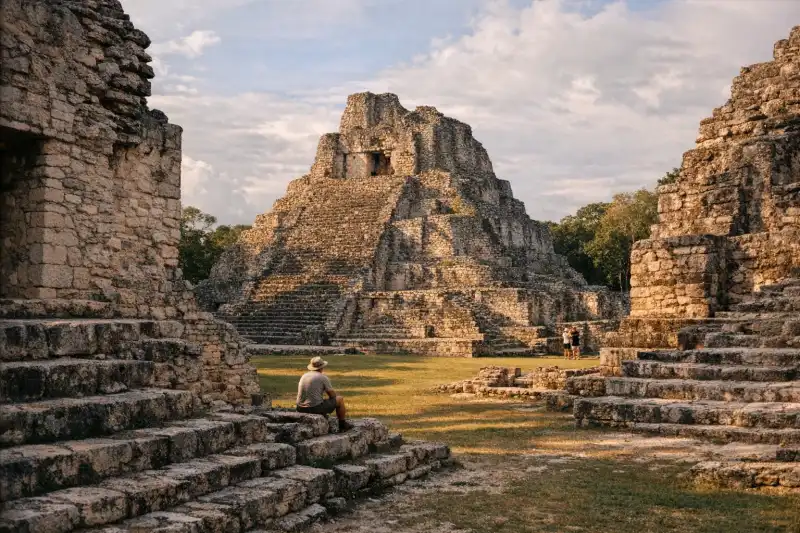
Becán
MayaExplore Becán, a moated Maya city in Campeche, Mexico, known for its causeways, temples, and forest ...
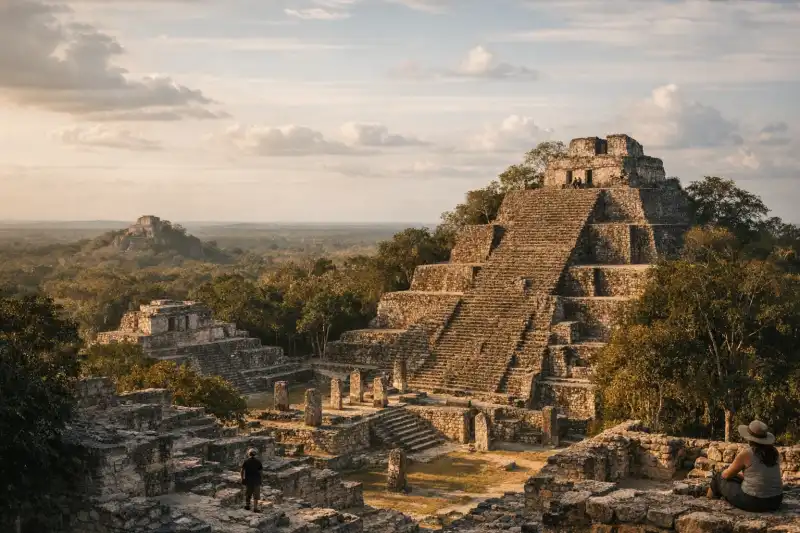
Calakmul
MayaExplore Calakmul, a vast Maya city deep in the forests of Campeche, Mexico, known for towering pyram...
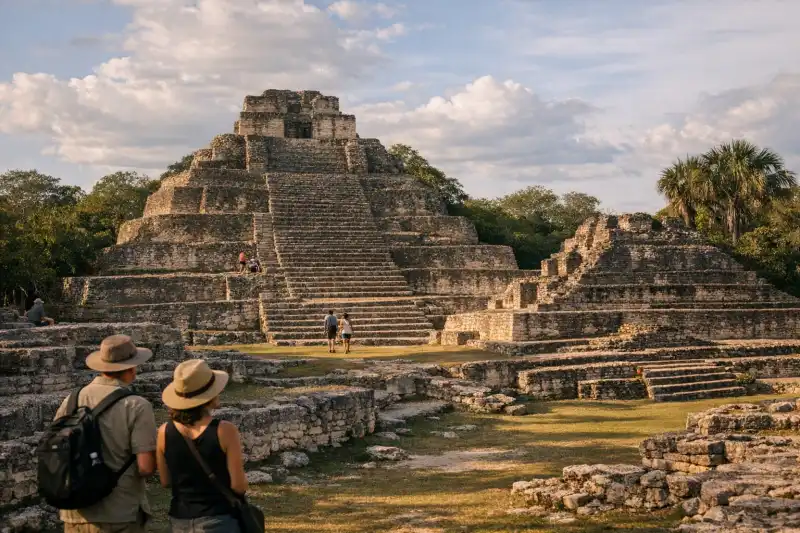
Chacchoben
MayaExplore Chacchoben, a serene Maya archaeological site in Mexico surrounded by jungle, lagoons, and i...