Quick Info
At a glance
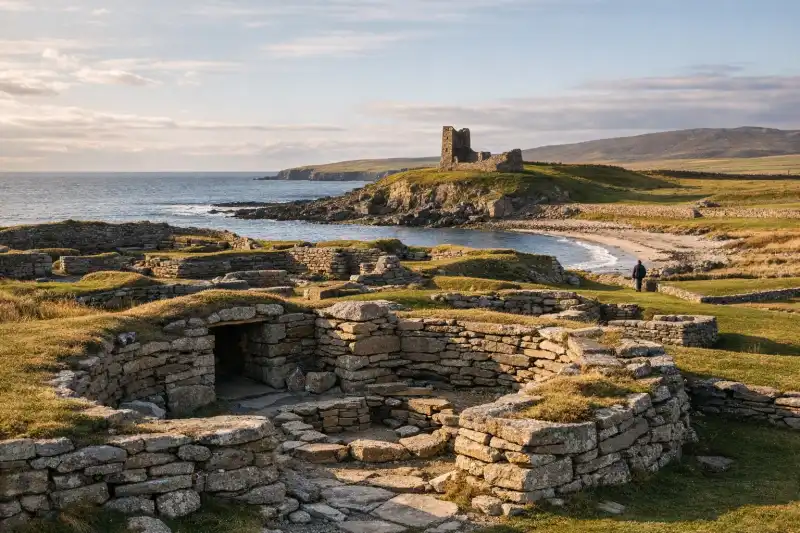
Jarlshof in the United Kingdom stands at the storm-battered southern edge of mainland Shetland, where the Atlantic and North Sea seem to press history out of the ground. Few archaeological places in Britain offer such an immediate sense of time layered upon time. Here, low stone walls, sunken dwellings, wheelhouses, Norse longhouses, and later farm buildings lie crowded together on a narrow coastal terrace, as if generations of settlers simply refused to abandon this exposed headland despite wind, salt, and sea. The result is one of the most extraordinary historic landscapes in northern Europe: a site where more than four thousand years of human occupation can be traced in a single walk.
What makes Jarlshof so memorable is not grandeur in the conventional sense. There are no towering columns, no massive fortifications, and no monumental temples. Instead, its power lies in continuity. Visitors move past the remains of Bronze Age homes, Iron Age broch settlements, Pictish structures, Viking halls, and a medieval laird’s house, each chapter built close to the last. The setting heightens that impression. The ruins sit beside dramatic shoreline, near Sumburgh Head and within sight of seabirds and open water, so the site feels both intimate and immense. Jarlshof is not simply a collection of ruins; it is a rare, almost cinematic record of how communities adapted, rebuilt, and endured at the very edge of the inhabited world.
History
Neolithic and Bronze Age beginnings
The earliest known activity at Jarlshof dates back to the Neolithic period, when people were already living and farming in Shetland several millennia before the Roman Empire existed. Archaeological evidence suggests occupation from around 2500 BCE, with settlers making use of the relatively sheltered ground and nearby marine resources. These early inhabitants built modest stone structures suited to the local environment, using materials that were available and durable in a treeless landscape. Though the remains from this phase are less visually dramatic than later constructions, they are crucial because they establish Jarlshof as a place of remarkably long continuity.
During the Bronze Age, settlement became more clearly defined. Excavations uncovered oval and rectangular houses, storage spaces, and domestic features that reveal a community rooted in farming, herding, and coastal subsistence. The people of this era lived in a demanding environment, and the archaeological record suggests practical resilience rather than luxury. Their homes were low, thick-walled, and efficient, designed to hold warmth and resist the weather. Even at this early stage, Jarlshof appears to have been a place where adaptation mattered more than monumentality.
Iron Age settlement and the broch period
By the first millennium BCE and into the early centuries CE, Jarlshof had developed into a more complex Iron Age settlement. One of the defining features from this period is the broch, a type of circular drystone tower unique to Scotland. Although the broch at Jarlshof does not survive intact to its original height, its presence indicates status, defensive awareness, and regional cultural connections. Around it, a village grew with houses and ancillary structures forming a dense community pattern.
This phase also includes the famous wheelhouses, circular buildings with internal stone piers radiating like spokes. These are among the site’s most striking remains and speak to an architectural tradition found in Atlantic Scotland. Their exact functions are still debated, but they were certainly important domestic or communal spaces. The Iron Age settlement shows that Jarlshof was not an isolated outpost. It participated in wider northern traditions of building and social organization, while remaining distinctly shaped by Shetland conditions.
Pictish occupation and transition
After the main broch phase, Jarlshof continued to be occupied during the period often associated with the Picts, roughly between the late Iron Age and early medieval centuries. This is an especially fascinating chapter because it demonstrates continuity rather than abrupt collapse. Existing structures were altered, reused, and adapted. New buildings appeared among the older ones, and life at the site carried on through cultural shifts that remain partly obscure in the archaeological record.
Artifacts from this period, including carved objects and tools, show local craftsmanship and links to broader northern British traditions. The Pictish phase at Jarlshof is important because it bridges the prehistoric world and the Norse era. Instead of a clean break between native and Viking settlement, the site suggests a more complex transition in which older communities and landscapes persisted even as new influences arrived.
Norse settlement and Viking-age life
The arrival of the Norse in Shetland from the 8th and 9th centuries onward transformed Jarlshof again. The Viking and Norse period is one of the best represented and best known phases of the site. Longhouses, byres, and associated structures reveal a settlement organized along Scandinavian lines, with elongated buildings designed for both people and animals. These were practical, durable forms of architecture that suited the climate and reflected the cultural identity of settlers whose world stretched across the North Atlantic.
Jarlshof’s Norse remains matter not just because they are well preserved, but because they document daily life in a frontier maritime society. This was a community connected by sea routes to Orkney, mainland Scotland, Iceland, Norway, and beyond. Trade, fishing, farming, and animal husbandry all formed part of the local economy. The Norse reused and built over earlier remains, creating the layered archaeology visitors see today.
Medieval and modern rediscovery
Occupation continued into the medieval and later periods, culminating in the laird’s house that gave the site its modern name. “Jarlshof” itself is a relatively recent romantic label, popularized in the 19th century after Sir Walter Scott visited the area and used the name in his novel The Pirate. Before that, the place had local identities tied more directly to farm life and the surrounding landscape.
In the late 19th century, severe coastal storms exposed buried remains, drawing scholarly attention to the site. Excavations in the 20th century revealed the extraordinary sequence of settlements now visible. What had once been an active place of habitation became instead a key archaeological monument. Today Jarlshof is managed as one of Scotland’s most important historic sites, valued for its unique ability to show nearly uninterrupted human presence across more than four thousand years.
Key Features
The most compelling feature of Jarlshof is its sheer archaeological range. Instead of presenting one neatly defined era, the site unfolds as a compressed history of northern settlement. Walking through it, you encounter architectural forms that change dramatically over time, yet remain linked by geography and necessity. This layered arrangement is what gives Jarlshof its unusual interpretive power. Visitors do not need to imagine separate sites scattered across a map; they can see whole cultural transitions happening within a single coastal enclosure.
Among the most visually memorable remains are the wheelhouses. Their curving walls and radial internal supports create interiors that still feel structured and purposeful, despite the absence of roofs and timber fittings. These buildings invite close attention because their plans are so distinctive. They also reveal how prehistoric communities in the north shaped stone into practical and symbolic living spaces. Nearby, the broch remains hint at a more imposing settlement phase. Even in ruin, the broch conveys status and strategic significance, showing that Jarlshof was once part of a broader Atlantic Iron Age world.
The Norse buildings offer a different atmosphere. Their elongated forms feel instantly recognizable to anyone familiar with Viking-age archaeology, yet here they sit directly beside much older remains, which makes the Norse presence feel less abstract and more tangible. You can trace outlines of halls, byres, partitions, and work areas, gaining a sense of how domestic and agricultural life were organized. These were not ceremonial ruins but working spaces for a community that lived by seafaring, stock-keeping, and hard northern routines.
Another key feature is the site’s relationship with the coastline. Jarlshof is not merely near the sea; it is inseparable from it. The surrounding views explain why this place mattered and why it was also vulnerable. The shoreline gave access to food, transport, and communication, but it also exposed the settlement to erosion and storms. In fact, that same coastal instability helped reveal the site to modern archaeologists. The sea therefore acts as both ancient lifeline and modern agent of discovery.
The later laird’s house and medieval remains add yet another layer. They remind visitors that Jarlshof did not end with the Viking Age. The headland remained useful and inhabited long after the classic prehistoric and Norse phases. This continuity is easy to overlook at many archaeological sites, where one period dominates interpretation, but at Jarlshof it is central to the experience.
Finally, the site’s compactness is one of its greatest strengths. Because so much is preserved in a relatively contained area, visitors can appreciate the sequence of change without long distances or disconnected fragments. The stonework is low but eloquent, and interpretation on site helps orient the eye. For travelers interested in archaeology, Jarlshof is rewarding because it combines scholarly importance with visual clarity. For general visitors, it works because the story is intuitive: people came here, built here, rebuilt here, and endured here for millennia.
Getting There
Jarlshof is located near the southern tip of mainland Shetland, close to Sumburgh and roughly 25 miles (40 km) south of Lerwick. The easiest way to reach it is by car. From Lerwick, the drive along the A970 usually takes around 35 to 45 minutes, depending on weather and road conditions. If you are renting a car in Shetland, expect daily rates often starting around £45 to £80 in the main season, sometimes higher in summer.
Sumburgh Airport is the nearest airport and lies only a short drive from Jarlshof, typically under 10 minutes by taxi. A local taxi from the airport to the site may cost about £10 to £15, though fares vary by time and operator. This makes Jarlshof unusually convenient for visitors arriving by air and wanting to fit in a heritage stop soon after landing.
Public transport is possible but requires planning. Bus services between Lerwick and Sumburgh operate on limited schedules, and a single adult fare is often in the range of £4 to £8 depending on route and ticket type. From the nearest stop, you may still need a short walk. If you are staying in Lerwick and do not drive, joining a local tour or arranging a taxi for a half-day outing can be more efficient. Taxi fares from Lerwick to Jarlshof commonly start around £50 to £70 one way.
Because Shetland weather can change quickly, leave extra time and check local service updates before traveling.
When to Visit
The best time to visit Jarlshof is usually from late spring through early autumn, when daylight is long, transport options are easier, and the site’s coastal setting can be enjoyed without the harshest winter conditions. From May to August, Shetland experiences remarkably extended daylight, which gives the ruins a spacious, almost luminous quality. Summer temperatures are generally cool rather than hot, often around 10 to 15°C, so walking the site is comfortable. This is also the busiest period, however, especially when cruises or holiday traffic increase visitor numbers.
Late spring, particularly May and early June, is an excellent balance for many travelers. Wildflowers begin to appear, seabird activity is strong around nearby cliffs, and the weather can be crisp but pleasant. September is another good option, offering fewer visitors while still retaining reasonable daylight and often clear atmospheric views. Photographers may especially appreciate the lower sun angles and dramatic skies.
Winter visits are possible and can be memorable, but they require flexibility. Strong winds, rain, and shorter daylight hours can make the exposed site feel far more severe. The same coastal drama that gives Jarlshof its character can also limit comfort. If you come in colder months, wear waterproof layers, sturdy shoes, and be prepared for sudden weather changes. Site opening times may also vary seasonally.
Whenever you visit, try to choose a dry or partially clear day if possible. Jarlshof’s details are easier to appreciate when walls, passageways, and room outlines are not obscured by heavy rain. Morning and late afternoon can be especially atmospheric, when shifting light sharpens the textures of the stone and the sea beyond becomes part of the experience rather than just a backdrop.
| Quick Facts | Details |
|---|---|
| Location | Near Sumburgh, Shetland, United Kingdom |
| Region | Shetland |
| Earliest occupation | Around 2500 BCE |
| Main periods represented | Neolithic, Bronze Age, Iron Age, Pictish, Norse, Medieval |
| Famous features | Wheelhouses, broch remains, Norse longhouses, later farm and laird’s house |
| Nearest airport | Sumburgh Airport |
| Approximate drive from Lerwick | 35–45 minutes |
| Typical visit duration | 1–2 hours |
| Best season | Late spring to early autumn |
| Why it matters | One of the most complete multi-period archaeological sites in the United Kingdom |
Jarlshof rewards slow looking. At first glance, it can seem like a field of low walls on a windy headland, but the longer you stay, the more the place resolves into a story of extraordinary persistence. Few sites in the United Kingdom allow visitors to stand in one place and read such a long sequence of human life so clearly. Here, architecture is biography: each wall line marks a decision to remain, adapt, and begin again. In that sense, Jarlshof is more than an archaeological attraction. It is a record of endurance at the edge of Europe, where people built homes against the weather and left behind one of the richest time capsules in Britain.
Guided tours: worth it?
Most travelers can visit Jarlshof independently. Compare a tour only if you want a tighter history-focused visit, easier logistics, or a guide who can answer questions on the spot.
Best for
- Short visits where a planned route saves time
When to go self-guided
Go independently if you prefer setting your own pace, reading as you go, and checking official hours or ticket rules directly before you arrive.
What I’d avoid
Skip paid tours that bundle unrelated stops you do not actually want. The best option should either save meaningful planning time or add historical context you would miss on your own.
Shetland archaeology tours
Useful when: you want to compare guided formats before deciding
Sumburgh and Jarlshof tours
Useful when: you want to compare guided formats before deciding
Shetland historical site tours
Useful when: you want to compare guided formats before deciding
Some tour links are affiliate links, which may earn Ancient Travel a small commission at no extra cost to you. I try to surface options that make practical sense for the site—not just anything bookable.
Frequently Asked Questions
What is Jarlshof?
Jarlshof is a multi-period archaeological site in Shetland, United Kingdom, with remains spanning from the Neolithic and Bronze Age to the Iron Age, Pictish, Norse, and medieval periods.
How much time should I allow for visiting Jarlshof?
Most visitors spend between 1 and 2 hours exploring Jarlshof, though archaeology enthusiasts may want longer to study the layers of occupation and coastal setting.
Is Jarlshof suitable for families?
Yes, Jarlshof can be rewarding for families, especially those interested in history, though the uneven ground and exposed coastal conditions mean sturdy footwear and supervision are important.
Can I visit Jarlshof without a car?
Yes, it is possible to reach Jarlshof by taxi or local bus from Lerwick and from the Sumburgh area, but schedules can be limited so planning ahead is essential.
Why is Jarlshof important?
Jarlshof is important because it preserves an exceptional sequence of human settlement over several millennia, making it one of the most significant archaeological sites in the United Kingdom.
Is Jarlshof near Sumburgh Airport?
Yes, Jarlshof is very close to Sumburgh Airport, making it one of the easiest major archaeological sites in Shetland to reach soon after arrival.
Nearby Ancient Sites
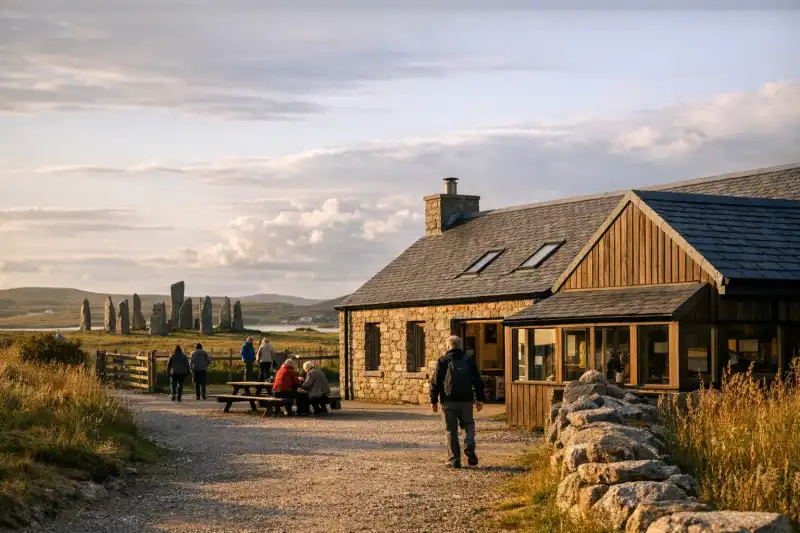
Calanais Visitor Centre
Neolithic ScotlandGateway to the famous Calanais standing stones on the Isle of Lewis in the United Kingdom.

Callanish Stones
Neolithic communities of the Outer HebridesExplore the Callanish Stones, a dramatic Neolithic stone circle in the United Kingdom's Outer Hebrid...
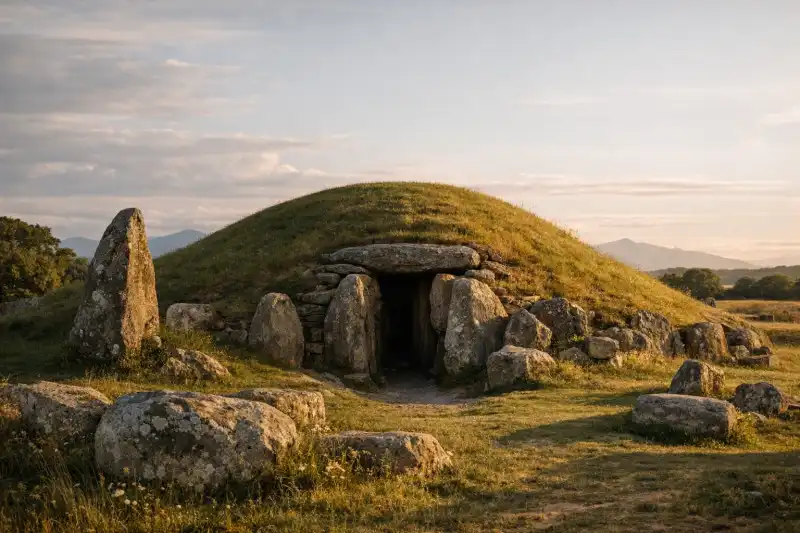
Bryn Celli Ddu
Neolithic BritainAtmospheric Neolithic burial chamber and henge on Anglesey, United Kingdom, famed for ritual alignme...