Quick Info
At a glance
Kabah, in Mexico’s Yucatán Peninsula, is one of those ancient places that feels both monumental and intimate at the same time. Less famous than nearby Uxmal but deeply rewarding, this Maya archaeological site rises from low forest and scrub with a quiet confidence: carved stone facades, long palace buildings, and sculpted masks that still seem to watch the landscape after more than a thousand years. Travelers who make the short detour along the Puuc Route often arrive expecting a secondary stop and leave remembering Kabah as one of the most atmospheric sites in the region.
Part of Kabah’s appeal is the balance it offers. It is substantial enough to reveal the sophistication of Puuc Maya architecture, yet compact enough to explore without the fatigue that can come with larger archaeological zones. Here, attention naturally settles on details: geometric masonry, columns, stairways, and above all the famous masks associated with Chaac, the rain deity so important in a region where water shaped survival. Even on a warm day, when cicadas hum and the stone radiates heat, Kabah carries a sense of calm that invites slower looking. You can imagine processions passing between buildings, elite families living in ornamented compounds, and a city connected by roads and alliances to a wider Maya world. For visitors interested in architecture, history, and a more contemplative experience of ancient Mexico, Kabah is one of Yucatán’s finest stops.
History
Early settlement and rise of the city
Kabah developed within the Puuc hills region of the northern Maya lowlands, an area known for limestone ridges, seasonal rains, and the scarcity of permanent surface water. This environmental setting mattered enormously. Unlike some other Maya regions where rivers or cenotes were more accessible, communities in the Puuc zone relied heavily on rain collection systems and carefully managed reservoirs. In this context, settlements that could organize labor, construct monumental architecture, and maintain water storage gained power and prestige.
Archaeologists generally place Kabah’s major period of development between about 600 and 900 CE, during the Late Classic and Terminal Classic eras. Although there may have been earlier occupation, the city’s surviving architecture belongs mainly to the period when Puuc-style building flourished across western Yucatán. Kabah was not an isolated ceremonial center. It formed part of a dense network of Maya cities and towns, linked by roads, political ties, and competition. Its scale suggests that it was an important regional capital, with elite compounds, public spaces, and administrative or ritual buildings serving a substantial population.
The name Kabah is often interpreted as having associations with a “powerful hand” or “strong hand,” though meanings of ancient place names can be uncertain. Whatever the exact origin, the surviving city reflects authority, organization, and the ability to mobilize skilled artisans.
The Puuc florescence
Kabah reached its architectural high point during the broader florescence of Puuc civilization. This style, named after the rolling hill country of the region, is characterized by elegant masonry, smooth lower walls, richly decorated upper facades, stone mosaics, colonnettes, lattice patterns, and repeated masks of deities. Compared with some southern lowland Maya cities, where towering temple-pyramids dominate the skyline, Puuc sites often impress through refinement and ornamentation.
At Kabah, the most famous expression of this aesthetic is the Palace of the Masks, where hundreds of carved Chaac masks cover the facade. Chaac, the rain god, was central to life in the Puuc region because water control was an existential issue. Invoking, honoring, or symbolically embodying the deity through architecture was not merely decorative; it reflected the religious and political concerns of the city.
Kabah’s importance is also shown by its sacbe, or raised white road, connecting it to nearby Uxmal. This causeway, several kilometers long, demonstrates close interaction between the two cities. Whether that relationship was one of alliance, shared dynastic ties, ritual cooperation, or political hierarchy remains debated, but the connection itself is unmistakable. Kabah was clearly integrated into one of the most sophisticated cultural landscapes in ancient Yucatán.
Decline and abandonment
Like many Maya cities of the northern lowlands, Kabah experienced change and eventual decline around the end of the first millennium CE. The reasons were probably multiple rather than singular. Shifting political networks, environmental stress, social upheaval, changing trade routes, and broader transformations across the Maya world likely all played roles. Monumental construction slowed, populations dispersed, and the great buildings ceased to function in the way they once had.
Importantly, “collapse” in the Maya world did not always mean sudden disappearance. Instead, many sites went through phases of reduced activity, partial occupation, and gradual abandonment. Kabah may have remained known locally even after its main political importance ended. Forest growth and centuries of weathering transformed it, but did not erase it.
Rediscovery, archaeology, and preservation
During the colonial and early modern periods, many Maya ruins in Yucatán remained visible to local communities and travelers. In the nineteenth century, explorers and writers helped introduce sites such as Kabah to a wider international audience. Surveying, sketching, and early descriptions documented the site’s architecture, especially its extraordinary facade decoration.
Modern archaeology has clarified Kabah’s place within the Puuc tradition and the history of northern Yucatán. Excavation, restoration, and conservation have focused on stabilizing key structures while preserving the site’s atmosphere. Today Kabah is protected as part of Mexico’s cultural heritage and often visited alongside Uxmal and other Puuc Route sites. Its significance lies not only in individual monuments, but in what it reveals about water management, political organization, and artistic achievement in the late Maya world.
Key Features
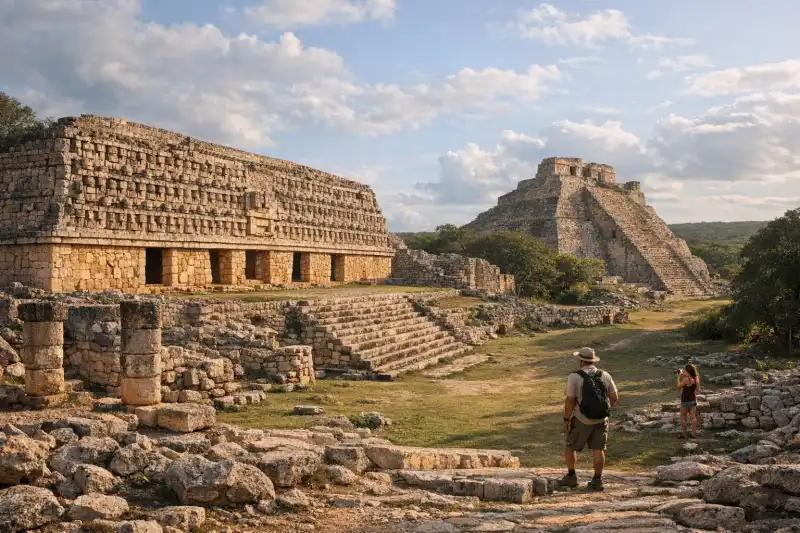
The defining image of Kabah is the Palace of the Masks, also known as the Codz Poop. Few buildings in the Maya world create such an immediate visual impact through repetition. The facade is crowded with long-nosed masks identified with Chaac, stacked and arranged so densely that the surface seems to dissolve into sacred imagery. Seen from a distance, the building appears almost textile-like, as if woven from stone. Up close, the craftsmanship becomes more astonishing: individual elements of the masks, geometric framing, and carefully fitted masonry blocks reveal technical control as well as symbolic intention. In a landscape where rainfall determined agricultural success and daily survival, the omnipresence of the rain deity on this building was both devotional and political.
Beyond this famous structure, Kabah rewards slower wandering. The site contains a number of elongated palace buildings and elevated platforms that illustrate the balance typical of Puuc architecture: relatively plain lower zones supporting ornate upper sections. This division draws the eye upward and gives the facades a rhythmic elegance. Columns, doorways, and repeated stone motifs suggest spaces designed for both practical use and ceremonial display. Many rooms would once have been covered by corbel-vaulted roofs, creating cool interior chambers behind those highly decorated exteriors.
One of the pleasures of Kabah is how the buildings are set within a broader archaeological landscape rather than compressed into a single crowded plaza. Paths lead visitors through open areas and clusters of structures where the city’s former scale becomes easier to imagine. You begin to sense that the surviving monuments are only the visible remnants of a much larger urban environment that included households, service areas, reservoirs, roads, and cultivated lands.
The sacbe connecting Kabah to Uxmal is another important feature, even if most visitors experience it more as a historical fact than a complete walkable route. Raised causeways in the Maya world were statements of power and connectivity. They linked communities physically, but they also linked them symbolically, shaping how people moved through ritual and political landscapes. The existence of such a road tells you that Kabah was not peripheral. It belonged to a regional network of centers that coordinated labor, exchange, and ceremonial life.
Architectural detail is where Kabah truly lingers in memory. Puuc builders excelled at creating facades that combine order and exuberance. At Kabah, geometric mosaics, masks, stepped patterns, and decorative stonework convey a sense of visual intelligence rather than simple ornament. The design is deliberate, disciplined, and highly expressive. Even ruined sections are revealing because they show construction methods: cut stones fitted into cores, remnants of roof combs or vaulted rooms, and traces of how architecture was staged for public effect.
The site’s quieter atmosphere is also a feature in its own right. Without the larger crowds found at headline destinations, Kabah offers space to observe texture, proportion, and light. Morning sun can sharpen carvings dramatically, while late afternoon lends the ruins a softer tone against the vegetation. Birds move through the trees, iguanas sometimes rest on warm stone, and the interplay between architecture and environment becomes part of the experience. Kabah feels less like a checklist stop and more like a conversation with a place that still holds much of its dignity.
Getting There
Kabah is most commonly reached from Mérida, the capital of Yucatán, or from towns in the southern part of the state such as Ticul. By car, it lies roughly 1.5 to 2 hours from Mérida, depending on traffic and your exact route, and around 20 to 30 minutes from Uxmal. Renting a car is the easiest option if you want flexibility along the Puuc Route, where several archaeological sites can be combined in one day. Daily car rental from Mérida often starts around MXN 700-1,300 before insurance, while fuel costs for a day trip are usually modest.
Guided tours are another practical choice, especially for travelers who want transport, entry logistics, and historical context handled together. Day tours from Mérida that include Uxmal and sometimes Kabah or other Puuc sites often range from about MXN 1,500 to 3,500 per person, depending on inclusions and group size.
Public transport can be less straightforward but is possible with planning. Buses or colectivos from Mérida toward towns such as Ticul, Santa Elena, or routes serving the Uxmal area may get you part of the way, after which a taxi is often necessary. A bus from Mérida to Ticul may cost roughly MXN 60-120, and a local taxi onward to Kabah can add around MXN 150-350 depending on distance and negotiation. If using public transit, confirm return options in advance, since schedules can be limited.
Many visitors pair Kabah with Uxmal because of the short distance between them. If you are already staying near Uxmal, a taxi there and back is usually the simplest arrangement and may cost around MXN 300-600 total depending on wait time.
When to Visit
The best time to visit Kabah is generally during the dry season, from roughly November to April, when skies are clearer, humidity is lower, and walking among the ruins is more comfortable. This period tends to bring the most pleasant sightseeing conditions in Yucatán, especially from December through February, when mornings can feel comparatively mild. If you are sensitive to heat, arriving early in the day is strongly recommended regardless of season.
The hotter months, especially April and May, can be rewarding for photography and lighter crowds, but midday temperatures may become intense. Carry more water than you think you need, wear a hat, and use sunscreen. The exposed stone and open paths can make the heat feel stronger than expected.
Rainy season, typically from late spring into autumn, transforms the landscape into a greener setting and can give the site a dramatic, atmospheric quality. Short downpours are common, and cloud cover sometimes makes walking easier, but sudden storms can interrupt plans. Mosquitoes are also more noticeable during wetter months, so repellent is useful.
In practical terms, Kabah is often quieter than Yucatán’s major headline sites year-round. That means timing matters more for comfort than for crowd avoidance. Early morning is ideal for softer light, lower temperatures, and a calmer experience. If you are combining Kabah with Uxmal and other Puuc Route stops, start early and leave the hottest part of the afternoon for lunch or indoor breaks.
| Quick Facts | Details |
|---|---|
| Location | Yucatán, Mexico |
| Civilization | Maya |
| Cultural area | Puuc region |
| Main flourishing | c. 600-900 CE |
| Best known monument | Palace of the Masks (Codz Poop) |
| Famous for | Chaac masks, Puuc architecture, quieter atmosphere |
| Nearest practical base | Ticul or Mérida |
| Common visit combination | Uxmal and the Puuc Route |
| Suggested visit length | 1-2 hours |
| Best time of day | Early morning |
| Travel style | Self-drive, guided tour, or mixed public transport and taxi |
Kabah may not carry the instant name recognition of Mexico’s most visited archaeological sites, but that is part of its strength. It offers grandeur without overload, artistry without excessive distance, and a deeper sense of the Puuc world than many travelers expect. For those willing to slow down, study the facades, and imagine the ancient concerns of rain, power, and ceremony written into stone, Kabah becomes far more than a stop between larger destinations. It is a place where Maya architecture still speaks with precision and quiet force.
Guided tours: worth it?
Self-guided works here, but a guide can add real value if you want the ruins explained as a living place rather than just a sequence of monuments.
Best for
- First-time visitors who want context, not just photos
- Short visits where a planned route saves time
When to go self-guided
Go independently if you prefer setting your own pace, reading as you go, and checking official hours or ticket rules directly before you arrive.
What I’d avoid
Skip paid tours that bundle unrelated stops you do not actually want. The best option should either save meaningful planning time or add historical context you would miss on your own.
Kabah tours from Merida
Useful when: transport or pickup logistics matter
Puuc Route archaeological tours
Useful when: you want to compare guided formats before deciding
Uxmal and Kabah day trips
Useful when: transport or pickup logistics matter
Some tour links are affiliate links, which may earn Ancient Travel a small commission at no extra cost to you. I try to surface options that make practical sense for the site—not just anything bookable.
Frequently Asked Questions
Where is Kabah located?
Kabah is in the state of Yucatán in Mexico, southwest of Mérida and close to Uxmal along the Puuc Route.
What is Kabah famous for?
Kabah is best known for the Palace of the Masks, whose facade is covered with hundreds of stone masks linked to the rain god Chaac.
How much time do you need at Kabah?
Most visitors spend 1 to 2 hours at Kabah, though architecture enthusiasts may want longer to explore the site in detail.
Can you visit Kabah and Uxmal on the same day?
Yes. Kabah is often combined with Uxmal and other Puuc Route sites in a single day trip from Mérida or nearby towns.
Is Kabah crowded?
Kabah is usually much quieter than major Maya sites such as Chichén Itzá, making it appealing for travelers seeking a calmer experience.
What should you bring to Kabah?
Bring water, sun protection, sturdy shoes, cash for tickets or local purchases, and a hat, as shade can be limited in exposed areas.
Nearby Ancient Sites
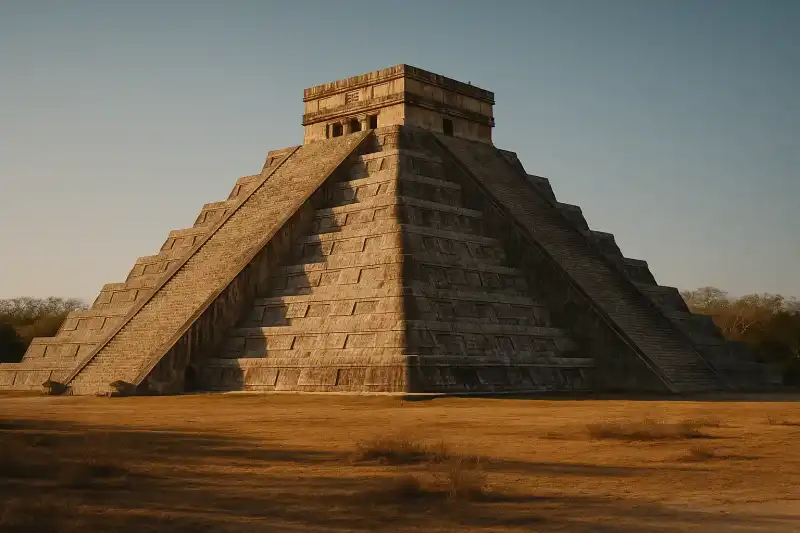
Chichen Itza Travel Guide 2026: Maya Secrets, Sacred Cenote, and Smart Timing
MayaChichen Itza stands as the most visited ancient site in Mexico, showcasing the architectural genius ...
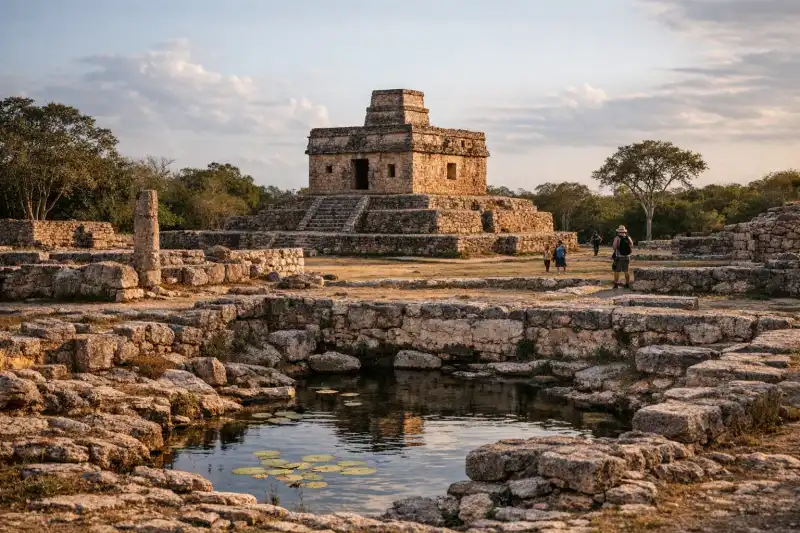
Dzibilchaltún
MayaExplore Dzibilchaltún, an ancient Maya city in Mexico known for its Temple of the Seven Dolls, sacbe...
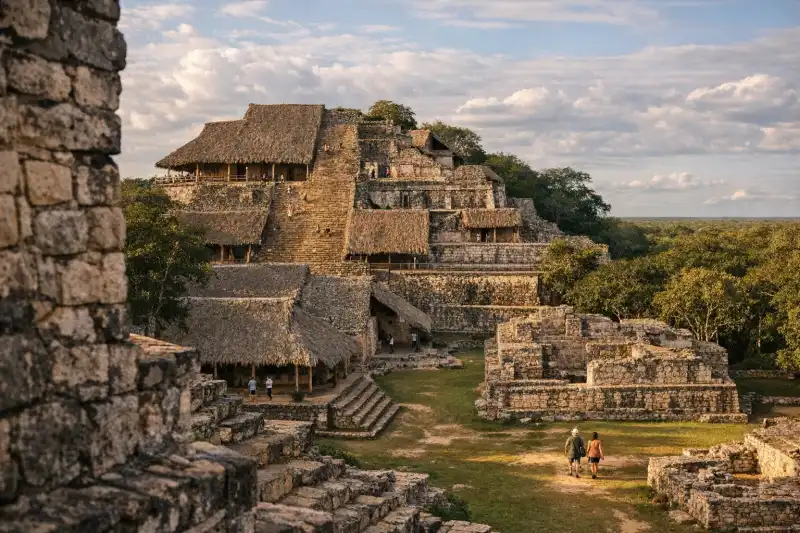
Ek Balam
MayaExplore Ek Balam, a remarkably preserved Maya city in Mexico known for its acropolis, carvings, and ...
Edzná
MayaExplore Edzná, a striking ancient Maya city in Campeche, Mexico, known for its grand plazas, elevate...