Quick Info
At a glance
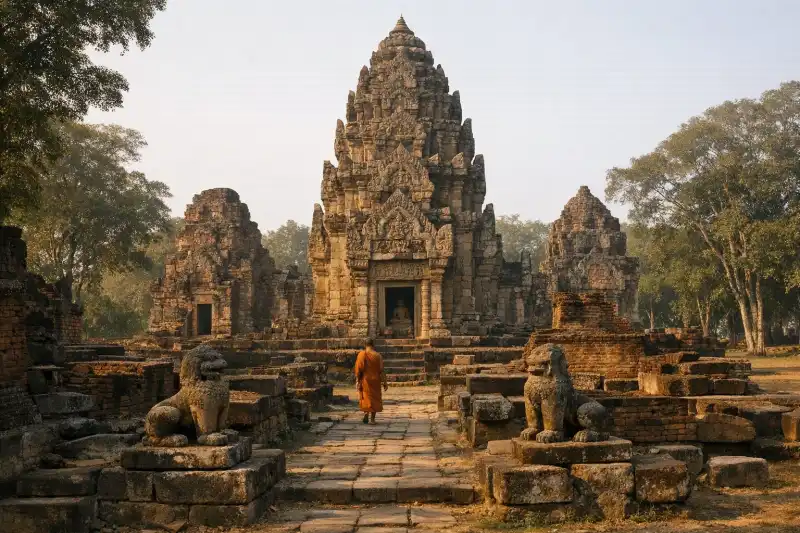
Ku Kaew Chaiyaram in Thailand is one of those archaeological places that rewards travelers who enjoy quiet discovery rather than crowds. Set in the northeastern region known as Isan, the site does not announce itself with the scale of Thailand’s better-known temple cities, yet its atmosphere is precisely what makes it memorable. Here, ancient masonry rises from a largely rural landscape, and the remains of a Khmer-era sanctuary hint at a time when political influence, religious practice, and artistic styles moved across what are now modern national borders. The setting feels intimate: low ruins, local roads, open skies, and the steady rhythm of agricultural life nearby.
For visitors interested in Thailand beyond Bangkok, Ayutthaya, or the beach destinations, Ku Kaew Chaiyaram offers a different perspective on the country’s past. It belongs to the broad network of Khmer-influenced monuments scattered across northeastern Thailand, where sanctuaries were often established as regional religious centers or markers of authority. Though modest in scale compared with the grand stone temples of Cambodia, sites like this are crucial for understanding how Khmer culture reached deep into the Khorat Plateau. A visit here is less about spectacle and more about texture: weathered laterite, brick fragments, the alignment of foundations, and the enduring sense of place that survives long after the original ritual life has faded.
History
Early Khmer influence in northeastern Thailand
To understand Ku Kaew Chaiyaram, it helps to place it within the expansion of Khmer cultural and political influence across mainland Southeast Asia. Between roughly the 9th and 13th centuries CE, the Khmer Empire, centered at Angkor in present-day Cambodia, extended its reach over large parts of what is now northeastern Thailand. This influence was not only military or administrative; it was also religious, artistic, and infrastructural. Sanctuaries appeared across the region, often connected by routes that linked local communities to larger power centers.
The Isan plateau became an especially important frontier zone in this network. Here, Khmer builders adapted their architecture to local terrain and materials, producing temples that reflected broader imperial styles while remaining rooted in regional conditions. Ku Kaew Chaiyaram likely emerged during this period as one of many provincial sanctuaries that served local worshippers and reinforced the authority of distant rulers. Such sites often had a dual role: they were sacred spaces dedicated to Hindu deities or later Buddhist practices, and they also symbolized the integration of local communities into a wider political world.
Construction and religious purpose
Although exact dating for smaller sites can sometimes be debated, Ku Kaew Chaiyaram is generally associated with the mature Khmer period, when laterite and brick temple construction was widespread in the region. The sanctuary was likely built between the 11th and 12th centuries, an era of substantial monument-building under Khmer kings who invested heavily in temple architecture. During this time, sanctuaries in outlying territories often followed familiar design principles: a central tower or shrine, enclosure elements, and carefully oriented layouts that reflected cosmological ideas.
Like many Khmer temples in Thailand, the original religious affiliation of Ku Kaew Chaiyaram may have been Hindu, possibly linked to Shiva or Vishnu, before later shifts in practice brought Buddhist use or reinterpretation. This pattern is common across Khmer monuments, where ritual functions changed over time as dynasties rose and fell and religious priorities evolved. Even when sculptures or inscriptions have been lost, the surviving plan and building techniques still suggest the sacred role the site once held.
The use of laterite is especially significant. This iron-rich stone was readily available in many parts of the region and became a practical building material for foundations, walls, and structural components. Brick was often used for upper sections, decorative areas, or towers, with stucco once covering surfaces that now appear bare. What visitors see today can look austere, but in its original form the sanctuary would have been visually richer, with carved details, plaster finishes, and ritual objects adding color and meaning.
Decline, reuse, and survival
The decline of Khmer central authority in the 13th century gradually changed the role of outlying sanctuaries like Ku Kaew Chaiyaram. As political control fragmented and regional powers shifted, many smaller temples lost their original administrative and religious importance. Some were adapted to local worship; others were abandoned, partially dismantled, or absorbed into village landscapes. Stones could be reused, vegetation could overtake masonry, and memory of the site’s original name or function could fade.
Yet abandonment did not mean disappearance. In Thailand, many ancient ruins survived precisely because they remained part of community geography. Even when no longer functioning as major ritual centers, they persisted as landmarks, local sacred spaces, or places associated with stories and seasonal visits. Ku Kaew Chaiyaram appears to have endured in this way, not as a monumental capital, but as a durable fragment of the Khmer past embedded in everyday rural surroundings.
Modern archaeological interest and heritage preservation have helped bring renewed attention to sites like this. As scholars and heritage agencies documented Khmer remains across Isan, Ku Kaew Chaiyaram became part of a larger narrative about northeastern Thailand’s role in premodern regional history. Today, while it may not be among the most famous ruins in the country, it remains valuable for visitors seeking a more complete understanding of Thailand’s ancient landscape.
Key Features
Ku Kaew Chaiyaram’s strongest appeal lies in the way its features reveal both the ambitions and the limitations of a provincial Khmer sanctuary. Unlike grand temple mountains or sprawling royal compounds, this site is relatively compact, which makes it easier to read architecturally. Visitors can often trace the essential plan without needing to cover a huge area. Foundations, low walls, and surviving structural elements allow the imagination to reconstruct the original shrine and its ceremonial setting.
One of the most notable characteristics is the use of laterite, a hallmark of many ancient monuments in northeastern Thailand. Laterite blocks have a rough, earthy texture and a deep reddish-brown color that changes with light and weather. In the morning and late afternoon, these surfaces often appear especially dramatic, standing out against green vegetation and open sky. Even when ornament has worn away, the material itself conveys age and resilience. It reminds visitors that Khmer builders worked with what the landscape provided while still adhering to a sophisticated architectural tradition.
The temple layout is another important feature. Although time has reduced much of the structure to fragments, the alignment of the surviving remains suggests careful planning rather than random construction. Khmer sanctuaries were not casual assemblages; they reflected cosmological concepts, directional symbolism, and ritual movement. Approaching the site today, you can still sense that order. The surviving remains are often low enough to invite slow observation, making it easier to notice transitions between outer and inner spaces, raised platforms, and the central focus of the shrine area.
Brickwork, where visible, adds another layer of interest. Brick was frequently used in Khmer religious architecture across Thailand, especially for tower superstructures. At Ku Kaew Chaiyaram, surviving brick elements help indicate where walls or sanctuaries once rose higher above the present ground line. Even broken or incomplete sections show the precision with which materials were combined. In their original state, these brick surfaces may have been coated in stucco and decorated, so what appears simple today once likely supported a far more refined visual program.
The setting is equally important to the experience. Ku Kaew Chaiyaram does not sit in an urban museum-like environment. Instead, it remains tied to the rural landscape of Isan, and that context shapes how the monument is understood. The site’s quietness can be striking, especially for travelers used to Thailand’s heavily visited destinations. Birds, wind, and distant agricultural activity often replace the sound of tour groups. This makes the ruin feel less like an exhibit and more like a surviving piece of lived geography.
For photographers, the site offers subtle rewards rather than dramatic spectacle. The interplay of texture, ruin, and open space works well in soft natural light. Details such as stone joints, weathered edges, and low vegetation often become the most memorable visual elements. For history-minded travelers, these same details reveal the long life of the monument: construction, use, decline, and preservation all become legible in the surfaces themselves.
Perhaps most importantly, Ku Kaew Chaiyaram serves as an interpretive bridge. It helps visitors connect the famous Khmer heritage of Angkor and the major temple complexes of Thailand with the smaller sanctuaries that once sustained everyday religious and political life across the region. Seen in this broader context, the site is not minor at all. It is a vital piece of the network.
Getting There
The easiest way to reach Ku Kaew Chaiyaram is by private car or hired driver from Maha Sarakham town, which serves as the most practical base. Depending on the exact starting point, a one-way taxi or ride with a local driver may cost around THB 400 to 900. If you are starting from Khon Kaen, which has better transport connections and an airport, expect a longer journey and a one-way car hire cost closer to THB 1,200 to 2,000, depending on vehicle type and waiting time.
For independent travelers, renting a car in Khon Kaen is often the most flexible option. Daily rental rates commonly start around THB 900 to 1,500, excluding fuel. Roads in the region are generally manageable, and driving allows you to combine Ku Kaew Chaiyaram with other Isan heritage stops. Motorbike rental may be possible in larger towns, usually from about THB 250 to 400 per day, but this is best suited to experienced riders comfortable with heat, sun exposure, and rural navigation.
Public transport can get you part of the way, but usually not all the way to the monument itself. Buses and vans connect Khon Kaen, Maha Sarakham, and surrounding districts, often for THB 50 to 150 depending on distance. From there, you may need a songthaew, tuk-tuk, or local motorcycle taxi for the last stretch, if available. Because rural services can be infrequent, it is wise to confirm return options before setting out.
If you prefer a smoother visit, ask your hotel in Maha Sarakham or Khon Kaen to arrange a driver for a half-day trip. This usually costs more than public transport but saves time and avoids uncertainty.
When to Visit
The best time to visit Ku Kaew Chaiyaram is during Thailand’s cool season, usually from November to February. In northeastern Thailand, this period brings the most comfortable daytime temperatures, lower humidity, and clearer skies. Since the site is largely exposed and offers limited shade, cooler weather makes a noticeable difference. Morning visits are especially pleasant, with softer light for photography and a calmer atmosphere before the heat builds.
The hot season, from around March to May, can still be manageable if you arrive early in the day, but midday temperatures in Isan can be intense. If you travel during this period, bring water, sunscreen, a hat, and light but sun-protective clothing. Even short visits can feel tiring under direct sun, especially on pale or reflective ground surfaces.
The rainy season, typically from May or June through October, transforms the countryside into a greener landscape and can make the area around the ruins especially scenic. However, rain showers, muddy ground, and occasional transport inconvenience should be expected. If you do not mind some unpredictability, this can be a rewarding time to see the monument in a lush setting with few other visitors.
Whenever you go, aim for either early morning or late afternoon. The lower sun emphasizes the textures of laterite and brick, while the overall experience feels quieter and more contemplative. If you are combining the site with other regional ruins, the cool season remains the best all-around choice for a multi-stop heritage itinerary.
| Quick Facts | Details |
|---|---|
| Site Name | Ku Kaew Chaiyaram |
| Location | Maha Sarakham Province, Thailand |
| Region | Isan, northeastern Thailand |
| Cultural Affiliation | Khmer |
| Likely Date | 11th-12th century CE |
| Main Materials | Laterite and brick |
| Best Visit Duration | 30-60 minutes |
| Best Season | November to February |
| Nearest Practical Base | Maha Sarakham |
| Ideal For | History travelers, archaeology enthusiasts, regional heritage road trips |
Guided tours: worth it?
Self-guided works here, but a guide can add real value if you want the ruins explained as a living place rather than just a sequence of monuments.
Best for
- First-time visitors who want context, not just photos
- Short visits where a planned route saves time
When to go self-guided
Go independently if you prefer setting your own pace, reading as you go, and checking official hours or ticket rules directly before you arrive.
What I’d avoid
Skip paid tours that bundle unrelated stops you do not actually want. The best option should either save meaningful planning time or add historical context you would miss on your own.
Maha Sarakham cultural day tours
Useful when: you want to compare guided formats before deciding
Khon Kaen historical tours
Useful when: you want to compare guided formats before deciding
Isan heritage private tours
Useful when: you want flexible timing or a private guide
Some tour links are affiliate links, which may earn Ancient Travel a small commission at no extra cost to you. I try to surface options that make practical sense for the site—not just anything bookable.
Frequently Asked Questions
What is Ku Kaew Chaiyaram?
Ku Kaew Chaiyaram is an ancient Khmer-influenced temple ruin in Maha Sarakham Province, northeastern Thailand, built as part of the wider cultural landscape once linked to the Khmer world.
Where is Ku Kaew Chaiyaram located?
The site is in Chaiyaram area of Maha Sarakham Province in Thailand’s Isan region, surrounded by rural communities, rice fields, and local roads rather than a large tourist hub.
How much time do I need to visit?
Most travelers can see the site in 30 to 60 minutes, though history enthusiasts may want longer to explore the remains, read signage, and combine it with nearby regional heritage sites.
Is there an entrance fee for Ku Kaew Chaiyaram?
Fees and local management arrangements can change, but many smaller archaeological sites in rural Thailand are free or charge only a modest amount. Bring small cash just in case.
What is the best way to reach Ku Kaew Chaiyaram?
The most practical way is by private car, hired driver, or taxi from Maha Sarakham or Khon Kaen, since public transport reaches the general area more easily than the exact monument.
When is the best time of year to visit Ku Kaew Chaiyaram?
The cool season from roughly November to February is the most comfortable, with lower humidity and milder temperatures for exploring exposed ruins during the day.
Nearby Ancient Sites
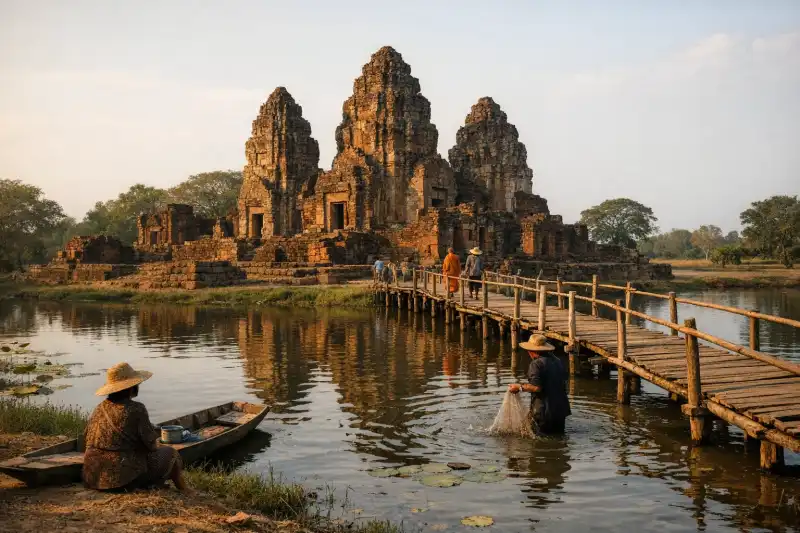
Ku Santarat
Khmer EmpireKu Santarat is a quiet Khmer-era temple ruin in northeastern Thailand, known for laterite towers, mo...
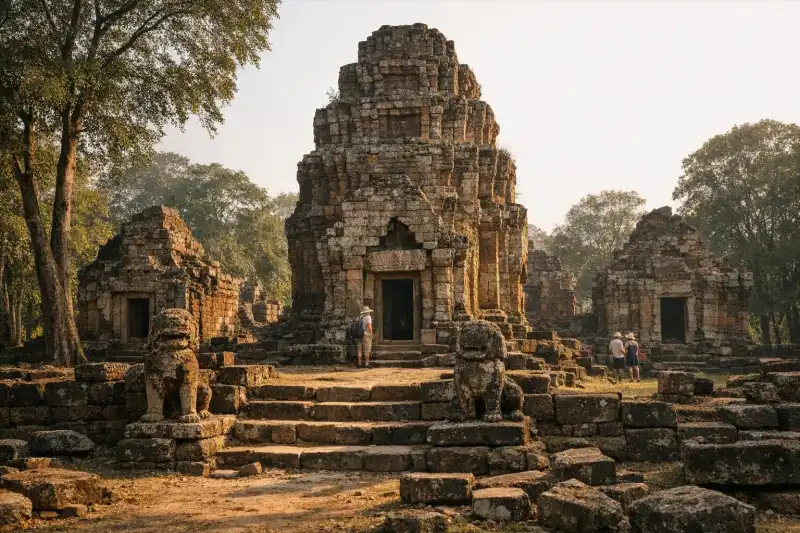
Ku Phra Kona
KhmerAn early Khmer sanctuary in northeastern Thailand, Ku Phra Kona preserves brick towers, carvings, an...
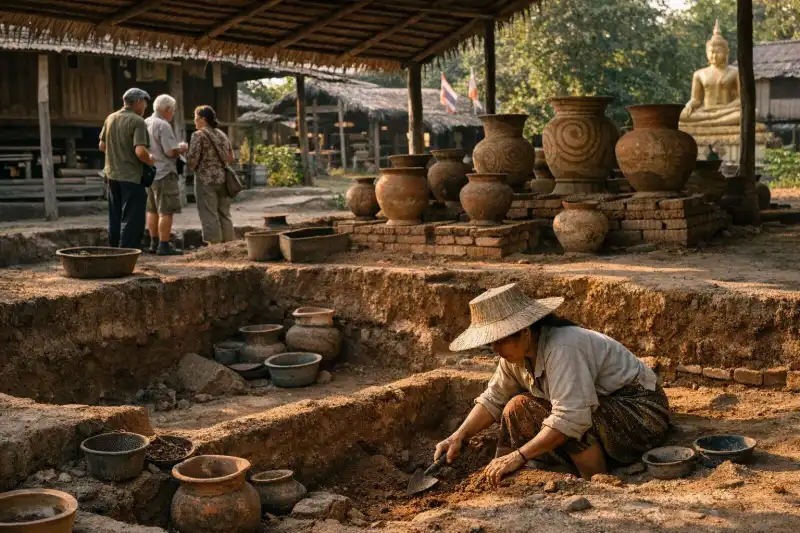
Ban Chiang
Prehistoric cultures of Northeast ThailandExplore Ban Chiang in Thailand, a remarkable prehistoric archaeological site known for early metallu...