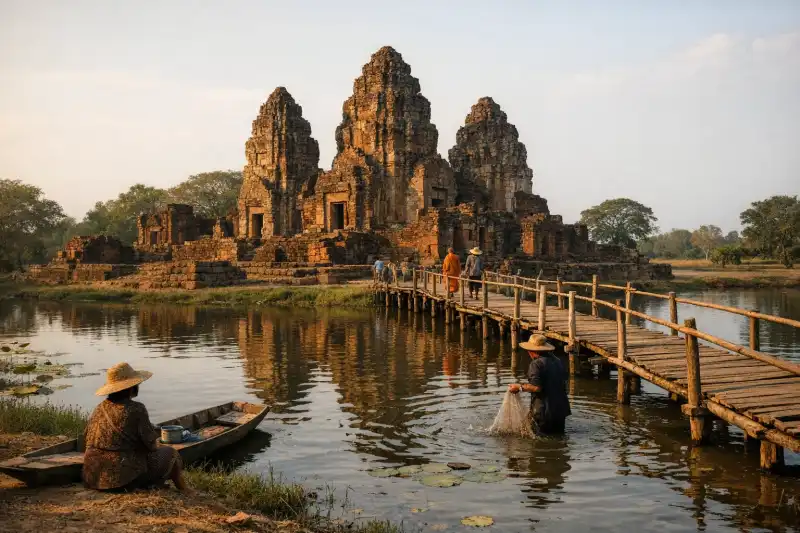
Quick Info
At a glance
Ku Santarat in Thailand sits quietly among the fields of the northeast, far from the country’s best-known tourist circuits. That calm isolation is part of its appeal. In a region where traces of the Khmer world still appear in unexpected places, this ancient sanctuary offers a more intimate experience than the grander temple complexes of Cambodia or the heavily visited ruins of central Thailand. Here, weathered laterite, fragmented stonework, and the outline of old moats and enclosures create a setting that feels both archaeological and deeply local.
A visit to Ku Santarat is not about spectacle alone. It is about atmosphere: the red-brown texture of ancient blocks warmed by the sun, the silence broken by birds and village life, and the realization that major religious and political networks once extended into what is now rural Isaan. The site reflects a period when Khmer architectural forms, religious ideas, and administrative influence shaped large parts of northeastern Thailand. Though smaller than famous monuments like Phanom Rung, Ku Santarat rewards careful attention. Its surviving towers, enclosure, and plan still communicate the logic of a sacred space built to align worship, authority, and ritual movement.
For travelers interested in lesser-known heritage, Ku Santarat offers something increasingly rare: a place where history is not hidden behind crowds. It remains accessible, legible, and atmospheric, especially for those willing to slow down and look closely.
History
Early Khmer Expansion into Isaan
The history of Ku Santarat is tied to the expansion of Khmer cultural and political influence across mainland Southeast Asia. Between the 10th and 13th centuries, areas of what is now northeastern Thailand formed part of a wider sphere linked to Angkor. This influence was not simply military. It spread through roads, religious patronage, administrative centers, and temple foundations that connected local communities to the Khmer state and its sacred geography.
In Isaan, many temples were built in durable materials such as laterite and sandstone, often positioned near settlements, reservoirs, or routes of communication. Ku Santarat belongs to this landscape of regional sanctuaries. While it was not a royal capital, its construction signals that the area around present-day Maha Sarakham was integrated into Khmer systems of ritual and governance. Temples like this were often more than places of worship. They could mark political authority, support agricultural communities, and anchor the identity of a local territory.
The name “ku” itself is commonly associated in the Thai northeast with ancient Khmer sanctuaries or towers. That linguistic continuity shows how the memory of these structures survived long after the fall of Angkorian power.
Foundation and Religious Role
Most scholars place Ku Santarat broadly within the 11th to 12th centuries CE, when Khmer architecture flourished across the region. The temple was likely established as a Hindu sanctuary, though, as with many Khmer sites, its ritual use may have shifted over time. Temples in this period were often dedicated to Shiva, Vishnu, or other deities represented through sacred images or lingas housed in the central tower.
Architecturally, Khmer sanctuaries were designed as symbolic sacred mountains, miniature versions of the cosmic order. Even a modest site such as Ku Santarat reflects that worldview. The central tower would have housed the most important cult object, while surrounding structures and enclosures organized access according to ritual hierarchy. Moats and walls also had cosmological meaning, representing boundaries between ordinary space and the divine center.
The temple’s builders chose laterite as a principal construction material, a practical and regionally common choice. Laterite was abundant and durable, though less suited to elaborate carving than sandstone. Even so, the site would once have had decorative architectural details, stucco, wooden elements, and religious images that no longer survive in full.
Adaptation, Decline, and Local Memory
As political conditions changed and the dominance of Angkor faded, many Khmer temples across northeastern Thailand lost their original patronage. Some were repurposed by later Buddhist communities, while others gradually fell out of formal ritual use. Ku Santarat likely experienced a similar process of adaptation and decline. Over centuries, roofs collapsed, masonry shifted, and decorative features disappeared through weathering, reuse, or simple neglect.
Yet abandonment in the archaeological sense rarely meant complete forgetting. Local communities often continued to recognize these ruins as meaningful places, associating them with spirits, legends, merit-making, or the deep history of the landscape. In many parts of Isaan, ancient Khmer sites remained embedded in village life, even when their original religious significance was no longer clearly understood.
This continuity of memory is one reason sites like Ku Santarat survived at all. Had they been entirely detached from local awareness, many more stones might have been removed for later building works. Instead, a mixture of respect, practicality, and cultural familiarity helped preserve at least the core remains.
Modern Recognition and Preservation
In the modern era, Thai historians, archaeologists, and heritage authorities began to document the Khmer monuments of the northeast more systematically. Better-known sites such as Phanom Rung and Phimai received major conservation attention, but smaller monuments including Ku Santarat also entered the broader map of national heritage.
Preservation at such sites is often selective rather than comprehensive. The aim is usually to stabilize surviving structures, clarify the original plan where possible, and make the site accessible without over-restoring it. At Ku Santarat, that means visitors encounter a ruin that still feels authentically aged rather than heavily reconstructed.
Today, Ku Santarat stands as both a historical monument and a reminder of the Khmer cultural layer within Thailand’s northeast. It helps illustrate that the story of ancient Thailand was never confined to one kingdom or one architectural tradition. Instead, it was shaped by overlapping spheres of influence, and Ku Santarat is one of the quieter but valuable witnesses to that complexity.
Key Features
What makes Ku Santarat memorable is not monumental scale but clarity of form. Even in ruin, the temple preserves the essential elements of a Khmer sanctuary: a central sacred core, surrounding enclosure, and a relationship between built structure and open space. Visitors can still sense how the complex was organized, and that legibility is one of its greatest strengths.
The most striking surviving feature is the laterite construction. Laterite has a rich reddish-brown color and a rough, porous texture that changes beautifully with the light. In the morning and late afternoon, the material seems to absorb and reflect warm tones, making the site especially photogenic. Unlike polished stone monuments, Ku Santarat feels earthy and grounded, almost as if it has risen out of the land itself. The weathering of the blocks adds to that impression, softening edges while emphasizing the age of the structure.
The remains of the sanctuary towers are another important element. Though incomplete, they still reveal the vertical ambition of Khmer religious architecture. These towers were not simply decorative structures. They were symbolic centers, housing sacred images and marking the axis of worship. At Ku Santarat, the ruined upper sections invite the imagination to reconstruct their original form, likely steeper, more enclosed, and visually dominant within the surrounding enclosure.
The site plan also deserves attention. Khmer temples were carefully arranged, and Ku Santarat preserves enough of that order to show how movement through the complex was intended. Visitors approach across open ground and encounter the remains in a sequence that once would have been even more formal. Boundaries, gateways, and enclosure lines mattered deeply in Khmer architecture because sacred space was meant to be entered gradually. Even where walls are fragmentary, the logic remains visible.
Another notable feature is the relationship between architecture and water. Many Khmer temples were associated with moats, ponds, or reservoirs. These were not merely defensive or practical additions. Water had symbolic value and was tied to ideas of cosmic order, purification, and fertility. At Ku Santarat, traces of the surrounding moat and the broader landscape setting help visitors understand how the monument would once have appeared as a distinct sacred island within cultivated land.
The atmosphere of the site is one of its strongest assets. Because Ku Santarat is not overwhelmed by tourism infrastructure, the experience remains relatively unmediated. There are no dramatic queues or tightly choreographed visitor flows. Instead, you encounter the ruins in a rural environment where modern life continues nearby. That contrast between ancient masonry and living countryside creates a powerful sense of continuity. The temple does not feel separated from the landscape; it feels woven into it.
Close observation reveals smaller details too. Look for masonry joints, threshold stones, collapsed fragments, and changes in elevation that hint at vanished architectural components. Even when carvings are sparse, these structural clues tell a story about construction techniques and ritual use. The precision with which heavy blocks were aligned speaks to skilled labor and a sophisticated building tradition.
Photography is especially rewarding here because the site offers texture rather than spectacle. Wide shots capture the relationship between ruins and fields, while closer framing highlights the granular surface of laterite and the geometry of surviving walls. During the rainy season, surrounding greenery can make the red stone stand out more vividly; in the dry months, the monument appears more severe and sculptural.
For travelers who have already visited larger Khmer sites, Ku Santarat offers a useful point of comparison. It shows how the Khmer architectural idiom was adapted at a local scale. For first-time visitors, it provides a manageable and contemplative introduction to the temple traditions of the region. In either case, the key features of Ku Santarat are best appreciated slowly, by walking its perimeter, pausing often, and allowing the ruin’s proportions and textures to reveal themselves.
Getting There
Ku Santarat is most conveniently reached from Maha Sarakham town, with Khon Kaen serving as the main regional gateway for travelers arriving by air or intercity transport. Khon Kaen has the nearest major airport, with domestic flights from Bangkok commonly priced around THB 1,000-2,500 each way depending on season and booking time. From Khon Kaen Airport, you can hire a taxi or use a ride-hailing app into the city for roughly THB 150-250.
From Khon Kaen to Maha Sarakham, buses and minivans usually take about 1.5 to 2 hours and often cost around THB 70-150. Private taxis or hired cars are faster and more flexible, generally ranging from THB 1,200-2,000 depending on negotiation and vehicle type. If you want to visit Ku Santarat comfortably, renting a car in Khon Kaen is often the easiest option, with daily rates commonly starting at THB 900-1,500 excluding fuel.
From Maha Sarakham town, the ruins are best reached by private car, motorbike, or local taxi. Short regional taxi hires may cost around THB 300-800 round trip depending on waiting time and distance. Motorbike rental, where available, can be a budget-friendly alternative at roughly THB 200-350 per day. Public buses may pass through the broader district, but they rarely offer the direct, predictable access most visitors want.
Roads in the area are generally manageable, but signage to smaller historical sites can be limited. It is wise to use offline maps, carry water, and plan your return transport in advance. If you are combining Ku Santarat with other Isaan heritage sites, hiring a driver for the day can be cost-effective and much less stressful.
When to Visit
The best time to visit Ku Santarat is the cool, dry season from November to February. During these months, temperatures are more comfortable, skies are often clearer, and walking around the site is easier. Daytime highs still feel warm, but the air is less oppressive than in the hot season, making it the most pleasant period for travelers who want to explore without rushing. Morning visits are especially rewarding, with softer light for photography and a quieter atmosphere.
From March to May, northeastern Thailand becomes very hot. Afternoon temperatures can rise sharply, and there is little shelter at many rural ruins. If you visit in this period, go early in the day, wear a hat, and bring plenty of water. The advantage of the hot season is strong, dramatic light and fewer weather interruptions, but the heat can shorten your time on site.
The rainy season, usually from June to October, transforms the surrounding countryside into vivid green. This can be a beautiful time to see Ku Santarat, especially if you enjoy landscapes that feel lush and alive. The red laterite often contrasts wonderfully with wet grass and cloudy skies. However, sudden showers, muddy ground, and humid conditions are common, so lightweight rain protection and sturdy footwear are useful.
Festival periods in Isaan can add cultural interest to a broader trip, though Ku Santarat itself remains a relatively low-key destination. If your priority is atmosphere and photography, aim for early morning in the cool season or just after rain in the wet season. If your priority is comfort, December and January are usually the safest choices.
| Quick Facts | Details |
|---|---|
| Location | Maha Sarakham Province, northeastern Thailand |
| Historical culture | Khmer Empire |
| Estimated date | c. 11th-12th century CE |
| Site type | Khmer sanctuary / temple ruin |
| Main material | Laterite with possible sandstone elements |
| Best base | Maha Sarakham or Khon Kaen |
| Typical visit length | 30-60 minutes |
| Best season | November to February |
| Recommended transport | Private car, hired driver, or taxi |
| Atmosphere | Quiet, rural, uncrowded |
Ku Santarat may not be the most famous ancient site in Thailand, but that is precisely why it lingers in memory. It offers a more reflective kind of travel experience, one shaped by proximity rather than grandeur. Here, the visitor is free to notice the weight of old blocks, the geometry of a ruined sanctuary, and the long reach of Khmer culture into the Thai northeast. For those interested in archaeology, regional history, or simply the pleasure of finding a remarkable place beyond the main tourist route, Ku Santarat is a rewarding stop. It reminds us that ancient landscapes are often built not only from capitals and masterpieces, but also from smaller sanctuaries whose silence still carries the shape of a lost world.
Guided tours: worth it?
Self-guided works here, but a guide can add real value if you want the ruins explained as a living place rather than just a sequence of monuments.
Best for
- First-time visitors who want context, not just photos
- Short visits where a planned route saves time
When to go self-guided
Go independently if you prefer setting your own pace, reading as you go, and checking official hours or ticket rules directly before you arrive.
What I’d avoid
Skip paid tours that bundle unrelated stops you do not actually want. The best option should either save meaningful planning time or add historical context you would miss on your own.
Khon Kaen and Isaan Cultural Sites Tours
Useful when: you want to compare guided formats before deciding
Northeast Thailand Temple and Heritage Tours
Useful when: you want to compare guided formats before deciding
Maha Sarakham and Khon Kaen Day Trips
Useful when: transport or pickup logistics matter
Some tour links are affiliate links, which may earn Ancient Travel a small commission at no extra cost to you. I try to surface options that make practical sense for the site—not just anything bookable.
Frequently Asked Questions
What is Ku Santarat?
Ku Santarat is an ancient Khmer-influenced temple ruin in Maha Sarakham Province, Thailand, built mainly of laterite and set within a historic sacred enclosure.
Where is Ku Santarat located?
The site is in northeastern Thailand in Maha Sarakham Province, within the Isaan region, and is usually visited from Maha Sarakham town or Khon Kaen.
How much time should I allow for a visit?
Most visitors spend 30 to 60 minutes at Ku Santarat, though photographers and travelers combining it with other regional ruins may want longer.
Is there an entrance fee at Ku Santarat?
Fees can change, but Ku Santarat is often free or very inexpensive to enter; carrying small cash is a good idea for local facilities or donations.
What is the best way to reach Ku Santarat?
The easiest way is by private car, hired driver, or taxi from Maha Sarakham or Khon Kaen, since public transport usually does not stop directly at the ruins.
What should I wear when visiting Ku Santarat?
Wear light clothing, sun protection, and comfortable walking shoes. As it is a historic sacred site, modest dress is respectful.
Nearby Ancient Sites
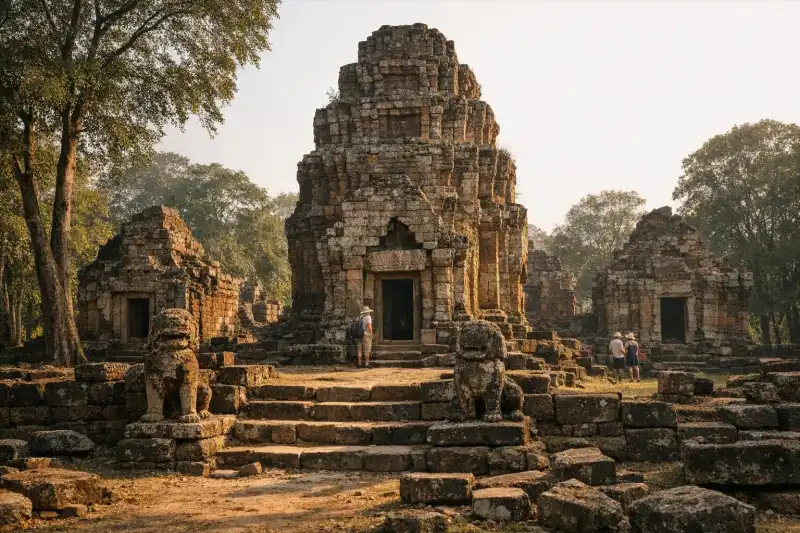
Ku Phra Kona
KhmerAn early Khmer sanctuary in northeastern Thailand, Ku Phra Kona preserves brick towers, carvings, an...
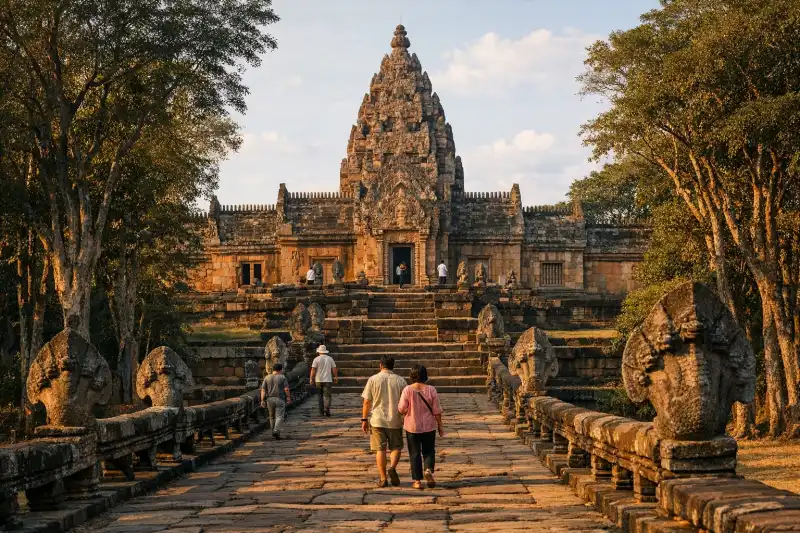
Phanom Rung
Khmer EmpireA dramatic Khmer hilltop temple in Thailand, Phanom Rung is famed for its sandstone carvings and sun...
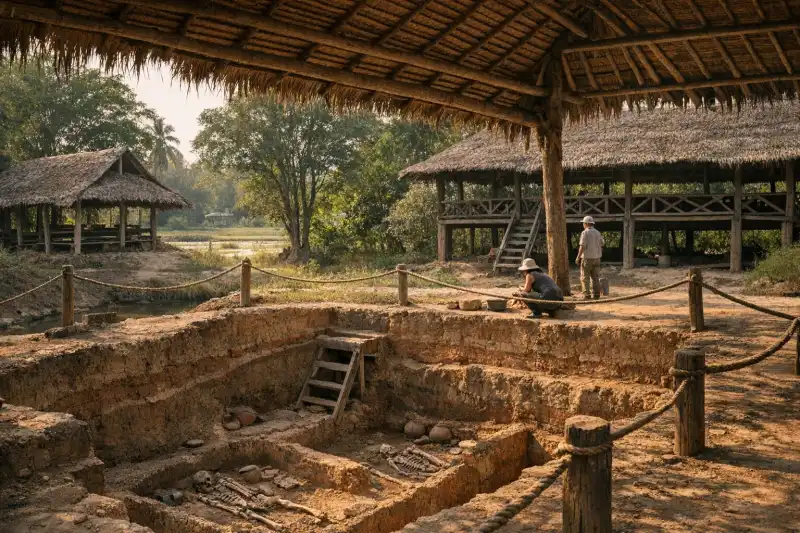
Ban Prasat Archaeological Site
Prehistoric communities of the Mun River basinExplore Ban Prasat Archaeological Site, a prehistoric burial and settlement site in Thailand’s Nakho...
Ban Chiang
Prehistoric cultures of Northeast ThailandExplore Ban Chiang in Thailand, a remarkable prehistoric archaeological site known for early metallu...