Quick Info
At a glance
Ban Prasat Archaeological Site in Thailand offers a quieter kind of historical encounter, one that asks visitors to look beneath the surface of modern village life and imagine communities that lived, buried their dead, shaped pottery, and adapted to changing technologies over thousands of years. Unlike the towering Khmer sanctuaries that often define heritage travel in northeastern Thailand, Ban Prasat is important precisely because its story is grounded in everyday life. Here, the past survives in soil layers, burial pits, ceramics, beads, and traces of ancient houses rather than monumental stone architecture.
Set in Nakhon Ratchasima province, in the broad cultural landscape of Isan, Ban Prasat is one of Thailand’s notable prehistoric excavation sites. It helps explain how settlements in the Khorat Plateau developed from early farming communities into more socially complex societies during the Bronze and Iron Ages. For travelers, the site feels intimate and legible: protective shelters cover excavated areas, interpretive displays explain what was found, and the atmosphere remains closely tied to the rural environment in which these ancient communities once thrived. A visit here is less about spectacle and more about perspective. You begin to see how regional history was built not only by kings and temples, but by ordinary households whose tools, ornaments, cooking vessels, and burial customs reveal a surprisingly rich picture of ancient Thailand.
History
Early settlement in the prehistoric landscape
Ban Prasat lies within a region long recognized as one of mainland Southeast Asia’s important prehistoric zones. The Khorat Plateau, with its river systems, fertile pockets of land, and access to varied natural resources, supported human communities for millennia. Archaeological work at Ban Prasat has shown that the area was occupied in multiple phases, beginning with early agricultural communities that were already adapting to settled life. These people cultivated crops, raised animals, made pottery, and built houses in ways suited to the seasonal rhythms of northeast Thailand.
The earliest settlement layers suggest communities that were still relatively small but increasingly stable. The move toward permanent or semi-permanent village life brought changes in diet, labor, and social organization. Pottery styles from the earliest phases help archaeologists identify cultural practices and regional connections, while burial evidence indicates that ideas about ancestry, identity, and the afterlife already played an important role in village society. Even at this early stage, Ban Prasat was not an isolated point on a map; it formed part of a broader prehistoric network across the plateau.
Bronze Age developments
One of the reasons Ban Prasat is so significant is its evidence for communities living through the Bronze Age, when metal technology became part of life in the region. Bronze did not immediately replace stone or bone tools, but it expanded the range of objects people could produce and likely altered patterns of exchange and prestige. At Ban Prasat, archaeologists found burials with grave goods that include ceramics, ornaments, and items reflecting changing technological skills.
These finds suggest a society becoming more differentiated. Some burials appear richer or more elaborately furnished than others, which may indicate differences in status, age, gender roles, or household identity. The presence of ornaments and crafted goods points to specialized production or at least to a growing investment in display and symbolism. Metalworking, whether carried out locally or supported through trade, linked Ban Prasat to wider developments in prehistoric mainland Southeast Asia.
The Bronze Age layers also reveal continuity in daily life. People still lived in domestic settlements, relied on agriculture, and maintained traditions of pottery making and burial. Rather than a dramatic break with the past, the archaeological evidence shows gradual transformation. New materials and technologies were absorbed into an already established village world.
Iron Age complexity and wider connections
By the Iron Age, communities in the region appear to have become more complex, with stronger evidence for social networks, craft production, and long-distance exchange. Iron tools offered practical advantages in farming and woodworking, supporting larger or more efficient settlement systems. At Ban Prasat, later layers point to a community participating in these wider regional shifts while retaining local cultural traditions.
Burials from these phases continue to be central to interpretation. The arrangement of bodies, the inclusion of pottery and ornaments, and the use of specific burial spaces all help scholars reconstruct beliefs and social patterns. Beads and other exotic items found in prehistoric sites across the region have often been used to trace trade routes connecting inland Thailand with coastal exchange spheres, and Ban Prasat contributes to that broader story of interaction.
What emerges from the Iron Age evidence is not a proto-state in the monumental sense, but a more interconnected and socially layered village society. It is this process of gradual complexity, rather than a single dynastic event, that gives Ban Prasat its importance.
Excavation and modern interpretation
Ban Prasat became more widely known through archaeological excavation in the twentieth century, especially as Thailand’s prehistoric heritage attracted increasing scholarly attention after major discoveries elsewhere in the northeast. Excavations exposed burials, habitation levels, pottery assemblages, and structural evidence, making the site a valuable reference point for understanding chronology and cultural development in the Khorat Plateau.
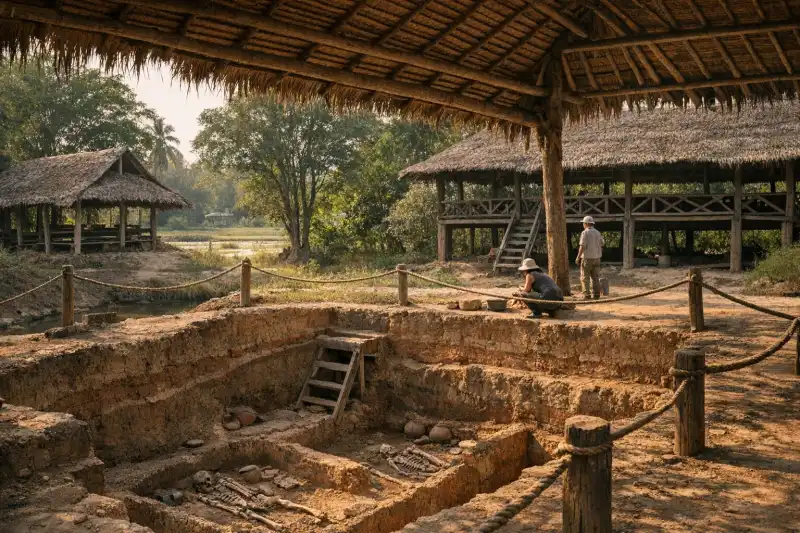
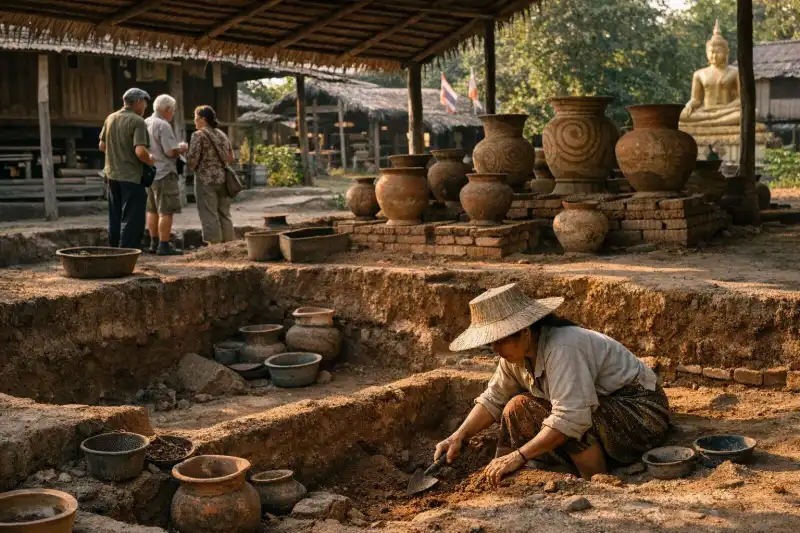
Today, part of the site has been preserved with protective roofing and interpretation for visitors. This is crucial because prehistoric sites are often difficult for non-specialists to read. At Ban Prasat, the presentation helps bridge that gap. Visitors can see actual excavated contexts rather than just museum cases removed from their landscape. The result is a site that remains academically meaningful while also being accessible to curious travelers.
Key Features
The most striking feature of Ban Prasat Archaeological Site is the preserved excavation area itself. Instead of reconstructed ruins or imposing structures, what visitors encounter are carefully protected trenches and burial zones that expose the physical logic of archaeology. Layers of soil, grave outlines, and artifact placements help explain how experts piece together the lives of ancient communities. This makes the site unusually educational. You are not simply told that a prehistoric village existed here; you are shown the material evidence from which that conclusion is drawn.
The burials are especially memorable. They offer a human connection that can feel more immediate than broken walls or weathered carvings. The placement of skeletons, associated pots, and funerary items reveals how ancient inhabitants treated death as part of a social and ceremonial order. Some burials include pottery vessels placed near the body, while others suggest distinctions in how individuals were commemorated. Even for visitors without a background in archaeology, these remains communicate that Ban Prasat was a lived landscape shaped by family, ritual, and memory.
Pottery is another central feature of the site. Ceramics from Ban Prasat help trace long-term shifts in technology and style, and they are among the clearest markers of cultural continuity and change. The forms, decorations, and manufacturing techniques represented here show how practical household goods also carried social meaning. A pot was never just a container; it reflected skill, available materials, and inherited design traditions. Displays and interpretation at the site usually emphasize this point, helping visitors appreciate everyday objects as historical evidence.
The on-site museum and interpretive structures add context to what might otherwise seem like subtle remains. Maps, diagrams, replicas, and explanatory panels usually describe the chronology of occupation, the stages of excavation, and the types of artifacts recovered. This support is important because Ban Prasat is best understood slowly. Rather than racing through, visitors benefit from reading the displays and comparing them to the excavated zones outside. The museum helps translate technical findings into a broader story of prehistoric life in Thailand.
Another key feature is the setting. Ban Prasat remains embedded in a rural environment, and that matters. The surrounding landscape helps visitors imagine why people chose to settle here in the first place. Access to arable land, seasonal water, and local resources made the area suitable for farming communities, while its position within the Khorat Plateau connected it to wider cultural movements. The setting gives the site a sense of continuity between ancient and modern habitation. Villages still endure here because the landscape still supports life.
Finally, Ban Prasat stands out because it complements the better-known temple sites of the region. Travelers heading to Phimai Historical Park or Phanom Rung often encounter the grandeur of later state societies and sacred architecture. Ban Prasat reaches much further back. It illuminates the deep background to northeastern Thailand’s historical development, showing how settled communities emerged long before the rise of Khmer political and religious centers. In that way, its greatest feature may be interpretive: it expands the timeline of what visitors understand Thailand’s heritage to be.
Getting There
Ban Prasat Archaeological Site is usually reached from Nakhon Ratchasima, often called Korat, the main transport hub of the province. From Bangkok, the easiest route is by train or bus to Nakhon Ratchasima first. Ordinary and express trains from Bangkok to Korat typically cost around 70 to 300 THB depending on class, while intercity buses usually range from about 200 to 350 THB. Travel times are generally three to five hours.
From Nakhon Ratchasima, the site is best reached by private car, taxi, rideshare where available, or a hired driver for the day. A one-way taxi or car hire to the Ban Prasat area can cost roughly 700 to 1,500 THB depending on distance, negotiation, and whether you combine it with nearby attractions. Many travelers find it practical to visit Ban Prasat together with Phimai Historical Park, which creates a fuller day of archaeology and history in the region.
Local buses and songthaews may serve nearby districts, but schedules can be limited and may not align well with independent sightseeing. If you are relying on public transport, ask at Korat bus stations for the latest route information to villages in the Non Sung or nearby district area, then use a motorcycle taxi or local pickup for the final stretch. Budget travelers might manage the journey for under 200 THB beyond Korat, but it requires flexibility and time.
For most visitors, renting a car is the most efficient option. Daily rentals in Korat often start around 900 to 1,500 THB, excluding fuel. Roads are generally straightforward, and having your own vehicle makes it easy to continue to other historical sites in northeastern Thailand.
When to Visit
The most comfortable time to visit Ban Prasat is from November to February, when northeast Thailand is relatively cooler and drier. Daytime temperatures are still warm, but the heat is much more manageable for walking around open archaeological areas and reading outdoor interpretation panels. This is the best season for combining Ban Prasat with longer regional trips to Phimai, Phanom Rung, or rural cultural destinations in Isan.
March to May is the hottest period. During these months, temperatures can become intense by late morning and early afternoon, and because Ban Prasat is not a shaded forest site, the heat can wear down visitors quickly. If you come in hot season, aim for an early start, carry water, and plan indoor or museum stops in the middle of the day. The advantage of this season is fewer crowds, though Ban Prasat is never heavily visited compared with Thailand’s major tourist landmarks.
The rainy season, usually from May or June through October, brings greener scenery and a softer rural atmosphere. Showers can be sudden but are often manageable if you plan around the forecast. Roads are generally accessible, though rural travel always benefits from caution after heavy rain. The site’s protective structures help preserve the excavated areas, but wet weather can still make a visit less convenient.
If your main goal is careful appreciation rather than simply ticking off landmarks, weekday mornings in the cool season are ideal. You will likely have more space, softer light for photography, and a better chance to absorb the details that make this prehistoric site so rewarding.
| Quick Facts | Details |
|---|---|
| Location | Nakhon Ratchasima province, northeastern Thailand |
| Type of site | Prehistoric settlement and burial site |
| Cultural period | Neolithic to Bronze Age and Iron Age occupation |
| Best known for | Burials, pottery, settlement layers, and evidence of early village life |
| Best base | Nakhon Ratchasima (Korat) |
| Suggested visit length | 45 minutes to 1.5 hours |
| Best season | November to February |
| Combine with | Phimai Historical Park, Phimai Sanctuary, regional museums |
| Ideal traveler | Visitors interested in archaeology, prehistory, and Thailand beyond temple tourism |
Ban Prasat Archaeological Site rewards travelers who are willing to slow down and look closely. It does not compete with Thailand’s great temple complexes in scale or visual drama, but it offers something rarer: a direct encounter with the long prehistoric roots of settlement in the region. Through burials, ceramics, and the preserved traces of village life, Ban Prasat shows how ancient communities adapted, innovated, and expressed identity over centuries. For anyone trying to understand Thailand’s deeper past, it is a meaningful and highly worthwhile stop.
Guided tours: worth it?
Most travelers can visit Ban Prasat Archaeological Site independently. Compare a tour only if you want a tighter history-focused visit, easier logistics, or a guide who can answer questions on the spot.
Best for
- Short visits where a planned route saves time
When to go self-guided
Go independently if you prefer setting your own pace, reading as you go, and checking official hours or ticket rules directly before you arrive.
What I’d avoid
Skip paid tours that bundle unrelated stops you do not actually want. The best option should either save meaningful planning time or add historical context you would miss on your own.
Nakhon Ratchasima Archaeology Day Tours
Useful when: you want to compare guided formats before deciding
Phimai Historical Park Tours
Useful when: you want to compare guided formats before deciding
Korat Cultural Tours
Useful when: you want to compare guided formats before deciding
Some tour links are affiliate links, which may earn Ancient Travel a small commission at no extra cost to you. I try to surface options that make practical sense for the site—not just anything bookable.
Frequently Asked Questions
What is Ban Prasat Archaeological Site known for?
Ban Prasat Archaeological Site is known for its prehistoric settlement layers, burials, pottery, and evidence of Bronze Age and Iron Age communities in northeast Thailand.
Where is Ban Prasat Archaeological Site located?
The site is in Nakhon Ratchasima province in northeastern Thailand, within reach of Korat and often visited together with Phimai and other Isan heritage attractions.
Do you need much time to visit Ban Prasat Archaeological Site?
Most visitors spend 45 minutes to 1.5 hours exploring the excavated areas, interpretation displays, and on-site museum, though history enthusiasts may stay longer.
Is Ban Prasat Archaeological Site suitable for families?
Yes. The site is compact, educational, and generally manageable for families, especially those interested in archaeology, ancient lifeways, and local history.
Can Ban Prasat Archaeological Site be visited as a day trip?
Yes. It is commonly visited as a day trip from Nakhon Ratchasima or combined with other cultural sites in the region such as Phimai Historical Park.
What should visitors bring to Ban Prasat Archaeological Site?
Bring water, sun protection, light clothing, and cash for local transport or small purchases, as the archaeological site is in a rural area with limited services.
Nearby Ancient Sites
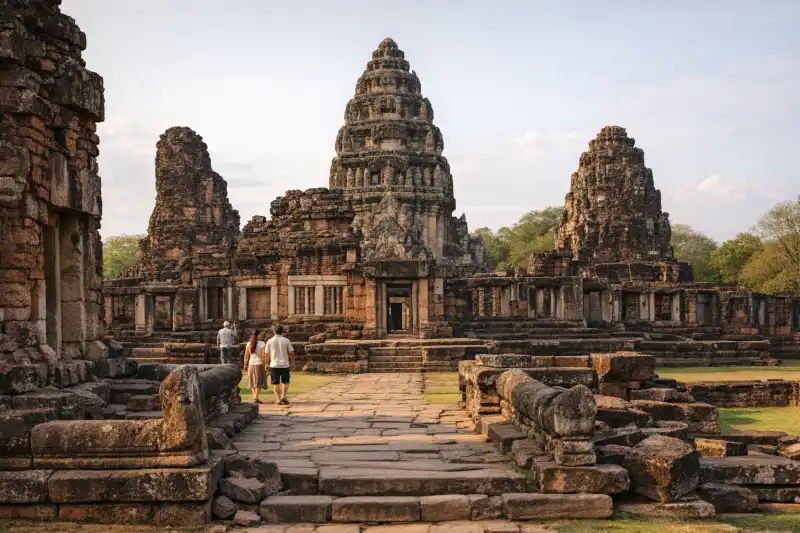
Phimai Historical Park
Khmer EmpireExplore Phimai Historical Park, a remarkable Khmer temple complex in northeastern Thailand famed for...
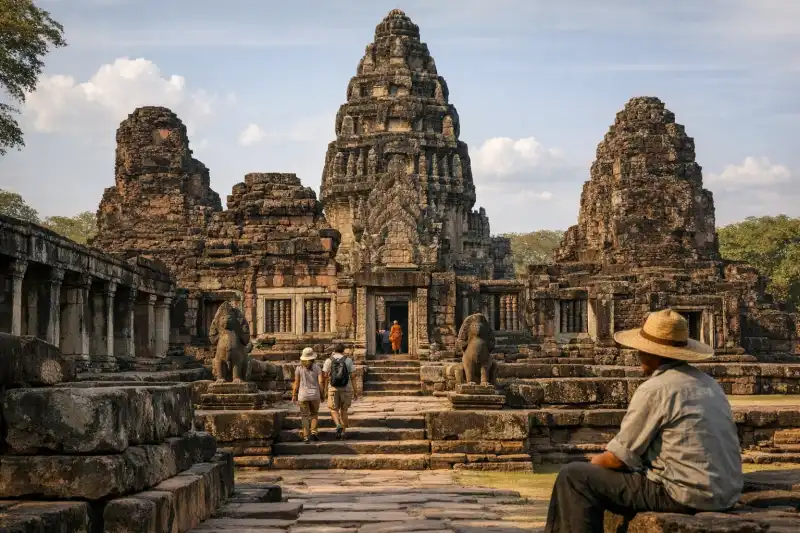
Phimai Sanctuary
Khmer EmpireExplore Phimai Sanctuary, a grand Khmer temple complex in Thailand known for elegant stone carvings ...
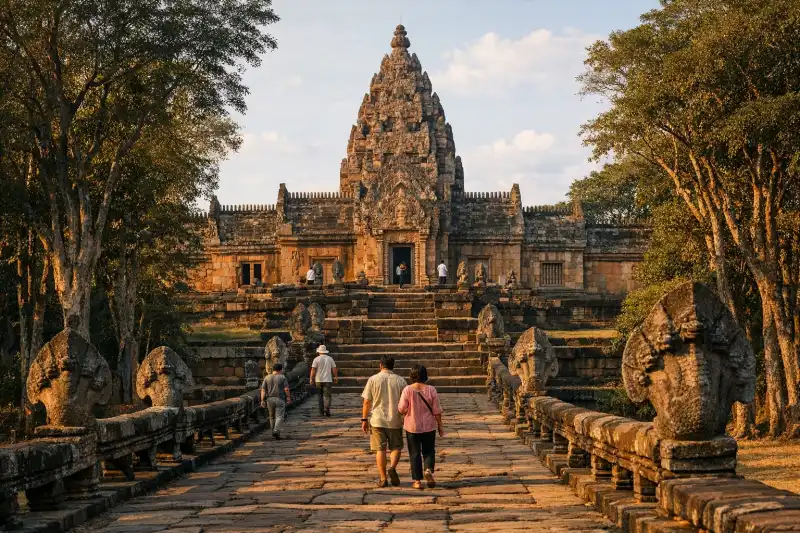
Phanom Rung
Khmer EmpireA dramatic Khmer hilltop temple in Thailand, Phanom Rung is famed for its sandstone carvings and sun...
Ban Chiang
Prehistoric cultures of Northeast ThailandExplore Ban Chiang in Thailand, a remarkable prehistoric archaeological site known for early metallu...