Quick Info
At a glance
Ban Chiang in Thailand is one of Southeast Asia’s most important prehistoric sites, yet its quiet village setting can make the first encounter feel surprisingly intimate. Instead of towering temples or massive stone walls, visitors arrive at a landscape where the significance lies beneath the ground and inside carefully presented museum galleries. This is a place where archaeology has transformed an ordinary-looking rural settlement into a window onto thousands of years of human life, innovation, and ritual in the Khorat Plateau.
The appeal of Ban Chiang is subtle but powerful. It is not a destination defined by monumentality. Rather, it is defined by layers: layers of habitation, layers of burials, and layers of scholarly debate about how early communities in mainland Southeast Asia developed agriculture, metalworking, and long-distance exchange. The discoveries made here challenged older assumptions that the ancient history of the region was peripheral or delayed compared with other parts of Asia. Instead, Ban Chiang showed that northeastern Thailand supported sophisticated communities with rich ceramic traditions and early metallurgy deep in prehistory.
For travelers, this means Ban Chiang rewards curiosity. The site combines a UNESCO-listed archaeological zone, an excellent national museum, and a village atmosphere that remains connected to the discoveries beneath it. If you enjoy ancient history, archaeology, or lesser-known heritage destinations, Ban Chiang offers a different kind of experience from Thailand’s famous temple cities: quieter, more reflective, and rooted in the story of everyday people who lived, worked, crafted, and buried their dead here over many centuries.
History
Early settlement and the first farming communities
The history of Ban Chiang stretches back several millennia, with occupation generally placed between the late Neolithic period and the Iron Age. Archaeological evidence suggests that early communities settled here because the environment supported farming, water access, and village life. Like many prehistoric settlements in mainland Southeast Asia, Ban Chiang likely began as an agricultural community where rice cultivation played a growing role alongside hunting, gathering, and animal domestication.
What makes Ban Chiang historically important is not just age, but continuity. Excavations revealed repeated occupation over long periods, showing how the settlement developed rather than appearing as a single short-lived phase. Burials, pottery, tools, ornaments, and traces of domestic life indicate a society that was stable enough to maintain traditions across generations while also adapting to new technologies and social practices.
The early residents lived in houses built of perishable materials, so the architecture did not survive like stone temples or brick sanctuaries elsewhere in Thailand. Instead, knowledge comes from soil layers, grave goods, ceramics, and the placement of bodies. These remains reveal a community with established customs and a material culture that became increasingly distinctive over time.
Bronze Age developments and the rise of metallurgy
Ban Chiang became internationally famous because of its association with early bronze technology. During the twentieth century, archaeologists working at the site uncovered burials containing bronze artifacts, including tools, ornaments, and weapons. These finds prompted major debates about the chronology of metallurgy in Southeast Asia. Some early interpretations suggested that bronze working in the region may have developed surprisingly early, forcing historians to reconsider technological diffusion across Asia.
Although dating methods and interpretations have evolved, Ban Chiang remains a key reference point in understanding prehistoric metallurgy. The site demonstrated that communities in what is now northeastern Thailand were engaged with metal production and use in a meaningful way. Bronze was not simply an isolated curiosity; it formed part of a broader social and economic system involving craftsmanship, status display, and exchange networks.
Ceramics from this period are among Ban Chiang’s most iconic objects. The red-painted swirling designs seen on many vessels have become visually synonymous with the site. These pots were not only practical containers but also markers of identity, ritual, and aesthetic tradition. Some were placed in graves, suggesting symbolic significance beyond daily domestic use.
Burial traditions and social life
One of the most revealing aspects of Ban Chiang is its burial record. Excavations uncovered human remains interred with pottery, ornaments, metal objects, and other grave goods. These burials help archaeologists reconstruct social structure, diet, health, and cultural beliefs. The dead were often buried near habitation areas, linking daily life and ancestral memory within the same settlement landscape.
Variation in grave goods suggests differences in age, role, or social standing, though Ban Chiang does not present an image of rigid hierarchy on the scale of later kingdoms. Instead, the evidence points to communities where craft specialization and ritual behavior mattered, but where social complexity emerged gradually. Shell ornaments, beads, ceramics, and metal items hint at exchange networks that connected Ban Chiang with broader regional systems.
The care invested in funerary practice also tells us that memory and ceremony were central to community life. The site therefore preserves not just technology, but emotion and belief: how prehistoric people honored the dead, expressed identity, and transmitted cultural traditions over time.
Modern discovery and UNESCO recognition
Ban Chiang entered global awareness relatively recently. Local finds and growing archaeological interest in the 1960s led to formal excavation campaigns by Thai and international teams. These investigations transformed the site into one of the most studied prehistoric locations in Southeast Asia. The discoveries were important enough to reshape broader narratives of regional prehistory and to draw attention to the cultural depth of Thailand beyond its classical temple traditions.
In 1992, the Ban Chiang Archaeological Site was inscribed as a UNESCO World Heritage Site. UNESCO recognized it for bearing exceptional testimony to prehistoric human settlement, agriculture, and metallurgy in the region. This status helped protect the site and encouraged the development of interpretation through the Ban Chiang National Museum and related conservation efforts.
Today, Ban Chiang stands at the intersection of local village life, national heritage, and international scholarship. It is both a scientific landmark and a cultural destination, preserving evidence of communities who lived here long before the rise of Thailand’s historic kingdoms.
Key Features
Ban Chiang’s most important feature is the way it makes invisible history legible. Unlike sites dominated by surviving ruins, here the meaning emerges through excavation areas, museum displays, and the relationship between present-day village space and buried ancient remains. For visitors willing to engage with interpretation, that creates a rewarding and unusually thoughtful heritage experience.
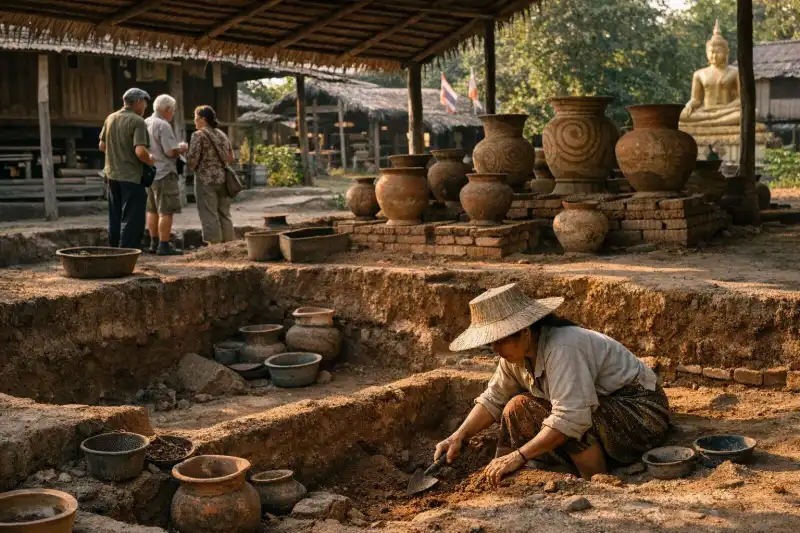
The Ban Chiang National Museum is the centerpiece of any visit. Its galleries explain the chronology of the site and display many of the artifacts that made Ban Chiang famous. Pottery is the immediate visual highlight. The elegant buff-colored vessels with bold red curvilinear painting are striking even if you know little about archaeology. Their designs feel both ancient and modern, and they communicate the artistic confidence of the communities that made them. Beyond the ceramics, the museum exhibits bronze tools, ornaments, burial goods, beads, and reconstructions that help visitors understand how archaeologists piece together prehistoric life.
Another major feature is the excavated burial area preserved in situ. Here, visitors can see stratified earth layers and burial contexts where skeletons and associated objects were found. This is crucial to appreciating Ban Chiang. In the museum, artifacts can seem detached from place; at the excavation, they regain context. You begin to understand how generations occupied the same settlement, how graves accumulated over time, and how archaeologists derived chronology from physical layers in the ground.
The village setting itself is also part of the site’s character. Ban Chiang is not isolated in a dramatic landscape but embedded in a living community. Houses, roads, shops, and local routines exist alongside the archaeological heritage. This can initially feel less spectacular than a monumental site, but it gives Ban Chiang authenticity. The prehistoric story is not sealed off from ordinary life; it survives within it. In some local shops and cultural spaces, visitors may also find pottery inspired by Ban Chiang’s famous designs, reflecting how the ancient site continues to shape modern identity and craft.
Interpretive material is another strength. Because Ban Chiang’s significance is intellectual as much as visual, a good visit depends on context. Museum panels, maps, burial reconstructions, and timelines help explain the progression from early farming communities to later metal-using societies. For travelers interested in the deeper human past, this educational layer is one of the destination’s greatest assets.
A further point of interest is Ban Chiang’s role in larger archaeological debates. Even without specialist training, visitors can appreciate that this site influenced scholarly understanding of Southeast Asia. It challenged simplistic assumptions that innovation always moved from a single center outward in neat sequence. Ban Chiang instead reveals a region with its own developmental trajectories, local traditions, and active exchange connections.
What Ban Chiang does not offer is monumental architecture, panoramic drama, or a packed itinerary of ruins. Its appeal is subtler: material culture, burial archaeology, chronology, and evidence of everyday life. That makes it especially rewarding for travelers who prefer reflective heritage sites over highly theatrical ones. If you take time to look closely, the pottery, burial layers, and museum interpretation combine into a compelling portrait of prehistoric Thailand.
Getting There
Ban Chiang is located in Udon Thani Province in northeastern Thailand, and the easiest base for most travelers is Udon Thani city. From central Udon Thani to Ban Chiang, the journey is roughly 50 to 60 kilometers and usually takes about 45 minutes to 1 hour by road, depending on traffic and your starting point.
The most convenient option is a taxi or ride-hailing car from Udon Thani. Expect fares in the range of about 700 to 1,200 THB for a one-way trip, depending on vehicle type and whether you negotiate a return wait time. Hiring a car with driver for a half-day or full-day excursion can cost around 1,500 to 3,000 THB and is a practical choice if you want flexibility.
Budget travelers can use local buses or vans heading toward Nong Han or routes that pass near Ban Chiang, though services may be less straightforward for foreign visitors. Combined local transport usually costs around 40 to 100 THB each way, but schedules can be irregular and may require a short motorcycle taxi or tuk-tuk ride for the final segment. A motorcycle taxi from a nearby drop-off point may add 30 to 80 THB.
If you are arriving from Bangkok, domestic flights to Udon Thani are frequent and often inexpensive, commonly ranging from about 800 to 2,500 THB one way when booked ahead. From the airport, a direct taxi to Ban Chiang is possible and usually costs roughly 800 to 1,300 THB. Renting a car in Udon Thani is another good option for independent travelers, especially if you want to explore more of the region.
When to Visit
The best time to visit Ban Chiang is generally during Thailand’s cool and dry season, from November to February. During these months, temperatures in northeastern Thailand are more comfortable, often making it easier to move between the museum, outdoor excavation areas, and the surrounding village without the fatigue that intense heat can bring. This is the most pleasant season for travelers combining heritage visits with longer days on the road.
The hot season, usually from March to May, is still manageable, but midday temperatures can become intense. Because Ban Chiang is not an all-day shaded site, the heat can make outdoor sections less comfortable. If visiting in these months, aim for early morning or late afternoon, drink plenty of water, and prioritize the museum during the hottest part of the day. The advantage of this season is that there may be fewer visitors.
The rainy season, roughly from June to October, brings greener landscapes and lower dust levels, but sudden downpours can affect comfort and local transport logistics. Roads are generally still accessible, and the museum remains worthwhile in any weather, but outdoor movement can be less convenient. If you travel during this period, keep an umbrella or light rain jacket and allow extra time for transit.
For photography, the cooler months offer softer daylight and clearer skies. For cultural atmosphere, local festivals in Udon Thani Province can add interest to a regional itinerary, even if Ban Chiang itself remains a relatively calm destination. Overall, if you want the smoothest and most comfortable visit, late November through February is the strongest window.
| Quick Facts | Details |
|---|---|
| Location | Nong Han District, Udon Thani Province, Thailand |
| UNESCO Status | World Heritage Site since 1992 |
| Cultural Period | Neolithic to Iron Age |
| Known For | Prehistoric burials, painted pottery, early metallurgy |
| Best Base | Udon Thani |
| Typical Visit Length | 1.5 to 3 hours |
| Main Highlights | Ban Chiang National Museum, excavated burial area, pottery displays |
| Best Season | November to February |
| Family Friendly | Yes, especially for museum-focused visits |
| Accessibility Note | Parts of the museum are easier to access than outdoor excavation areas |
Guided tours: worth it?
Most travelers can visit Ban Chiang independently. Compare a tour only if you want a tighter history-focused visit, easier logistics, or a guide who can answer questions on the spot.
Best for
- Short visits where a planned route saves time
When to go self-guided
Go independently if you prefer setting your own pace, reading as you go, and checking official hours or ticket rules directly before you arrive.
What I’d avoid
Skip paid tours that bundle unrelated stops you do not actually want. The best option should either save meaningful planning time or add historical context you would miss on your own.
Ban Chiang archaeological site tours
Useful when: you want to compare guided formats before deciding
Udon Thani cultural day tours
Useful when: you want to compare guided formats before deciding
Northeast Thailand heritage tours
Useful when: you want to compare guided formats before deciding
Some tour links are affiliate links, which may earn Ancient Travel a small commission at no extra cost to you. I try to surface options that make practical sense for the site—not just anything bookable.
Frequently Asked Questions
What is Ban Chiang known for?
Ban Chiang is famous for its prehistoric burials, distinctive red-painted pottery, and evidence of early bronze technology in mainland Southeast Asia.
Where is Ban Chiang located?
Ban Chiang is in Nong Han District, Udon Thani Province, in northeastern Thailand.
Is Ban Chiang a UNESCO World Heritage Site?
Yes, the Ban Chiang Archaeological Site was inscribed on the UNESCO World Heritage List in 1992.
How much time should I spend at Ban Chiang?
Most visitors spend 1.5 to 3 hours exploring the museum and the excavated site area, though archaeology enthusiasts may stay longer.
Can I visit Ban Chiang as a day trip from Udon Thani?
Yes, Ban Chiang is commonly visited as a half-day or full-day trip from Udon Thani.
What can I see at Ban Chiang?
Visitors can see excavated burial layers, ceramics, interpretive displays, prehistoric artifacts, and the Ban Chiang National Museum.
Nearby Ancient Sites
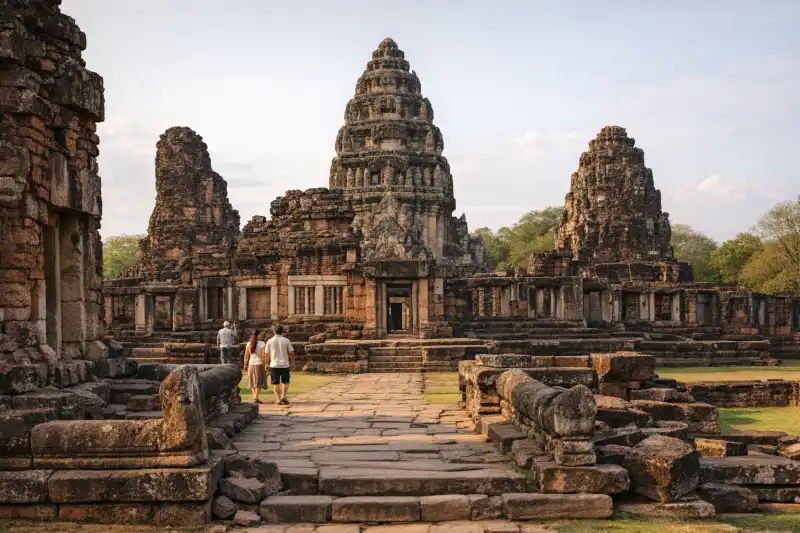
Phimai Historical Park
Khmer EmpireExplore Phimai Historical Park, a remarkable Khmer temple complex in northeastern Thailand famed for...
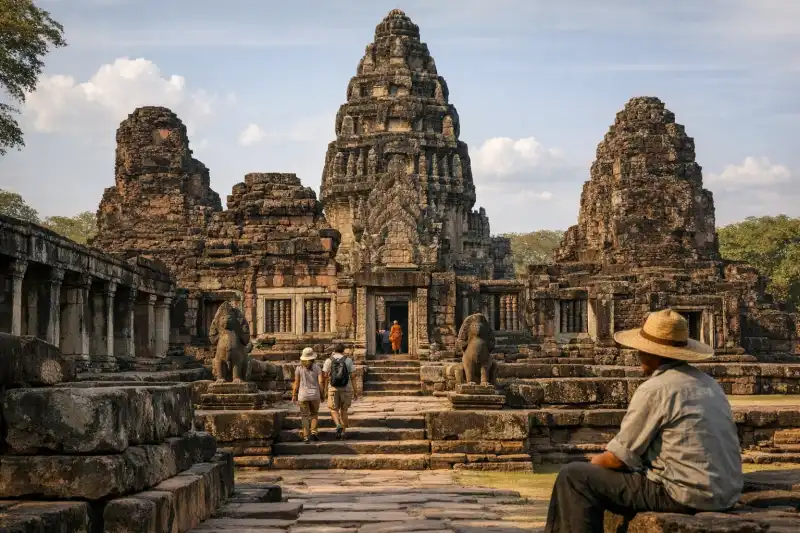
Phimai Sanctuary
Khmer EmpireExplore Phimai Sanctuary, a grand Khmer temple complex in Thailand known for elegant stone carvings ...
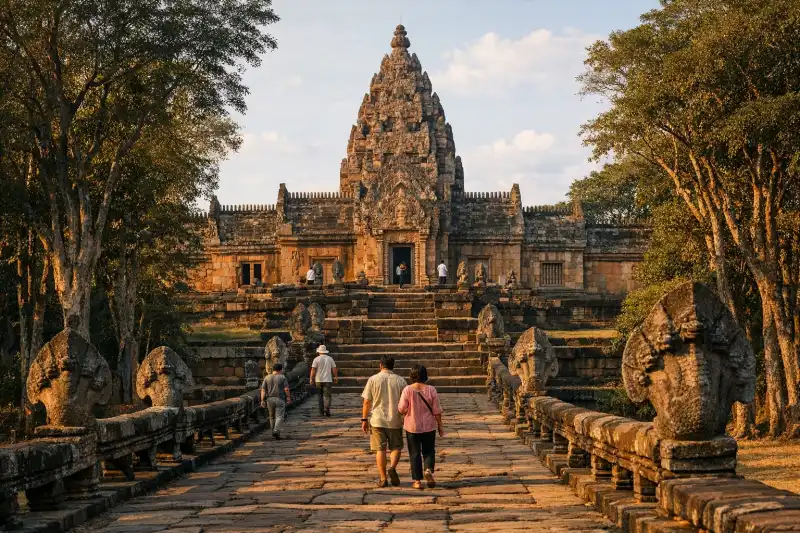
Phanom Rung
Khmer EmpireA dramatic Khmer hilltop temple in Thailand, Phanom Rung is famed for its sandstone carvings and sun...
Prasat Muang Tam
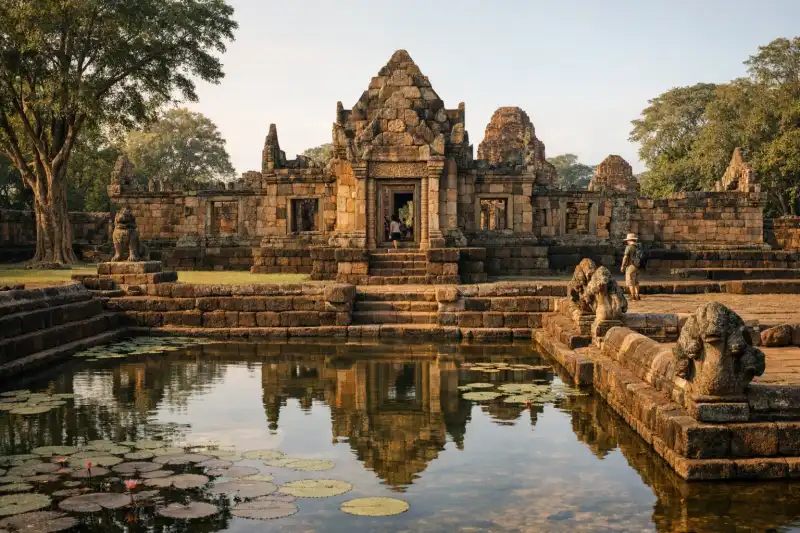
Khmer EmpireA beautifully preserved Khmer temple in Thailand, Prasat Muang Tam is known for serene courtyards, l...