Quick Info
At a glance
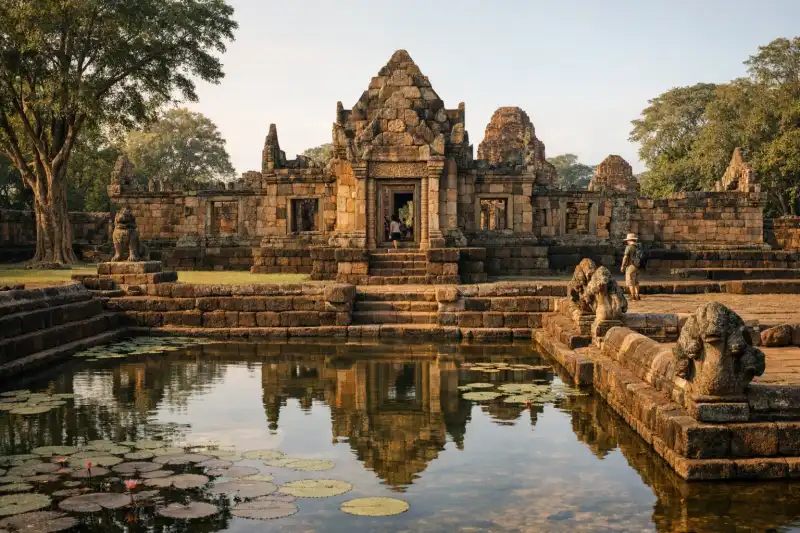
In the shadow of an extinct volcano in northeastern Thailand, Prasat Muang Tam offers one of the most graceful temple experiences in the country. Located in Thailand’s Buriram Province, this Khmer sanctuary is often paired with nearby Phanom Rung, yet it has a distinct personality of its own: quieter, lower in elevation, and framed by lotus ponds that soften the geometry of stone. Instead of a dramatic hilltop approach, visitors arrive at a sanctuary that feels intimate and grounded, where galleries, courtyards, and carved doorways invite a slower kind of attention.
Prasat Muang Tam is not vast in the way some famous temple cities are, but that is part of its appeal. Its scale allows you to understand the logic of Khmer sacred architecture in a single visit. The temple’s sandstone details, brick towers, enclosing walls, and symmetrical pools reveal a design that balanced ritual purpose with visual harmony. In the early morning, the grounds can be especially atmospheric, with soft light resting on laterite walls and reflections trembling in the water. Even when other monuments in the region draw larger crowds, Muang Tam feels contemplative.
For travelers interested in ancient Southeast Asia, the site is a rewarding stop because it shows how the Khmer world extended beyond present-day Cambodia into what is now Thailand. It also demonstrates how landscape mattered to temple planning. Here, water, enclosure, and ornament work together to create an environment that is as much about sacred order as it is about beauty.
History
Early Khmer expansion into the region
Prasat Muang Tam was built during the period when the Khmer Empire extended its political and cultural influence across large parts of mainland Southeast Asia. By the 10th and 11th centuries CE, the empire’s administrative reach included areas of present-day northeastern Thailand, where local elites and royal networks supported the construction of major temples. The region around modern Buriram became one of the most important Khmer frontier zones, linked to larger ceremonial and political centers by roads, religious patronage, and shared artistic styles.
The temple’s name is often translated in ways that suggest a “lower city temple,” a useful contrast with Phanom Rung, the mountain sanctuary nearby. While Phanom Rung dominates the volcanic ridge, Muang Tam occupies a lower plain, suggesting a deliberate spatial relationship between the two. Scholars generally place the construction of Prasat Muang Tam between the late 10th and early 11th centuries, with much of its surviving form associated with the Baphuon style of Khmer art. The sanctuary was likely dedicated to Hindu worship, especially Shaivism, though the iconographic program and long use of the site may have incorporated multiple strands of belief over time.
Temple construction and sacred design
As with many Khmer temples, Prasat Muang Tam was more than a single building. It was a carefully ordered sacred complex. Builders used laterite for structural elements and sandstone for carved decoration, door frames, lintels, and more refined architectural details. Brick towers rose at the center, representing the most sacred zone of the sanctuary. Around them stretched walls, galleries, courtyards, and ponds arranged according to ritual and symbolic principles.
The temple’s layout reflects a key idea in Khmer sacred architecture: the temple as a model of the cosmos. Central towers stood for the divine realm, while surrounding enclosures marked stages of spiritual approach. Water features were not simply ornamental. In Indic and Khmer religious thought, water carried associations of purification, fertility, and cosmic order. At Muang Tam, the four corner ponds are among the site’s most striking survivals, reinforcing the sanctuary’s ceremonial character and connecting architecture to landscape in a memorable way.
Carved lintels and pediments also help date the monument and reveal its devotional imagery. Many motifs feature floral forms, mythic beings, and narrative scenes linked to Hindu tradition. Even where some carvings have weathered, the quality of the surviving work shows the skill of artisans active in the Khmer sphere during this era.
Later use, decline, and rediscovery
Like many ancient temples in the region, Prasat Muang Tam did not remain unchanged forever. Political centers shifted, religious practices evolved, and the monumental network that once sustained Khmer sanctuaries weakened over time. Some temples were adapted to new uses, some were neglected, and others were gradually absorbed into the surrounding landscape. Muang Tam likely experienced a long phase in which local memory preserved its presence even as its original ritual function faded.
Natural weathering affected the brick and sandstone, while vegetation and seasonal moisture altered the appearance of the site over centuries. Yet because parts of the enclosure, pools, and carved architectural elements survived in recognizable form, the temple remained an important archaeological and cultural landmark. As scholarly and national interest in Thailand’s Khmer-era monuments increased in the 19th and 20th centuries, Prasat Muang Tam drew more sustained attention from researchers, heritage officials, and conservation teams.
Conservation in modern Thailand
In modern Thailand, Prasat Muang Tam has been conserved as one of the country’s major Khmer monuments. Restoration efforts focused on stabilizing structures, preserving carved elements, and making the sanctuary legible to visitors without stripping it of character. The site is now managed as part of the wider heritage landscape of Buriram Province, where it complements the better-known Phanom Rung Historical Park.
Today, Muang Tam plays an important role in helping visitors understand the regional reach of Khmer civilization. It is not just an isolated ruin but part of a broader historical network that linked temple building, royal patronage, sacred geography, and long-distance cultural exchange. Its survival also highlights Thailand’s layered past, in which modern national borders do not limit the historical worlds that shaped the landscape. Walking through the site now, you encounter not only an ancient sanctuary but also the result of decades of preservation that allow the temple’s quiet elegance to remain visible.
Key Features
Prasat Muang Tam is admired above all for its balance. Unlike sites that overwhelm through sheer size, this sanctuary reveals itself through proportion, rhythm, and detail. The complex is enclosed by laterite walls that create a clear sense of sacred boundary. Passing inward, visitors experience a sequence of spaces that gradually lead toward the central sanctuary zone. This progression is a hallmark of Khmer planning, but at Muang Tam it feels especially readable. The site is large enough to feel ceremonially significant yet compact enough that the arrangement can be grasped in a single circuit.
The central group of towers, constructed largely of brick with sandstone details, forms the ritual heart of the temple. Although not all elements survive intact, the remaining towers still suggest the original vertical emphasis of the sanctuary. Their forms direct the eye upward, contrasting with the low horizontal spread of walls, galleries, and ponds. This interplay between vertical and horizontal architecture is one reason the site photographs so well, especially in soft light. The towers do not dominate aggressively; instead, they emerge from the enclosure as part of a carefully composed sacred environment.
One of the most memorable features of Prasat Muang Tam is its set of four L-shaped ponds, each lined with stone and historically enriched by lotus growth. These ponds transform the mood of the temple. They add reflection, movement, and seasonal variation to what might otherwise feel like a purely stone monument. In many visits, the water and greenery soften the geometry of the architecture, creating a sense of serenity that distinguishes Muang Tam from more austere temple ruins. The naga-headed corner details around the ponds are especially notable, linking the water features to powerful mythological symbolism. In Khmer art, nagas often mark protection, liminality, and sacred energy, and here they animate the edges of the pools in a striking way.
Carved sandstone lintels are another major attraction. Even when weathered, they display the refined decorative language of Khmer temple art: scrolling vegetation, divine figures, guardians, and ornamental motifs arranged with dense but controlled energy. These carvings were not random embellishments. They framed passages, signaled sacred thresholds, and expressed theological meaning. Standing close to them, visitors can appreciate both the artistic discipline of the craftsmen and the durability of sandstone as a medium for sacred imagery.
The libraries and galleries around the sanctuary contribute to the site’s architectural richness. Though not always immediately understood by casual visitors, these subsidiary structures gave the complex texture and practical ritual function. Their placement helps define the temple’s internal order, while the surviving walls and openings create shifting vistas as you move through the grounds. At Muang Tam, architecture does not unfold in a single dramatic reveal. Instead, it encourages lateral discovery: a doorway framing a tower, a pond opening beside a wall, a lintel catching light from one side.
The surrounding landscape also matters. Because the temple sits in a plain beneath the volcanic rise of Phanom Rung, it feels connected to a broader sacred topography. Many travelers visit the hilltop sanctuary first and then come to Muang Tam, where the lower setting offers a calmer counterpoint. The contrast can deepen appreciation for both sites. Where Phanom Rung impresses through elevation and procession, Muang Tam charms through intimacy, enclosure, and water.
Perhaps the site’s greatest feature is the atmosphere it creates. The architecture is sophisticated, but never inaccessible. The ponds make it peaceful, the carvings make it rewarding, and the manageable size makes it easy to absorb without fatigue. For visitors interested in ancient religion, art, or landscape design, Prasat Muang Tam provides a complete and coherent temple experience.
Getting There
Prasat Muang Tam is in Buriram Province in northeastern Thailand, about 8 kilometers from Phanom Rung and roughly 35 to 40 kilometers from Nang Rong, the usual base for visitors. The easiest way to reach the site is by private car, hired driver, or taxi. From Nang Rong, a one-way taxi or private transfer typically costs around 500 to 800 THB depending on negotiation, season, and whether you combine Muang Tam with Phanom Rung. A half-day driver arrangement covering both temples may range from 1,200 to 2,000 THB.
If you are coming from Buriram city, expect a road journey of about 1.5 to 2 hours. Private transfers from Buriram can cost roughly 1,500 to 2,500 THB for a return trip with waiting time. Many travelers arrive in Buriram by train or bus from Bangkok, then continue by rental car. Daily car rental rates often start around 900 to 1,500 THB, excluding fuel. This is a practical option if you want flexibility to explore several Khmer sites in the region.
Public transport directly to the temple is limited. You can take a bus or minivan from Bangkok to Nang Rong, often in the 250 to 450 THB range, then hire a local tuk-tuk, songthaew, or taxi for the final leg. Availability varies, so arranging return transport in advance is wise. Some hotels in Nang Rong can also help organize local drivers.
Many visitors pair Prasat Muang Tam with Phanom Rung on the same day. This is highly recommended, as the short distance between the two sites makes for an efficient and rewarding itinerary.
When to Visit
The best time to visit Prasat Muang Tam is generally the cool season, from November to February. During these months, temperatures are more comfortable, skies are often clearer, and walking around the exposed stone structures is much easier than in the hotter part of the year. Mornings are especially pleasant, with softer light and fewer visitors. If you enjoy photography, early hours can be ideal for capturing reflections in the ponds and warmer tones on the sandstone.
The hot season, usually from March to May, can still be manageable if you arrive shortly after opening time, but midday heat in Buriram can be intense. Carry water, wear a hat, and avoid the central hours if possible. The site has less shade than a forested ruin, so sun exposure matters. On the other hand, the drier conditions can make architectural lines especially crisp and clear.
The rainy season, from about June to October, brings greener surroundings and can make the temple feel especially atmospheric. The ponds and lotus growth may be more visually appealing, and the broader landscape becomes lush. Rain showers are often intermittent rather than constant, but pathways can be wet and skies may change quickly. If you do not mind occasional rain, this season can be very rewarding because the site often feels vivid and alive.
For the best overall experience, aim for a weekday morning in the cool season or early rainy season. If you are combining Muang Tam with Phanom Rung, consider visiting the hilltop site first at sunrise or early morning, then heading to Muang Tam for a slower, quieter exploration later in the day.
| Quick Facts | Details |
|---|---|
| Location | Buriram Province, northeastern Thailand |
| Ancient culture | Khmer Empire |
| Main period | 10th–11th century CE |
| Religious association | Primarily Hindu, especially Shaivite traditions |
| Architectural materials | Sandstone, laterite, and brick |
| Best paired visit | Phanom Rung |
| Typical visit duration | 45 minutes to 1.5 hours |
| Nearest base | Nang Rong |
| Best season | November to February |
| Distinctive feature | Four L-shaped lotus ponds with naga details |
Guided tours: worth it?
Self-guided works here, but a guide can add real value if you want the ruins explained as a living place rather than just a sequence of monuments.
Best for
- First-time visitors who want context, not just photos
- Short visits where a planned route saves time
When to go self-guided
Go independently if you prefer setting your own pace, reading as you go, and checking official hours or ticket rules directly before you arrive.
What I’d avoid
Skip paid tours that bundle unrelated stops you do not actually want. The best option should either save meaningful planning time or add historical context you would miss on your own.
Buriram temples day tour
Useful when: you want to compare guided formats before deciding
Phanom Rung and Muang Tam tour
Useful when: you want to compare guided formats before deciding
Northeast Thailand cultural heritage tour
Useful when: you want to compare guided formats before deciding
Some tour links are affiliate links, which may earn Ancient Travel a small commission at no extra cost to you. I try to surface options that make practical sense for the site—not just anything bookable.
Frequently Asked Questions
Where is Prasat Muang Tam located?
Prasat Muang Tam is in Buriram Province in northeastern Thailand, close to the better-known Phanom Rung temple complex.
What is Prasat Muang Tam known for?
The temple is famous for its elegant Khmer design, lower elevation setting, carved lintels, and four L-shaped ponds filled with lotus blooms in season.
Can I visit Prasat Muang Tam and Phanom Rung on the same day?
Yes. The two sites are very close to each other and are commonly visited together as a half-day or full-day excursion.
Is Prasat Muang Tam suitable for independent travelers?
Yes. Travelers with a rental car, taxi, or private driver can visit easily, though public transport options are limited near the site.
How much time should I spend at Prasat Muang Tam?
Most visitors spend 45 minutes to 1.5 hours exploring the sanctuary, ponds, and surrounding grounds.
When is the best time to see the lotus ponds?
The cooler season and parts of the rainy season often offer the most attractive greenery and water levels, though conditions vary by year.
Nearby Ancient Sites
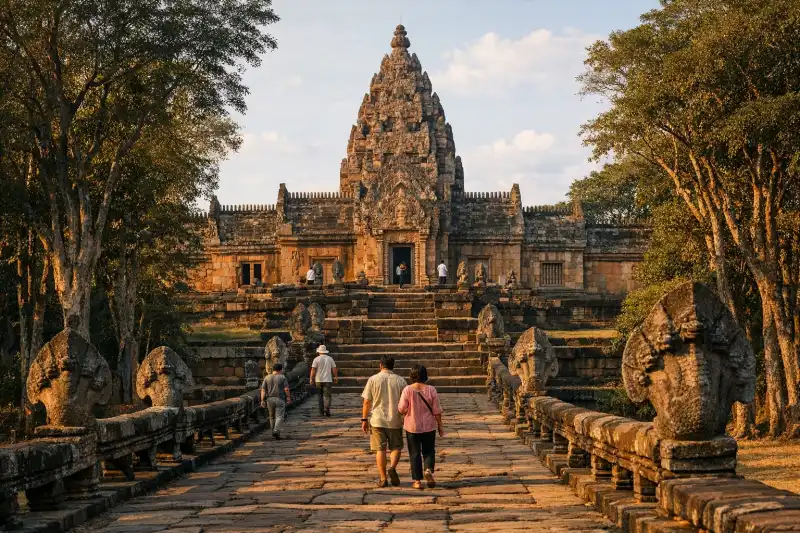
Phanom Rung
Khmer EmpireA dramatic Khmer hilltop temple in Thailand, Phanom Rung is famed for its sandstone carvings and sun...
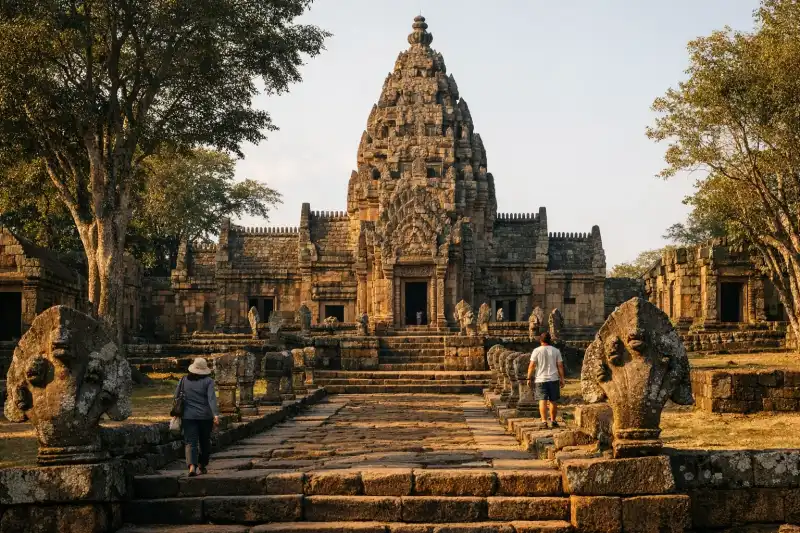
Prasat Hin Khao Phnom Rung
Khmer EmpireA dramatic Khmer hilltop temple in Thailand famed for its sandstone architecture, sacred processiona...
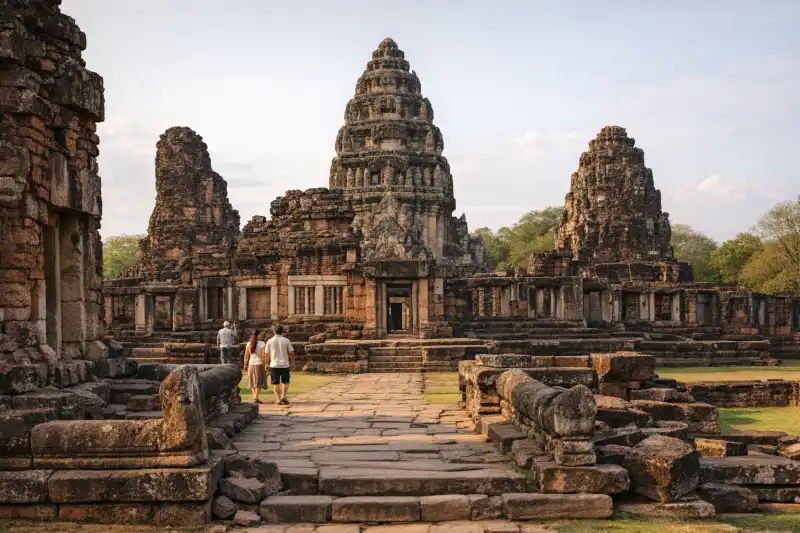
Phimai Historical Park
Khmer EmpireExplore Phimai Historical Park, a remarkable Khmer temple complex in northeastern Thailand famed for...