Quick Info
At a glance
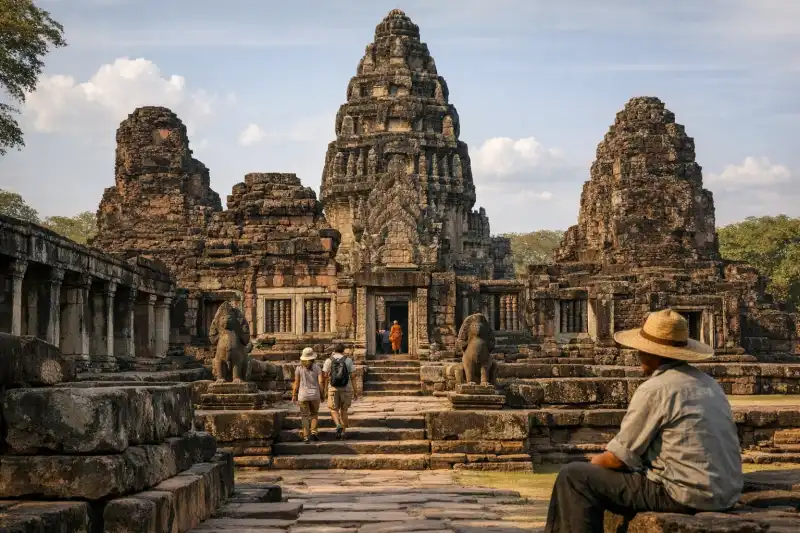
Phimai Sanctuary in Thailand rises unexpectedly from the flat plains of Isan, where quiet streets, market stalls, and shade trees give way to one of the finest Khmer monuments outside Cambodia. For many travelers, the first impression is not sheer size but elegance: pale stone surfaces, measured symmetry, and carved details that reveal themselves slowly as you move through gateways and courtyards. Although often overshadowed by Angkor in popular imagination, Phimai has a presence all its own. The sanctuary feels both grand and intimate, monumental in plan yet human in scale, with galleries, lintels, and towers arranged in a way that encourages careful looking rather than hurried sightseeing.
Part of what makes the site memorable is its setting. Phimai is not isolated on a remote hilltop but woven into the life of a modern Thai town, which gives the visit a special rhythm. You arrive from ordinary roads, hear local conversation beyond the walls, and then step into a space shaped centuries ago by imperial ambition, religious devotion, and masterful stonework. The sanctuary once stood on an important route connected to Angkor, and that wider world is still legible in its architecture. Yet the site also reflects local adaptation and changing beliefs over time. Visiting Phimai means encountering a place where Hindu and Buddhist imagery overlap, where Khmer planning meets the geography of northeastern Thailand, and where history survives not as a ruin of silence alone, but as a living landmark still central to regional identity.
History
Early foundations and the Khmer frontier
The history of Phimai Sanctuary begins in the period when the Khmer Empire extended its influence across much of mainland Southeast Asia. By the 11th century, the region that is now northeastern Thailand had become an important frontier zone linked politically, economically, and culturally to Angkor. Rather than existing as an isolated outpost, Phimai occupied a strategic position within a wider network of roads, settlements, reservoirs, and temple foundations. Its location near the Mun River basin helped support agriculture and movement, while its placement along imperial routes made it significant to administration and ceremonial life.
The earliest structures at Phimai were likely established in the 11th century, when Khmer rulers and local elites invested in sacred architecture as a way to express power and religious legitimacy. As with many Khmer temples, the sanctuary was not built all at once. It developed through phases, with additions, refinements, and rebuilding over time. Materials such as sandstone and laterite were carefully worked into a complex of enclosures, towers, and galleries that reflected sophisticated engineering as well as symbolic planning. The layout embodied the cosmological ideas common to Khmer sacred architecture, with central elevated structures representing the divine center of the universe.
Religious transformation and the height of construction
Phimai flourished especially during the 11th and 12th centuries, a period of intense temple building across the Khmer world. What distinguishes the sanctuary is that, although Khmer temples often began as Hindu foundations dedicated to Shiva or Vishnu, Phimai appears strongly associated with Mahayana Buddhism in its principal phase. This makes the monument particularly valuable for understanding the religious diversity of the empire. Rather than presenting a simple shift from one faith to another, the site shows how Khmer sacred spaces could accommodate overlapping traditions and iconographies.
Construction at Phimai reached a high level of artistic refinement. The sanctuary’s central tower, enclosed courts, cruciform passages, and ornate lintels demonstrate close connections to Angkorian design, yet they also possess regional character. The temple’s orientation is especially striking. Unlike many Khmer temples that face east, Phimai is oriented toward the southeast, aligned with the ancient road leading to Angkor. This suggests that movement, processions, and symbolic connection to the imperial capital were integral to its conception.
At its height, the sanctuary would not have functioned merely as a shrine for isolated ritual. It was part of a broader urban and ceremonial landscape. Religious specialists, patrons, attendants, and pilgrims likely moved through the complex, and the surrounding settlement supported that activity. The sanctuary’s walls and gateways expressed sacred hierarchy, but they also organized how people approached and experienced the monument.
Decline of imperial power and local continuity
From the 13th century onward, political changes gradually altered the position of Khmer sites across the region. As imperial authority weakened and new centers of power emerged, frontier monuments such as Phimai lost some of their former administrative and ceremonial importance. Religious life in mainland Southeast Asia was also changing, with Theravada Buddhism becoming increasingly prominent. Like many major sanctuaries, Phimai was not simply abandoned at a single moment; instead, its function evolved.
Some sacred significance persisted locally, even as the original imperial system faded. Communities continued to inhabit the surrounding area, and elements of the monument remained visible in local memory and landscape. Over centuries, weathering, vegetation, reuse of materials, and the ordinary pressures of time altered the complex. Yet the essential form endured strongly enough that later scholars and officials could still recognize its importance.
Modern rediscovery, archaeology, and restoration
In the modern era, Phimai attracted growing attention from historians, archaeologists, and the Thai Fine Arts Department. As interest in Khmer architecture in Thailand expanded, the sanctuary became a key site for research into regional history and the cultural links between Thailand and Cambodia. Careful surveys, documentation, and conservation work helped recover architectural details that had been obscured or damaged.
Restoration efforts in the 20th century aimed to stabilize structures and reassemble collapsed elements while preserving the integrity of the monument. This work was significant not only for tourism but for scholarship. Phimai offered evidence for construction techniques, iconography, urban planning, and the spread of Khmer influence beyond the Angkor heartland. Today, the sanctuary is one of the best-preserved and most accessible major Khmer monuments in Thailand. It stands as both a national treasure and an essential piece of Southeast Asian history, illustrating how empires project power through architecture and how sacred places can survive long after the states that built them have disappeared.
Key Features
The most compelling feature of Phimai Sanctuary is its overall composition. The complex is arranged with a clarity that feels ceremonial from the moment you approach. Causeways, gateways, and enclosing walls guide the eye inward toward the main sanctuary, creating a sequence of transition from the outer world to the sacred center. This progression is one of the site’s great pleasures. Even casual visitors can sense that every threshold matters. The architecture is not random ruin but a carefully ordered environment designed to shape movement and attention.
The central prang, or tower sanctuary, dominates the ensemble and serves as the visual and symbolic heart of the site. Built in pale sandstone, it rises with a refined verticality that recalls Angkorian forms while maintaining its own distinctive proportions. From a distance it seems almost serene, but close up the surfaces reveal extraordinary workmanship. Carved motifs, moldings, niches, and structural joints all demonstrate the precision of Khmer stone construction. The tower’s silhouette is especially photogenic in late afternoon light, when shadows deepen the recesses and soften the pale stone.
Around the central sanctuary are galleries and subsidiary structures that enrich the experience of exploration. Instead of taking in the monument in a single glance, you discover it through movement. Corridors frame views of the tower. Doorways open onto courtyards. Carved lintels reward careful observation. Some depict floral and mythological motifs, while others preserve traces of religious imagery tied to the site’s changing spiritual life. The texture of the stone varies from worn smoothness to crisply preserved detail, reminding visitors that weathering is part of the monument’s biography.
One particularly notable element is the naga bridge, a ceremonial walkway flanked by sculptural serpents associated with transition and protection. In Khmer architecture, such bridges often symbolized passage from the human realm toward the divine. At Phimai, the feature is not merely decorative; it contributes to the emotional rhythm of arrival. Crossing it, even today, feels like entering a more ordered and elevated domain. This ability of architecture to stage experience is one reason the sanctuary remains so powerful.
The entrance gopuras, or gate pavilions, are also major highlights. These structures mark the boundaries between successive enclosures and display the Khmer love of monumental thresholds. Their passages, chambers, and carved details reveal how access to sacred space was controlled and dramatized. As you move through them, the relationship between enclosure and revelation becomes clear: the temple does not expose itself all at once, but unveils itself in stages.
Phimai’s orientation is another key feature, though one that many visitors overlook unless they know to look for it. The sanctuary’s axis is associated with the ancient route toward Angkor, and this unusual directional emphasis gives the site broader historical meaning. It links the monument not only to local worship but to the political geography of the Khmer Empire. In other words, the temple is both a religious structure and a statement of connection.
The setting within the historic park contributes greatly to the experience. Lawns, trees, and open space around the monument make it easier to appreciate the massing of the buildings and the harmony of the plan. Because the site stands within the town rather than in deep isolation, there is also a subtle contrast between past and present. Modern Thailand surrounds the sanctuary, but the old sacred geometry remains intact enough to command attention.
Visitors with an interest in iconography will find the sanctuary especially rewarding. The carvings reflect a blend of Buddhist and Hindu themes, evidence of the complex religious environment in which the site developed. While some decorative programs are fragmentary, enough survives to suggest a world of celestial beings, vegetal abundance, divine narratives, and royal symbolism. For photographers, the combination of linear galleries, framed doorways, and textured stone creates endlessly changing compositions throughout the day.
Getting There
Phimai Sanctuary is located in Phimai District, Nakhon Ratchasima Province, in northeastern Thailand. The most common gateway city is Nakhon Ratchasima, often called Korat. From Bangkok, you can travel to Korat by train, intercity bus, or private car. Buses from Bangkok to Nakhon Ratchasima generally take about 4 to 5 hours and often cost roughly 220 to 350 THB depending on service class. Trains can be slower but scenic, with many tickets falling in the approximate 100 to 300 THB range for ordinary or second-class seats.
From Nakhon Ratchasima to Phimai, local buses and vans are straightforward and affordable. The journey usually takes around 1.5 to 2 hours, with fares commonly around 50 to 90 THB. Taxis or app-based private rides from Korat are faster and more convenient, especially for small groups, and usually cost around 1,000 to 1,800 THB one way depending on vehicle type and negotiation. Renting a car is a practical option if you want flexibility to combine Phimai with other Khmer sites such as Phanom Rung.
If you are traveling directly from Bangkok by car, expect a drive of roughly 4.5 to 5.5 hours depending on traffic. Organized day tours do exist, but many visitors find it more comfortable to stay overnight in Korat or Phimai. Once in town, the sanctuary is easy to reach by tuk-tuk, songthaew, bicycle, or on foot if you are staying nearby. Local transport within Phimai is inexpensive, often around 40 to 100 THB for short rides.
When to Visit
The best time to visit Phimai Sanctuary is generally from November to February, when northeastern Thailand is cooler and drier. During these months, daytime temperatures are more comfortable for walking the grounds, and the softer light can make the sandstone architecture particularly appealing for photography. Early morning and late afternoon are the most pleasant times of day year-round, offering less heat and gentler shadows across the carvings and towers.
From March to May, temperatures rise sharply across Isan. Midday visits can feel intense, especially on exposed stone surfaces and open walkways. If you must travel during the hot season, arrive as close to opening time as possible, carry plenty of water, and plan a shaded lunch break afterward. The advantage of this period is that the site can feel quieter, and clear skies often produce excellent visibility.
The rainy season, usually from about June to October, brings greener surroundings and fewer crowds, but also heavier humidity and occasional downpours. Rain can add atmosphere to the sanctuary, deepening the color of the stone and cooling the air after storms. However, sudden showers may interrupt your visit, so carrying a light rain jacket or umbrella is wise. Paths are usually manageable, but footwear with good grip is useful.
If your timing allows, try to pair your visit with local cultural events in Phimai town, which can add depth to the experience. Even outside festival dates, weekdays tend to be calmer than weekends and Thai public holidays. For the most rewarding visit, aim for the cool season, arrive early, and allow enough time to see the sanctuary slowly rather than treating it as a quick stop.
| Quick Facts | Details |
|---|---|
| Site name | Phimai Sanctuary |
| Also known as | Main temple complex of Phimai Historical Park |
| Location | Phimai District, Nakhon Ratchasima Province, Thailand |
| Civilization | Khmer Empire |
| Main period | 11th-12th centuries CE |
| Religious associations | Mahayana Buddhism with Hindu influences |
| Notable feature | One of the finest Khmer temple complexes in Thailand |
| Architectural highlights | Central prang, galleries, gopuras, naga bridge, sandstone carvings |
| Best base | Phimai town or Nakhon Ratchasima |
| Recommended visit length | 1.5 to 3 hours for the sanctuary; half a day with museum and town |
Guided tours: worth it?
A guide can be genuinely useful at Phimai Sanctuary, especially if you want help with transport, timing, tickets, or understanding a large site without losing half the day to logistics.
Best for
- First-time visitors who want context, not just photos
- Travelers who want transport, timing, or entry logistics handled
- Trips where tickets, circuits, or timed entry can shape the day
- Short visits where a planned route saves time
When to go self-guided
Go independently if you already have transport and tickets sorted, enjoy moving at your own pace, and are comfortable checking the latest official rules before you arrive.
What I’d avoid
Skip paid tours that bundle unrelated stops you do not actually want. The best option should either save meaningful planning time or add historical context you would miss on your own.
Phimai Historical Park day tours
Useful when: you want to compare guided formats before deciding
Nakhon Ratchasima cultural tours
Useful when: you want to compare guided formats before deciding
Phanom Rung and Phimai temple tours
Useful when: you want to compare guided formats before deciding
Some tour links are affiliate links, which may earn Ancient Travel a small commission at no extra cost to you. I try to surface options that make practical sense for the site—not just anything bookable.
Frequently Asked Questions
Where is Phimai Sanctuary located?
Phimai Sanctuary is in Phimai District, Nakhon Ratchasima Province, in northeastern Thailand. It stands within the historic core of the modern town and is usually visited as part of Phimai Historical Park.
Is Phimai Sanctuary the same as Phimai Historical Park?
Phimai Sanctuary commonly refers to the main Khmer temple complex inside Phimai Historical Park. In practice, many visitors use the names interchangeably, though the historical park includes surrounding walls, grounds, and related archaeological remains.
How much time should I allow for a visit?
Most travelers spend 1.5 to 3 hours exploring the sanctuary itself. If you also want to visit the nearby museum, stroll the old town, and photograph the site at a relaxed pace, allow at least half a day.
Can I visit Phimai Sanctuary as a day trip from Bangkok?
Yes, but it is a long day trip. Travel by car usually takes around 4 to 5 hours each way. Many visitors prefer to stay overnight in Nakhon Ratchasima or combine Phimai with other Khmer temple sites in northeastern Thailand.
What is Phimai Sanctuary famous for?
Phimai Sanctuary is famous for being one of Thailand's most important Khmer monuments. It is noted for its refined sandstone carvings, axial layout, impressive central tower, and its unusual orientation toward the southeast along an ancient road linked to Angkor.
What should I wear when visiting?
Light, breathable clothing, comfortable walking shoes, a hat, and sunscreen are ideal. As this is a historic sacred site, respectful dress is recommended, especially if you are combining the visit with temples or local religious spaces nearby.
Nearby Ancient Sites
Phimai Historical Park
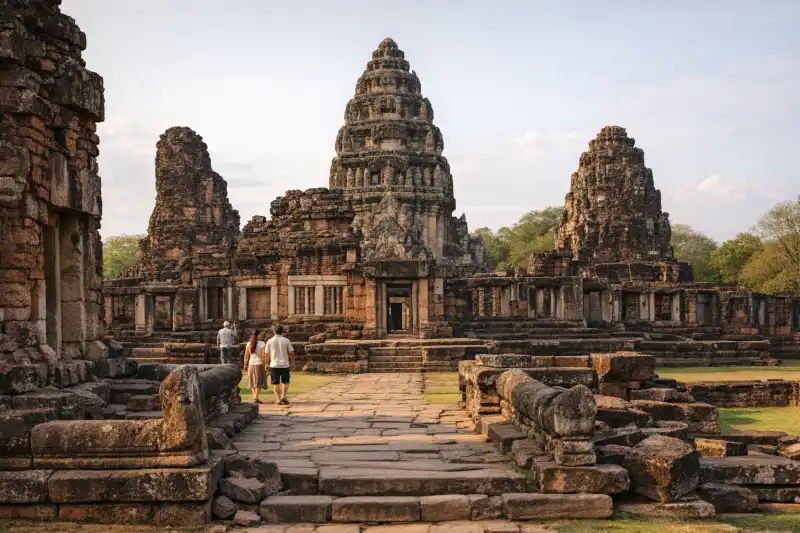
Khmer EmpireExplore Phimai Historical Park, a remarkable Khmer temple complex in northeastern Thailand famed for...
Phanom Rung
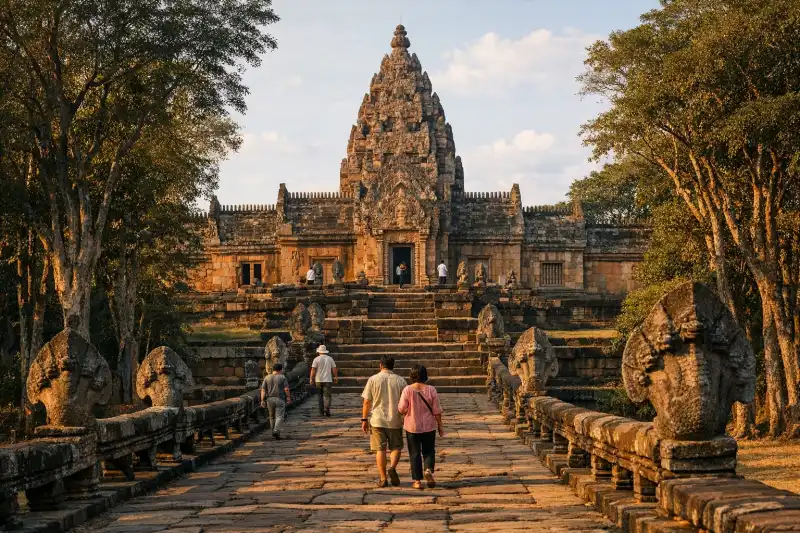
Khmer EmpireA dramatic Khmer hilltop temple in Thailand, Phanom Rung is famed for its sandstone carvings and sun...
Prasat Hin Khao Phnom Rung
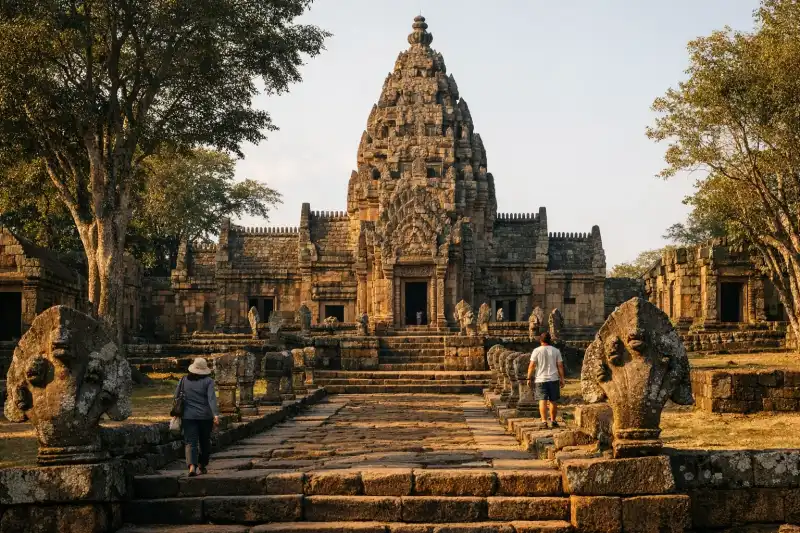
Khmer EmpireA dramatic Khmer hilltop temple in Thailand famed for its sandstone architecture, sacred processiona...
Ayutthaya Travel Guide 2026: Temple Ruins, Day Trip Planning, and What to Prioritize
Ayutthaya KingdomPlan a focused Ayutthaya visit with practical temple routing, timing, and transport guidance from Ba...