Quick Info
At a glance
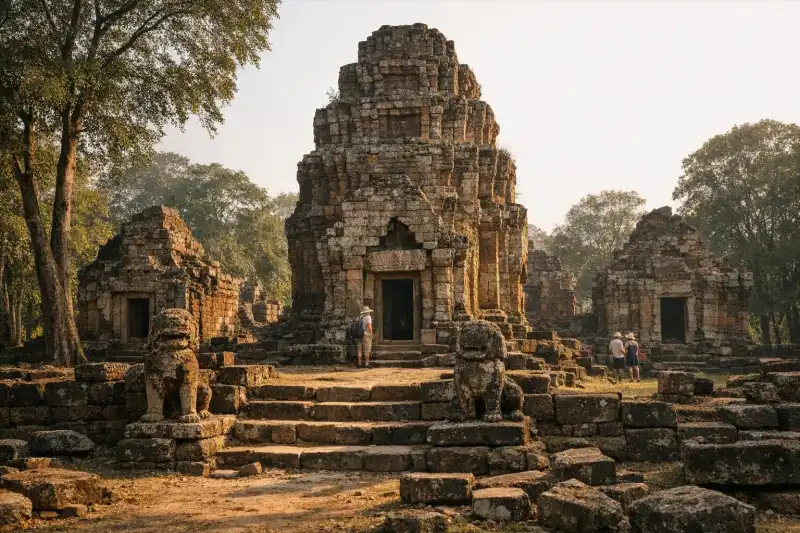
Ku Phra Kona in Thailand sits quietly in the plains of Roi Et Province, far from the crowds that gather at the country’s better-known temple parks, yet it offers one of the most evocative glimpses into the early Khmer world in northeastern Thailand. Here, amid village roads, trees, and rice-growing landscapes, ancient brick towers rise from the earth with a dignity that feels both weathered and enduring. The atmosphere is not one of monumental scale but of intimacy: a place where broken lintels, worn carvings, and surviving sanctuaries invite close attention rather than hurried sightseeing.
For travelers exploring Isan, Thailand’s northeastern region, Ku Phra Kona is the kind of destination that rewards curiosity. It is not a polished spectacle designed around mass tourism. Instead, it is an archaeological site whose appeal lies in texture, age, and context. The remains reveal a period when Khmer artistic and religious influence extended well beyond the imperial heartlands of present-day Cambodia into what is now Thailand. At Ku Phra Kona, those regional connections become tangible in fired brick, sandstone details, and sacred planning.
A visit here is also a reminder that ancient Southeast Asia was shaped by networks rather than modern borders. Temples like this one served ritual, political, and cultural roles in communities linked by trade, belief, and kingship. Standing before the towers of Ku Phra Kona, you are not just seeing ruins in the countryside. You are encountering a surviving fragment of an older landscape of devotion, craftsmanship, and power that once stretched across much of mainland Southeast Asia.
History
Early settlement and regional context
Before Ku Phra Kona was built, the Khorat Plateau and the wider Isan region were already part of long-established human landscapes. River systems, seasonal wetlands, and fertile lowlands supported agriculture and settlement for centuries. By the first millennium CE, northeastern Thailand was connected to religious and artistic currents coming from India through the intermediary cultures of mainland Southeast Asia. Over time, local communities adopted forms of Hindu and Buddhist worship while also maintaining regional traditions.
By the 9th and 10th centuries, Khmer political and cultural influence expanded significantly across areas that now belong to Thailand. This did not always mean direct rule in the modern sense. Rather, power often radiated through administrative centers, temple foundations, elite patronage, and networks of local authorities aligned with the broader Khmer sphere. Sacred architecture was one of the clearest expressions of these ties. Temples asserted legitimacy, organized ritual life, and linked provincial communities to larger religious and royal systems.
Ku Phra Kona emerged within this environment. Its architectural language places it firmly within the Khmer tradition, yet the site also reflects the regional character of outlying sanctuaries. It was not built on the immense scale of Angkorian capitals, but it participated in the same symbolic world.
Construction in the early Khmer period
Scholars generally date Ku Phra Kona to around the 10th century CE, with some components possibly extending into the 11th century. The sanctuary is especially valued because it preserves features associated with early Khmer architecture in Thailand. Brick was the principal building material for the main towers, while sandstone was used for architectural frames, carvings, and decorative elements. This combination was common in early Khmer temples, where brick provided mass and form while sandstone supplied the more intricate sculptural surfaces.
The temple appears to have been conceived as a Hindu sanctuary, likely dedicated to Shiva, as was typical of many Khmer foundations in the region. The arrangement of multiple towers suggests a ritual complex with a central sacred focus and subsidiary shrines. Such plans reflected cosmological ideas as much as practical worship. The temple mountain concept found in larger Khmer architecture was translated here into a more compact but still symbolically charged composition.
Construction would have involved highly skilled artisans familiar with Khmer design conventions. Lintels, colonettes, doorframes, and decorative motifs were not improvised village creations but parts of a recognized religious and artistic system. Even at a provincial site, craftsmanship mattered because the temple served as a statement of sanctity and status.
Religious use and local importance
Once completed, Ku Phra Kona functioned as more than a monument. It was a living sacred place, likely attended by ritual specialists and supported by the surrounding community or local elites. Offerings, ceremonies, and acts of merit would have structured its use. In the Khmer world, temples often had economic roles as well, tied to land, labor, and agricultural resources assigned for their upkeep.
Sites like Ku Phra Kona helped knit together local society and broader regional identity. They represented the adoption of Sanskritic religious concepts, Khmer artistic models, and forms of authority linked to sacred space. Yet they were never simply copies of major imperial centers. Provincial sanctuaries adapted shared styles to local needs, local materials, and local patronage. That is part of what makes Ku Phra Kona historically important: it shows how Khmer culture was interpreted on the ground in northeastern Thailand.
Over time, as political centers shifted and religious practices evolved, the original function of the sanctuary changed. Theravada Buddhism became increasingly dominant across the region, and many older Hindu sanctuaries lost their initial ritual role or were reinterpreted in new religious settings. Some were maintained, some partially reused, and others slowly declined.
Decline, rediscovery, and preservation
Like many ancient sites in Southeast Asia, Ku Phra Kona endured centuries of weathering, vegetation growth, and gradual structural collapse. Brick towers are especially vulnerable when protective surfaces erode and roots find their way into weakened joints. Sandstone carvings also suffer from rain, heat, and seasonal cycles. Even so, enough survived to establish the site’s significance.
Modern archaeological attention brought Ku Phra Kona into clearer scholarly view as part of Thailand’s Khmer heritage. Conservation efforts have aimed to stabilize the towers, document surviving ornament, and present the site as an educational destination. Preservation at places like this is always a balance between accessibility and authenticity. Too much reconstruction can erase historical texture; too little intervention can allow further deterioration.
Today, Ku Phra Kona stands as both an archaeological resource and a cultural landmark. It is valued not only for its age, but for what it reveals about the spread of Khmer architecture into Isan, the local history of Roi Et Province, and the diversity of Thailand’s ancient past. Its survival gives visitors the rare chance to see an early brick sanctuary in a setting that still feels close to the rhythms of the countryside.
Key Features
Ku Phra Kona is best appreciated slowly, with attention to proportion, material, and surviving detail. The first feature most visitors notice is the group of brick towers, which form the visual and spiritual core of the complex. Though time has damaged parts of the structures, the towers still convey the essential grammar of Khmer sacred architecture: vertical massing, recessed openings, and a carefully ordered relationship between central and secondary shrines. Their scale is modest compared with major temple complexes, but this is part of their charm. You can stand close, study the masonry, and sense the craft involved in shaping each sanctuary.
The brickwork itself is one of the site’s great attractions. Ancient Khmer builders used finely made bricks fitted with remarkable precision, often minimizing the visible mortar joints. Even when surfaces have crumbled, the construction still demonstrates both technical ability and aesthetic discipline. Brick was not merely practical; it created warm, earthy color that changes with light throughout the day. In morning sun, the towers can glow softly against the green surroundings, while in overcast weather they seem older and more austere.
Equally important are the sandstone elements. Doorframes, lintels, and decorative fragments preserve traces of the sanctuary’s original artistic richness. Some carvings display floral motifs, scrolling forms, and mythic imagery typical of Khmer ornamentation. Even where damage has obscured the full composition, the surviving pieces reveal how carefully the temple was adorned. These carved components were visual thresholds, marking entrances to sacred interior spaces and guiding the visitor from the ordinary world toward a divine center.
Another compelling feature is the plan of the sanctuary complex. Ku Phra Kona does not overwhelm through size; instead, it invites interpretation through layout. The relationship among the towers suggests a designed ritual hierarchy. In Khmer sacred architecture, arrangement mattered deeply. Orientation, axiality, and enclosure created a symbolic landscape where movement through space mirrored spiritual approach. Even if the original walls or subsidiary structures survive only in part, the site still communicates this sense of ordered sanctity.
The atmosphere around the ruins is also part of what makes the site memorable. Unlike highly commercialized destinations, Ku Phra Kona retains a calm, almost contemplative character. Visitors often hear birds, wind in the trees, or sounds from nearby village life rather than tour buses and crowds. This quietness can sharpen your sense of place. The temple no longer functions as it once did, yet it remains capable of producing the stillness associated with sacred architecture.
The surrounding grounds help place the sanctuary in its regional setting. Ku Phra Kona belongs to the lowland agricultural world of Isan, where ancient monuments often appear unexpectedly amid present-day rural communities. This continuity between old and new landscapes is one of northeastern Thailand’s most distinctive qualities. The temple is not isolated in an empty archaeological reserve; it survives within a lived environment. That setting makes it easier to imagine how the sanctuary originally related to local settlements, cultivation, and movement across the region.
Finally, Ku Phra Kona’s significance lies in its relative rarity. Thailand has several famous Khmer sites, but many travelers know only the largest examples. Ku Phra Kona offers a different experience: an earlier, quieter, more intimate sanctuary where the architecture can be read at human scale. For students of art history, it provides valuable evidence of early Khmer forms. For general travelers, it offers a chance to connect with a less-publicized chapter of Thai heritage. And for photographers, it provides strong textures, warm tones, and evocative compositions without the pressure of crowds.
Getting There
Ku Phra Kona is located in Suwannaphum District, Roi Et Province, in northeastern Thailand. The most practical base for most travelers is Roi Et city, which has domestic flight connections to Bangkok and regional road links across Isan. From Roi Et city to Ku Phra Kona, the journey by car usually takes around 1 to 1.5 hours, depending on route and traffic. Hiring a private car or taxi is the easiest option, with round-trip fares often in the range of 1,800 to 3,000 THB if arranged locally for half a day or a full day with waiting time.
If you are coming from Bangkok, you can fly to Roi Et Airport, where one-way fares commonly range from about 1,000 to 3,000 THB depending on season and booking time. From the airport, you can continue by rental car or taxi. Car rental in Roi Et may start around 900 to 1,500 THB per day, which can be economical if you plan to visit multiple sites in the region.
Budget travelers can use interprovincial buses from Bangkok to Roi Et, generally costing roughly 450 to 750 THB one way depending on class. From Roi Et bus terminal, local transport onward to Suwannaphum can be less straightforward. Songthaews and local buses may be available toward district centers for modest fares, often under 100 THB, but reaching the temple itself usually requires a motorcycle taxi, tuk-tuk, or pre-arranged ride.
Because local public transport schedules can be irregular, it is wise to confirm directions in advance and keep the site name written in Thai if possible. Pairing Ku Phra Kona with other Roi Et cultural stops or a broader Isan road trip is often the most convenient approach.
When to Visit
The best time to visit Ku Phra Kona is generally during Thailand’s cool and dry season, from November to February. At this time, temperatures are more comfortable, skies are often clearer, and walking around the site is far more pleasant than during the hottest months. Morning visits are especially rewarding. The softer light brings out the color of the brickwork, and the quieter early hours enhance the reflective mood of the sanctuary.
From March to May, the hot season can make midday exploration uncomfortable, especially in open areas with limited shade. Daytime temperatures in Isan can climb well above 35°C, so if you travel during these months, aim to arrive soon after opening hours or later in the afternoon. Carry water, wear a hat, and expect stronger sun than in many other parts of Thailand.
The rainy season, typically from May or June through October, has both drawbacks and advantages. Heavy showers can make travel less predictable, and rural roads may feel slower or muddier depending on conditions. On the other hand, the surrounding countryside becomes lush and green, which can make the site particularly photogenic. Rain also tends to keep visitor numbers low. If you choose this period, bring waterproof protection for yourself and your camera gear, and allow extra time for transport.
There are no major crowd seasons at Ku Phra Kona in the way you might find at Thailand’s flagship historical parks, so timing is more about weather than congestion. If possible, avoid the harshest midday heat year-round. A calm weekday morning in the cool season offers the most comfortable and atmospheric experience, especially if you want time to absorb the details of the towers without rushing.
| Quick Facts | Details |
|---|---|
| Location | Suwannaphum District, Roi Et Province, Thailand |
| Cultural Region | Isan, northeastern Thailand |
| Civilization | Khmer |
| Main Period | 10th-11th century CE |
| Original Religion | Primarily Hindu, likely Shaivite |
| Notable Materials | Brick and sandstone |
| Best Visit Duration | 30-90 minutes |
| Best Time to Go | November to February |
| Closest Base | Roi Et city |
| Experience Level | Ideal for history lovers, photographers, and travelers seeking lesser-known ruins |
Ku Phra Kona may not be the largest or most famous ancient site in Thailand, but that is precisely why it leaves such a lasting impression. It asks visitors to slow down and notice what survives: the curve of brick masonry, the dignity of a fractured lintel, the careful placing of towers in a sacred plan, and the way an old sanctuary can still hold meaning in a modern rural landscape. In a country celebrated for glittering temples, tropical islands, and royal capitals, this Khmer ruin in Roi Et offers a different kind of beauty—quieter, older, and deeply rooted in regional history.
For anyone tracing the ancient cultures of mainland Southeast Asia, Ku Phra Kona deserves a place on the itinerary. It connects Thailand to the wider Khmer world while preserving a strong local identity shaped by Isan’s landscapes and communities. More than a short stop, it is an encounter with continuity: a reminder that sacred spaces can outlast kingdoms, that provincial monuments can illuminate major histories, and that some of the most rewarding archaeological visits happen not in crowded headline destinations, but in places where the past still feels close enough to hear in the silence.
Guided tours: worth it?
Self-guided works here, but a guide can add real value if you want the ruins explained as a living place rather than just a sequence of monuments.
Best for
- First-time visitors who want context, not just photos
- Short visits where a planned route saves time
When to go self-guided
Go independently if you prefer setting your own pace, reading as you go, and checking official hours or ticket rules directly before you arrive.
What I’d avoid
Skip paid tours that bundle unrelated stops you do not actually want. The best option should either save meaningful planning time or add historical context you would miss on your own.
Roi Et and Isan Cultural Sites Tours
Useful when: you want to compare guided formats before deciding
Khmer Temples of Northeastern Thailand Tours
Useful when: you want to compare guided formats before deciding
Isan History and Archaeology Day Trips
Useful when: transport or pickup logistics matter
Some tour links are affiliate links, which may earn Ancient Travel a small commission at no extra cost to you. I try to surface options that make practical sense for the site—not just anything bookable.
Frequently Asked Questions
What is Ku Phra Kona?
Ku Phra Kona is an ancient Khmer sanctuary in Roi Et Province, Thailand, known for its brick towers and early Khmer architectural style.
Where is Ku Phra Kona located?
The site is in Suwannaphum District of Roi Et Province in northeastern Thailand, within the wider cultural region often called Isan.
How old is Ku Phra Kona?
Most scholars date Ku Phra Kona to the early Khmer period, around the 10th to 11th centuries, though some elements may reflect slightly earlier artistic influences.
Is Ku Phra Kona worth visiting?
Yes, especially for travelers interested in archaeology, Khmer architecture, and quieter historical sites away from Thailand’s better-known temple complexes.
How much time do you need at Ku Phra Kona?
Most visitors spend 30 to 90 minutes exploring the sanctuary, reading interpretive signs, and walking around the towers and surrounding grounds.
Can you visit Ku Phra Kona on a day trip?
Yes. It is commonly visited as a day trip from Roi Et or as part of a broader itinerary through northeastern Thailand’s Khmer heritage sites.
Nearby Ancient Sites
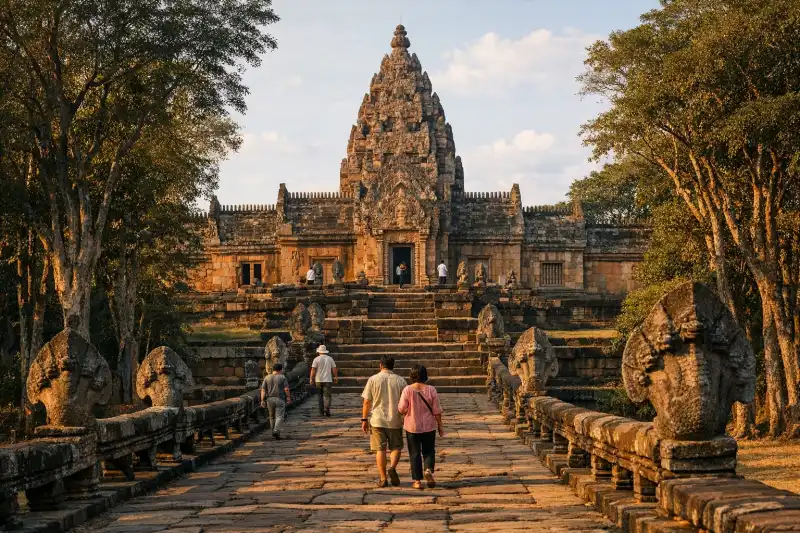
Phanom Rung
Khmer EmpireA dramatic Khmer hilltop temple in Thailand, Phanom Rung is famed for its sandstone carvings and sun...
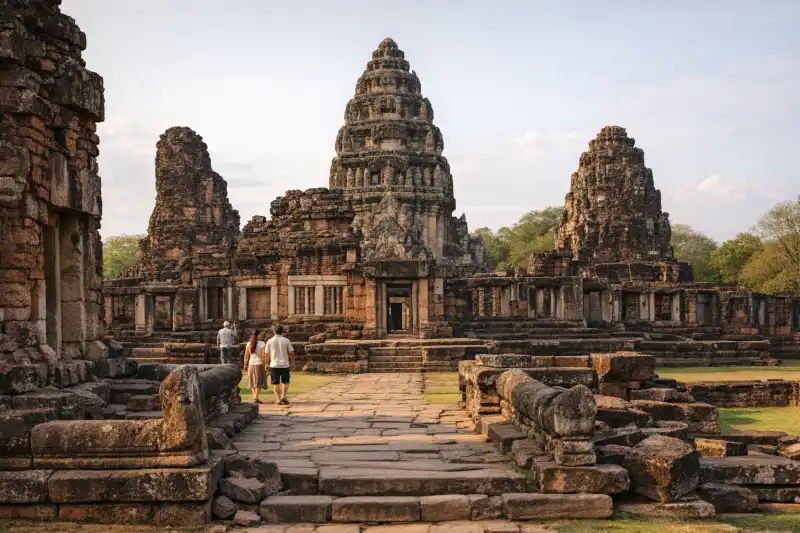
Phimai Historical Park
Khmer EmpireExplore Phimai Historical Park, a remarkable Khmer temple complex in northeastern Thailand famed for...
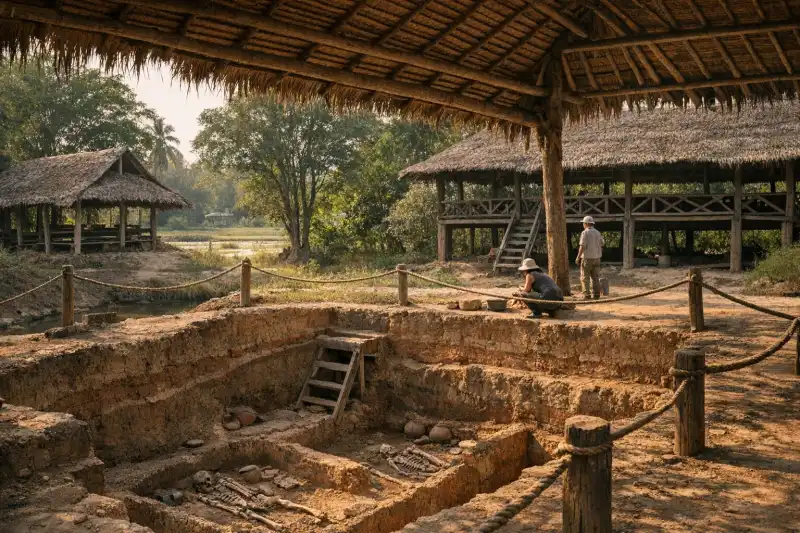
Ban Prasat Archaeological Site
Prehistoric communities of the Mun River basinExplore Ban Prasat Archaeological Site, a prehistoric burial and settlement site in Thailand’s Nakho...